Ruminations

Blog dedicated primarily to randomly selected news items; comments reflecting personal perceptions

Friday, July 01, 2022

Feeding the World

"I've not heard of other places where there's been a pollination shortfall."
"Beekeepers are having more problems maintaining their colonies and there's more demand for their colonies for pollination."
Robert Paxton, zoology head, Martin Luther University Halle-Wittenberg, Germany
 
"We've built this dependency on managed pollinators, specifically honeybees."
"We've created this demand for commercial pollinators that we move around in pollination units."
"That's pretty far from the natural environment where a honeybee could thrive."
Maggie Shanahan, bee-keeper, researcher, Spivak Laboratory, University of Minnesota 
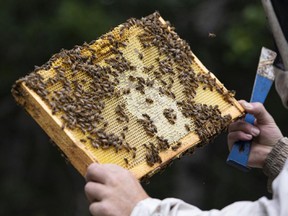
Beekeeper Kevin Nixon inspects one of his hives near Penhold, Alta., on June 24, 2022.
When berry crops go into flowering, berry farmers are no longer reliant on the timely arrival of bees to pollinate the flowers so berries will be produced. What was once a routine natural occurrence has been imperilled by a global die-off of bees. Some are presumed to have died as a result of the use of pesticides, of loss of habitat, of naturally-occurring disease afflicting bees. And nor have bees belonging to hives maintained by bee-keepers for honey production been spared. 

"We probably haven't seen this high of losses since one of our early years to bee-keeping. I know some guys that lost 90 percent [of their hived bees]", said Kevin Nixon, in the business for close to three decades. Of the 10,000 hives he manages near Red Deer, Alberta, he has lost 40 percent. Across the entire country growers of blueberries face problems relating to a shortage of commercial hives they've become reliant on for the production of Canada's most valuable fruit crop.
 
In Canada, bee-keepers on average have lost half their colonies this year. Massive honeybee deaths have been reported worldwide by bee-keepers in the last several years. Canada is seeing catastrophic levels of bee hive losses. Its $274-million blueberry market  makes it the world's seventh-largest exporter. But the fragile pollination industry, facing a breakdown, is threatening that export crop.
 
There has been a boom in acreage devoted to fruit and vegetables throughout North America, even as the number of wild bees have diminished. Where once bee-keepers struggled to earn a living selling honey, they began renting out hives to farmers needing to boost their yields. This led to "pollination brokers" connecting growers with hives, an industry criss-crossing the continent on semi-trucks reaching destinations.
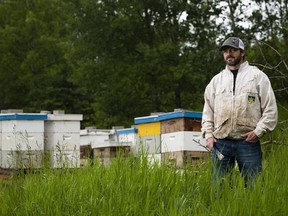
 
Beekeeper Kevin Nixon with some of his hives.
Beekeeper Kevin Nixon with some of his hives. Photo by Gavin John/Bloomberg

Bees' critical role in pollination of flowering plants to trigger reproduction benefits the world with nutritious and colourful foods like apples, cherries, melons and almonds. Over 100 crops in the United States are reliant on pollinators The added revenue brought to crop production is valued at $18 billion on an annual basis, according to the U.S.Department of Agriculture.

The very fact that bees have been overworked has helped to create the crisis in pollination. "The paradigm of bringing in honeybees is at a breaking point. Bees are not getting better; they are slowly getting worse", commented Mark Winston, a leading expert in bees and their pollinating role in agriculture.

In 2005, wholesale death rates in the United States among honeybee colonies were alarming, a phenomenon occurring in other countries as well, attributed to issues from extreme weather and chemical exposure, to parasites. Typically, bee-keepers in the U.S. lose on average 40 percent of their bees annually; losses in Canada on the other hand, average about 20 percent.

Studies suggest the number of managed honeybees rose over 80 percent since the early 1950s in tandem with beekeepers expanding to match rising demands of agriculture. In Canada, about 400,000 colonies of bees were lost this year, with few replacement options according to the Canadian Honey Council. Canada has sourced 85 percent of its imports of honeybees from New Zealand. A two-pound package of bees  holds about 8,000 bees. Australia and Chile provide the remainder of Canada's bee imports.
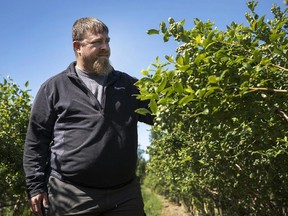
Jason Smith is chair of the British Columbia Blueberry Council, which is the country’s largest blueberry producing province.
Jason Smith is chair of the British Columbia Blueberry Council, which is the country’s largest blueberry producing province. Photo by Jennifer Gauthier/Bloomberg

Labels: , , ,

Tuesday, January 21, 2020

Another Animal Species Abused by Human Culture

"The bees in the almond groves are being exploited and disrespected."
"They are in severe decline because our human relationship to them has become so destructive."
Patrick Pynes, organic beekeeper, environmental studies, Northern Arizona University

"We have to think about how we grow monocultures. And that is much bigger than an individual issue."
"We have to look at regions, like the Central Valley of California where we take billions and billions of bees to pollinate the almonds and say, 'Okay, what could we plant here so that we could have bees here all the time'?"
"Because ultimately, bees are not supposed to move. They build a colony, they stay there, they map out where everything is ... they're like us, moving into a new city."
"The solution might be diverse enough agriculture in the region so that the pollinators don't have to move."
Lenore Newman, author of Lost Feast: Culinary Extinction and the Future of Food

Over the past few decades Western society in its search for the perfect food, has invented substitutes for certain products that food 'experts' deem can be harmful to human health, or conversely reflecting a movement away from animal products to provide people with foods that are similar, considered more healthful, and aren't derived from an animal source. Almond milk falls into that category. Blended and strained in huge quantities to serve a specialized market, nut milk is seen as a nutritious and sustainable non-dairy beverage popular among today's consumers.
Image result for almond crop, california
Food Navigator, U.S.A.

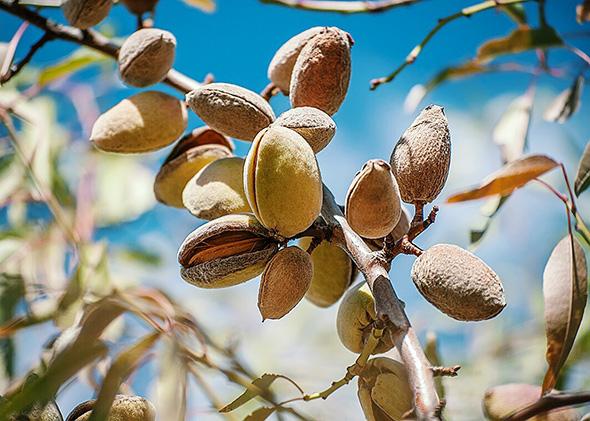
Almonds, originating and native to the Tian Shan Mountains of Central Asia, hosts a honeybee population that specializes (as in species-specific) in pollinating almond blossoms, as a byproduct of their honey-making process. Almond tree seedlings have long since been transplanted to California which now grows 82 percent of the world's almonds, in a hot, dry climate, requiring a huge amount of irrigation in what is also a water-deficient landscape. Above all, the vast mega-farms in the state require pollinators since almond production is reliant on honeybees for pollination of the millions upon millions of blush and white blossoms on millions of trees.

Image result for almond crop, california
Slate Magazine

For over a full one-third of vegetation bearing food for our species, without pollination there would be no resulting fruit. The huge demand of the almond blossoms has created a situation of frenzied deliveries of bee pollinators. The bees packed in boxes are loaded onto trucks and vast numbers are transported to the huge California forests of almond trees. This is yet another industry linked to the growing of almond trees; bees for hire. And those hard-working bees are seen to be perishing at what beekeepers and scientists speak of as unprecedented rates.

For California, the almond industry represents a $14-billion crop. Which has resulted in fifty-billion bees dying, themselves representing 40 percent of the honeybee colonies in the United States, not surviving last year's winter, according to a national survey. Once considered an efficient and high-yielding process, mass pollination of monocultures appears to be failing. In view of almost universal record losses of bees, beekeepers were placing blame on pesticide exposure and parasites.

Organic beekeepers, on the other hand, along with environmentalists, beg to differ, placing their belief in a more fundamental causation. No other California crop uses bees in the numbers that almond orchards require. Pesticides like glyphosate (an active ingredient in the Monsanto product Roundup) is pointed out as the leading cause of colony collapse disorder, but bees also face other threats threatening their longevity.

The bees' winter dormancy is being disrupted by transporting them to California almond orchards. They are placed under huge stress by concentrating them in an area that facilitates the spread of disease. Lacking diversity in a monocrop places them under additional stress.

The full causes of colony collapse remain elusive. But it does seem clear to environmentalists that the very shipping of pollinators from crop to crop represents part of the problem. Bee die-off during the winter months is not unusual. It is the sheer scope and scale of the bee die-off that is so troubling and not reflective of nature's programming.


We ourselves discovered decades ago the presence of wild-bee hives in a forest near where we live. And winter after winter, we see hundreds of bee corpses flung out of the hive. Which each successive snowfall that occurs, new dead bees appear, in a presumed ritual of perpetual house-cleaning by the remaining hale and healthy bee population in that hive located thirty feet in height inside the trunk of a venerable, stout pine growing deep in a forested ravine.


In spring, when the forest recovers itself after a long cold, snowy winter, wildflowers begin to blossom, long after we see bees flying about the undergrowth on the forest floor when warm spring weather reactivates the bees, awakening them to activity, heralding the beginning of their busy season and nature-lovers' appreciation of the appearance of huge arrays of wildflowers.


In that forest there are wild apple trees and hawthorns, along with honeysuckle and grape vines as an understory. The forest is also rife with the growth of berries; tiny strawberries, stands of raspberries and blackberries and thimbleberries, none of which would bear their delicious fruit without the vital intervention of the wild honeybees.

Labels: , , , , , ,

 
()() Follow @rheytah Tweet