Congenital Syphilis in Newborns
"In high-income countries you see it in pockets of disadvantaged populations.""It's a marker of inequality Its a marker of low-quality prenatal care."Teodora Elvira Wi,World Health Organization HIV, Hepatitis and sexually transmitted infection program"It's just the whole system, and all the things that we've done in bad was no to support Indigenous communities.""We probably need a million tests to get out there around the country. The solution's right in front of us."Sean Rourke, scientist with the Li Ka Shing Knowledge Institute, St.Michael's Hospital, Toronto"All of the social circumstances that contributed to this have just gotten worse over the [time and diversion of health-care attention] pandemic."Ameeta Singh, infectious diseases specialist, HIV/STI practice, Edmonton, Alberta
 |
Syphilis has made a resurgence globally in the last five years, and in that time, Canada has the distinction of being far ahead of other wealthy, developed nations in the steep rise of the sexually-transmitted disease that has resulted in much larger numbers of Canadian children born with syphilis than its counterparts proportionally throughout Europe.
According to Health Canada, the incidence of babies born with syphilis has reached 26 per 100,000 live births in 2021, an increase from 2 in 2017. Expectations are that the increase will continue, in accord with preliminary government data. Congenital syphilis places babies at higher risk of low birth weight, bone malformations and sensory difficulties, outlines the World Health Organization. It is the second-leading cause of stillbirth worldwide.
It is, on the other hand, a condition readily preventable should an infected woman have access to penicillin throughout a pregnancy. Only the United States reported a higher incidence of syphilis at birth, logging in at 74 per 100,000 live births in 2021, triple 2017's numbers as revealed by the U.S. Centers for Disease Control and Prevention. In a population of 332 million, 2,677 cases of congenital syphilis emerged, reflecting preliminary CDC data, while Canada had 96 cases for a population of 38 million.
It is Canada's Indigenous population that experiences a disproportionate number of these births, often having poor access to health and social services, that sets Canada apart, leading to these high numbers. According to Jared Bullard, a Manitoba pediatrician researching babies born with syphilis since 2021in a longitudinal study for the Public Health Agency of Canada. "It's pointing at multiple failures along the path".
Canada's three prairie provinces, Manitoba, Saskatchewan and Alberta see the concentrated rise in babies born with syphilis. They also experience higher crystal meth use, have remote populations where Indigenous populations may find it difficult accessing health care. The highest rate of such births are recorded in Manitoba, with some 371 cases per 100,000 live births in 2021.
A public awareness campaign urging people to practise safe sex and to get tested has been launched in Saskatchewan A study revealed that at least two-thirds of babies born with syphilis were born to women reporting a history of substance abuse. 45 percent of the women identified as Indigenous, another 40 percent no ethnicity recorded in a reality where Indigenous people represent about five percent of the Canadian population.
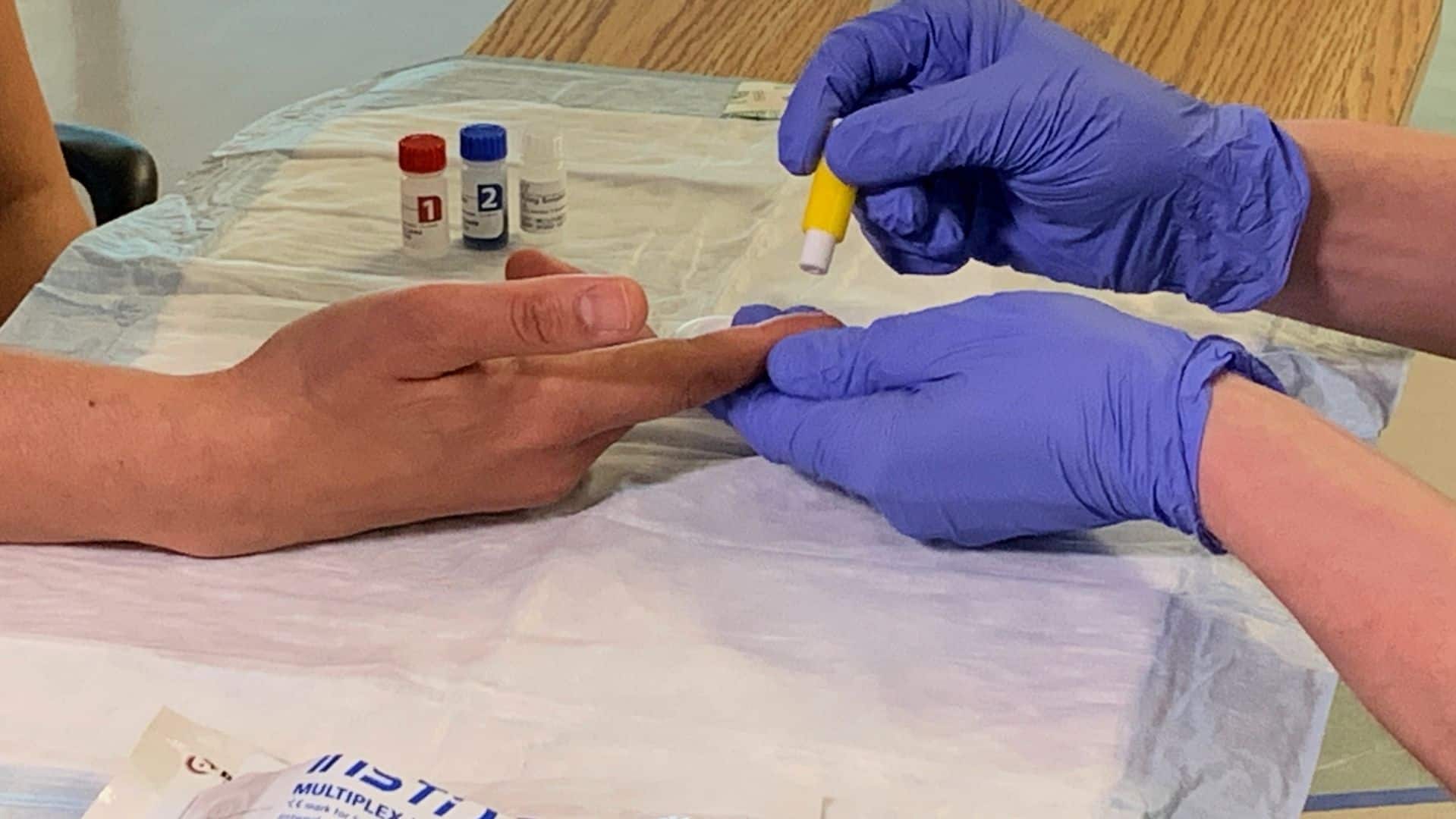 |
| Doctors and outreach workers are hopeful wider use of a new rapid test for syphilis could help slow the spread of the dangerous sexually transmitted infection. CBC |
"[Research into syphilis is complicated by the fact that the] bacterium is very difficult to work with,""We really don't understand how it works, how it infects a person or ways to appropriately combat it, or prevent that infection.""We are starting to get more philanthropic organizations who are providing funding for research and we're starting to see more people join the field, which is what is really needed in order to get those innovative research programs going,"Caroline Cameron, professor, department of biochemistry and microbiology, University of Victoria
Labels: Babies Born With congenital Syphilis, Canada, Drug Dependency, Indigenous Population, Medical Are, Prairie Provinces, Testing
posted by Pieface @ 8:30 PM
0 comments


