Ruminations

Blog dedicated primarily to randomly selected news items; comments reflecting personal perceptions

Sunday, April 02, 2023

Congenital Syphilis in Newborns

"In high-income countries you see it in pockets of disadvantaged populations."
"It's a marker of inequality Its a marker of low-quality prenatal care."
Teodora Elvira Wi,World Health Organization HIV, Hepatitis and sexually transmitted infection program

"It's just the whole system, and all the things that we've done in bad was no to support Indigenous communities."
"We probably need a million tests to get out there around the country. The solution's right in front of us."
Sean Rourke, scientist with the Li Ka Shing Knowledge Institute, St.Michael's Hospital, Toronto
 
"All of the social circumstances that contributed to this have just gotten worse over the [time and diversion of health-care attention] pandemic."
Ameeta Singh, infectious diseases specialist, HIV/STI practice, Edmonton, Alberta 
Syphilis has made a resurgence globally in the last five years, and in that time, Canada has the distinction of being far ahead of other wealthy, developed nations in the steep rise of the sexually-transmitted disease that has resulted in much larger numbers of Canadian children born with syphilis than its counterparts proportionally throughout Europe. 

According to Health Canada, the incidence of babies born with syphilis has reached 26 per 100,000 live births in 2021, an increase from 2 in 2017. Expectations are that the increase will continue, in accord with preliminary government data. Congenital syphilis places babies at higher risk of low birth weight, bone malformations and sensory difficulties, outlines the World Health Organization. It is the second-leading cause of stillbirth worldwide.

It is, on the other hand, a condition readily preventable should an infected woman have access to penicillin throughout a pregnancy. Only the United States reported a higher incidence of syphilis at birth, logging in at 74 per 100,000 live births in 2021, triple 2017's numbers as revealed by the U.S. Centers for Disease Control and Prevention. In a population of 332 million, 2,677 cases of congenital syphilis emerged, reflecting preliminary CDC data, while Canada had 96 cases for a population of 38 million.

It is Canada's Indigenous population that experiences a disproportionate number of these births, often having poor access to health and social services, that sets Canada apart, leading to these high numbers. According to Jared Bullard, a Manitoba pediatrician researching babies born with syphilis since 2021in a longitudinal study for the Public Health Agency of Canada. "It's pointing at multiple failures along the path".

Canada's three prairie provinces, Manitoba, Saskatchewan and Alberta see the concentrated rise in babies born with syphilis. They also experience higher crystal meth use, have remote populations where Indigenous populations may find it difficult accessing health care. The highest rate of such births are recorded in Manitoba, with some 371 cases per 100,000 live births in 2021.

A public awareness campaign urging people to practise safe sex and to get tested has been launched in Saskatchewan A study revealed that at least two-thirds of babies born with syphilis were born to women reporting a history of substance abuse. 45 percent of the women identified as Indigenous, another 40 percent no ethnicity recorded in a reality where Indigenous people represent about five percent of the Canadian population.
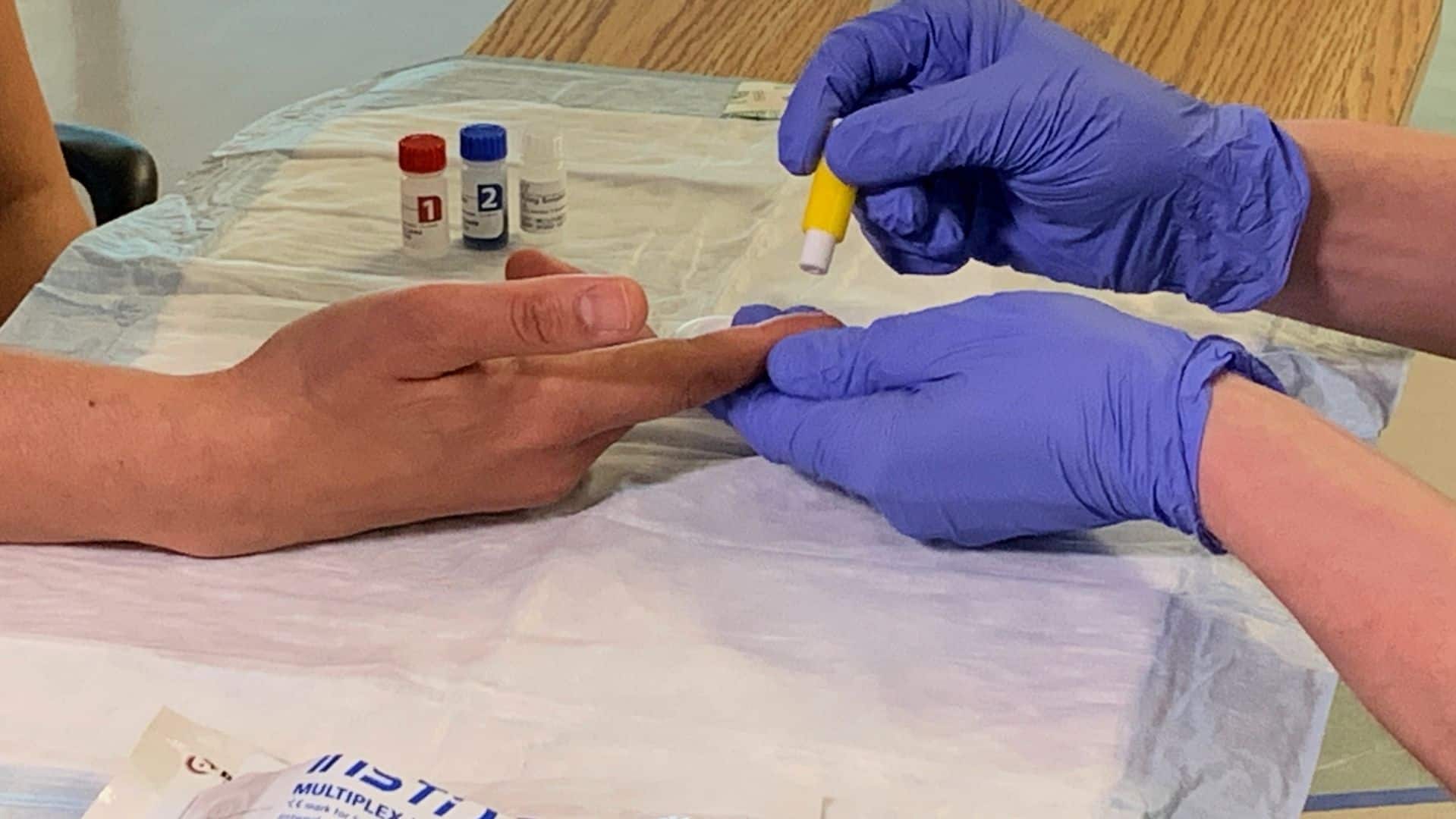
 
Doctors and outreach workers are hopeful wider use of a new rapid test for syphilis could help slow the spread of the dangerous sexually transmitted infection.   CBC
"[Research into syphilis is complicated by the fact that the] bacterium is very difficult to work with,"
"We really don't understand how it works, how it infects a person or ways to appropriately combat it, or prevent that infection."
"We are starting to get more philanthropic organizations who are providing funding for research and we're starting to see more people join the field, which is what is really needed in order to get those innovative research programs going,"
Caroline Cameron, professor, department of biochemistry and microbiology, University of Victoria

Labels: , , , , , ,

Friday, June 04, 2021

Locating the Next COVID Variant Outbreak

"[Delta is] the next scariest variant that is worrying people [all the more so that most people in Ontario received only a single dose of inoculation against the SARS-CoV-2 virus]."
"There is a lot of pressure [to complete the test], but, at the end of the day, we want to make sure it works. We have to balance the time pressure with the quality and reliability of the test."
"Scientists, we have very few eureka moments and I guess that's one of them [testing community wastewater for the presence of COVID]."
"A million-dollar question right now in the field is trying to correlate the case numbers in the city or any surveyed area with the wastewater signal, and we still don't really have a good idea of how to do that."
"I think at this point in time, [it] is not a question of if it's going to happen. It's a question of when and so the earlier we can get this information into the hands of public health officials, the better."  
Tyson Graber, research cell biologist, Children's Hospital of Eastern Ontario
Scientists at the CHEO Research Institute in Ottawa say this is the first test in Canada that can detect the variant first reported in the U.K., using wastewater. (Francis Ferland/CBC)

The World Health Organization, in a bid to move identification of viruses away from the geographic location in which they originally surfaced has now resorted to renaming the U.K., India, Brazil, South Africa variants with the letters of the Greek alphabet to make them neutral in character. Dr.Graber and other researchers are working frantically in the creation of tests to track the latest variants of concern, to be found in municipal wastewater in an expanding move to more fully understand how the viruses causing COVID-19 mutates.

Funding has just been made available to the project out of CHEO and the University of Guelph, to financially support the research on testing potentials. The funding has come out of Genome Canada, Ontario Genomics and Illumina for researchers working out of the University of Ottawa, Children's Hospital of Eastern Ontario, and the University of Guelph, collaborating on the project. It is vital to develop new and expanded testing for the purpose of measuring variants, and all the more critical that it be done as expeditiously as possible at a time when the variant that surfaced first in India, now known as Delta spreads in Ontario and elsewhere in the world.

It has proven to be more contagious than the U.K. variant (now identified as Alpha) which was responsible for the virulence of the third wave that pushed through Ontario, taking hospitals to the brink of operational collapse. The urgency to identify the presence of these viruses in wastewater increases in the face of the reality that the Delta variant is known to be more resistant to vaccines. One dose of vaccine offers merely 33 percent protection against this version of COVID-19 in comparison to the 50 percent protection against the Alpha variant.
 
Scientists are still working to develop a test that will detect variants first found in Brazil and South Africa using wastewater. (Francis Ferland/CBC)
 
An incomplete schematic of rates of variants is currently the reality reflecting the fact that only a small percentage of clinical samples in Ontario are sequenced in the bid to identify variants of concern. Wastewater surveillance increases knowledge of which variants are circulating and spreading. Delta has been found to be the dominant strain in the United Kingdom, at the present time. While in Ontario a small number of cases have surfaced.
 
Peel, the hardest hit region in southern Ontario, can expect the Delta variant to dominate within a month, according to its chief medical officer, Dr.Lawrence Loh. Who made his projection reliant on wastewater data leading him to the conclusion that in his region variant spread is a looming threat. Labs in Ontario will now be processing metagenetic wastewater testing, long done at the National Microbiology Lab in Winnipeg. 
 
The end function of wastewater monitoring is to identify potential outbreaks before they are diagnosed in people through clinical testing. This is the kind of testing that can give medical authorities a heads-up a week in advance of clinical tests verifying the presence of the COVID-19 virus or its variants. That heads-up can prepare the medical community to react before people develop symptoms, measuring as well infections in people without symptoms.

The additional research funding is meant to expand metagenetic testing to research centres across the province from the genetic sequencing currently done that can produce a picture of what to expect in regions of the province. Dr.Graber, who had previously developed a test to identify wastewater Alpha variant, is now focusing his team on like tests for Delta and the Brazil-surfaced variant now identified as Gamma.

Ottawa COVID-19 Wastewater Monitoring

Labels: , , , ,

Saturday, October 10, 2020

Interpreting COVID Caseload In Canada

"I think minimizing right now is a real mistake. People are not wanting to believe that this is a thing, because I think they don't want to return to the state we were living in earlier in the year. That's a dangerous path to take."
"The threshold for what we consider high on percent-positivity probably should be considered different now than it was in the spring."
Dr.Lynora Saxinger, University of Alberta

"We are still screening asymptomatic people, but these are people we have a reason to believe were exposed, and that seems to capture most of the cases."
"So we have to always be reacting to what is coming and not necessarily what's happening today."
Dr.Craig Jenne, infectious diseases researcher, University of Calgary

"There's been a definite increase in the number of people who are infected. It isn't just because they're testing more."
"That's kind of the tip of the iceberg [hospitalizations creeping into triple digits]. It ... tells you there's way more community transmission than you might expect."
Dr.Ameeta Singh, infectious diseases specialist, Royal Alexandra Hospital / University of Alberta
 
"[There is a host of] very clear, accelerating trends [in places like Toronto, Peel and Ottawa. Ontario is now imposing stricter measures in those regions to clamp down on the situation, as a record 939 new cases were recorded Friday]."
"The curve continues to increase in terms of its steepness."
"[The province is seeing] a dramatic growth in the percent of tests that are positive."
"In worst-case scenarios, it crosses other thresholds that lead to the reduction of access to hospital care."
"It's there in that older population [the increased positivity rate] where the consequences for health and the consequences for the health system are most severe."  
Dr. Adalsteinn Brown, adviser to Ontario government
 
"There's not a perfect, single metric that's going to give you a perfect sense of what's happening in terms of transmission."
"We certainly shouldn't be looking at the reported case numbers alone. They've become very difficult to interpret."
"The challenge with all of these is you can't really look at them in isolation. But I think the signal we're seeing right now in terms of increases in hospitalizations and people being admitted to ICUs really are indicators that cases are increasing in the community."
"So basically, [it means] you're at a point where you are going to be struggling to understand and identify where people are getting infected." 
Ashleigh Tuite, epidemiologist, University of Toronto's Dalla Lana School of Public Health
Ontario instituted measures like shutting down indoor dining in some areas of the province Friday in an effort to curb the spread of COVID-19. (Evan Mitsui/CBC)

A recent surge in COVID-19 cases surpassing a spike that occurred last spring, warns infectious disease specialists, must not be given short shrift as representing a mere byproduct of increased testing. Data publicly posted in Alberta, British Columbia, Ontario and Quebec over the week ending April 21 for that specific single week, and another ending October 6 meant to obtain a sense of just how the two case surges compare was compiled by the Canadian Press. The results do not inspire confidence.

In Alberta daily cases are now two percent higher in the most recent period in comparison to the week in April, while Ontario's were 13 percent higher, Quebec's 14 percent higher and cases in British Columbia were more than tripled the mid-to-low, double-digit numbers experienced in that province in April. As an early leader in increased testing Alberta took close to four times as many swabs during the week of October than in the April week, while B.C.'s daily testing grew eightfold, Ontario and Quebec performed roughly 4.5 times as many weekly swabs in the fall week as compared to the spring.

The positivity rate representing the percentage of tests coming back positive, in all four provinces dropped markedly between spring and fall surges. Quebec averaged some 6,300 daily tests and 930 new cases in April with a positivity rate during that period of about 15 percent. More recently in October as Quebec coped with five consecutive days of new cases in quadruple digits, its positivity rate sat at about four percent.

In Ontario, dealing with a large backlog of swabs awaiting analyzing, the province posted an official daily positivity rate of two percent for October 7, reduced from the roughly six percent range it had posted in mid-April. The positivity rate in Alberta dropped to one percent from close to five percent, and B.C.'s fell to 1.3 percent from four percent. Yet experts indicate that the lower positivity rates are no cause for comfort. They point out that early testing was largely limited to people with specific symptoms and those who came into close contact with them.

Test now tend to service a much broader portion of the population, many with mild symptoms or asymptomatic cases. Testing among people with no suspected exposure or symptoms in Alberta over the summer unearthed very few new cases, pointed out infectious diseases researcher Dr. Crag Jenne, at the University of Calgary. Testing has since been tightened to those at higher risk, or with upcoming travel, by the province. Yet, pointed out Dr.Jenne, today's results reflect viral transmission of ten to 14 days earlier.

Trends in hospitalization are seen as a lagging indicator eyed with concern by experts. For example, in Ontario, hospitalization began creeping into the triple digits roughly two weeks earlier. The percentage of people testing positive grows in a "very sharp way", according to Dr.Brown, against the backdrop of "relatively strong" testing numbers. According to provincial data released Friday, some regions in Ontario are far above the three percent positivity rate, recognized as an international benchmark reflecting a serious problem.

People wait in long lineups for a COVID-19 test at a drive-thru testing centre in Toronto on Sept. 28. The province has since moved to an appointment-only testing model, though a testing backlog remains. (Evan Mitsui/CBC)

Labels: , , , , , , ,

Sunday, June 21, 2020

Waste-Water Warning for COVID

"Waste water is a portal to what's happening in society, and in your community. A lot of things we do on a day-to-day basis touches water. We touch water. We excrete water. Fecal matter has water and goes into the waste water."
"When we run our showers, the medications we take, the personal care products we use ... all of that ends up in the water. And we have the sewer system that is an intricate network that ends up in one spot. And, if you go to that one spot, the waste water treatment plant here in Ottawa, and take a water sample, then  you have a little portal as to what's happening in the community."
"So that shows the promise. That's why people are saying, 'Yeah, maybe we should be doing this'."
"There's good and bad to that [co-location of another jurisdiction's waste water plant]. The good is that it's all been collected and it's all rushing through there. The negative part is that it's ALL rushing through there; there are tons of constituents in that water. So that makes it difficult."
"Two weeks ago we got to the point where we could say, 'We can do this'. We now feel we're getting real data that we're confident in."
"The idea is to catch the next wave and maybe multiple waves [of virus presence]. That's really a goal of ours, where we can catch it and say, 'Hey, something might be up in the community; we're starting to see something again'."
Dr.Robert Delatolla, engineering professor, University of Ottawa
Robert Delatolla
Prof. Robert Delatolla is part of a research team at the University of Ottawa Faculty of Engineering exploring how wastewater testing could be used to detect a second wave of coronavirus.

A team of researchers has embarked on a process to detect tiny pieces of severe acute respiratory syndrome coronavirus (SARS-CoV-2) in the waste water collection depots of Canada's National Capital. It has a purpose; to perfect methodology whereby in the near future scientists will be enabled swiftly to detect trends reflecting the health condition of the population at large before a situation explodes into a broad health emergency. Among the researchers is Dr.Delatolla.

For years Statistics Canada has used data gleaned from waste water from five Canadian cities; Halifax, Montreal, Toronto, Edmonton and Vancouver, to determine drug use prevalence among people living in those cities. Health officials in Amersfoort, the Netherland, a city of some 150,000 people located near Utrecht on March 5 discovered the presence of virus remnants in a waste-water check, well before the first clinical case of COVID-19.

That all the human excrement and run-off reflecting the city's human waste activity flushes into the Robert O.Pickard Environment Centre, adjacent Shefford Road in Gloucester, to collect Ottawa's waste water and treat it, represents a direct aid to the research in question. As does the fact that waste water collected in Gatineau's treatment facility located directly across the Ottawa River from Ottawa's own, both feeding into similar systems, and both providing waste-water data reflecting any possible viral-transmission trends.

Robert o. Pickard Environmental Centre  in Ottawa, October 11, 2019.   Photo by Jean Levac/Postmedia News assignment 132504
Robert O.Pickard Environmental Centre. Ottawa. Jean Levac/Postmedia

There are some 3,000 chemicals resulting from personal care products and pharmaceuticals alone contained in the waste water, points out Dr.Delatolla. Daniel Figeys and Marc-Andre MacKenzie, professors with the biochemistry, microbiology and immunology department of the University of Ottawa, along with scientist Alex MacKenzie of the Research Institute of Children's Hospital of Eastern Ontario, who along with Dr.Delatolla comprise the research team, are searching out fragments of the virus's RNA and proteins.

The team has the capacity to detect single fragments; copies of RNA in a microlitre of waste water; (a microlitre represents one-millionth of a litre -- a single drop of liquid from a commercial eyedropper contains about 50 microlitres, to put things into perspective). While still in the early stages of their data-gathering, the team drew their first samples in early April; weekly tests alternate between the two waste-water facilities as the scientists refine their process.

Only a certain percentage of the population is tested, and some carriers of the virus are asymptomatic, as Dr.Delatolla points out: "But with this, you can go into the waste water, because, literally, everyone has to go to the bathroom, and we know that the virus is shed from our bodies fecally. I imagine the data will tell us a story in this regard [whether the recent easing of provincial and municipal lockdown restrictions will be reflected in greater amounts of novel coronavirus copies found] by the end of the month."

Labels: , , , , ,

 
()() Follow @rheytah Tweet