Ruminations

Blog dedicated primarily to randomly selected news items; comments reflecting personal perceptions

Monday, March 20, 2023

Making An Impression

 
"[Mundfish has] an incredible team ... from ten countries including Poland, Ukraine, Australia, Georgia, Israel, Armenia, UAE, Serbia, and Cyprus [and the tenth?]."
"We apologize if using the vintage cartoon or music has caused hurt or insult. We will edit the parts in question." 
"Founded in 2017 by a team of four like-minded gaming enthusiasts, Mundfish is a video grame development studio headquartered in Cyprus. Mundfish is led by a talented global team focused on creating an original, captivating,  and unique gaming experience with their first title, 'Atomic Heart'."
"[We are]  pro-peace [and] against violence. Guys, we have noted the questions surrounding where we, at Mundfish, stand."
"We want to assure you that Mundfish is a developer and studio with a global team focused on an innovative game and is undeniably a pro-peace Organization  against violence against people. We do not comment on politics or religion. Rest assured, we are a global team focused on getting Atomic Heart into the hands of gamers everywhere."
"Our game and website DO NOT collect any information or data."
"The website's privacy statement is outdated and wrong, and should have been removed years ago. We have shut down the shop to assure our fans of the integrity of our studio and products. We apologize for any confusion on this matter."
Mundfish website and Twitter
As a propaganda vehicle, it is a diabolically clever device. Gaming is big. Big boys and little boys are addicted to it. Make it flash, make it pop with activity and firearms, lots of those. Some explosive devices wouldn't hurt, either. Remember the protagonists, the good guys versus the bad guys. And, in this instance, symbolism, lots of it. If the game itself is derivative of another, previous high-popularity game, that's deliberate; a tried-and-true strategy to grip peoples' imagination and  hook them on the action and the subliminal message, clumsy as it may be.
 
"We are now flying over the majestic Call of the Motherland monument -- erected in 1949 to mark the Soviet Union's victory in World War Two", a female's mellow voice intones as a statue looms through the clouds. An immense statue of a vengeful woman, sword held high in one hand, a gigantic atom cradled in the other. Below her there are monorails of a futuristic city, with suspension bridges and whirring drones. How does that suit the mood?
 
A still from the video game "Atomic Heart."
A still from the video game Atomic Heart.  Mundfish

 The statuesque symbol of victory stands 300 feet in height and as you pass it in your pixelated conveyance high in the sky above the Volga River you are deep in the world of Atomic Heart which seems to extol Soviet Russia as a socialist paradise with its triumphalist architecture.  Ukraine is not particularly thrilled with this novel conveyance of slurs against all that is Ukrainian. From the sexy female bots whose silver hair is braided in the traditional Ukrainian coiffe, to the many allusions of Ukraine as deficient in all aspects of its national identity.
 
Game developer Mundfish, based in Cyprus, won't tell you, but its chief executive worked previously at the Russian communication company Mail.RU. Funding reached Mundfish from GEM Capital, a Cyprus-based investment fund that a former chief executive of Russia's state-owned gas company Gazprom, established. The game itself is distributed in Russia by VK Play of the social media platform VKontakte owned by Gazprom.
 
Just incidentally Vladimir Kiriyenko, son of Vladimir Putin's deputy chief of staff Sergey Kiriyenko is president of VK Play. Mundfish was said to have been founded in Moscow before it moved its HQ to Cyprus in 2022. During a Moscow launch event for the game the downtown venue reached into the nostalgic past with signs reading "Glory to Soviet engineers", and "Comrade, join the society of tomorrow". 
 
Atomic Heart launched on the first anniversary of Vladimir Putin's formalizing the independence of 'separatist' regions of East Ukraine, Luhansk and Donetsk, then adding another few provinces for good measure.
A still from the video game "Atomic Heart."
Still from video   Mundfish

Mundfish, however, declares itself to be staunchly"pro-peace". Within the Mundfish organization there is one outstanding dissenter, Mick Gordon, who composed the game's soundtrack. "My motivations are solely to support the Ukrainian people affected by the conflict", he stated of his decision to donate his fee to Red Cross Australia's Ukraine Crisis Appeal.
 
According to Mundfish, Atomic Heart is not sharing player data with Kremlin authorities. It had been revealed that the company's Russian website included a clause informing users their data could be collected and sent to the Federal Security Service (FSB) the updated KGB. "Our game and website DO NOT collect any information or data", it insisted. 
 
What cannot be denied, evidently, is the presence of ample insults toward Ukraine integrated into the game. Ukrainian politicians have called for a universal boycott of the game. Sony and Microsoft have been contacted, with Ukraine seeking a ban on the game's sale of digital versions in Ukraine. 
 
Skilled gamers appear not to have been overly impressed with the game's lack of sophistication and juvenile dialogue. Patterning itself after the hugely successful BioShock, it missed its mark.
 
Atomic Heart, from Mundfish, is one of the year's most controversial video games.

"We also urge limiting the distribution of this game in other countries due to its toxicity, potential data collection of users, and the potential use of money raised from game purchases to conduct a war against Ukraine."
Kyiv Ministry of Digital Transformation of Ukraine

Labels: , ,

Sunday, March 13, 2022

Ukrainian Bio-Lab Threatening Russia?

"[There is likely a] high degree of probability that the United States and its Western allies were producing chemicals for the distinct purpose of selectively attacking] various [groups from within the population of Russia]." 
"[Documents uncovered by the Russian military in Ukraine on 24 February - the day the Russian invasion started] show that the Ministry of Health of Ukraine has set the task of completely destroying bio-agents in laboratories."
"The Pentagon knows that if these documents fall into the hands of Russian experts, then it's highly likely that Ukraine and the United States will be found to have violated the Convention on the Prohibition of Biological and Toxin Weapons."
General Igor Kirillov, head, Radiation, Chemical and Biological Protection Troops, Russian Armed Forces
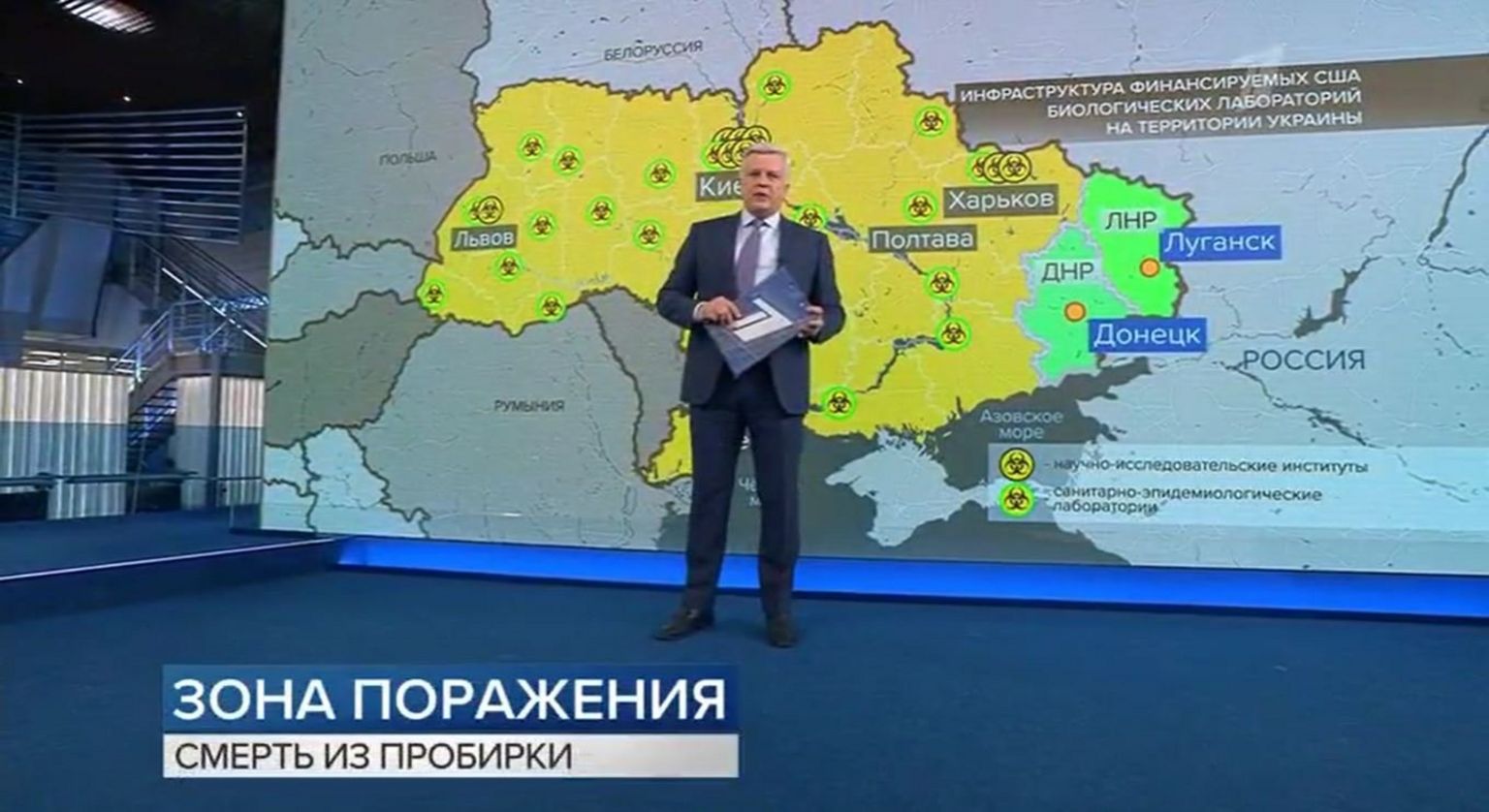
Russian state TV
Russian state TV has been showing sites which officials say are being used to develop bioweapons
 
"There are no indications that Ukrainian labs have been involved in any nefarious activity, or any research or development in contravention of the Biological Weapons Convention."
Filippa Lentzos, biosecurity expert, King's College London
 
"[The World Health Organization advised Ukraine to destroy high-threat pathogens stored at the country's public health labs to prevent] any potential spills [that would spread disease among the population]."  
"[The agency collaborated with Ukrainian public health labs for several years to enhance biosafety and biosecurity and help prevent] accidental or deliberate release of pathogens."  
World Health Organization
 
"These labs publish in openly available literature."
"They collaborate on many public health projects with global partners."
Brett Edwards, senior lecturer, security and public policy, University of Bath

"Devoting considerable sums of money and significant resources to conducting bioweapons research makes no strategic sense for Ukraine given the difficulty in using them in a conflict."  
"Conventional warfare weapons are much easier and more effective to use for countries like Ukraine."                                                                                                      Dan Kaszeta, former US serviceman, expert on defence against biological weapons
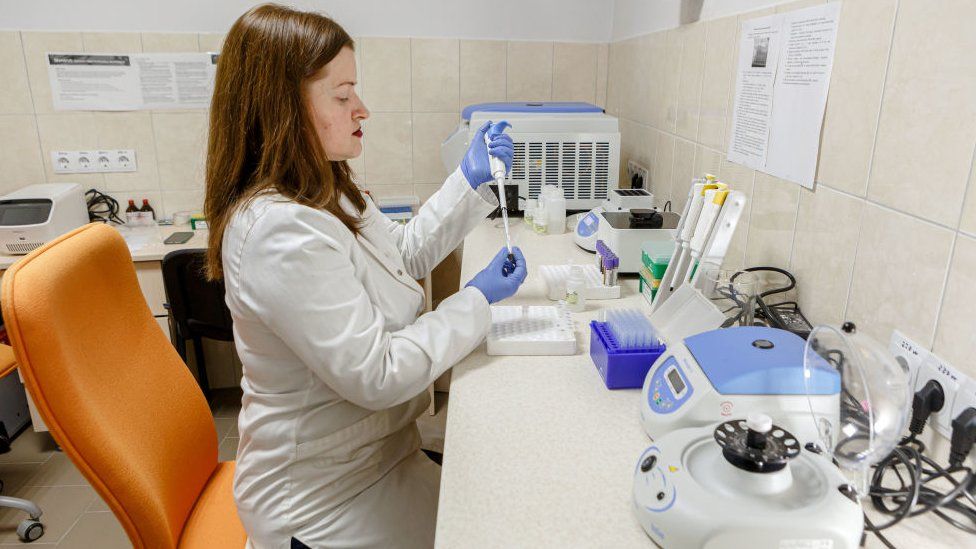
Lab in Ukraine
The US says it funds work in Ukrainian labs to tackle dangerous diseases  Getty Images

 Back in 1991, several former Soviet bioweapons laboratories in Ukraine underwent conversion by the United States, becoming facilities meant to decommission weapons of mass destruction. For the obvious purpose of preventing them from falling into the possession of those who might wish to use them following the dissolution of the Soviet Union. This appears to be the program that has now sparked conspiracy theories, useful to Russian propaganda intent on painting Ukraine and its Western allies with broad, black strokes of threats by whatever means, to Russia.

In 1992 when then-Russian Premier Boris Yeltsin, visited the United Kingdom, at a time when relations between Russia and the West were on a friendly track with signs of warming trust and collegiality, he spoke with members of the Defence Intelligence Staff, telling them that Russian bioweapons scientists were undertaking research into the influence on human genes of chemical substances.

This was echoed years later when Dr.Christopher Davis, serving on the Defence Intelligence Staff spoke of the research as having opened the door to a weapon that could be indiscriminately sprayed, yet it would prove lethal to only "certain people it was designed to find and attack". Russia has first-hand knowledge of the potential of developing biological weapons to target individuals of a distinct ethnic group, since Russia itself developed such weapons in the past.

Scientists are notoriously inquisitive about the nature of things and their interaction; it is what moves science forward, for good and for ill. Laboratories may not be involved directly in formulating bioweapons, but legitimate fears abound with respect to "dual-use" biological research. The type of research whose product could feasibly be used for nefarious purposes, once in the wrong hands.

In 2019, the Centre for the Study of Existential Risk at Cambridge University circulated a warning of the possibility that biological weapons could be formulated and produced for the very purpose of targeting a demographic representing a particular ethnic group, based entirely on their DNA. Russia's new claims warning that Ukraine was producing just such weapons, fall directly into the type of claims that follow a typical pattern of disinformation linked to Russian propaganda.
 
Dr. Filippa Lentzos, co-director of the Centre for Science and Security Studies at King's College London, had on an earlier occasion tackled similar claims made by Russia of the existence of a laboratory in Georgia dedicated to a similar purpose, to justify its invasion and conflict with Georgia, another former USSR satellite which was anxious to go its own way of independence with the collapse of the Soviet Union. Reports in Russian state media in 2018 claimed untested drugs were given to citizens at a lab funded by the U.S. in Georgia.
 
A convoy of pro-Russian troops are seen outside the separatist-controlled town of Volnovakha in the Eastern Ukrainian Donetsk region on Saturday. (Alexander Ermochenko/Reuters)
 
Now the very same claims, under very similar circumstances are once again being trotted out to justify Russia's need to invade Ukraine leading to the destruction not of a putative bioweapons laboratory but the entire national infrastructure. When Russia invaded Georgia, it re-possessed the allegiance of two provinces. Moscow has already done that in Ukraine, repeating the very same pattern that the Kremlin never seems to tire of, declaring eastern Ukraine's Donetsk and Luhansk regions in the Donbas to be independent of Ukraine; Russian territory. With Crimea thrown in for good measure.
 
And with Mariupol encircled and battered with artillery and constant shelling, with the bombing of apartment buildings, schools, government offices and hospitals it too is meant to fall into Russian hands to provide a land link between Russia and the Crimean peninsula. A gradual, creeping reclamation of a sovereign geography Moscow claims historically to be part of Greater Russia.
 
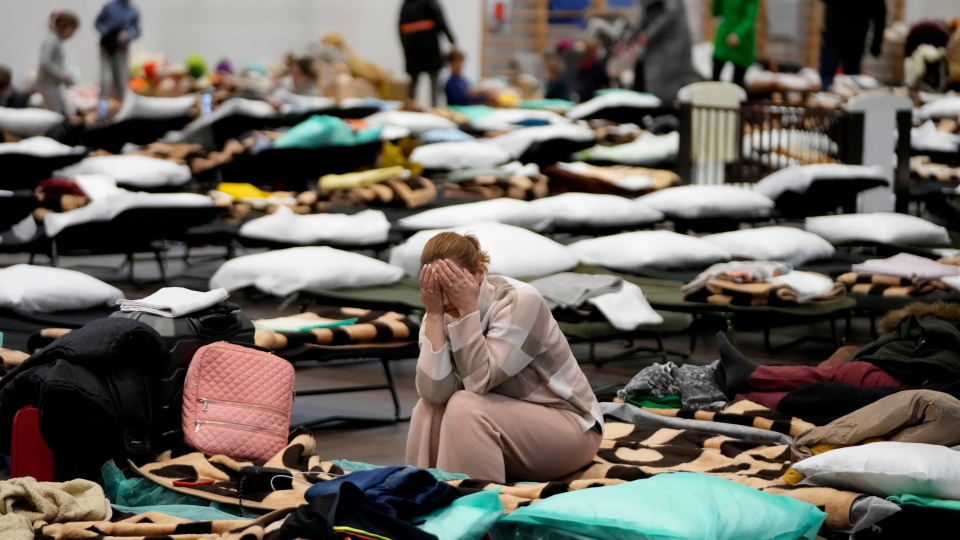
Poland shelter
A woman puts her head in her hands as she sits on a cot in a shelter, set up for displaced persons fleeing Ukraine, inside a school gymnasium in Przemysl, Poland, Tuesday, March 8, 2022. (AP Photo/Markus Schreiber)

Labels: , , , ,

 
()() Follow @rheytah Tweet