Ruminations

Blog dedicated primarily to randomly selected news items; comments reflecting personal perceptions

Sunday, July 26, 2026

Iran on a Repressive Execution Tear
https://gdb.rferl.org/868A86FE-AD64-42F4-8B33-CBAEF0D3489F_cx6_cy7_cw87_w1023_r1_s.jpg
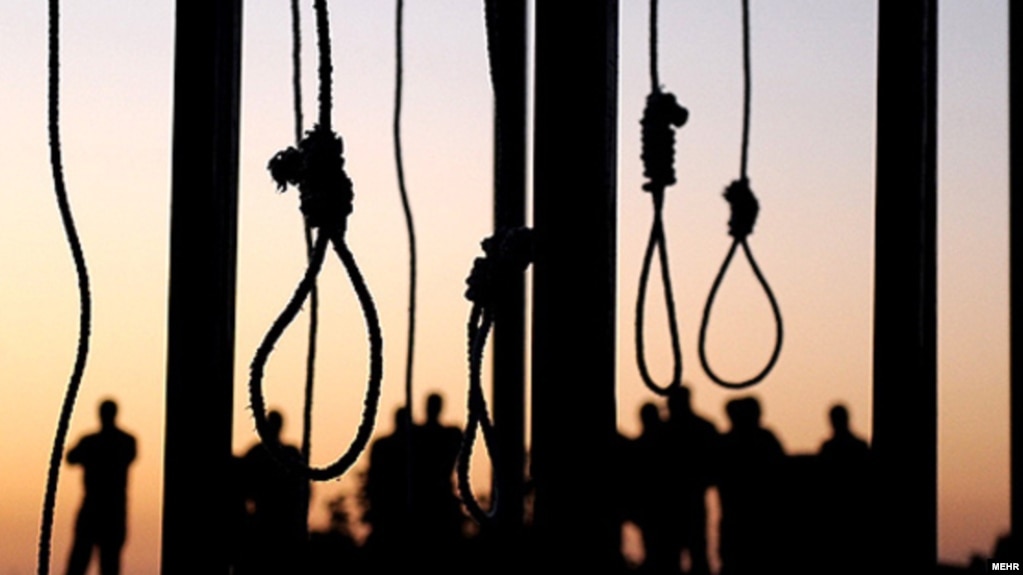
Rights groups condemned the latest executions and warned that they could signal a wider crackdown on protesters facing death sentences. (file photo, MEHR)
 
 
"With the breakdown of the ceasefire and the resumption of the war, we are deeply concerned that the authorities will exploit the situation to intensify the execution of political prisoners."
"The international community -- and the European Union in particular -- must make an immediate moratorium on executions a central issue."
Mahmood Amiry-Moghaddam, director, Iran Human Rights NGO (IHR) 
"Hundreds of political prisoners and protesters are currently facing capital charges", with around 100 already sentenced to death, warns the Iran Human Rights NGO. Over 70 people await the gallows in the central city of Isfahan. Iran's "Killing machine" must be a central issue for dialogue with the Islamic Republic, the IHR has repeatedly stressed.

 
https://i.iranintl.com/images/rdk9umy0/production/c6d1c0e0cc15f78a588c9a4af76847c3d560c77f-670x483.png?rect=13,0,644,483&w=768&h=576&q=58&fit=max&auto=format
Iran executed Erfan Esfandiari, reportedly 18, and Gol Mohammad Mohammadi, a 23-year-old Afghan national, on July 19. Iranian authorities accused them of involvement in the deaths of four members of the security forces.  IHR
 
Vahid Baniamerian, 34, and a physics academic, was sentenced to death, included with sentences issued to five other defendants charged with membership in the Iran-outlawed People's Mujahedin (MEK) organization. He and the five others have been hanged, their families only discovering their execution when it was reported by Iranian state media reports.
 
Dozens of Iranians identified as political prisoners by rights groups, are political prisoners that have been executed since the U.S.-Israel aerial bombardment of Iran began. They represent Iranian protesters against the regime, as well as people accused of being members of banned groups, along with others who have been convicted on charges of spying. 
 
https://i.iranintl.com/images/rdk9umy0/production/4167aa690c8c3891bee77ad1c049cea1eceeb474-1000x668.jpg?rect=0,1,1000,667&w=768&h=512&q=58&fit=max&auto=format
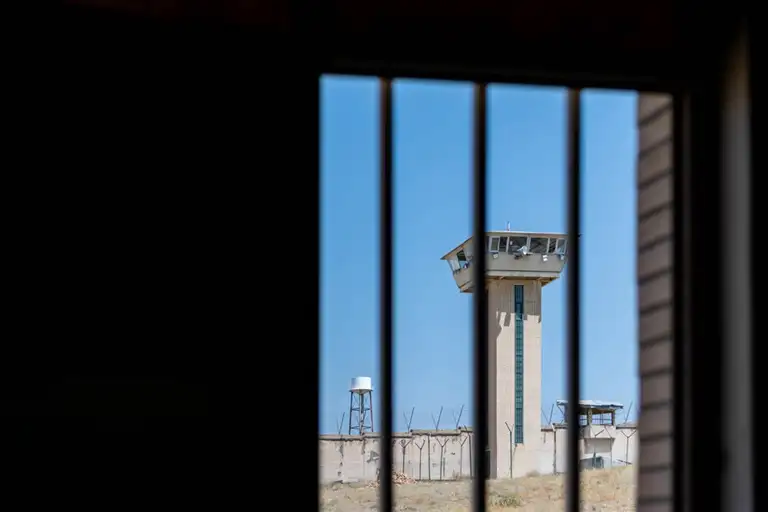
File photo by ISNA shows Rajaeishahr Prison west of Tehran
 
Since the earliest days of the war which came to a halt in March, Iran has committed to increasing executions, interpreted by activists as a scheme to instill fear within Iranian society, with a view to preventing mass protests that shook the regime's leadership last year, from recommencing. The rupture of the on-again-off-again ceasefire has rights groups fearing that executions will continue to be expedited as another intimidation tactic to ensure silence prevails within the fearful populace.
 
According to Iranian authorities, the convicted are guilty of having carried out deadly attacks against security forces, or having targeted public buildings. Rights groups respond by charging that those arrested and confined in Iran's prisons were tortured and convicted in fast-tracked trials.  
 
So far this year according to IHR, over 400 people have been executed, even as the bulk of capital punishment strikes at those hanged on drug-related or murder charges. Inmates at Ghezel Hesar prison outside Tehran, in nearby Karaj, staged a sit-in protest in the wake of fellow prisoners taken to solitary confinement preparatory to hanging on drug charges.  
"These are prisoners who committed errors simply to afford the basic necessities of life, and they deeply regret their actions."
"Where else in the world is a human life taken for a first mistake?"
Prisoner statement 
Over 2,150 Iranians were put to death in Iran in 2025. Identifying it as one of the world's most prolific executioners, second only to China.  
 
https://gdb.rferl.org/a95856d3-f970-4bfe-86e5-c2407da973af_w1023_r1_s.jpg
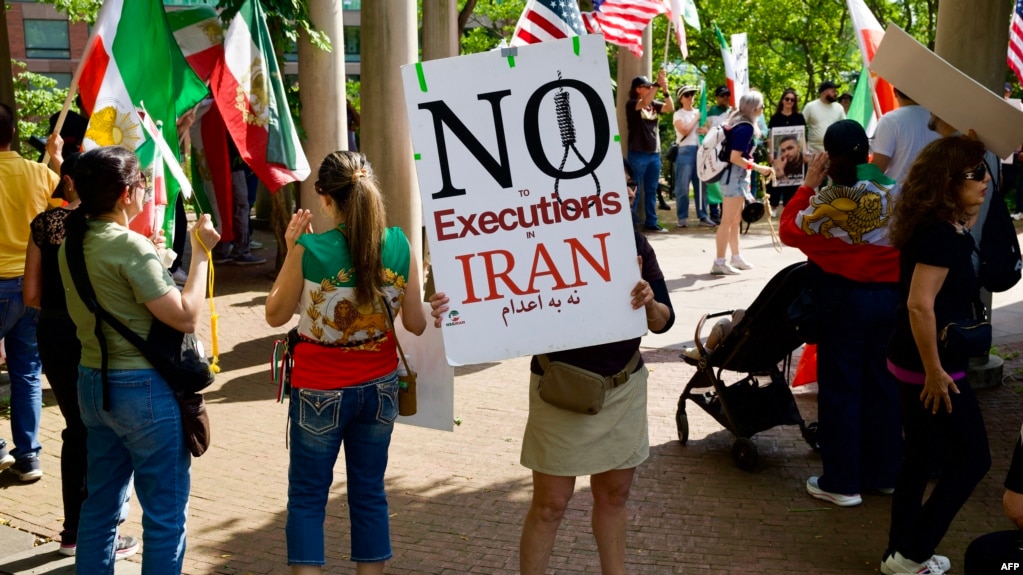
Radio Free Europe / AFP


Labels: , , , , , ,

Tuesday, December 01, 2020

Flout Masking Rules -- Get to the Back of the Health Service Lineup

"We're not saying don't treat. We're saying, if you're going to run around and claim exemption to endorsed and established behavioural policy, you should volunteer, if  you get sick, to go to the end of the line."
"[Should people wilfully engage in behaviours known to potentially harm others], then if you get sick, you have an obligation to think about saying, 'let others go before me, because I wasn't responsible'."
"If you are a real believer in liberty, then you have to say, 'I'll pay the price'."
"Patrick Henry's famous proclamation, carried by many protesters, is 'give me liberty or give me death', not 'give me liberty and if that doesn't work out so well give me a scarce ventilator'."
"I think it's more consistent with what the anti-mask, anti-social distancing, anti-quarantine crowd wants. As soon as they understand they can get on a plane or go on a cruise if they get vaccinated, I think they'll shift their attitudes."
Arthur Caplan, founder, division of medical ethics, New York University School of Medicine

"[A basic principle in medical ethics, all the more so in a country like Canada, is that] you get medical care, if and when you need it, and need is really the only criterion that we should use."
"[Sanctions should be applied to people who break laws]. Certainly that assault on the Walmart employee would seem to qualify, but that doesn't disqualify them from receiving care."
"I think everybody is kind of operating at a level of anxiety and fear that has polarized societies."
"Even though it might be tempting when seeing people flouting common sense public health directives to say 'you guys, back of the line' ... I think it really behooves the medical establishment to look beyond the crisis."
"We're all going to have to live in society together and avoid any acts that may exacerbate polarizations or fractures in society."
Daniel Weinstock, professor of law, Katherine A.Pearson chair in civil society and public policy, McGill University
There are some ethicists, in the face of the public spectacle of vociferous protests against imposed lockdowns, against mandated wearing of face masks, against quarantining and social distancing, who are of the opinion that if you endanger society as well as your own future health prospects by damning and refusing to align your public behaviour with public health guidelines, you automatically distance yourself from the use of the public health care system; which is to say you should do so voluntarily, since your actions have gone against the established grain.

People who flout or publicly make clear they have no use for the new rules and regulations imposed on society by governments in consultation with health experts in the face of a public health threat of singular proportions, place themselves at risk of contracting the COVID disease, with its unknown, haphazard consequences, but worse, endanger the health of others around them -- yet they are entitled to the same health care services as the countless other people who, though inconvenient, practise safe distancing and mask-wearing.

The prospect of steadily rising COVID cases beginning to overwhelm the health care system has raised concerns over whether the system will be able to operate efficiently and effectively as it should, under the strain of coping with high numbers of patients. And while health experts are beginning to mull over the morals of selecting who will be the recipient of extraordinary measures and will who be excluded due primarily to age and/or existing health complications, the thought has been extended to include withholding service in some measure from those to refuse to abide by common sense prevention rules.

New York University's Dr.Arthur Caplan clearly places himself in the school of thought believing that those refusing to lend themselves to the effort of community responsibility have no moral right to then demand treatment equal in measure and timeliness to those who have taken their community responsibility seriously. Dr.Caplan, with his medical peers, co-authored a study arguing that while most individuals diligently adhere to public health recommendations, thousands of others fail to understand the gravity of the situation, exhibit skepticism and act accordingly.

The most commonly used argument in support of denying the need of all citizens to equally make sacrifices in the greater cause of the struggle to starve the SARS-CoV-2 virus of victims, nay-sayers invoke the cry that the demands to mask and limit social gatherings violate their Charter rights inclusive that of freedom of peaceful assembly and freedom of association. To this, Dr. Caplan responds that in a "plague" situation a threat to others  justifies limitations on individual civil liberties.

As far as he is concerned, protesters should be agreeable to signing a personal pledge stating their willingness to forego medical care should emergency rooms or intensive care units become inundated by numbers of COVID cases requiring urgent care. In his opinion, vaccines should be treated differently, "because if you get vaccinated, you may stop infecting other people. I think the thing that motivates people to not wear a mask, to go where they want to go, oddly enough that's what a vaccine will let them do."

And while Dr.Weinstock, on the other hand at McGill University doesn't believe that treatment should be withheld or that protesters should be forced to the back of the line, he does agree that people who break laws should face sanctions for their anti-social acts, citing a 30-year-old man charged with assault after attacking an employee at a British Columbia Walmart -- where store policy holds that mask wearing is mandatory -- for requesting that the customer wear a mask on entering the establishment in a province where mask wear is a requirement.

People protest against measures taken by public health authorities to curb the spread of COVID-19, in Montreal, Saturday, November 28, 2020. Photo by Graham Hughes/The Canadian Press/File
"I can just imagine the level of despair people are feeling. Absolute despair."
"One of the great things about a vaccine is that at least people see there may be an end to this despair -- 'I can get hopefully through the next three months, or the next five months'."
"We think there is actually a finite end."
Dr.Peter Goldberg, critical care physician, Montreal

Labels: , , , ,

 
()() Follow @rheytah Tweet