Ruminations

Blog dedicated primarily to randomly selected news items; comments reflecting personal perceptions

Thursday, October 23, 2025

Fascist Moscow Slandering Democratic Kyiv

"You see, if we just stop, it means forgetting the root causes of this conflict which the American administration clearly understood."
"I am referring to ensuring Ukraine's non-aligned, non-nuclear status, which implies refraining from any attempts to draw it into NATO."
"[Freezing the fighting at this point] would mean only one things: a large part of Ukraine would remain under Nazi rule."
Russian Foreign Minister Sergei Lavrov 
 
"Russia's Stalling Tactics have shown time and time again that Ukraine is the only party serious about peace."
"We can all see that Putin continues to choose violence and destruction."
Joint statement by Britain, France, Germany, Italy, Poland 
 
"Let it [the contested region] be cut the way it is."
"It's cut up right now. I think 78% of the land is already taken by Russia... I said: cut and stop at the battle line."
"Go home. Stop fighting, stop killing people."
U.S. President Donald Trump 
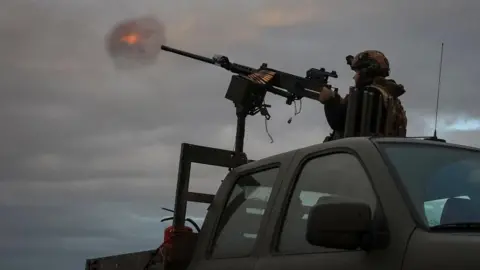
Reuters Ukrainian servicemen from an anti-drone mobile air defence unit fire a M2 Browning machine gun during combat shift on the front line in the Donetsk region
Russia has rejected European calls for a ceasefire based on existing front lines  Reuters
 
President Trump's call on Tuesday to freeze Ukraine fighting at the current front line was rejected by Russia. Last week the U.S. president stated he believed that Vladimir Putin wanted to secure a deal. Yet Trump's most recent demand for "an immediate ceasefire" was sloughed off by Russian foreign Minister Lavrov, as a non-starter "which has suddenly become a topic of discussion again". 
 
Calling it the opposite of what was agreed to at the Alaska summit when Trump and Putin met in August. At that juncture Trump had left off pressuring Putin to end the fighting before negotiations began.
 
On Saturday, Trump stated that both Russia and Ukraine should agree to stop fighting, that Kyiv and Moscow had to "stop the war immediately at the current battle lines". Following which Britain, France, Germany, Italy, Poland and top E.U. officials signed off on a statement Tuesday giving their support to the proposal for a ceasefire along the existing line of contact, prior to any talks. 
 
Firefighters work at the site of the kindergarten hit by a Russian drone strike, amid Russia's attack on Ukraine, in Kharkiv, Ukraine, October 22, 2025.
Firefighters work at the site of a building housing a kindergarten hit by a Russian drone strike, in Kharkiv, Ukraine, on Wednesday, Nov.22. (Sofiia Gatilova/Reuters)
 
As for Russia's efforts at negotiations and its interest in ending the conflict, the statement reflected the group's skepticism about Russian sincerity. It is this very disagreement  that was likely responsible for the  delay in a planned face-to-face meeting between Lavrov and Secretary of State Marco Rubio set for this week in preparation for the proposed Trump-Putin summit in Budapest. That would be replaced, stated Lavrov, with phone contact between the two leaders.
 
Trump had accepted Putin's rejection of a ceasefire, at the Alaska summit. It had been decided that the best way to end the war was to "go directly to a peace agreement, which would end the war, and not a mere ceasefire agreement which often times do not hold up", Trump had recorded on Truth Social, his social media site. 
 
Since no agreement was reached, and the matter was left up in the  air for future discussion, Russia felt free to ramp  up its attacks on Ukraine while resisting Trump's later calls for a meeting between Putin and Volodymyr Zelenskyy. Putin once again demanded during Thursday's phone call with Trump, that Ukraine surrender all of Donetsk region, including territory Russia had yet to conquer, clarified U.S. officials.
 
On Friday at a subsequent White House meeting with Zelenskyy, Trump urged him to surrender all of the Donbas, inclusive of Donetsk region, portraying it as an opportunity to get a deal, rather than see his country destroyed by Russia. This was yet another meeting with a tense atmosphere prevailing, according to people familiar with the exchange that had taken place.
 
Nevertheless at the conclusion of the inconclusive meeting with Zelenskyy, Trump echoed a stance that Zelenskyy had endorsed, calling for a ceasefire along the front line, as it currently stood. A call that served to incense Lavrov, no doubt in emulation of Vladimir Putin's reaction. 
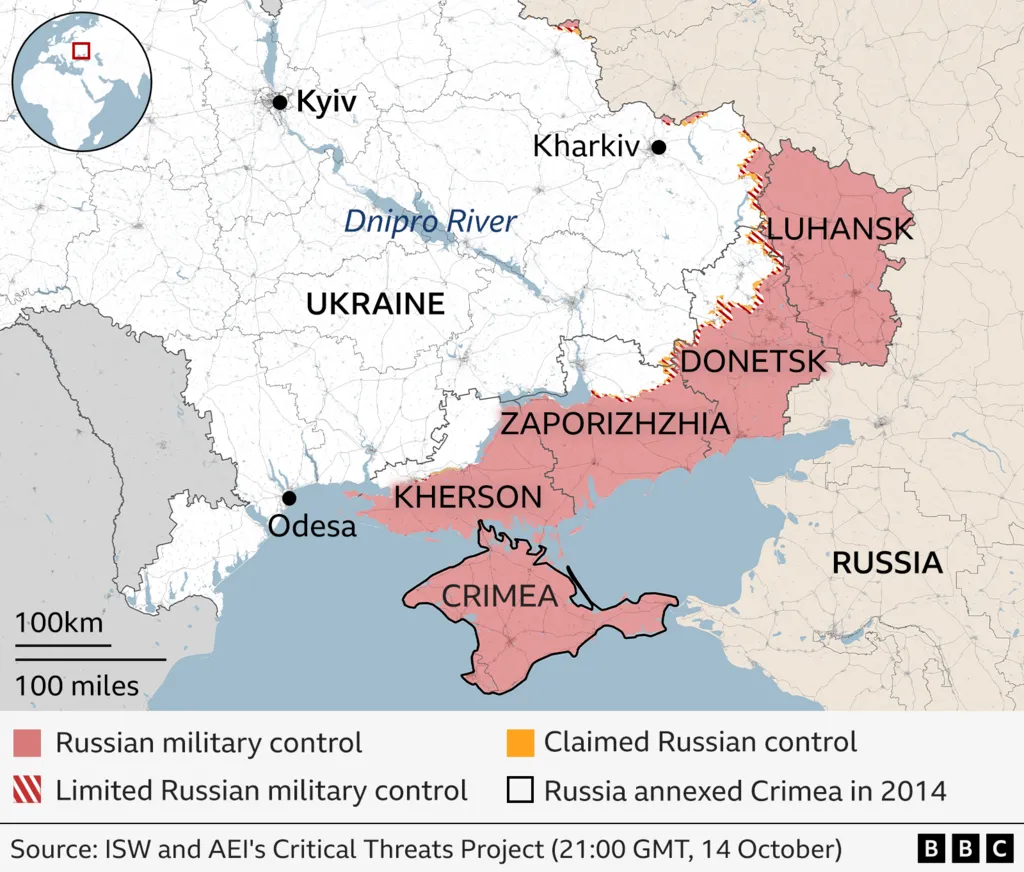
 
https://ichef.bbci.co.uk/news/1024/cpsprodpb/924b/live/2d89e610-ae89-11f0-ba75-093eca1ac29b.png.webp


Labels: , , , ,

Saturday, October 21, 2023

Five Eyes Intelligence Sharing

"One of the things we tried to do with the private sector is to say, 'Be on the lookout because now what they cannot do from the front door, they're going to do it through the back door'." 
"We had a very difficult discussion with a business leader in Canada where we essentially were able to show that person that we had discovered ... that some components of high-tech guidance had been used in Russian drones to kill Ukrainians, absolutely unbeknownst to that business leader."
CSIS director David Vigneault

"[The Chinese government is engaged in the] most sustained, scaled and sophisticated theft of intellectual property and acquisition of expertise that is unprecedented in human history."
"The problem with that is they're engaged in wholesale intellectual property theft and the acquisition of expertise."
Australian Security Intelligence Organization director-general Mike Burgess

"They [Beijing Communist Party] have a bigger hacking program than that of every other major nation combined."
"Combine that with human intelligence [humint] operations [and China is deploying intellectual property theft tools] at a scale that the likes of which we've never seen."
FBI head Christopher Wray

"[Five Eyes agencies are seeing intellectual property theft rise at an unprecedented rate]."
"There is real concern amongst our organizations that AI, over time and potentially sooner than we might think, will give various of our adversaries and less sophisticated adversaries, new ideas and new access to dangerous knowledge."
"[MI-5 collects] thousands and thousands [of  hours of audio data in] lots of interesting places [every week that it uses to glean knowledge and train AI."
"You can imagine the tiny microphones that we might plant lawfully in certain locations to achieve that."
But what that means is we end up with a lot of audio products that we need quickly to translate into knowledge that is searchable. And the best means of doing that is to have AI scan across the material."
British Security Service (MI-5) director general Ken McCallum 
FBI Director Convenes Five Eyes Summit on Protecting Innovation, Preventing Economic Espionage

Sharing intelligence between partner-nations who have the most to gain by using their expertise and information-gathering to advise and alert collegial intelligence services is usually conducted under covert circumstances, relaying secret data to others in a manner that is circumspect and secure. This, however, was an occasion when members of the Five Eyes panel congregated in a public arena and permitted their findings and conclusions to be echoed by legacy media outlets.
 
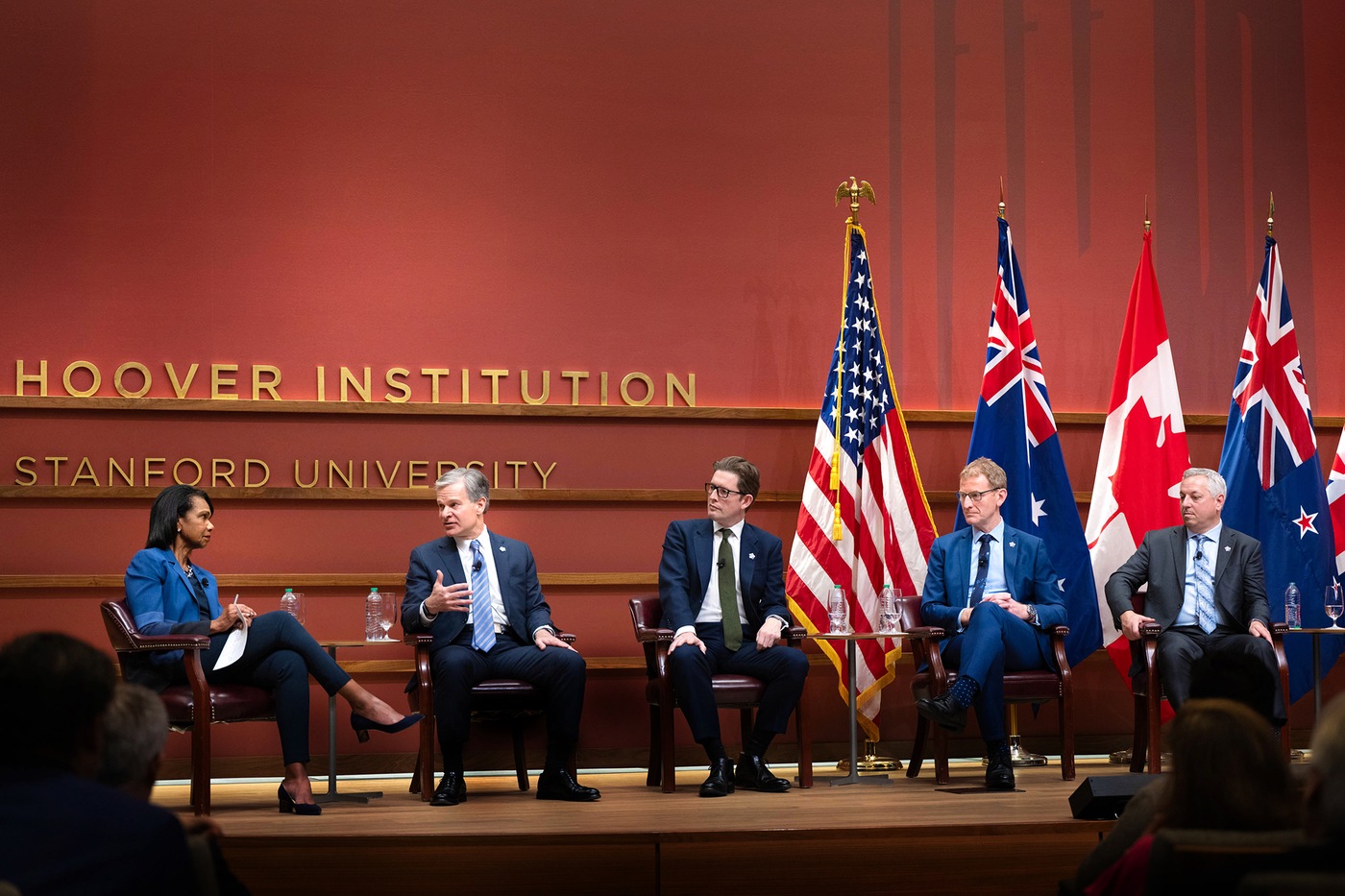
The event, billed as "Emerging Threats, Innovation, and Security", a conference that included the United States, United Kingdom, Australia, New Zealand and Canada, took place this week at Stanford University. It is where Canada's head of the Canadian Security Intelligence Service revealed in a semi-public forum that Russia is making use of front companies and agents to surreptitiously bypass Western sanctions and trade barriers.
 
His agency, stated David Vigneault, had discovered an unfortunate situation where Canadian technology was being incorporated into weapons deployment in the Russian invasion of Ukraine, linking that technology and its manufacturer to Moscow's growing death toll of Ukrainian lives. What ensued, he said was a "very difficult discussion" with the company, to alert its head to the situation and to ensure the understanding that any further such trade would represent a criminal action.
 
Additionally, following an ensuing panel discussion Eric Balsam, a CSIS spokesperson stated that the agency's 2022 annual report noted as well that Canadian technology had been discovered in Iranian-produced Shahed-136 drones, used by Russian resident Vladimir Putin's military against Ukrainian civilians in his all-out war to destroy Ukraine. 
 
One of the most pressing impediments to CSIS effectiveness, director Vigneault explained to his audience, is its internal culture and "finding a way for our officers or our experts to think differently. That cultural reticence from our organization is something we need to break". CSIS is at work to emerge from its "silos" to engage with more external institutions such as universities, research centres and venture capitalists.

Moreover, he admitted the agency must search out concrete methods to explain the threat from Canada's adversaries such as China and Russia, since it is no longer sufficient to "cry wolf". There was general agreement that the threat China poses to the western world and specifically to members of the Five Eyes intelligence alliance, dominated the conversation.

FBI head Wray informed attendees that China's state-operated hacking program vastly exceeds those of the world at large. Concerns echoed by British Security Service director general McCallum who also mentioned the speed at which artificial intelligence is now developing and providing new and increasingly vital hacking tools to actors in cyber threats.

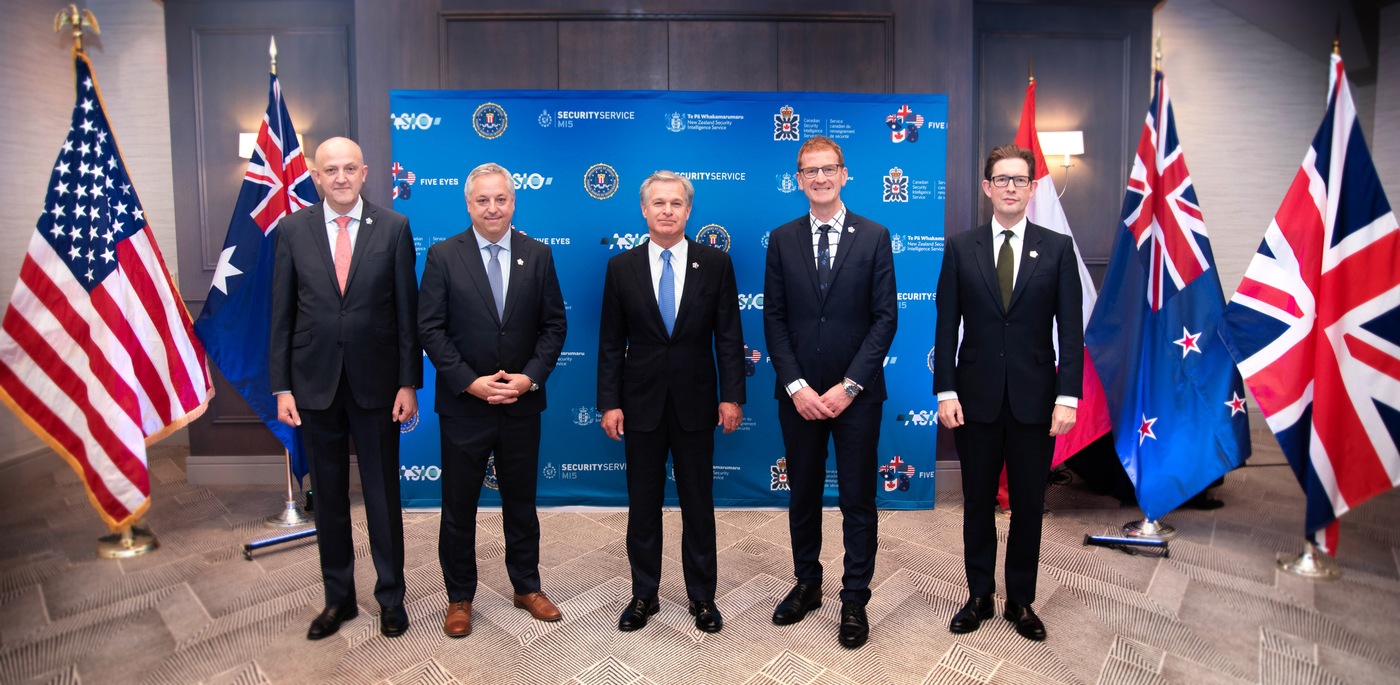
(From left to right), Australian Security Intelligence Organisation Director-General Mike Burgess; Canadian Security Intelligence Service Director David Vigneault; FBI Director Christopher Wray; New Zealand Security Intelligence Service Director-General of Security and Chief Executive Andrew Hampton; and MI5 Director General Ken McCallum pose for a group photo ahead of the Emerging Technology and Securing Innovation Summit in California's Silicon Valley on October 16, 2023.
From left to right: Australian Security Intelligence Organization Director-General Mike Burgess, Canadian Security Intelligence Service Director David Vigneault, FBI Director Christopher Wray, New Zealand Security Intelligence Service Director-General of Security and Chief Executive Andrew Hampton, and MI5 Director General Ken McCallum pose for a group photo during the Emerging Technology and Securing Innovation Summit in Palo Alto, California, on October 16, 2023.


Labels: , , , , ,

 
()() Follow @rheytah Tweet