Ruminations

Blog dedicated primarily to randomly selected news items; comments reflecting personal perceptions

Friday, January 06, 2023

Parents Out, Teachers In: Solving The Issue of Gender Dysphoria

"The way that I see it, the schools are triangulating the family -- they're becoming a wedge between the child and parent."
"It's not a benign act. It's a psychological intervention -- and it's not a minor psychological intervention -- that teachers and counsellors are entering into without any psychological training at all."
Mother of student and former academic with doctorate in psychology
 
"School is an incredibly important part of this. School is a fundamental part of youth experience, growing up and becoming adults. They spend six, seven, eight hours a day at school. It's fundamental to their well-being."
"The parents ultimately realize the child is the person they've always loved. With the parents' support, the child starts to go to school again, they come out of their room, they start talking with their parents and siblings."
"They're having plans for their future they did not have before."
Dr.Margaret Lawson, endocrinologist, head, Children's Hospital of Eastern Ontario gender identity clinic

Canadian schools accept name and pronoun preferences, provide gender-neutral washrooms and teach from a young age about gender identity. In some cases, they can even refer students directly to gender-treatment clinics.
Canadian schools accept name and pronoun preferences, provide gender-neutral washrooms and teach from a young age about gender identity. In some cases, they can even refer students directly to gender-treatment clinics. Photo by Getty Images

"My real concern here is that people are using schools and the education system for decisions that should be made in the medical system."
James Cantor, former scientist with Centre for Addiction and Mental Health, Toronto
Dr. Cantor is not comfortable with the intervention of schools and teachers' involvement in guiding children toward solutions to their gender confusion. To his professional sense, the role of the schools in ushering children toward transitioning makes it likelier for a young person to move on to medical transition, inclusive of cross-sex hormones and gender-reassignment surgery. In his new role in private practise as a psychologist he has become a prominent critic of the affirmative approach taken by school boards.

For her part, Dr. Lawson -- as head of a major children's hospital's gender identity clinic, co-founder of the TransYouthCan! research project -- points to what she sees as potential perils should schools not affirm new identities for their students. Her studies suggest that close to 40 percent of gender-dysphoria patients at Canadian clinics avoid school on occasion to avoid harassment. Supporting these children "is not pointing a child in a direction they wouldn't otherwise take. No one chooses to be transgender", she states.

According to some professionals in the field, there is good reason for schools to be involved in what is referred to as social transitioning; that otherwise these institutions of learning would represent exposure to harm to the well-being of their students. This, despite parents' legitimate and responsible concerns that their agency as parents and guides to their children's well-being is being usurped by those in the teaching profession who have taken it upon themselves to pattern their students in ways parents do not approve of, and without parental consent.

In the United States where a similar situation prevails, some Republican-led state governments have passed laws that bar transgender students from school washrooms or sports teams and discussion of gender identity is prohibited in classrooms. Moves that have been widely condemned as transphobic and politically motivated. 'Progressive' advocates tend to label questioning of the "affirmation" approach taken up by schools and the health-care system as anti-trans or representative of hate-speech.

Dr. Lawson points out that the number of young people reporting gender dysphoria has been "exponentially growing"; the majority of whom are adolescent girls. Whereas traditionally it has been very young, prepubescent boys or alternately middle-aged men most likely to identify themselves as trans. Professionals in the field tend to feel the transgender boom is now occurring lately based on growing social awareness and acceptance following years of intolerance and violence.

There are other explanations more popular with skeptics; that online influencers, social contagion and education in schools represent the prompting elements to convince confused or troubled teenagers in their decisions to choose gender-identity as the source of their troubled social status. Another of Dr. Lawson's studies disproves "conclusively" that "rapid-onset gender dysphoria" is a problem.

It seems, however, that the phenomenon is such that it has convinced jurisdictions such as the U.K.,
Sweden and Poland to back away from the affirmative approach over concerns that other mental health issues could be overlooked in the rush to address and advance gender identity. Britain's Cass Review recently released a report on gender-identity services for young people, claiming the decision to begin social transition should be carefully decided by "the young person, along with their family/carers".
 
 
On the other hand, Canadian schools are instructed that parental involvement is not required in affirming a child's wish to transition socially. A background document put out by Public Health Agency of Canada instructs teachers and other school staff not to disclose a student's changing gender-identity to anyone -- "including parents/caregivers" -- who is not aware of the situation. The document reads: Disclosing a new gender identity "may signify the end point of a very long internal struggle to be secretive with their identity because of fear or shame".

Evidence indicates that social transitioning results in making it more likely for a young person to move on to medical transition which can include cross-sex hormones and gender reassignment surgery, which makes the involvement of schools as initiators in transitioning problematical. "It's a really new area that nobody really understands and I think the schools and everybody else is just saying 'Let's make this child happy, no matter what'", remarked the mother of a Toronto District School Board student whose child at birth was male and has come out now as a girl at the end of Grade 11.

Her school, including a summer-school teacher, without consulting the parents, immediately adopted the new name and pronouns. She also has a number of friends and acquaintances with children identifying as trans, said the mother, wishing the school required parents to at least sign off on gender-related name changes, offering opportunity for discussions to families. 
 
In north-central Ontario, a father explained he simply accepted the situation when his transitioning daughter's school adopted her new male name. However, when she was assigned to a hotel room with three boys during an out-of-town trip, even his child was uncomfortable. She has since reverted to her birth-gender identity.

In Ottawa, a mother took a local school to the Ontario Human Rights Tribunal when her daughter's Grade 1 teacher suggested to the class that no difference existed between boys and girls during a lesson on gender fluidity. This left her child confused and upset, and the mother reacted as any mother would under normal circumstances. As it happened, the tribunal ruled in favour of the school. 
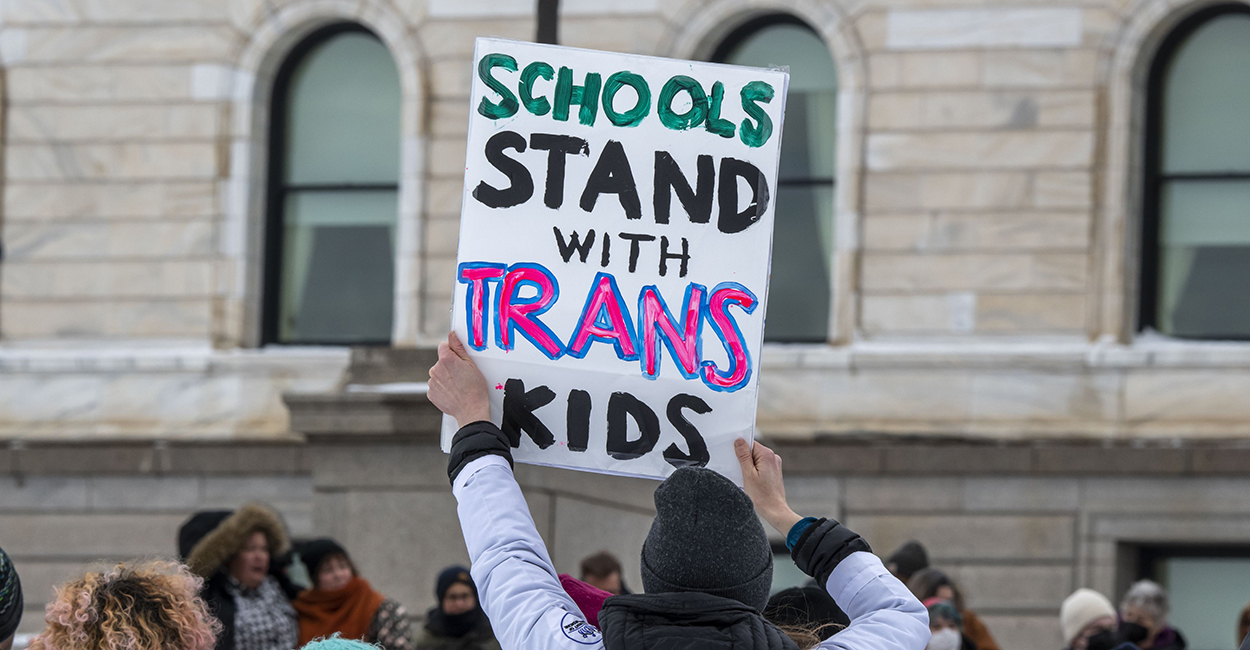
Schoolkids gender transition
Schools are promoting transgender ideology in the classroom and “socially transitioning” confused children with official “gender support plans” while keeping parents in the dark. Pictured: People rally at the state capitol in St. Paul, Minnesota, to support transgendering for children, March 6, 2022. (Photo: Michael Siluk, UCG/Universal Images Group/Getty Images)

Labels: , , ,

Friday, May 10, 2019

Instilling Civility

"I've had lots of conversations with people across the country, and one thing that people are thinking is that the kids aren't having as much time to be outside, and having free play, because they are spending much more time on screens."
"When you are playing outside with others, you have to develop patience, you have to learn how to take turns, and learn how to pretend, and all of those are things that help you develop the ability to stop, plan and think."
"I've seen kids have absolute meltdowns at 18 months to two years of age. You are out to dinner and the parents have brought along an iPad for the kid to play with so they don't have any second of boredom. They take the iPad away when the food comes, and [the child] has a massive melt-down."
"It's something we need to as a society really examine: are screens replacing face-to-face time?"
"If [teachers] are only focused on what reading level do they have, how many words do they have, then they miss this whole other part that interferes with everything about learning, and not just their own learning but the learning of all the kids in the class."
"I remember talking to a little boy, and the classroom had been cleared, and he said, 'I was so frightened being in that classroom all by myself. I didn't know what as going to be happening next. There was nobody there to help me'. That's how he experienced it."
"For a four-year-old, that's pretty frightening. ... What a four-year-old needs is an adult to come in and help co-regulate them, go in and stay with them. 'Buddy, come here, can I give you a hug?; Physical contact, help soothe them."
"One of the things that we know is that for younger kids -- I'm talking about kids under six -- physical touch, asking for permission to give a hug, soothing a child by allowing them to snuggle in, is very, very important developmentally. The boards that have no-touch policies really have to examine that for the early years."
Jean Clinton, child psychiatrist, clinical professor, McMaster University
girl's face with hair tied in a pigtail giving a wondering look
"I was terrified my first year because we were told, 'You do not touch the children'."
"But they're little. Some of them are only three. They'll say, 'Can I have a hug?' Or I'm sitting on the floor and they'll put a head on my shoulder."
"They are little, that is what they need, that is what they want."
Early childhood educator, kindergarten class
Detention written in chalk on a green chalkboard
Dr. Clinton feels that schools with "hands-off" policies, instructing their employees that they are not, under any circumstances to physically touch the youngest children in their administrative care should re-think this policy. Physical contact with permission to give hugs, and to empathize with a confused or frightened child through a gentle, caring touch, she feels could solve some of the alienating aspects of a very young child who might be feeling isolated or abandoned in the first few years of school and who responds by 'acting out'.

Nor is she a fan of the "evacuation" method used in some schools that when a child in the classroom acts out and is out of control, unwilling or unable or defiant to a teacher's instructions, they are left in the classroom on their own as a lesson through isolation, of the consequences of throwing books and furniture around, much less attacking other pupils or the teacher. All other children in the classroom are quietly escorted out of the room, and the obstreperous child is left on his/her own, presumably to think out why it is that he/she is left alone.

School boards are concerned that the old traditional method of teachers yanking unruly children about to impress upon them that their behaviour is unacceptable, is no longer representative of today's methods of dealing with problem children. Children whose parents, upon hearing that their child may have been man-handled will contact the news media to broadcast the 'assault', and even call police or launch a lawsuit against the teacher, the school, the school board.

It simply is not done. That old order to older children to 'go to the principal's office' where hand smacks are administered represents the dark ages of a bygone era.

In this era of public schooling, exposing children to the education system, it is strictly hands-off for teachers. And whether and how much that has contributed to young people from an early age on into their more mature years, knowing that whatever they do the punishment can only be as bad as a suspension, and even expulsion from school, see few restraints now on their compulsion to be violent, either toward other students or the teachers themselves. They know it is unlawful for them to be 'touched' by any adult.

Reports of "violent incidents" that school administrations and their boards must deal with now has doubled in the past two years. Incidents of violence that encompass children from all grades. Early childhood educators working in kindergarten, elementary teachers and educational assistants report having been bitten, punched, kicked, scratched, spat upon and sworn at by children, ranging from kindergarten age up to Grade 3.

Social skills, respect for others, ability to interact civilly, appear to have been lost in lock-step with the availability of and fascination with technological toys. Digital devices consume increasingly more of children's time, leaving them little interest in anything else. Even potty seats and bouncy chairs come with built-in pockets handy for storing an iPad. Instant gratification that digital devices can deliver is, notes, Dr. Clinton, "very, very enticing".

Parents seem to be failing their own grade in instilling in children civil values and behaviours. Either they lack those values themselves, or they are too inept and disinterested in ensuring their children are imbued with them. They neglect their parental obligations to their children and their society, send their children off to school, and expect those in the teaching profession to correct and ameliorate what they have themselves neglected. By which time it can be too late.

And in the attempt to imbue the children with needed discipline, too time-consuming for a teacher whose responsibility to an entire class cannot be consumed by one acting-out child. Mothers have traditionally been the parent expected for the most part, to teach manners to their children. With both parents now mostly in the paid workforce, little actual time is left for children to be taught directly; they emulate their parents, disengaged, focused on technology.

Behavioral Problems: When Your Child Acts Differently At School

Teachers feel pressure from parents to prepare their kindergarten-age children for the next grade up when they will be learning the fundamentals of academic knowledge, leaving their play-time in kindergarten behind. Kindergarten is the time when children learn relationship skills, develop "social and emotional intelligence", reasonably enough. Or they don't. And that inability to interact civilly with others will follow them throughout their school years and into the future, if not developed adequately.

The situation has become so dire that some teachers leave the profession, unable to continue coping, while others take more time off because of depression and burn-out. Suffering physical assaults by children while trying to maintain professional composure and focusing on teaching children their academic lessons can be exhausting physically and mentally draining.

Children Fighting
Johner Images - Kronholm, Susanne / Brand X Pictures / Getty Images

Labels: , , , ,

Wednesday, January 16, 2019

Chilling Out With the Latest "Cool"

"The bottom line is the JUUL is the best example of a technology that delivers nicotine more efficiently."
"This is a genuine phenomenon. Everyone would like this to be a fad. The concern is that this fad involves a highly addictive drug in the form of nicotine."
"I've been in a corner store at the Slurpee machine with my kids and there's a 10-foot banner overhead [advertising vaping products]. It took 20 or 30 years to get rid of cigarette displays. They reach everyone who goes into the store."
"Flavour is [a] big driver for kids. It's what gets into their mouths. And then nicotine takes over."
David Hammond, professor, School of Public Health and Health Systems, University of Waterloo
The JUUL vaping device is rechargeable, easy to conceal and has a sleek design, all features that appeal to youth.
The JUUL vaping device is rechargeable, easy to conceal and has a sleek design, all features that appeal to youth. Julie Oliver / Postmedia
"[JUUL was founded] with the goal of providing a satisfying alternative for adult smokers", the company states, but of course it's hardly debatable that 'adult smokers' would be drawn to such flavours as 'unicorn horn' and 'cereal milk', putting the lie to the company's feeble declaration of honourable intent. While tobacco smoking among adults is no longer as prevalent as it once was, nicotine-product manufacturers have been diligently exploring methods that would be attractive to a new generation.

Formerly known as Philip Morris Companies Inc., now Altria Group Inc., seeing a new wave of users enthusiastic for nicotine delivered in a modern, neat and streamlined package, have responded somewhat predictably by buying in to this new phenomenon through a 35-percent stake in JUUL Labs late last year, paying out close to $13-billion for the privilege. JUUL is a battery-powered, rechargeable device designed to heat a "Pod" or cartridge of "juice" containing flavouring and nicotine; the resulting vapour is what users inhale.
"I don't know if youth know how much nicotine is in them. They're consuming an entire cartridge in one shot."
"It's an emerging issue. We want to tackle it as soon as possible. We don't want to be dealing with it fifty years down the line."
"For some [users], getting fined will be a deterrent. Others can be convinced of the danger of nicotine because their parents smoke, and they've seen what it did to their parents. And some can be convinced that they're the targets of marketing, and they don't like it."
"Each school has its own culture. In some schools, there is little vaping. In some, it's in the bathrooms. In others, it's under the trees."
"For youth, tech is interesting. They can build their own. There are thousands of different kinds of juices and flavours. You can conceal it if you want [clouds of vapour], or don't conceal it if you don't want to."
Dana Periard, project officer, Ottawa Public Health, tobacco control and prevention
Ads for vaping devices in the window of an Ottawa convenience store.
Ads for vaping devices in an Ottawa convenience store. Julie Oliver / Postmedia

In the city of Ottawa, Canada's capital city, bylaw officers take "enforcement action" when students are found to be illegally using vaping devices on school grounds. A bylaw office can issue a fine of $490 to anyone selling or supplying a vapour product to someone under the age of 19. The Ottawa Catholic School Board has given the authority to its schools to remove doors from school washrooms to more readily enable staff to determine what is happening there; vapour is a dead giveaway. Schools have also been authorized to issue fines of $305 to students caught vaping indoors.

The Smoke-Free Ontario Act, amended in October to include vaping, enables school principals to call in bylaw officers to attend to vaping students. "I am extremely confident that the removal of washroom doors and the issuing of fines will discourage those tempted to vape or smoke indoors", commented the principle of one school in the Catholic School Board. In contrast to that move, the public school board has no plans to remove washroom exterior doors but does provide evidence statements to bylaw officers enforcing no-vaping regulations.

The new fad of school bathroom vaping seems to have occurred as a virtual overnight sensation as the JUUL brand name made its way into the high school lexicon as a tempting foray into disobeying adult authority to the extent that teens now refer to school washrooms as the "JUULroom". The device is attractive to youth challenging authority; its sleek look, ease of use, readily concealed size make it irresistible to slip in "pods" delivering flavoured nicotine salts.

A single pod contains nicotine equivalent to 20 cigarettes. Teens vaping an entire pod at a time become nauseous from overconsumption of nicotine, leading the new lexicon to expand with the inclusion of "nicking out". Professor Hammond has been receiving emails from school principals across the country seeking advice. Close to 21 percent of high school seniors claim to have vaped in the past month in 2018 where in 2017, that number was 11.7 percent.

The U.S. Surgeon General Jerome Adams in December issued an unusual public health advisory addressing the "epidemic" of e-cigarette use among teens, fuelled by new types of e-cigarettes recently entering the market. He noted that JUUL experienced a 600-percent leap in sales in 2016 and 2017. Health Canada for its part announced a week ago a campaign to warn youth of the risks of vaping.

Recently a province-wide survey of teens and substance abuse revealed that ten percent of Ottawa  high school students in 2017 had vaped. In comparison, six percent of students had smoked. It is Ottawa Public Health's intention to work toward a goal that would see the "de-normalization" of vaping and to that end work with bylaw enforcement along with police and addiction counsellors is proceeding.

Vaping has the potential to assist adults who wish to stop smoking, by weaning them off tobacco, even while it presents as a risk to youth. E-cigarettes and vaping are acknowledged as less harmful than smoking so the potential is there to reduce risk for smokers as long as they commit to transition from cigarettes to e-cigarettes, according to the U.S. Surgeon General. The reality is, however, that a majority of adults who make  use of e-cigarettes do so only to supplement their regular cigarette smoking.

Photographs of JUUL vaping kit Julie Oliver / Postmedia


Labels: , , , ,

 
()() Follow @rheytah Tweet