Ruminations

Blog dedicated primarily to randomly selected news items; comments reflecting personal perceptions

Friday, May 19, 2023

Why . The . Mystery?

"After arduous searching by our military, we have found alive the four children who went missing after a plane crash in Guaviare. A joy for the country."
"I have decided to delete the tweet because the information provided by [the government’s child welfare agency, ICBF] could not be confirmed. I apologize for the confusion."
"The Military Forces and the indigenous communities will continue in their tireless search to give the country the news it is waiting for."
"At this time there is no other priority other than moving forward with the search until you find them. Children’s lives are the most important thing."
Colombian President Gustavo Petro
 
"Information was received from the area assuring contact was made with the four children who were part of the group transported on the aircraft. This report stated that they had been found alive and in good health."
"However, the military forces have not yet been able to establish official contact due to adverse weather conditions and difficult terrain. "
"[Authorities have not been able to] corroborate the information received by the ICBF from various sources."
Colombian child welfare agency statement
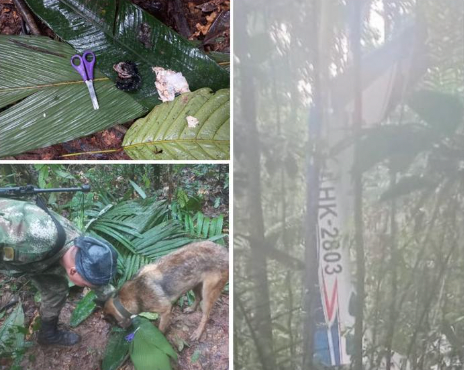
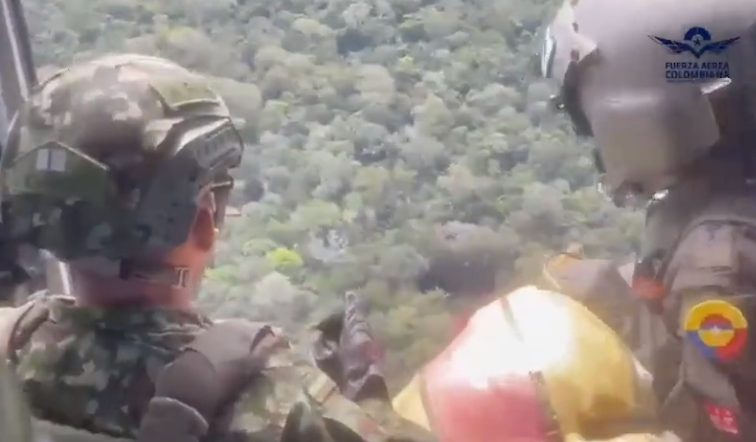
<p>The Colombian Air Force has escalated searche efforrs  </p>

The Colombian Air Force has escalated search efforts  (Fuerza Aerea Colombiana)

On Wednesday, the President of Colombia celebrated news that the four children whose mother had perished in a plane crash in a remote jungle area in Colombia's Amazon Basin, had been found, after a ten-day search. Information he said was relayed to him was that an Indigenous Colombian tribe living in isolation in the region had found and were caring for the four children, and that once contact had been made it was arranged to transport the children by sea in a speedboat to Bogota to be reunited with their father.

A day later, the Colombian President had deleted his Wednesday tweet of joyful affirmation the children were safe and en route. Now, the director of the country's child welfare arm informed the media that the children are safe, but communication via satellite had been lost. Teams had been sent to three key areas by the ICBF where they believe the children are to be found, and, said ICBF director Astrid Caceres, she is "very confident" they would be found soon.
 
From a journalist came word that area indigenous communities conveyed the information that the children are in a speedboat with no means of communication, but expected to arrive in a rural area where they could be taken into safe custody. This all began weeks ago, when the plane the children were being flown in from a jungle location to San Jose del Guaviare, a major city in Columbia's Amazon rainforest, experienced engine problems and crashed.

Aboard were the four children, with their mother, the pilot and co-pilot. All the adults died in the crash, but the children were presumed to have survived. In the search that ensued items belonging to the children were discovered and it seemed obvious the children had left the scene of the crash, intending to find help. A search party discovered the plane and the bodies of the three adults at the crash site. A 17-day search commenced involving over 100 soldiers, sniffer dogs and three helicopters.

Although the president made haste to assure his nation that the children were safe and would soon be turned over to the state child welfare authorities, then presumably reunited with their father, the army failed to confirm that the children were safe, which lead to confusion with respect to the president's 'good news' announcement.

According to the owner of the crashed aircraft, Avianline Charters, one of its pilots involved in searching the area was informed the children had been found, and were "being transported by boat down river and they were all alive". At the same time the caution was given that there was a risk to the children safely reaching haven given thunderstorms taking place in the area, that would affect the seaworthiness of the craft they were in.

The group of children, from 11-month-old Cristin Neriman Ranoque Mucutoy, on up to four-year-old Tien Noiel Ronoque Mucutuy, nine-year-old Soleiny Mucutuy, and big brother of thirteen Lesly Mucutuy, the oldest must have had his young wits about him to guide his younger siblings away from the crash site in search of help. But their very wandering about in the jungle created its own problems, making it extremely difficult for rescue groups to discover their whereabouts.

At one point, a rescue helicopter played a message on loudspeakers from the children's grandmother, who asked them to stop moving about, to enable the rescuers to find them. These are themselves children of aboriginal backgrounds, taught some basic elements of self-preservation in wilderness areas, amidst speculation with respect to how they were able to survive. Authorities believe the children clambered out of the wreckage to begin to move through the jungle to find help.

Once search efforts revealed a "shelter built in an improvised way with sticks and branches", assumed to have been the work of the children, the army's search efforts intensified, believing there were survivors to be found. A baby's drinking bottle and partially consumed fruit was found, along with scissors, shoes and hair ties lying among branches on the jungle floor.

The downed aircraft's pilot had reported back to base that he was experiencing problems with the engines, and a few moments later the plane disappeared from radar, according to the Colombian disaster response body. Heavy rainfall, along with giant trees growing up to 130 feet in height conspired to make the search, dubbed Operation Hope, even more of a challenge. There are few roads in such remote regions of Colombia, and access via the river is difficult, leaving air transport as the reliable choice.

The Indigenous Huitoto community develops skills in hunting, fishing and gathering, and the children are descended from that community, known for living in harmony with the remote jungle, and dependent on their singular exposure to self-reliance in such settings, which authorities speculate, may very well be the case with the four children. 
 
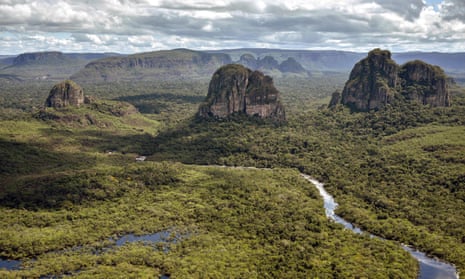
The Serrania de Chiribiquete national park in the Amazonian jungle departments of Caqueta and Guaviare, Colombia.
The Serrania de Chiribiquete national park in the Amazonian jungle departments of Caqueta and Guaviare, Colombia. Four children survived over two weeks in dense rainforest after their plane crashed. Photograph: Guillermo Legaria/AFP/Getty Images


Labels: , , , , ,

Friday, September 28, 2018

The Aching Vacuum

"[It's not a specific dream, but] mostly the comfort of his presence, seeing  him, hearing his voice -- just a feeling that he is with me. [Dreaming, there is a brief reprieve from] the constant aching void that I feel for him every waking minute."
"...I didn't want to be that helicopter parent, the overprotective mother."
"It's such a backward and such a corrupt country [Peru]."
"At the cemetery [for her father's funeral, late August], I scooped up a shovel full of earth and dropped it on the coffin -- and said, 'Oh, my God, this is my goal'. It hit  me like a ton of bricks: I'm  trying to bring my son home in a coffin. But it's not even that; it's that I have to know what happened."
"Because I brought them [son and daughter] up alone and because he was the older one, he was my friend. Jesse was not just my son, but he was my best friend. We took ski  trips out west alone together annually, loved spending time together, and we talked about everything."
"We were closer than the usual mother-son relationship -- even through his teens. He was an enormous emotional support to me, and a huge part of my life."
"Every single time I go back [to Peru] with hope anew -- and I am disappointed. But I have to keep going. I can't finish it until I have an ending."
Alisa Clamen, 53, Montreal
Alisa Clamen at home in Côte-St-Luc. "Jesse was not just my son, but he was my best friend." John Mahoney / Montreal Gazette

"We built a psychology profile of Jesse to figure out what he considered and what he did not consider and to figure out how he made his decisions."
"Either he was carried out of the area [Santa Cruz Trail, Peru], or hidden very carefully."
"[Alisa Clamen is] one of the strongest people [I've ever encountered in such missing persons cases.] She is very strong, very rational and she is making every effort."
"Though it takes time, we believe we will reach a solution."
Magnus International Search & Rescue CEO Guy Atzmon

"To find him now is a matter of intelligence to point you in the right direction to look. It means very deep work, getting into small villages, local people."
"...My heart is with the mother. That's what is driving me, to try to raise the mystery out of those mountains."
"We would like to provide some peace for her soul."
Hilik Magnus, founder, Magnus International Search & Rescue
Jesse Galganov
Jesse Galganov, 22, (right) is seen with his mother Alisa Clamen in this undated photo. (CP24)

He was 22 years old, a young man of adventurous spirit, about to begin medical school in Philadelphia, come July. Before then, he planned to satisfy his sense of adventure on a solo trip to South America and Asia, an eight-month travel venture. His mother drove him to the airport so he could board a flight for Peru. That was a year ago. On the 28th of September Jesse texted his mother, informing her he'd be out of touch for four days while he hiked the Santa Cruz trail along the world's highest tropical mountain range.

October 2 arrived and Jesse's mother felt certainthat her son must have set out on a longer trail. By the following week she contacted the Canadian embassy to be informed that a police report was required to alert Interpol. On October 17, the single mother of two young adults, a practising lawyer, set out herself for Peru. From her experience while there, she gained the indelible impression that authorities were not all that interested in tracking her son's whereabouts. Not did she get much help elsewhere.

She found a lack of security and organization. Registration trail logs were missing or incomplete; technology companies and service providers refused to release details of last use of Jesse's electronic devices. She quickly organized searches both by local teams and through an elite Israeli-based search-and-rescue group with equipment and advanced technology inclusive of underwater robots and drones, in the search and investigation. So far all that activity has come in at a cool $2 million. Helped by community support, fundraising, and mortgaging her home, she carried on.

She no longer hopes to find her son alive, but she desperately wants to know what happened to him, and if at all possible, to discover where his body is, and to bring it home to Canada. She has been long divorced; her daughter was one year old at the time, Jesse two. She is no longer capable of practising her profession as she once did; concentration eludes her. She now lives a fairly secluded life, unwilling to socialize, seeing none but close friends and family. "I don't have the desire or energy for anything else", she points out, understandably.

She is no longer "in step" with the world at large. She goes out of her way to avoid running into people she knows: "They don't know what to say. I hate putting them in that position." She continues to pay her son's cellphone invoices: "I can't bring myself to stop", and until recently maintained his car lease. People admire her strength and perseverance. "What's the alternative? I can fall apart and just stay in bed -- or I can try to function. If I don't continue the search for Jesse, who else will?"

The Magnus crew analyzed Jesse's trek, the environment in which he found himself, how he managed to forge ahead with his plans. They contacted close to 200 other travellers from around the world they managed to identify through Facebook photos, "to build the full picture of who Jesse met, whom he spoke to". Two hikers who had shared the same campsite with Jesse on September 30 for example. They discovered that on October 1, Jesse had enquired of a group of Czech tourists where he might find water. After that there was no sign of him.

There are those who feel Jesse may have been assailed with altitude sickness causing him to wander off trail where he succumbed to the elements. Possibly, someone might have come across his body, robbed him and moved him to a remote location by donkey or horse, or even thrown his body into a body of water nearby. Not content to allow others to do the searching Alisa Clamen spent four months in the past year in Peru, 21 nights of which were spent on the Santa Cruz trail, willing herself to view what her son encountered, to walk in his footsteps.

The trail, she found, is difficult to navigate, dangerous, poorly marked with ample hazards aside from altitude sickness. There are mud fields, jagged rock fragments (scree) and slippery rock sheets to negotiate. In July she went along with a local guide-company owner she trusts and his team on a glacier search on the trail, encountering a 50-cm snowfall that impeded progress on their search. A canine team trained to sniff out human remains failed to work due to the difficulty of the terrain.

Alisa Clamen yearns, and needs her son Jesse, alive or dead, to return home to her, so her soul can be at rest just as his will be put to rest.

Jesse Galganov Fund

Missing Children's Network Canada

Labels: , , , , ,

 
()() Follow @rheytah Tweet