Ruminations

Blog dedicated primarily to randomly selected news items; comments reflecting personal perceptions

Wednesday, December 18, 2019

Friendly Visits -- With Family Pets

"Our hostess went in to the kitchen to get the vanilla cake, but it was gone. There was frosting on Bodhi's mouth."
"The lesson is that as well as  you think you know y our dog, they can always surprise you."
"Our dog [Bodhi] sleeps with us, but a lot of people don't like a dog in a bed. So we bring our dog bed [for overnight visits], but I confess, our dog doesn't always stay in it."
Sean Sheer, Urban Dog blog

"Do not presume that when you and your family are invited for the holiday or the weekend that this extends to your dog."
"Don't just show up after a six-hour car ride and have your dog pop out of the back seat to a look of horror on the host's face."
"I try to avoid situations that are going to be fraught with peril."
Jodi R.R. Smith, president, Mannersmith, etiquette consulting

"A pet as a weekend guest adds a lot of responsibility for a host, even if they are dog people."
"Sometimes that means getting a pet sitter [if it appears likely the invitation doesn't include the family pet]."
"It's nice to also bring a roller brush so you can keep hair off of the furniture."
Lisa Grotts, etiquette expert, San Francisco

"I would not bring my trio overnight unless someone was literally begging me to do it."
"My dogs are used to a lot of attention. It's better to leave them at home with housesitters and to keep their routine as normal as possible."
"Don't set your dogs up for failure [as a result of constant concerns on your part to have them avoid doing unpleasant things while in someone else's house]."
Becky Pugh, owner, grooming and boarding business

Tricky business, that. You receive an invitation that you were hoping would be forthcoming. But there is no mention of an important part of your family. You speculate that the person doing the inviting knows how important your dog is to your life, and just assume the invitation is all-inclusive. And you may be wrong. It's awkward, when you respond that you'd love to come and thank you for inviting us; do you expand hesitantly to enquire whether that means all of 'us'? This is when assuming too much can be fraught with complications.

It's embarrassing, yes, but that unspoken barrier must be broken and the subject broached. 'Is it all right if Brandy comes too?' 'Did you mean to invite Cocoa along with the rest of us?' 'Would it complicate matters if we were to bring Jangles along for that wonderful weekend with you that we're so excited about?' However it's put, it can be awkward, but there are times when these things cannot be avoided, and that time is not when you've arrived and innocently assume what you haven't bothered to be certain of.

Your furry friend may be allowed on the furniture at your house, but it's important to know the rules at other homes. Check out these dog pictures.
It's important to know the rules at other homes. Photo: tshortell

Could be your dog would never stand up to a kitchen counter to see what's on offer. But can you extract a promise from him that he won't indulge in someone else's kitchen? Blogger Sean Sheer discovered to  his huge embarrassment that  his beloved eight-year-old Weimaraner did just that. He had the kitchen to himself while everyone else was having dinner in the dining room. And there was this irresistible aroma wafting down to him from the kitchen counter...

The people who have invited you to visit their home may have dogs of their own, or cats, or both, but don't assume they'll be delighted to have to cope with situations where their own family pets are disquieted at the presence of other animals and your hosts then have to walk on tiptoes of suspense over how their home, suddenly turned into a bit of a zoo with animals snarling at one another, perhaps threatening physical action, and/or indicating displeasure by leaving unanticipated 'gifts' of protest, end up regretting the invitation....

Make sure the whole family -- including all the pets -- are OK with your visit.
Make sure the and host pets -- are OK with your visit.
Photo: Elenathewise

So balance your pleasurable anticipation of an enjoyable overnight or weekend stay with people you like with the obligation as a guest to ascertain clearly what is expected of you; minus the family pet, or alternately inclusive, but with the expectation that certain rules must be recognized and followed. There will be strain of some kind, but better that than an aura of irritated annoyance plus strain. Take no offence if the invitation is limited; respond intelligently and with courtesy. It is your host who faces a raft of planning complications.

Should you be informed graciously that your hosts fully expect the arrival of  your pet along with the rest of your family, make yourself knowledgeable about their house rules. Whether dogs are permitted on furniture, or not allowed into certain rooms of the house. Above all, whether they are forbidden to expect food from the table when everyone is dining. Consider bringing along with you everything your dog would normally require, from its bed, to food, feeding bowls, toys and waste bags.

Determine whether your hosts would take offence at your pet sharing  your bed. It is their bed, their home, after all. And what if there's an accident? Clean it up and say nothing? Or alert your host and offer to take care of the resulting mess? Could be they use a certain cleaning formula, so make certain that you follow their orders for the cleaning up of messes in their home. And think twice, and then again, if you've been invited to a house with more than its share of fragile ornaments, antiques or family heirlooms which bespeak a special commitment to good behaviour.

Things will go more smoothly if your pet is friendly to everyone.
Photo: tzooka

Be prepared to apologize profusely should your pet have done something to embarrass you and discommode your hosts. And because your host went to the extremes of accommodation in extending their invitation to include  your pet, go beyond a thank-you note, to include with it after your stay a memorable gift of appreciation. That having been said, enjoy yourself and be a good guest, fully appreciative of everything your hosts have done to make your stay with them pleasant.

Labels: , , , , ,

Thursday, October 03, 2019

The Human Condition : Celebrity Familial Dysfunction

"You can't tell me what's happening? My Dad isn't here with you [funeral home]?"
Jose Joel, Mexican entertainer

"No one knows anything about what's happened. His children are absolutely devastated, to the point where they wonder if it's even true that he died."
"She [youngest daughter Sarita Sosa] wouldn't answer any of our calls, but then she's on TV all pretty, with makeup, and hair, saying a bunch of lies ... It's so easy to pick up the phone and say, 'Come see my dad. Come see your dad."
Brenda Ocana, Manager, Jose Jose

"My history has been one of ups and downs."
"But thanks to God, I keep working, drawing from my life experiences songs that I can sing."
"I want to you to know that aside from the small tumor, I am well. I am ready to take on this new adventure in my life."
Jose Jose

"He left in peace. Thank God, he left very calm."
"Actually, I don't like doing interviews. I don't like fame, that's why I've always been so private, but I know my dad would have wanted me to do this for him."
"Despite all our differences, we must be united in these moments. My responsibility as a daughter and as a sister is to tell them what happened with their dad, and that we have to stick together."
Sarita Sosa, daughter, Jose Jose

"We have every right to see my dad. My half-sister has a lot to explain to me and to all of Mexico."
"Please, wherever you are [Sarita], get in touch with us. I've been talking to you all day [leaving unanswered messages] and I'm here, and I've been telling you since yesterday: I see my dad's body, or I don't believe anything."
Marysol Sosa
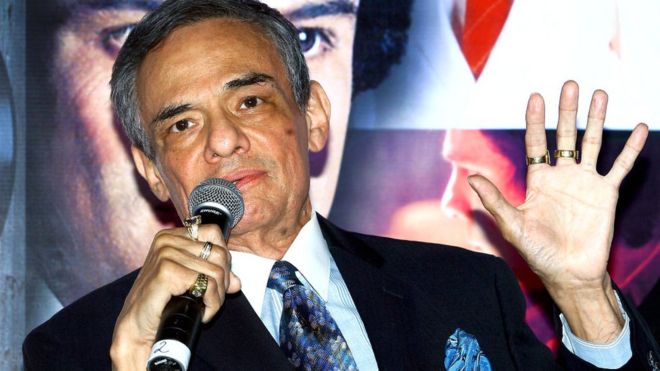
The Mexican singer José José accepts his award during the 6th Annual Latin Grammy Awards show in Los Angeles in 2005. Photograph: Héctor Mata/AFP/Getty Images

Spanish language singer, actor and songwriter Jose Jose known to his global music fans as "el Principe de la Cancion ("Prince of Song") has died of pancreatic cancer at age 71. His three children, two older, a son and daughter, and a third through a third marriage, have captured headlines of their own, Jose Joel, the singer's son, and Marysol, the older daughter, accusing their step-sister of a sinister plot to keep them from seeing their father's body.

On arrival at the Caballero Rivero Westchester funeral home in Miami on a flight from Mexico City, Jose Joel was informed by a funeral director his father was not there, despite that he was meant to be: "In this moment, he's not. I have no information", the son was told.

The younger daughter was front and centre on television, recounting her famous father's final days, while her two older half-siblings were searching Miami in an effort to discover where their father was lying, preparatory to a funeral and burial. The older siblings, trailed by swarms of reporters no doubt intrigued by the potential of capturing photographs and narratives of family dysfunction in the claims that the younger daughter 'kidnapped' the father, and obstinately refuses to allow her half-siblings access to his body have accused their sister of keeping details of their father's death from them.

She was, however, generously recounting for the studio audience how she had taken her father home to Miami from Mexico, to stay with her while his descending health sapped his life. The children, all themselves in the entertainment industry and as such fodder for gossip, admiration and celebrity status, can not be less than mindful of that old adage in show business that "any publicity is good publicity", focusing the eye of the public on their curious shenanigans.

A singing icon in Latin America, his children obviously seek to replace their father in the Latin American public's vast and admiring public acclaim for one of their own.

José José in Mexico City in 2015
Known as the Prince of Song, José José sold over 100 million albums  Getty

Jose Jose, who took on the double name from his father, an opera singer after whom he was named as Jose Romulo Sosa Ortiz, recorded 30 albums and 20 Hot Latin Songs all of them hits, focusing for the most part on love and loneliness; obvious hot-button issues in Latin American song-lore. Jose Jose was one of those rare Mexican artists who surpassed one million album sales each year for twenty years. On the dark side, his alcoholism and cortisone shot-habit prior to performances added up to poor health.

With the poor health went unsteady finances, until the hammer came down with the diagnosis of pancreatic cancer in 2017. Marysol and Joel accuse their half-sister Sarita of isolating their father from the rest of his family, in a calculated effort to profit from his legacy, once she flew him to Miami to live with her. As a result, it has been two years since the two older siblings had seen their father. Just after he died, Sarita contacted her siblings, and that was the last contact they had with her about their father.

When they arrived in Miami with their entourage, they stopped by the police, the Mexican Consulate and the Homestead hospital where their father was reported to have died. None of these authorities were able to give the two any information relating to the death. Moreover, the Homestead hospital found that there was no record of the singer having been there at all. No one was able to confirm the death.

Sarita meanwhile, in her exclusive interview with Primer Impacto on Univision, claimed her father died from the effects of a poor physical state, and not pancreatic cancer as reported. A celebrity-family-style circus to have all their fans salivating in delight.
The '2013 Latinos de Hoy Awards' At Los Angeles Times Chandler Auditorium
Singer José José seen Saturday, October 12, 2013. Getty


Labels: , , ,

Friday, September 28, 2018

The Aching Vacuum

"[It's not a specific dream, but] mostly the comfort of his presence, seeing  him, hearing his voice -- just a feeling that he is with me. [Dreaming, there is a brief reprieve from] the constant aching void that I feel for him every waking minute."
"...I didn't want to be that helicopter parent, the overprotective mother."
"It's such a backward and such a corrupt country [Peru]."
"At the cemetery [for her father's funeral, late August], I scooped up a shovel full of earth and dropped it on the coffin -- and said, 'Oh, my God, this is my goal'. It hit  me like a ton of bricks: I'm  trying to bring my son home in a coffin. But it's not even that; it's that I have to know what happened."
"Because I brought them [son and daughter] up alone and because he was the older one, he was my friend. Jesse was not just my son, but he was my best friend. We took ski  trips out west alone together annually, loved spending time together, and we talked about everything."
"We were closer than the usual mother-son relationship -- even through his teens. He was an enormous emotional support to me, and a huge part of my life."
"Every single time I go back [to Peru] with hope anew -- and I am disappointed. But I have to keep going. I can't finish it until I have an ending."
Alisa Clamen, 53, Montreal
Alisa Clamen at home in Côte-St-Luc. "Jesse was not just my son, but he was my best friend." John Mahoney / Montreal Gazette

"We built a psychology profile of Jesse to figure out what he considered and what he did not consider and to figure out how he made his decisions."
"Either he was carried out of the area [Santa Cruz Trail, Peru], or hidden very carefully."
"[Alisa Clamen is] one of the strongest people [I've ever encountered in such missing persons cases.] She is very strong, very rational and she is making every effort."
"Though it takes time, we believe we will reach a solution."
Magnus International Search & Rescue CEO Guy Atzmon

"To find him now is a matter of intelligence to point you in the right direction to look. It means very deep work, getting into small villages, local people."
"...My heart is with the mother. That's what is driving me, to try to raise the mystery out of those mountains."
"We would like to provide some peace for her soul."
Hilik Magnus, founder, Magnus International Search & Rescue
Jesse Galganov
Jesse Galganov, 22, (right) is seen with his mother Alisa Clamen in this undated photo. (CP24)

He was 22 years old, a young man of adventurous spirit, about to begin medical school in Philadelphia, come July. Before then, he planned to satisfy his sense of adventure on a solo trip to South America and Asia, an eight-month travel venture. His mother drove him to the airport so he could board a flight for Peru. That was a year ago. On the 28th of September Jesse texted his mother, informing her he'd be out of touch for four days while he hiked the Santa Cruz trail along the world's highest tropical mountain range.

October 2 arrived and Jesse's mother felt certainthat her son must have set out on a longer trail. By the following week she contacted the Canadian embassy to be informed that a police report was required to alert Interpol. On October 17, the single mother of two young adults, a practising lawyer, set out herself for Peru. From her experience while there, she gained the indelible impression that authorities were not all that interested in tracking her son's whereabouts. Not did she get much help elsewhere.

She found a lack of security and organization. Registration trail logs were missing or incomplete; technology companies and service providers refused to release details of last use of Jesse's electronic devices. She quickly organized searches both by local teams and through an elite Israeli-based search-and-rescue group with equipment and advanced technology inclusive of underwater robots and drones, in the search and investigation. So far all that activity has come in at a cool $2 million. Helped by community support, fundraising, and mortgaging her home, she carried on.

She no longer hopes to find her son alive, but she desperately wants to know what happened to him, and if at all possible, to discover where his body is, and to bring it home to Canada. She has been long divorced; her daughter was one year old at the time, Jesse two. She is no longer capable of practising her profession as she once did; concentration eludes her. She now lives a fairly secluded life, unwilling to socialize, seeing none but close friends and family. "I don't have the desire or energy for anything else", she points out, understandably.

She is no longer "in step" with the world at large. She goes out of her way to avoid running into people she knows: "They don't know what to say. I hate putting them in that position." She continues to pay her son's cellphone invoices: "I can't bring myself to stop", and until recently maintained his car lease. People admire her strength and perseverance. "What's the alternative? I can fall apart and just stay in bed -- or I can try to function. If I don't continue the search for Jesse, who else will?"

The Magnus crew analyzed Jesse's trek, the environment in which he found himself, how he managed to forge ahead with his plans. They contacted close to 200 other travellers from around the world they managed to identify through Facebook photos, "to build the full picture of who Jesse met, whom he spoke to". Two hikers who had shared the same campsite with Jesse on September 30 for example. They discovered that on October 1, Jesse had enquired of a group of Czech tourists where he might find water. After that there was no sign of him.

There are those who feel Jesse may have been assailed with altitude sickness causing him to wander off trail where he succumbed to the elements. Possibly, someone might have come across his body, robbed him and moved him to a remote location by donkey or horse, or even thrown his body into a body of water nearby. Not content to allow others to do the searching Alisa Clamen spent four months in the past year in Peru, 21 nights of which were spent on the Santa Cruz trail, willing herself to view what her son encountered, to walk in his footsteps.

The trail, she found, is difficult to navigate, dangerous, poorly marked with ample hazards aside from altitude sickness. There are mud fields, jagged rock fragments (scree) and slippery rock sheets to negotiate. In July she went along with a local guide-company owner she trusts and his team on a glacier search on the trail, encountering a 50-cm snowfall that impeded progress on their search. A canine team trained to sniff out human remains failed to work due to the difficulty of the terrain.

Alisa Clamen yearns, and needs her son Jesse, alive or dead, to return home to her, so her soul can be at rest just as his will be put to rest.

Jesse Galganov Fund

Missing Children's Network Canada

Labels: , , , , ,

Saturday, September 22, 2018

A Mother's Challenge

"No regrets. I wouldn't change a thing. And I won't wonder about anything."
"You do anything for your kid. We were looking for quality. And the Mexican treatments were less invasive and gave her quality."
"I love all my girls for different reasons. I don't love any of my other girls for the same reasons I love Kaisy."
"She was the courageous one. The one who made me come out of my box. I said: 'You're doing it again, Kaisy. Making me do something I never thought I would do'. Then I busted out laughing."
"The funeral director looked at me like I was nuts."
Melany Knott, 40, mother of four girls, Mount Airy, Maryland
Kaisy Knott sits at Starbucks in August 2017, before heading to Mexico for experimental cancer treatment. (Jason Andrew/The Washington Post)

Daughter Kaisy, 13, the youngest of Melany Knott's four girls, turned to her mother and told her: "Mom, I can't do this anymore" on September 9, twenty-one months after she had been diagnosed with diffuse intrinsic pontine gliomas (DIPG) a dread cancer known to be aggressive, inoperable, incurable: A 100 percent lethal brain cancer. Kaisy was given eight months, tops, to live. "It felt like I was being stabbed in the head", explained Kaisy at an earlier time.

A day later, Kaisy uttered the word "Mom", and then she died. Two days later her mother arrived at the funeral home, fearful, distressed, forlorn and desolated. Melanie Knott suffered from a deep aversion to the cold, irreversibly final aspect of a dead body. Now, her beloved youngest daughter was that dead body. And the mother had to muster the courage to overcome her fear for her daughter's sake; so she could braid her hair, as Kaisy loved it to be done by her mother, for the very last time as she lay in her coffin.

The plan was that Kaisy was going to have her hair braided that week as she prepared and looked forward to attending her first day of school. That was back a few days earlier when she felt fine, her usual rambunctious self before her diagnosis, before she died on September 10. Kaisy had a Facebook following of thousands; her page titled Kick Butt KK. After Kaisy's diagnosis of a fatal brain cancer the doctor told her mother: "go home and make memories".

That's just what they did, but not quite in the way the doctor and conventional medicine might have imagined they would. Setting about raising the required funds, the rural, farming family auctioned off goats and guns, chainsaws and other implements usually found on a farm. They ran fundraisers at the country fair, and they used up all their savings, including the carefully padded funds for their other daughters' education -- and they worked double shifts.

They had decided to take Kaisy to Mexico, to a medical clinic specializing in untested treatment for cancer. A mystery treatment for which there have been no published studies and for which the ingredients of the customized chemotherapy cocktails have been maintained in absolute secrecy. Miraculously, Kaisy became animated, swam in the ocean, went kayaking, rode roller coasters and showed her prize hog and steer at 4-H competitions.
Kaisy Knott and her mom, Melany, waiting at Reagan National Airport for their plane to Mexico, where Kaisy is undergoing experimental treatments for a lethal form of brain cancer. (Jason Andrew/The Washington Post)

The dramatic change in Kaisy's condition became public knowledge and she became a celebrity figure among others in similar medical conditions, leading other families to fly to the Mexico City clinic from Norway, London, Italy, Australia, to themselves take part in the experimental, controversial cocktail of drugs injected into children's arteries to buy time, precious time to continue living.

Kaisy and her family went off on holiday junkets to "make memories". The original eight months that Kaisy was given left to live by the diagnosing medical community in the U.S. came and went, and Kaisy felt great, went swimming, paddle-boarding, everything she wanted to do. When President Trump signed the Right to Try Bill, allowing people with life-threatening illnesses to have access to experimental treatments and bypass the U.S. Food and Drug Administration for approval, Melany cheered.

Kaisy, whose life was being enriched when her body responded so positively to the unknown cocktail of drugs from the Mexican clinic, loved having her mother -- who lived her entire life in rural Maryland on farms, companion to hogs, horses, steers and chickens -- accompany her everywhere. Her fearful mother was persuaded to get on a roller coaster with her eager daughter, to go to the beach, to take time off work, to take air flights, leave the U.S. to rent an apartment in Mexico.

Each of those treatment cycles at the Mexican clinic came with a price tag of $33,000. A total of $695,000 was spent altogether in the 21 months when Kaisy's life was prolonged, her symptoms of medical duress relieved so she could feel her normal ebullient self and savour those adventures with her mother. Melany Knott figured it out that they spend about $1,100 for each of those days that preserved her daughter's life just a little longer.

Worth it. Every penny.

Melany Knott and her daughter Kaisy on a roller coaster for the first time. (Family photo)

Labels: , , ,

Wednesday, May 23, 2018

Family, Home and Hearth

"After a discussion with your Mother, we have decided that you must leave this house immediately. You have 14 days to vacate. You will not be allowed to return. We will take whatever actions are necessary to enforce this decision."
"Michael Joseph Rotondo, You are hereby evicted from 408 Weatheridge Drive, Camillus, New York effective immediately. You have heretofore been our guest and there is no lease or agreement that gives you any right to stay here without our consent."
"A legal enforcement procedure will be instituted immediately if you do not leave by 15 March 2018."
Michael, here is $1,100 from us to you so you can find a place to stay."
"There are jobs available even for those with a poor work history like you. Get one -- you have to work! If you want help finding a place your Mother has offered to help."
Mark Rotondo
Christina and Mark Ronaldo
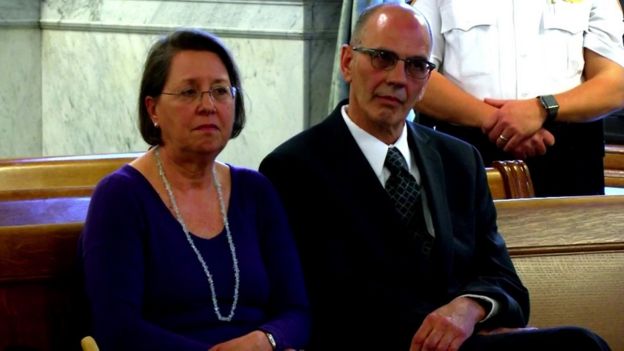
Christina and Mark Rotondo in court   Reuters

"I am just so outraged."
"[I had] never been expected to contribute to household expenses, or assist with chores and the maintenance of the premises."
"I don't see why they can't just, you know, wait a little bit for me to leave the house. [Six months is] a reasonable amount of time for someone who has been depending on persons for support."
Michael Rotondo
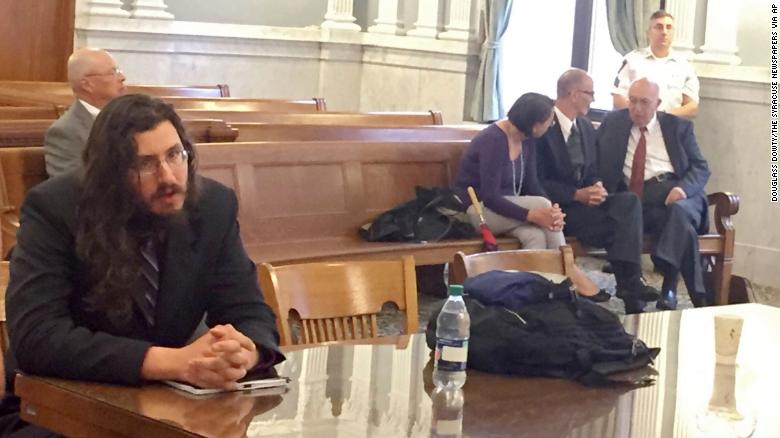
Michael Rotondo (left) at his eviction proceeding in Syracuse, New York. His parents, Mark and Christina, confer with their lawyer in the court gallery behind.
Michael Rotondo (left) at his eviction proceeding in Syracuse, New York. His parents, Mark and Christina, confer with their lawyer in the court gallery behind.  Douglas Dowty, The Syracuse Newspapers via AP 

Upstate New York State Supreme Court Justice Donald Greenwood informed Mark and Christina Rotondo that their lawyer would be instructed to draft an eviction order giving their son Michael reasonable time to vacate the home they no longer wished to share with him. They had, in fact, been resentful of their 30-year-old, unemployed son living with them for quite some time.

A situation not made any easier by the fact that he would not speak with them, nor do anything remotely useful around the house; much less that he paid no rent for his accommodation.

The couple's request for an eviction order was granted by the judge who also indicated that adult protective services would be engaged to check on matters in the home that appeared to him to be rather concerning. As for their son, Michael Rotondo informed the judge he was well aware his parents wished him to leave their home, arguing that as a member of the family he felt entitled to six months additional time to make alternative arrangements for himself.

When Michael Rotondo spoke to the media he pointed out that he did his own laundry and provided for his own food. His exasperated parents, feeling it was beyond time their adult son became an adult rather than a recluse who felt no urge to find employment and to be responsible for himself, preferring to live in a bedroom in their split-level ranch home, gave him an initial note requesting he leave in March, repeated it in February, and then again when their son made no move to honour their request.

They felt finally driven to taking legal means when he ignored all their requests, including that he remove his Volkswagen from outside their home, despite offering financial assistance to have it repaired to working order. The eviction order was their last desperate attempt to force their son to take steps toward overdue responsibility for himself. In view of a gaggle of curious reporters, the Rotondo son engaged the judge in a 30-minute verbal sparring, when the judge suggested he address his parents directly, and he refused.

"It really seems kind of outrageous that someone in this day and age could be in someone else's home for six months" before they agree to leave, when requested to do so, remarked the judge. "I want you out of that household." At the hearing's conclusion, the son invited television camera crews to meet him outside the court where he responded to questions and stated baldly that he is not prepared to leave home where he occupies a bedroom, will not speak to his parents and has a business.

Refusing to respond when asked what the business was other than to state tersely "My business is my business".

According to a recent study, an estimated 22.5 percent -- 12 million -- Americans between 24 and 36 years of age live at home with their parents, a notable increase from the 14 percent that did so in 2005.

They all, obviously, believe wholeheartedly in the old adage that "There's no place like home", unwilling to make one of their very own.

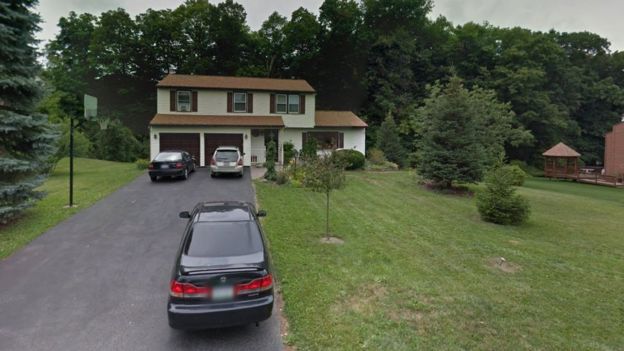
Photo of house
The home near Syracuse, New York that is at the centre of the family dispute   Google Maps

Labels: , , , ,

Monday, January 08, 2018

Familial Dysfunction

"To the extent you are actively trying to distance yourself and maintain that distance, that makes you estranged."
"Estrangement is a] continual process. In our culture, there's a ton of guilt around not forgiving your family. [So] achieving distance is hard. But maintaining distance is harder."
Kristina Scharp, assistant professor, Utah State University, Logan

"[Estrangement] occurs across years and decades. All the hurt and betrayals, all the things that accumulate, undermine a person's sense of trust."
Kylie Agllias, social worker, Australia

A survey commissioned in Britain by Stand Alone, a charity whose purpose is to give support to estranged people, concluded that of two thousand people interviewed, eight percent claimed they had severed communication with a family member. Adults reported being estranged from parents for three main reasons in a study published in the journal Australian Social Work: abuse, betrayal and poor parenting, with instances where there was overlap between those issues

According to social worker Kylie Agllias who wrote "Family Estrangement" in 2016, most of the participants described their estrangement having taken place after childhoods where they experienced poor connections with their parents. As for Dr. Scharp's study published in June, 52 adults were interviewed and found to have distanced themselves from their parents in a variety of ways over time; some creating a geographic distance, other making no effort to fulfill familial expectations.

An example was given of one 48-year-old woman who had cut off all contact with her father for a 33-year period. When he was ill and hospitalized she made no effort to see him, nor was she interested in attending his funeral. Others interviewed for the study made the decision to limit their contact with family members to superficial conversations, while yet others dramatically reduced contact altogether.

One public servant living in Ottawa, now 47, maintains some contact with most of his family, but a psychologically remote one. He dreaded family holiday meals and spoke in particular of his father's temper, upsetting him from the time he was a child forward. He resented having been entrusted with the care of his two younger siblings, a situation that led in adulthood to disinterest in having any children of his own.

When he decided to have a civil ceremony in marrying his long-term girlfriend he decided not to invite any members of his family, concerned his father might be disruptive. "I agonized over inviting them or not, for a long time", said Nikolaus Maack. "But in the end, decided, 'I can't have them there'." It was through Facebook that his family discovered the marriage had taken place.

This is an instance where a social Internet site has taken the place of intimate family, and it is likely one of countless such instances when personal intimacy and links to family are subordinated to social media sites. Nowhere in the research cited is there even a whiff of a hint that the people who chose to estrange themselves might themselves be afflicted with some minor disorder having little to do with their family other than resentment.

Some children at an early age may very well experience feelings similar to authority affective disorder which grows over time and extends beyond the family, becoming a social incapacity to get along with anyone. That, quite aside from legitimate disruptions in family life and the rejection of parents and/or other family members resulting from unpleasant or imagined early experiences leading to disaffection and emotional dislocation.

Labels: , , ,

Thursday, September 07, 2017

Patronizing Mature Women

"[,,,Many women who desire sterilization at a young age experience barriers from physicians who decline to facilitate the request."
"...A woman who is child-free and wishes to remain so is less likely to regret sterilization than a mother who wants no additional children."
Drs. Dustin Costescu and Dylan Ehman, McMaster University Medical Centre, Hamilton

"It's unclear if this [chafing against the universal belief that women are meant to be mothers] is more women choosing to be child-free, or increased comfort in advocating [for sterilization]."
"Often these women have other role models in their life who are also child-free. They may be aunts or people in senior positions in their workplace -- role models who demonstrate they can meet all of their other life goals without having children."
Dr. Dustin Costescu, Family planning specialist

"I personally have zero worries about the risk of regret. I actually don't remember a time when I've had a parental instinct [other than with animals]."
"[I have experienced] the typical comments about how I'll change my mind, and that I'm 'too young to know what I want'. I've had doctors, all men, simply laugh off the situation and my concerns and tell me I'm not ready to make that decision [even though I have medical issues with my uterus and cervix]."
Anonymous 26-year-old woman awaiting tubal ligation at McMaster University Medical Centre
National Post
Certainly the observations made by the two doctors who co-authored a paper published in the Journal of Obstetrics and Gynaecology of Canada know of what they speak when they refer to the 'paternalistic attitude' of male doctors confronted with requests by young women for sterilization, explaining to them that they will regret their decision at some time in the future, refusing to perform the procedure on the basis that 'doctor knows best'. But then Dr. Costescu falls into the same trap himself when he speaks of role models as leading young women into such decisions.

The fact being that by the age of majority women in their 20s and 30s should be regarded as sufficiently mature to have of their own agency reached their own conclusions about whether they foresee childbearing in their future as a choice for them personally. To his great credit, however, Dr. Costescu will not refuse such requests, basing his position on the fact that he believes women approaching him to take advantage of his professional capabilities as a doctor, have every right for their requests to be honoured.

He and his colleague, Dr. Ehman, wrote their article in response to what they see as their professional colleagues in refusing to conduct sterilization procedures on women who request them with full consideration respecting the fall-out are doing these women an injustice. Those women who have convinced themselves for whatever reason that motherhood is not and never will be a goal that appeals to them have the right to due consideration, as far as these two doctors are concerned.

And Dr. Costescu, as a family planning specialist and assistant professor, states without equivocation that any woman seeking to permanently prevent pregnancy and with no contraindications or medical reasons that might complicate sterilization should be -- as he does himself -- considered an appropriate candidate for the procedure of sterilization.

Professional guidelines, in fact, clearly state that well-informed, mentally competent women knowledgeable of birth control options and the resulting "permanency of the procedure", should be respected in their wish for sterilization, irrespective of age or birth history. The two doctors reviewed medical records of 29 women under age 30 on a wait-list for sterilization at Dr. Costescu's clinic to find that most had reported their experience in previously seeking the process elsewhere as demeaning.
Why is it so hard for some women to get their tubes tied?
Illustration, Mikey Burton. Chatelaine

Doctors consistently refused to perform the requested procedure, or would not refer the women to someone else in the profession who would provide sterilization for them. Among the women were some who related they were recommended the services of a psychiatrist to evaluate their requests, the implication being it is "pathological" to wish voluntarily to close out motherhood prospects for the future.

The surgery itself uses clips placed across the Fallopian tubes through laparocopic (minimally-invasive) laser surgery; alternately cutting away a part, or all of the tubes in their entirety, preventing the potential of a mature egg reaching the uterus to become fertilized. Fallopian tubes can be reopened, untied or reconnected with the traditional form of "tubal" ligation, though a reversal is no guarantee that pregnancy will ensue.

The study revealed that some of the women presented with medical conditions that could be risky for pregnancies while others had carried pregnancies to fruition and with children felt their families were complete and had no wish for additional offspring, while a third of the women studied had never gone through a pregnancy. Surgical risks in this generally safe and effective procedure include excess bleeding and infection with a complication rate of under two percent. Considered a minor surgery, it is performed under full anaesthetic.

A previous review undertaken in the United States involved over 11,000 women who'd received permanent sterilization in the 1970s and 80s, finding that fourteen years later the risk of regret was 20 percent in those 30 or younger at sterilization, and 6 percent for women over age 30. For women who had never had a child, compared with women who'd borne at least one, regret was lower.

As for the woman quoted above whose identity was not revealed on request, her partner is fully in support of her decision not to bear children. New Canadian guidelines recommend no restrictions on the basis of age, while according to Dr. Costescu, who had a hand in authoring the new guidelines, other doctors inform women in his practice they must await age 30 before they will be accommodated.

Labels: , , , , ,

Wednesday, March 01, 2017

One of the Most Amazing People

"Anyone with lungs can get lung cancer. I'm hoping that by sharing my story with others that I'm able to change the face of lung cancer to show that if a 26-year-old, non-smoking, new-mom-to-be can get lung cancer, then anybody can."
"That day [when her son was born] was filled with so much happiness and love. It was also filled with fear -- fear of not getting to see my son grow and fear of missing out on so many of his life's
'firsts'. We recently celebrated his first birthday -- a day that I was so afraid of missing. I feel as though I am living on borrowed time and am so unbelievably grateful to be here to share each day with him."
"These past two weeks have been incredibly challenging. Unfortunately, last Tuesday we learned that the drug that I had taken since February, Lorlatinib, was no longer working and I had progression of disease ... This time to both lungs."
"Despite the fact that we always knew that this could happen [and with lung cancer, there was a very high probability], I was just so close to that miracle. My NED [no evidence of disease] status was taken away from me much sooner than I had hoped."
Elizabeth Dessureault, 27, lung cancer victim, Ottawa, Ontario
Elizabeth Dessureault and son Jack.
Elizabeth Dessureault, with her son Jack when he was 18 months old.

"We are all desperately sad here today. She leaves a huge impression on all the people she touched."
"That's what Lizzie did so effectively -- to bring to the public eye in that lung cancer can affect anyone. Such a beautiful young woman and such a positive attitude. She really just lit up every environment she was in."
Dr. Paul Wheatley-Price, president, Lung Cancer Canada, oncologist, Ottawa Hospital Cancer Centre

It was an initial diagnosis, shocking in its finality, delivered to Elizabeth Dessureault in April 2015 when she was five months into her pregnancy that warned her and her family she hadn't long to live. At age 26, that kind of diagnosis for a young woman in seemingly good health, preparing to carry a pregnancy to term, to learn that she might live a year, no more, with her advanced-stage non-small cell adenocarcinoma lung cancer, would have shattered anyone's equilibrium.

Digesting the diagnosis with no doubt disbelief, this young woman nevertheless was determined to see her pregnancy through, even while she was undergoing treatment, and she did, successfully. She and her husband knew that they both desperately wanted to be able to nurture their child, and they did, for a short while, lavishing their love on a little boy they named Jack. That short while lasted until Saturday, when Jack's mother ended her destiny with cancer, in hospital.

The chemotherapy treatment she received to be able to continue living and to bring Jack into the world, two months' premature, enabled her to live with her child for a year and a half, before she slipped away. Elizabeth Dessureault was raised in a non-smoking family, and nor was there ever any knowledge of a genetic predisposition in her family to cancer. She was an elementary school teacher, she married the man she loved, and they looked forward to having a family of their own.

The public automatically relates to lung cancer as a preventable disease, one common to habitual smokers. Lung cancer causes the death of 10,000 women yearly in Canada alone, twice the number of women who die from breast cancer. Lung cancer kills more women than all other female cancers combined, yet 14 percent of those who are diagnosed with lung cancer have never been smokers. With lung cancer the five-year survival rate is 17 percent, though 85 percent for breast cancer.

She wrote in her blog and her Facebook page "From Lizzie's Lungs" in December that cancer had spread to her bones and she was also developing blood clots. "On the bright side, my brain scan was clear! (I'll take wins where I can get them!)"  On an earlier occasion she had written that living with cancer had become her "new normal".
"Despite everything that has happened ... I absolutely love my life. I consider myself to be one of the luckiest people in the world because I am surrounded by the most amazing people."
Image result for elizabeth dessureault, jack
elizabeth-dessureault-_-family-_-hr

Labels: , , ,

Saturday, January 28, 2017

Crime and Punishment : Victims of Incest

"It's a relief. I am very satisfied with the number of years that I think is appropriate for what we endured."
"As long as he's alive, he'll be in the registry as a sexual predator. That's what he is, a sexual predator." 
Nathalie Lesage, 49, Gatineau, Quebec courtroom

"Reassertion of control can be very important to women who have been raped. They're [the three daughters of Jacques Lesage, Val-des-Monts, Quebec] ensuring that their father can't disappear into anonymity, and that he will be named and exposed."
Elizabeth Sheehy, law professor, University of Ottawa

"We've turned a page/"
"Don't hesitate. Don't hesitate to denounce those who are trying to keep [their abuse] a secret."
Lucie Lesage, 53, Gatineau, Quebec courtroom
Lucie Lesage, left, and her sister Nathalie at their father sentencing for incest Jan. 27, 2017
Lucie and Nathalie Lesage speak to reporters after their father was sentenced to 15 years in prison. (Amanda Pfeffer/CBC)

Justice, according to three sisters who were mercilessly set upon by their father when they were children, has finally been done. But after all the years of their lives living with the bitter memories and the vicious harm the man who is their father imposed upon them as he victimized them by viewing his daughters as  his sexual prey, it might seem to come as a hollow victory. Their lives were destroyed; they had no normal childhood and their adulthood was fraught with misery.

A week ago a jury convicted 79-year-old Jacques Lesage of three counts of incest and one of indecent assault. And then days later, he was sentenced to 15 years in prison. For the unspeakable crimes of raping children. Children who had every reason to trust their father to protect them from the evils that the world sometimes visits on children. From time to time society is made aware that children are horribly abused by those they are most dependent on for emotional support and love.

This case of a man selecting his children for sexual gratification before they were ten years of age, impregnating one for the first time at age 13, then following that pregnancy up with another two resulting from violently forced sex, is unusual in the severity of its degrading wretchedness. Three little girls in one family living in fear of their father's constant predations on them; how much more vulnerable can children be?

His sentence is said to reflect the crime in its severity. And perhaps given his age, it might be considered so. Yet he ravaged three lives and those decades of loss cannot be retrieved. In his own defence at his sentencing hearing he sought compassion by claiming to have been a victim of incest himself; that a sister was also his mother. Would that normalize what he did to his children in any rational mind?

He married he said, at age 16 because his wife, at 13, was being sexually abused by her father, and he had a wish to rescue her. Obviously then, he was well aware that incest and sexual abuse are horrendous crimes against the innocent. Yet knowing that, he embarked on his own journey of imposing fear and pain on his children.Seeking to elicit sympathy for his spectacular failure as a human being?

He fathered eight children. He spoke of the abuse meted out by his father, and from brothers at a Catholic orphanage, as though his experiences should be viewed as a reasonable explanation for his own horrible lapse at humanity in his relationship with his dependent children. But just in case his experience as a child himself did not melt the hard hearts sitting in judgement of him as a disgustingly blemished human being he divulged that he had cancer and to halt the spread of the cancer had his genitals removed.

Nathalie Lesage had testified that she was five years of age when her father began molesting her. That molestation culminated in the first rape attack by her father when she turned eight. Which was followed by a childhood of never-ending panic resulting in an adult who felt her life was hell, leaving her with depression and post-traumatic stress disorder.

A third daughter, Chantal Knippenburg, 45 gave evidence against her father, but the judge acquitted the man of sexual assault and indecent assault in her instance. He is yet to be tried on one count of sexual assault and one count of sexual interference relating to an 11-year-old girl, in 2001. The daughters took steps to publicly reveal their names to ensure that in turn their father's name would be publicly revealed so he would not remain an anonymous offender.

And while prosecutors had preferred a sentence of between 20 to 22 years in prison, lawyer for the defence Antonio Cabral argued for a prison term of no more than five to seven years. But Quebec Superior Court Justice Michel Pennou felt it necessary to impose a sentence reflecting the serious nature of this man's crimes.

The lengthy prison term is lessened given credit for time served prior to trial. Should he live that long, he will serve 11 years and 8 months in prison. Jacques Lesage has been in prison since 2014, when his daughter Lucie went to police to report her father's criminal past. She did so just after her mother died. 

Labels: , , ,

Friday, January 13, 2017

The Cross-Wired Mind Motivating Gender Identity

"It is possible that kids who have a tendency to get obsessed or fixed on something may latch on to gender."
"Just because kids are saying something doesn't necessarily mean you accept it, or that it's true, or that it could be in the best interests of the child. A four-year-old might say that he's a dog -- do you go out and buy dog food?"
Dr. Kenneth Zucker, psychologist, past director, gender-identity clinic, Centre for Addiction and Mental Health, Toronto

"Autistic adolescents struggling to deal with their quirky cerebral wiring do not need to be told they are 'a girl trapped in a boy's body' or vice versa."
"[However], many parents are buying into this completely unscientific hypothesis."
Dr. Susan Bradley, former chief of psychiatry, Hospital for Sick Children, Toronto

"[A diagnosis of autism] should not exclude the potential for GD [gender dysphoria] treatment [inclusive of cross-sex hormones]."
Newly published guidelines aimed at the medical community

"Children and adolescents with autism spectrum disorders may be less aware of the social restrictions against expressions of gender variance and therefore less likely to avoid expressing these inclinations."
"It could also be theorized that excessively rigid or 'black and white' thinking could result in such a child's rigidly interpreting mild or moderate gender nonconforming inclinations as more intense or absolute."
Dr. John Strang, Children's National Health System, Washington
“It is possible that kids who have a tendency to get obsessed or fixed on something may latch on to gender,” Zucker says in the film, according to The Telegraph.
Getty Images    “It is possible that kids who have a tendency to get obsessed or fixed on something may latch on to gender” 
 
Medical science is constantly on the move, with new theories taking the place of old ones, usually after a struggle when those invested in the beliefs that are being contested take umbrage until such time as the evidence in support of the new theory becomes too persuasive to continue to resist. Perhaps there are as few puzzling phenomena to ponder as the dichotomy between those who believe that gender always has a fixed biological basis identifying children whose sex is determined by physical characteristics and those who believe that sex identity is fluid and can be whatever the child wants or believes it to be, despite those physical identity prompts.

But when a belief becomes widespread and accepted within society at large and the greater medical community, woe betide the scientific mind whose opinionated theory differs from that accepted norm. In Western societies there has been a steadily growing movement to allow children from infancy forward to declare their preferred gender, irrespective of their presentation at birth as male or female. If a little girl insists she is really a boy or a little boy yearns to be a girl, their declarations are taken at face value, owing in no small part to the efforts of the transgender and LGBTQ community whose voice has grown steadily louder and authoritative over the years.

A group that was once pitilessly hounded and discriminated against, once victims of violence, now lives in a gentler social climate that accepts their differentiated presence, as that society turned on itself driven by guilt, to become a more accepting society. And as acceptance became mainstream, the previously hard-done-by community of gays and lesbians, transgender and others become more abrasively vocal, demanding their just due as respected members of society. And there was an inevitable branching out to offer 'support' and advice to puzzled parents of children with confused gender identities.

Simultaneously, medical specialists in gender disorder clinics are facing a phenomenon of higher-than-anticipated numbers of children with autism spectrum disorder. Concurrently, recent studies have discovered that young people suffering from autism are eight times likelier to exhibit "gender variance", interpreted as the desire to be viewed as the sex opposite to what they have been identified with, in comparison to normally developing children harbouring no such confusion. Out of these studies comes the controversial opinion that autistic traits of fixation could be responsible for convincing children they are a sex other than the one they reject.

Dr. Kenneth Zucker, who brings that message, was summarily dismissed after 30 years as director of the gender identity clinic in Toronto at the Centre for Addiction and Mental Health, because his views deviated so egregiously with the prevailing accepted view that children's voice on the matter should be accepted. But he has not been silenced, and continues to voice his opinion despite the anger that voice is drawing from the LGBT community. Several studies suggest that autism and gender dysphoria co-occur more frequently than can be attributed to chance in adolescents. 
 
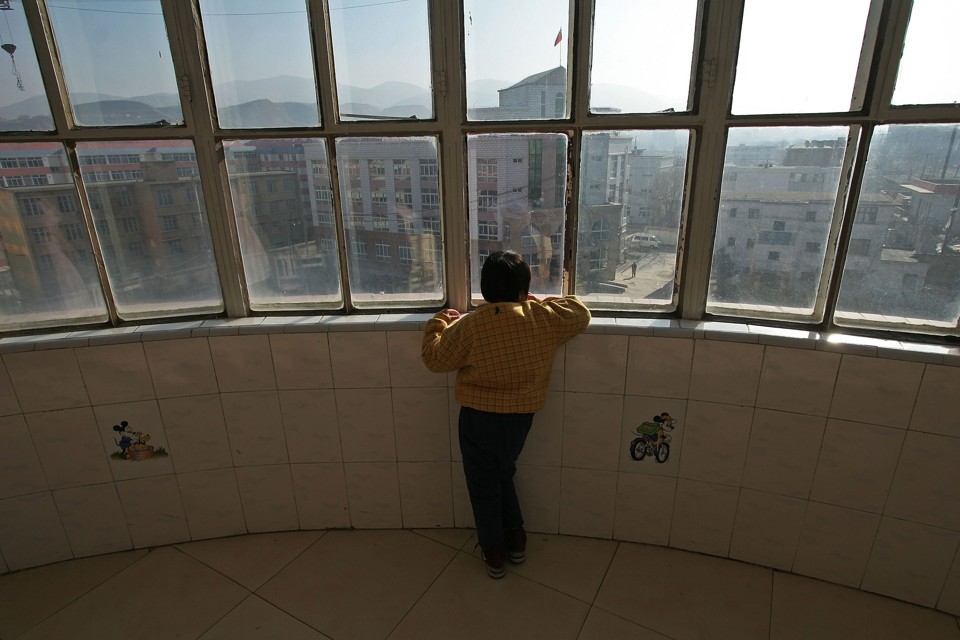
A child with autism looks out a window at the Xining Orphan and Disabled Children Welfare Center, in China.
A child with autism looks out a window at the Xining Orphan and Disabled Children Welfare Centre, China. The Atlantic
A ground-breaking study led by Dr. John Strang of the Children's National Health System in Washington, D.C. two years ago, discovered variance in gender to be eight times commoner in children with autism spectrum disorder, and seven times more likely to occur in children with ADHD. Although the conclusion may to some seem clear enough, the reason, is not. Autism, it has been noted, is described as "social blindness", and children are uninhibited by social expectations, leading to their unaware state of avoidance resulting in impulsive behaviour.

Dr. Zucker's theory leads to his belief that traits so common in autism of "fixating" could be responsible in influencing children to believe that are the wrong sex. While he was director of the Toronto clinic, an external review came to the conclusion that some of his practices were not "in step with the latest thinking", with his published research suggesting that 80 percent of children treated for gender dysphoria see that condition lifting by the time they reach high school, when they finally accept their "assigned-at-birth" gender.

Children on the autism spectrum are over-represented at his gender diversity clinic, feels Dr. Stephen Feder, co-director of the Children's Hospital of Eastern Ontario. "Our approach is still affirmative. But we perhaps take a bit more time to make sure that we get to know the kid as well as we possibly can. It doesn't change the overall approach. I think we're just even more vigilant about making sure we're responding to the appropriate needs of the kid. The issue of obsessiveness certainly comes up", said Dr. Feder.

However, he points out, when asked about their feeling of gender with obsessions of the past, adolescents "really identify it as quite different. This is not about interests. It's about how they see themselves. At the end of the day, we feel it's inappropriate to turn around and say, well if you're autistic , that probably explains your gender. The risk is that people will say, aha, that explains it And I think we want to move away from that."

Labels: , , ,

Thursday, January 12, 2017

Recalcitrant Parents versus Child Welfare Disease Inoculation

"In our view, exceptional circumstances where it may be appropriate for a physician to contact a child protection agency would be one where, due to the child's specific clinical circumstances and local presence of the disease in question, not getting vaccinated threatens the life or long-term health of the child."
Dr. Doug Bell, associate executive director, The Canadian Medical Protective Association (CMPA)

"Technically, if the right conditions existed, it may be legally appropriate for a physician to report a child."
"Generally there must be a serious threat -- and usually imminent -- to the health of the child."
Timothy Caulfield, Canada research chair in health, law and policy, University of Alberta
hi-immunization-istock-852
If passed, new legislation would require Ontario parents to attend an 'education session' if they want a vaccine exemption for their children.  CBC

"Regardless of circumstance, judges ultimately decide, based on a number of factors, whether apprehension is in the best interest of a child."
Zoe Cooper, Alberta Human Services

"One could reasonably argue vaccination for those children [at risk] is necessary medical treatment, because the parents have demonstrated an unwillingness to take a critically ill child to the doctor."
Juliet Guichon, bioethicist, University of Calgary
Joe Raedle/Getty Images Files -- Invoking child welfare in vaccination has some questioning state intervention


Vaccination rates against many diseases that afflict children and that can have long-term consequences for many, are by and large fairly high in Canada, ranging from 78 percent for pneumococcal to 91 percent for poliomyelitis. Still, a survey undertaken in 2013 discovered that 1.5 percent of Canadian children have never in their lives received any type of vaccination. Despite a UNICEF report of recent vintage on uptake rates of immunizations ranking Canada 28 out of 29 developed countries.

But the demographic of parents refusing to allow their children to be inoculated against many types of what are normally considered to be 'childhood' diseases is growing. British Columbia and Alberta have seen resurgences in measles lately, as an example. Surveys point out that one in five Canadians subscribe to the view, despite its scientific inaccuracy, that vaccines are the cause of autism. There is a five percent rate of parents who feel that homeopathy and chiropractic manipulation are capable of eliminating the requirement for inoculations, among other types of "alternative" remedies.

There is the notoriously tragic case in point of an 18-month-old child whose Alberta parents insisted on treating his illness with nutritional supplements. The parents were convinced that natural products inclusive of vinegar, onion powder, ginger, garlic and hot peppers would cure their son of his illness. They were informed by a nurse that the child might have meningitis, but this gave them little pause for rational thought and they continued to administer 'natural products', calling 911 only when the child stopped breathing.

The father had an investment in 'natural products' for he and his father operated an alternative health store in Prince George, British Columbia, promoting in particular a nutritional supplement they claim as an effective treatment for mental illness. "Healthy products for mind, body and soul", is how they promote their products. The parents were found guilty of the charge of "failing to provide the necessities of life" brought against them in the child's death, but were given slight sentences; the father four months in prison.

And nor did the parents regret their actions leading to their infant's death, expressing no remorse, but blaming paramedics in the ambulance taking their son to hospital, for causing the child's death. In the words of Justice Rodney Jerke of the Court of Queen's Bench of Alberta, the parents' failure to seek medical treatment "contributed significantly" to the risk to their son's life. A move is now going forward to revisit the sentence meted out to the father to reflect his "complete lack of remorse for his own inaction and an entrenchment of his refusal to seek medical attention when it becomes necessary for those in his care", wrote the judge of this man who has three other children in his care.

Although under Canadian law, no parent can be coerced to have a child vaccinated, measures can be taken under the right circumstances. As an example, when the Ottawa Children's Aid Society took steps when a father insisted on his right to treat his infant's leukemia with cannabis oil instead of chemotherapy. And the fact that Canadian judges uniformly rule that Jehovah's Witnesses have no right to deny life-saving blood transfusions to their ailing children. At this juncture, doctors are now being advised o report such parents to authorities if a child is at risk of serious harm.

According to Dalhousie University professor of pediatrics, circumstances could exist where "if you were the court, you would probably think seriously about" intervening when faced with vaccine refusal, explained Dr. Noni MacDonald. Children with their spleens surgically removed, she explained are at "incredible risk for a bunch of infections", including meningococcal disease. "If you were in the middle of a meningococccal outbreak, if they get it, they might die. These kids really need to be immunized."

Labels: , , ,

 
()() Follow @rheytah Tweet