Blog dedicated primarily to randomly selected news items; comments reflecting personal perceptions
Wednesday, June 28, 2023
Here Comes the Sun!
"The sun would appear green if your eyes could handle looking at it."
"Basically, when you look at the sun, it has enough of all the different colours in it and it's so bright that everybody's eyes are firing like crazy and saying, 'It's too bright for me to tell you what colour it is'."
"That's why the sun looks white to us."
"Essentially, it's a green star that looks white because it's too bright, and it can also appear yellow, orange or red because of how our atmosphere works."
"The sun is at its mid-life, and it still has quite a lot of years before it changes colours. It still hasn't dimmed out one bit."
"When astronomers say colour, they really mean temperature. But to anyone in the public, colour just means the colour you see and how you make sense of the world."
W. Dean Pesnell, project scientist, Solar Dynamic Observatory, NASA
"We think of perception and vision as being really straightforward, with this idea of 'I have my eyes and see'. And, actually, it's not like that at all. It's influenced by where you grow up, when you grow up and who you grow up around."
"When you're a kid, you don't necessarily pay that much attention to these deep philosophical questions about the nature of colour and light in the way you might start to when you're sitting in your office looking out the window on a sunny day, so perhaps you just override your memory with the learned association of 'yellow equals sun', which you leaned on heavily as a child."
"This is just another neat example of how life paints colour."
Alice Skelton, researcher of developmental colour science, University of Sussex, Britain
Do you know what color the sun really is? solarsystem.nasa.gov
While children in Japan might colour a circle red to represent the sun, in alignment with their national flag [Land of the Rising Sun], those in North American have a tendency to sketch a yellow circle. Adults are now debating the colour of the star at the centre of our solar system, some of whom feel it has changed hues since the time of their childhood. Weeks back, writer Jacqui Deevoy tweeted her opinion that the round yellow sun of her childhood had turned white and looks wonky. Her post amassed 6 million views.
Some of those had responses with people either agreeing with Deevoy's observation or those who claimed the sun had always appeared white. And as far as science is concerned, it's neither -- while being a bit of both. The sun from its 150 million kilometre distance generally appears a white spot in the sky, while the yellow tint perceived by some people is related to how light is scattered. Molecules in the air redirect sunlight's blue and violet wavelengths, and this directs more yellow and red to meet our eyes.
Sunlight passes through a thicker atmosphere as day transforms into night, so more molecules scatter its blue hues and lead to displays of oranges and reds at sunset. The sun's hue is really light bouncing off surfaces. With stars, colour equals temperature; the hotter a star, the more blue light it gives off. Cooler stars appear red. The sun at its core has a temperature topping 15 million degrees Celsius; "somewhere in the middle, in this weird space where we can't perceive its colour", observed Dr. Pesnell. In the distant future the sun is expected to change hues.
The
sun appears different depending on who’s looking. From left, NASA’s
NuSTAR sees high-energy X-rays; the Japanese Aerospace Exploration
Agency’s Hinode mission sees lower energy X-rays; and NASA’s Solar
Dynamics Observatory sees ultraviolet light. NASA/JPL-Caltech/JAXA
The source of all the light and heat that makes flowers bloom, birds sing and people smile emanates as a result of the conversion of hydrogen to helium taking place deep inside the sun's core. The hydrogen gas will -- in a vast stretch of time run out. The sun will enlarge exponentially and take on a deep red shade then ingest all the planets surrounding it and finally it will glow bright blue for a while, and then dim to such a low temperature its colour will become imperceptible ... but no one will be around by then to perceive it.
That colossal event won't take place for at least four billion to five billion years into the future. The sun has some people convinced it has become whiter, but this is connected with the brain's perception more than with astrophysics, according to Dr. Pesnell. Perception itself differs from person to person. Colour, in its most physical sense is what people see when a wave length enters the eye and specialized cells send signals to the brain which translates waves into the colours we see. Everyone may be receiving the same information, but individual life experiences and backgrounds dictate what we make of it.
In the Arctic Circle for example, where some children are born during its long periods of darkness and others experience prolonged sunlight, colour looks different, depending on those life-beginning circumstances. As adults, research shows time of birth influences abilities to distinguish different shades. Language and culture may also play a role, with some not having a specific word to differentiate between blue and green, as an example. Dr. Skelton points out that people's upbringing and how they learn to associate colours with objects can affect perception.
The Sun from space... the color should be obvious. Image credit: NASA
Rare Celestial Sightings : Green Comet, February 10
"Comets
are notoriously unpredictable, but if this one continues its current
trend in brightness, it'll be easy to spot."
" It's just possible it could become visible to the unaided eye under dark skies."
NASA Blog
"I'm
telling you - binoculars, dark site - you'll see something. Bring
friends and you all will see something of a lifetime."
"Whenever
you have a lake system around you, or ocean system, it causes a
smoother airflow. Smoother airflow means the stars don't twinkle as much
so you get more details."
Astrophotographer Dan Bartlett, Yosemite National Park, California
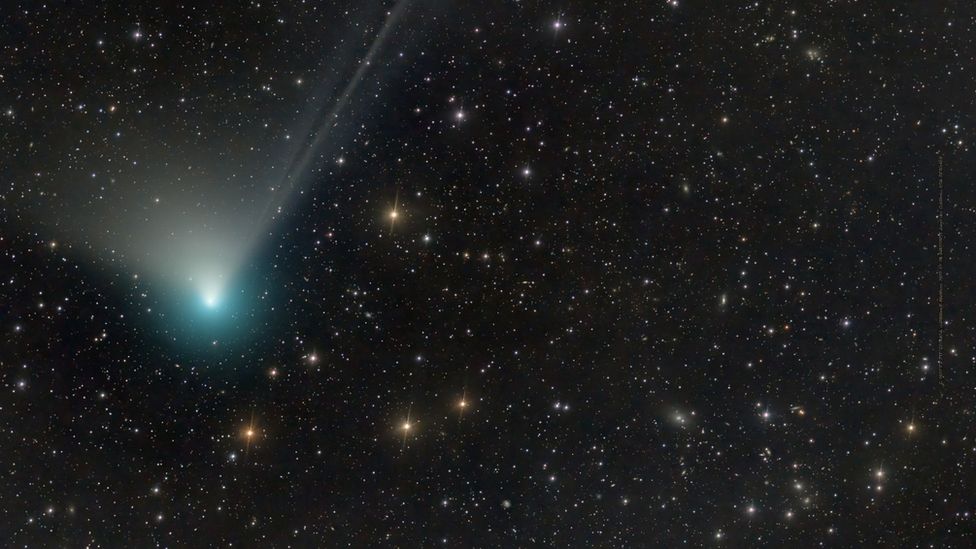
A photo of comet C/2022 E3 (ZTF) (Image credit: Chris Schur)
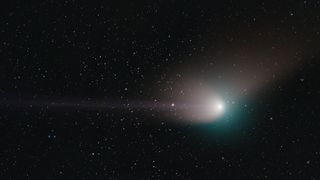
As objects in the night sky this one is remarkable for several reasons, its green colouring and its age. Come to think of it, its name is also fairly remarkable: Comet C/2023 E3(ZTF). It's on a visit to Earth on its way elsewhere within the endless space of the universe. And while it's whizzing by, some fortunate people will be able to sight it. It's thrilling, like seeing shooting stars, or satellites, bright specks in the velvet deep-dark-blue of the nighttime sky, illuminated here and there by constellations and numberless stars.
It's been around here before, but not since the last 50,000 years when our distant relatives roamed Earth. Astronomers casually call comet "dirty snowballs" for their constituents; ice, dust and rocks. They emerge from icy matter called the Oort cloud at the outer edge of our solar system. Comprised of a solid rock core, covered with ice and dust, a thin, gassy atmosphere of more ice and dust called a coma travels with comets, their tails. Which melt in their approach to the sun, releasing a gas stream and dust blown off the comet's surface by solar radiation and plasma, which forms a cloudy, outward-facing tail.
Gravitational forces capture the comets from where they park themselves at the inner solar system, moving them from the Oort cloud. They become more visible moving closer to heat exhaled by the sun. Observatories around the world discover up to a dozen comets annually. Back when Neanderthals called Eurasia their home and homo sapiens was streaming out of Africa, when Ice Age creatures such as mammoths and sabre-tooth tigers called the landscape home, someone may have noticed the comet passing by.
Astrophysicists studying comets' formation and longevity can detect clues of the primordial solar system before its formation during its earliest stages of explosive turbulence and massive dispersal. Astronomers making use of the Zwicky Transient Facility telescope at Caltech's Palomar Observatory in San Diego discovered the comet on March 2nd 2022. The comet's chemical composition expresses itself in its unique emerald colouring; the result of interaction between sunlight and carbon-based molecules in the coma of the comet.
"We're going to be looking for the fingerprints of given molecules that we can't access from the ground."
"Because JWST's so sensitive, we're expecting new discoveries"
Planetary scientist Stefanie Milam, NASA Goddard Space Flight Center, Maryland
Retired science teacher, Dan Bartlett, captured this image from his cabin near Yosemite National Park in California
"For centuries, humanity has only been able to observe this atmosphere from afar. Now ... we have finally arrived."
"Humanity has touched the sun."
Nicola Fox, director,Hheliophysics Division, NASA
"[The Parker Solar Probe's success in] touching the sun [was] a monumental moment for solar science and a truly remarkable feat."
"Not only does this milestone provide us with deeper insights into our Sun's evolution and [its] impacts on our solar system, but everything we learn about our own star also teaches us more about stars in the rest of the universe."
Thomas Zurbuchen, associate administrator, Science Mission Directorate, NASA
"Touching [the sun with a probe, a long-sought mission, was] very exciting."
"It feels like visiting a planet for the first time."
"That was the sense of excitement we got."
Justin Kasper, lead author, study, deputy chief technology officer, BWX Technologies. Professor, Climate and Space Sciences and Engineering, University of Michigan
Since the Parker Solar Probe launched in 2018, it's been orbiting the sun and inching closer with every loop.
NASA/Johns Hopkins APL/Steve Gribben
A close encounter with our solar life source. Ambitious beyond belief. But now a reality. Those present Tuesday at the American Geophysical Union Fall Meeting held in New Orleans, heard directly from NASA scientists that one of its spacecraft achieved their goal as the first to "touch the sun". Representing a long-anticipated milestone, potentially recognized as a giant leap in understanding that life-giving orb's influence on the solar system.
In April, the Parker Solar Probe succeeded in flying through the sun's corona (upper atmosphere) to sample particles and the corona's magnetic fields. The research was published in the journal Physical Review Letters. Launched three years earlier, the spacecraft represented an effort to study the sun and its dangers for the purpose of aiding scientists to reveal significant and unknown information about Earth's closest star.
One of the goals in this specific project is to discover how the flow of the sun's particles can influence the planet. The associate administrator for NASA's Science Mission Directorate examines how discoveries in one scientific discipline are connected to other study areas; so 'touching the sun' is a great advance toward full and deep understanding of the physics involved in nature's fundamental plans of creation.
The Earth's closest star is absent a solid surface, comprised, according to a description in a NASA video, as "a giant ball of hot plasma that's held together by its own gravity". The sun's material helps to form the atmosphere of the sun; the corona, an area significantly hotter than the sun's actual surface. While the surface of the sun is around 10,350 degrees Fahrenheit, the corona is about 1.8 million degrees Fahrenheit at its hottest point. Solar wind is comprised of some of those hot, fast particles from the corona.
It has long been a struggle to predict space weather events given the ferocious environment around the sun. The boundary, named the Alfven critical surface, marking the end of the solar atmosphere and the beginning of the solar wind has long been studied by scientists. And then, on April 28, the Parker Solar Probe crossed the Alfven critical surface for the first time, entering the solar atmosphere on its eighth flyby of the sun.
"My instinct is, as we go deeper into the mission and lower and closer
to the sun, we're going to learn more about how magnetic funnels are
connected to the switchbacks."
"And
hopefully resolve the question of what process makes them."
Stuart Bale, study co-author, astrophysicist, University of California, Berkeley