Ruminations

Blog dedicated primarily to randomly selected news items; comments reflecting personal perceptions

Monday, November 28, 2022

Massive Environmental Headache in Florida

"This is storm debris on a scale Florida hasn't seen in a long time."
"With hundreds of people moving to Florida every day and coastal development off the charts, the combination of that and more intense hurricanes results in this massive problem."
Jon Paul Brooker, director of Florida conservation, Ocean Conservancy

"We have a landfill we're trying to maximize the life of."
"And we don't have that much space in our county to create a new one."
John Elias, director, public works, Charlotte County, Florida

"There's a lot of debris we know is in the water that we can't see."
"Anything that was on the land, you should expect to be pushed, pulled, dragged into the water."
Jason Rolfe, coordinator, National Oceanic and Atmospheric Administration, Marine Debris Program 
A view of the overflow debris management site at Maximo Park where debris from Hurricane Ian collected in St. Petersburg has been taken over the past month. The city is on schedule to finish debris collection next week, an administrator said.
A view of the overflow debris management site at Maximo Park where debris from Hurricane Ian collected in St. Petersburg has been taken over the past month. The city is on schedule to finish debris collection next week, an administrator said. [ DIRK SHADD | Times ]
 
Clean-up crews are continuing to work in the removal of "ghost" lobster traps in the Florida Keys that were abandoned over five years ago when Hurricane Irma struck; traps that continue to ensnare and kill marine animals, a special concern of Jason Rolfe. It is imperative that the waste be removed, but of first concern to authorities is digging out homes and businesses, leaving environmentalists to fear that storm waste remaining in the water could damage sea grasses and fragile habitats in the shallow coastal waters of the state.

Hurricane Michael inflicted heavy damage four years ago, leaving Florida's Bay County in the position of still pulling debris and broken-down boats out of their waters today. An estimated 2.4 million pounds has been removed from their bays. "We are still cleaning up". Country Manager Bob Majka confirmed.

When Hurricane Ian slammed into the southwest Florida coast almost two months ago it destroyed thousands of homes, taking over 100 lives and leaving state and local governments to wrestle with the conundrum of how to manage a staggering amount of storm debris. Mountains of refuse sit at dozens of temporary sites throughout the state. The debris is comprised of fallen trees, mildewing carpet, sodden drywall and allied household items the storm destroyed.

State officials estimated that in the past seven weeks crews removed about 20.4 million cubic yards of debris. That's a huge amount of waste, but millions more litter the state. Hurricane Ian is estimated to have left close to 31 million cubic yards of debris. according to the Army Corps of Engineers. Representing about five times the amount of storm debris left by Hurricane Sandy in New York. 

Efforts at cleanup in Florida's coastal cities and counties hit hardest by the Category 4 storm is expected to take months of hard work, at a cost of billions. Following Hurricane Nicole's east coast hit as a Category 1 hurricane on November 10th the enormous clean-up became even more challenging. Beachside homes were toppled into the sea, leaving others uninhabitable when the November storm lashed Daytona Beach; for which no estimate of damage has yet been determined.

In 2017, after Hurricane Irma swept Florida, major damage was left in the Florida Keys, causing about two-thirds of the residents to lose power across the state and leaving close to 29 million cubic yards of debris. Hurricane Michael the next year created close to 33 million cubic yards. Science indicates that these costly disasters will continue to grow in number as sea levels rise and waming waters cause hurricanes to gain rapid strength prior to roaring ashore. 

Because of its shallow water table and potential for makeshift landfills leaching contaminants into groundwater, there are particular challenges Florida faces. "Where are we possibly going to find room for all this [debris]?", asks University of Florida professor of environmental engineering, Timothy Townsend. When damaged drywall from flooded homes reaches landfills, he points out, the wet gypsum mixes with bacteria that produce hydrogen sulfide gas. Not only does it stink like rotten eggs, the toxic gas can trigger headaches and nausea and cause health problems for people with asthma.

https://m107833-mcdn.mp.lura.live/iupl/0F7/140/0F7140CA1EF8D3F23EEC6F81C59EF606.jpg

Labels: , , , , ,

Wednesday, October 04, 2017

Weather Conditions

"Florida knows hurricanes, it just hasn’t met many lately. The state has withstood more direct hurricane strikes than any other state, and it is often grazed by storms that end up making landfall elsewhere."
"However, until Hermine made landfall in September, Florida had gone more than a decade without a direct hit from a major storm. This lengthy lull came after two hyperactive hurricane seasons in 2004 and 2005, which together produced more than 40 named storms and 13 major hurricanes. The 2005 season produced 28 named storms, the most since 1851 and eight more than the second busiest season of 1933."
"This hurricane season has proved a rude awakening from that decade-long lull. Hurricane Matthew, the 13th named storm of the season, has pummeled Florida’s east coast and is projected to batter the coasts of Georgia, South Carolina and North Carolina. Forecasts even showed it hooking a U-turn and heading to every storm's landmass of choice: Florida."
The Washington Post, 100 years of hurricanes hitting and missing Florida, visualized  By Lazaro Gamio  October 7, 2016

In 1950 the population of the United States was 152 million people. By 2015 the population had ballooned to 320 million people living in the United States. That represents an average growth rate in the population of 1.2 percent annually. Texas, Louisiana, Florida, Georgia and South Carolina, all known for their mild climate unlike the raging cold that winter brings in the north saw an average increase far outdistancing the growth rate in say, Massachusetts, Minnesota, Michigan, Wisconsin and Nebraska.
The tropical winds turn dangerous.
The tropical winds turn dangerous. (Reuters/Carlos Barria)  
Tropical Depression 16 formed this morning (Oct. 4) in the southwestern Caribbean Sea. The National Hurricane Center forecasts it could hit Florida as a hurricane on Sunday

In the first group the average growth rate of the population was two percent yearly, double the average on a national scale and representing in their totality 21 percent of the American population. The northern state group, on the other hand, saw a growth rate of 0.7 percent annually, and its total percentage fell from the original 12.3 percent of the American population to 9.3 percent. A net gain for the south, a net loss for the north. Representing where the population of the United States preferred to locate to.

In 1950, both the southern group and the northern group of states each collectively represented roughly 12.3 percent of the entire American population. What led to and distinguished their changing population fortunes was the choice of people to live in warmer, albeit wetter climates, rather than commit to living in distinctly four-season climates which may be drier, but also colder. The benefit of living in the north, however, is the lack of hurricanes, whereas in the south hurricane season is guaranteed.

The vast geography of the United States of America offers to its residents the opportunities to live in the frigid north of Alaska, to its extreme opposite, Florida, and everything in between; where there are forests, mountains, great plains, deserts and rainforests. The popularity of warm atmospheres and comfortable, minimally-changing in degrees of comfort temperatures influence peoples' choices enormously, enabling them to discount the threat of major disruptions when untoward weather systems erupt, as they always have historically.

Before the advent of recognized human-activity loading the atmosphere with greenhouse gas emissions, hurricanes were guaranteed on schedule during their typical seasonal activities. According to the U.S. National Hurricane Center, the U.S. underwent between fifteen and twenty-four landfall hurricanes every decade between 1851 to 1960. Atlantic cyclones represent an expected climate event, having nothing to do with climate change.

Of those historical weather events between one and ten were considered major. When human GHGs began to sharply rise, from 1960 to 2010, landfalling hurricanes presented at the rate of 12 to 19 every decade, and four to seven of those were considered major, yet still within the historical range. It had been noted that since 2010 there were fewer occurrences of landfall hurricanes, and of those, two of a total of three were considered to be major events.

The hurricanes that came along in 2017 some of which have been considered once-in-a-century events for the damage they caused resulting from their category-force status, owes in large part to the fact that human habitation has altered the geology of sensitive areas from their natural capacity to absorb great volumes of sea water and withstand gale-force winds. But because of the growth in population and in particular the growth of people opting to settle in those weather-sensitive areas such as flood plains, the hurricane effects have been magnified.

In choosing to locate to vulnerable areas of the United States reflecting a preference for warmer, wetter potentially more hazardous climate events, the situation where such events impact so deleteriously on human habitation is vastly magnified. These are deliberate choices on the part of the population, to live where they will be exposed to inimical weather events, and in so doing, altering the lay of the land, adjacent the oceans.

Government responds by coming to the rescue through economic and disaster relief. Leading people to waive their responsibility to insure their properties, and to think less about where they are building when building codes are lax, despite enabling people to over-build in areas prone to weather hazards. Under these conditions, when severe weather systems do arrive as they have historically, great shifts in population temporarily relieve people from direct exposure to danger, but their homes become threatened.

Resulting in those vulnerable populations calling on government to both act on climate change, and rescue their possessions when they become threatened and damaged leading to tremendous personal and infrastructure loss. The risk has always been known, but that hasn't stopped real estate entrepreneurs and town councils from encouraging people to come along and make their homes where instability and climate threats can be guaranteed.

And to pay for these costly rescues and efforts to correct the damage done to natural geological defences drains both local, state and federal coffers. So would the Americans who make conscious decisions to place themselves and their families in annual danger including the prospect of losing all their possessions agree to funding needed reactions to meet the demands of such climate events by agreeing to pay increased taxes?

Those words and such a prospect represent anathema. 

NHC Atlantic Ops ✔ @NHC_Atlantic
A Tropical Storm Warning has been issued for portions of the coast of Nicaragua & Honduras for TD 16. Full advisory: http://hurricanes.gov 

Labels: , , , ,

Friday, September 22, 2017

Business As Usual

"There could have been ways to have more green space and more green infrastructure over the years, and it just didn't work that way, because it was fast and furious."
"It's been known for years how to do it. It just costs the developers more money to do it that way."
"And so the building just went rampant, and there weren't many controls. It was like the Wild West, and you just built housing subdivision after housing subdivision up close to the bayous, up close to the channels."
Dr. Phil Bedient, professor of Engineering in Civil and Environmental Engineering , Rice University, Houston

"If you put the kind of super-strict planning shackles on Houston, that would be the way to kill it."
"Why would you live in a hot, humid, flat space if it was expensive?"
Joel Kotkin, urban theorist

"Houston will accept anybody who's got hustle -- it respects energy more than any place."
"Houston is a very resilient city, and it will overcome."
Larry McMurtry, Texas writer
Matt Finn reports from Houston
Bright Cove, Houston, Foxnews.com

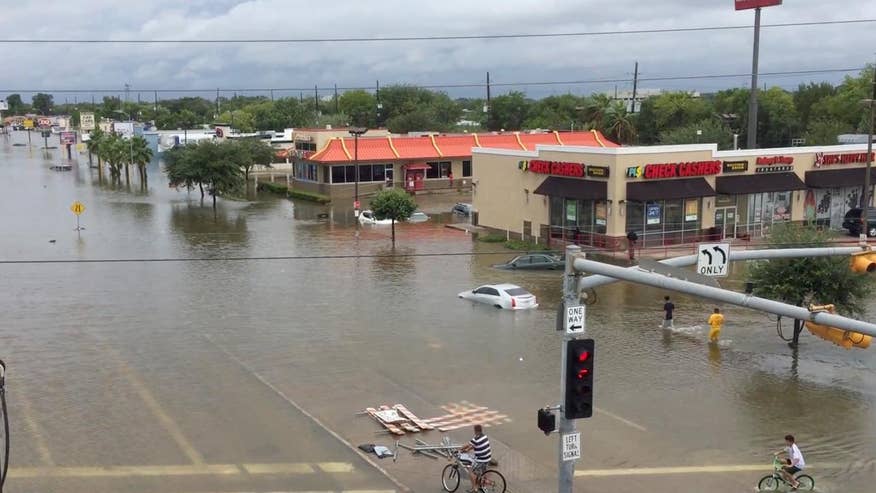
In other words, it will be business as usual for Houston now that the inconvenience of a massive flooding event thanks to a one-in-a-500-years hurricane has come and passed. Of course, equally inconvenient is the fact that environmentalists warn that these unique and deadly hurricanes are on track to become more common, more numerous, and places like Houston that faced up to nature's wrath, with most of its natural surroundings devised by nature to protect the geography from flooding have been severely compromised by gung-ho building.

The city itself was the brainchild of speculators in real estate from New York. And since Houston was chosen as a site for a city that would evolve to an energy powerhouse in the 1830s, homes and businesses have routinely flooded. Attempts to drain the swampy land failed to protect its residents, the floods just kept coming in, one after another. In Houston's first one hundred years of existence it has coped with no fewer than 16 major floods. But none of that kept Houston from becoming a flourishing metropolis, the centre of the petroleum industry in the United States.

It was from Houston that the U.S. Space Agency first sent humankind to visit the moon. It is where the world's largest medical center has been established. No fewer than 145 languages are spoken in the city, as a teeming melting pot model of humanity on display, live and energetic and bursting with pride. Of course on the way to achieving all of this, as the city's population grew so did its need to push nature around, to claim for human habitation and corporate business areas intended by nature to absorb extravagant amounts of water from storms to protect the mainland.

Without the municipal authority agreeing that there was no need to regulate the environment, much less to place restraints through onerous building code regulations that would slow down industry, development and the growing population base requiring places to live, the result has been that it isn't dreadfully expensive to afford a  house in Houston. Because homes were developed on the cheap, on the very wetlands and prairies that were meant to remain as the natural sponges nature had intended them to be.

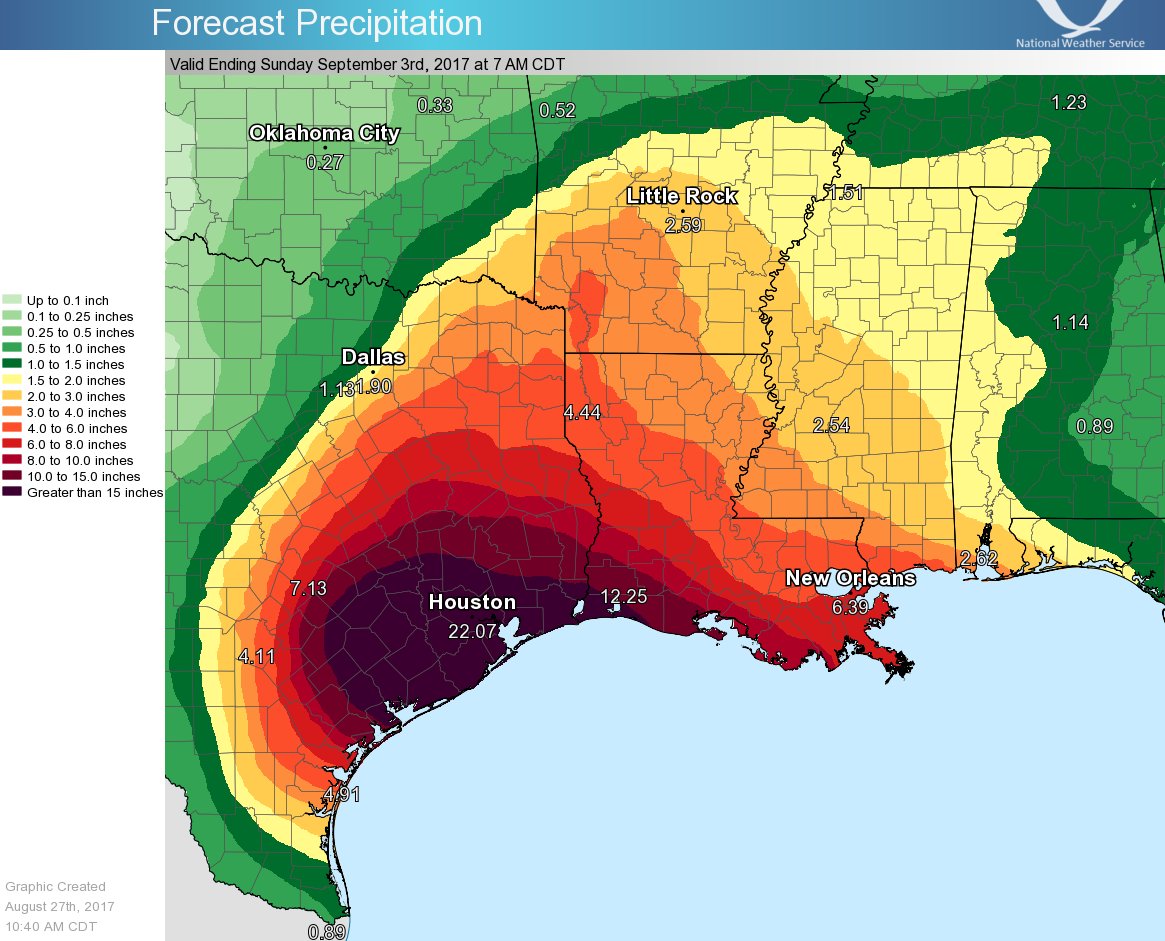
The irony cannot be escaped that it is the industry that made Houston the power house it is, that has been identified as the major contributor to the pollution that threatens to incite those overwhelmingly dangerous storms. Houston itself is the unlikeliest of natural environments to host a growing mega-city of aggressive enterprise. Throughout its inner geography it is burdened with the presence of slow-moving bayous where clay soils fail to absorb excess water. During Hurricane Harvey close to 1,400 millimeters of rain fell; while the average annual rainfall in Houston registers about 1,200 millimeters.
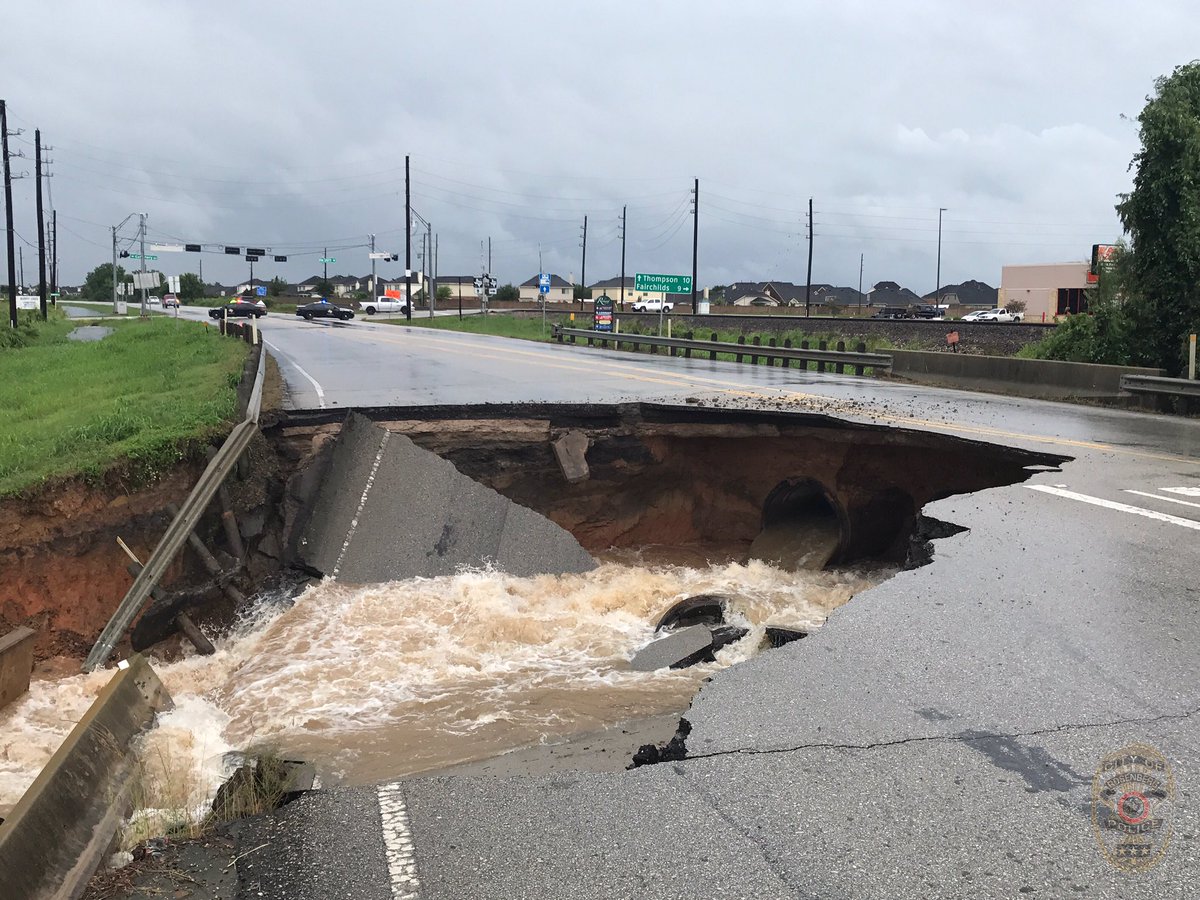
Rosenberg Police Department -- Twitter

The city had decided it would control stormwater by directing the runoff to the Gulf of Mexico, and to that end two key bayous were channeled by conversion to concrete culverts, and a third one widened. Houston must have felt it had accomplished its due diligence in a massive engineering network of 1,400 channels totalling 4,000 kilometers, built for storm runoff to be directed out of the city and funnelled down to the sea. Thus assured, city planners felt free to allow building to run rampant.

Then came the realization that such large rainfalls couldn't, after all, be  handled by the system devised, since green space that might have absorbed all that extra water falling during a big storm had been paved with parking lots, houses, churches and malls. An initiative undertaken in 2010 to improve roads and renew the drainage system represented a major financing effort necessitating new taxes. Raising taxes is singularly unpopular anywhere, particularly when it is paired with a recommendation that homeowners living in flood plains return the land to green space through government buy-outs.

The result of which, concerns many planners; that with stricter regulations on building codes the momentum that has always inspired Houston to grow as it wished, and unregulated, will result in houses no longer being as affordable, and thus attractive to lure people to live and work in Houston, in its signature industry.

Labels: , , , ,

 
()() Follow @rheytah Tweet