Ruminations

Blog dedicated primarily to randomly selected news items; comments reflecting personal perceptions

Saturday, August 08, 2026

North America Gripped by Wildfires

"In Canada, temperatures have increased by more than one degree Celsius, and in the north, where those fires are having huge consequences, many of those areas have warmed more than two degrees Celsius."
"Doing those improvements [suppression and Indigenous burning practices] isn't going to stop wildfires."
"We are going to be living with more and more fire on our landscape."
Lori Daniels, professor of forest and conservation sciences, University of British Columbia
 
"Thinning and prescribed burning helps us with some particularly problematic components of that fuel equation."
"[Instead of doing what's needed], the fuels have just continued to accumulate [for lack of budgets, commercial markets, liability concerns and insufficient numbers of trained professionals]."
John Bailey, associate forestry professor, Oregon State University 
 
"There are ways that we're having to pay that debt [of tardy forest management]: We're getting bigger fires, more extreme fires, a lot of smoke."
"If we want to pay down the debt, we have to invest in restoration." 
"Even if Canada was doing everything right with climate change, there are things that are going to burn hotter and more aggressively than they used to."
Robert Bonnie, former undersecretary for Farm Production and Conservation, U.S Department of Agriculture
 
"The United States is being unnecessarily invaded by filthy, polluted, and unhealthy air."
"[This is] wilful negligence. [Canada is] not properly maintaining [its forests]."
U.S. President Donald J. Trump 
https://cms.accuweather.com/wp-content/uploads/2026/08/GettyImages-2289279598.jpg?w=632
Firefighters and first responders wait in line for dinner at the Spokane County Fair and Expo Center which is being utilized as a base camp for firefighters on August 5, 2026 in Spokane, Washington. (Photo by Mario Tama/Getty Images)
 
Wildfires are ablaze in Washington State, Oregon, Idaho, Montana, California and Utah, placing communities, building infrastructures and residential homes -- not to mention the firefighters dispatched to fight those blazes, at high risk. In Canada too, there are wildfires in Ontario, Quebec and the Northwest Territories, and the worst-hit of the Canadian provinces, British Columbia. Smoke wafts everywhere, a threat to human health. Just as the smoke from Quebec and Ontario wildfires float over to the northern U.S. States, smoke from wildfires in Colorado, Oregon and Washington State waft over to British Columbia.
 
Smoke from Canadian boreal forest fires swept into the United States, resulting in air quality alerts for over 120 million Americans. Air quality in New York and Chicago was heavily compromised with smog blanketing their regions. Canada was accused by four Republican lawmakers of failing to prevent wildfire smoke from covering areas in the United States; that "continued inaction" was "unacceptable", they huffed in concert with President Trump's fuming condemnations. 


The U.S. President threatened new levies once again, this time imposed as punishment for the smoke Canada has allowed to drift over the U.S. He more recently announced the finalization of his plan to punish Canada for the smoke. This interpretation of natural events has forest management experts declaring the oversimplification of a complicated problem by the Trump administration. Robert Bonnie, for one, points out that the president's own decision-making has cut Forest Service capacity and  resources, under-investing in fire prevention and restoration.
 
Despite that both countries are facing similar fire pressures, Canada's forests are for the most part public lands that provinces and territories manage. There are far more private forestlands in the United States, with a fragmented federal-state system prevailing. And, as Lori Daniels of the University of British Columbia points out, both countries make use of similar suppression tools even while Canada has far more forest, fewer people and remote boreal areas where wildfires ignited by lightning can be dreadfully difficult to reach.
 
https://i.cbc.ca/ais/41e807d4-8f9b-4bd3-b57d-5cc670ebe0ea,1786172767413/full/max/0/default.jpg?im=Crop%2Crect%3D%280%2C378%2C4032%2C2268%29%3BResize%3D616
Residents look toward the Bald Range wildfire. (Jay Bertagnolli/CBC)
 
Thinning and prescribed burns are fundamental to fuel management in forests; reducing ladder and surface fuels to make it more difficult for fires to reach up to the mass of forest crowns, spreading the fires with the help of prevailing winds. "Thinning and prescribed burning helps us with some particularly problematic components of that fuel equation", pointed out Oregon State University's John Bailey.
 
The U.S., he points out, has been tardy to adapt that methodology at the required pace and scale, partially as a result of weak commercial markets for small-diameter wood, along with local and state smoke rules. "The fuels have just continued to accumulate", as a result, he added. Both countries, points out Lori Daniels, must move toward forest management, reflecting the hotter drier conditions of today's natural environment. 
 
The areas so susceptible to wildfires have seen multi-year droughts, and since Indigenous burning practices were banned while suppression took its place as the dominant policy, forests grew denser. "I don't think the problem is forest management. I think the problem is climate", stated Jonathan Boucher, researcher at the Canadian Forest Service. While he agrees that thinning out trees, adding fuel breaks, conducting prescribed burning, and producing defensible spaces near communities can be of help, they would not stop every fire. 
 
https://www.castanet.net/content/2026/8/bytes5_p4297047.jpg
BCWS crews battling the Bald Range wildfire overnight.  Photo: BCWS
 
"Our agencies work together. We're going to throw smoke your way. You're going to throw smoke our way."
"Let's work together to make sure we can restore our forests in a way that we can contain this problem going forward."
Robert Bonnie, associate forestry professor, Oregon State University 

Labels: , , , ,

Sunday, June 21, 2026

Disregard For The Rule of Law

"It's a symbol of the short-sighted damage that this administration is doing to the world's most important bilateral trading relationship."
"Businesses in Ontario are angry. My American business friends and partners, they say the same thing. They're angry about unacceptable delays in the opening of infrastructure that is essential to their economy and to ours."
"It yet again appears the private interest is being prioritized over the public interest of both 
Americans and Canadians."
"What will be really sad here is if there is any significant delay in getting this infrastructure open at the exact time that businesses in both countries are struggling and trying to invest in their own growth." 
Daniel Tisch, president, Ontario chamber of Commerce
https://i.cbc.ca/ais/1.7643551,1758821002000/full/max/0/default.jpg?im=Crop%2Crect%3D%280%2C806%2C3024%2C2975%29%3BResize%3D796
The Gordie Howe International Bridge is silhouetted against an orange sky over the Detroit River between Windsor and Detroit. (Pratyush Dayal/CBC)
 
Ottawa and Michigan signed an agreement in 2012 over plans to build a new bridge linking Michigan with Ontario for transport purposes. It was mutually agreed that Canada would have sole responsibility for the design, construction and financing of the project, the new international trade crossing bridge to be named in memory of storied Canadian hockey player Gordie Howe. Toll revenues from the Gordie Howe International Bridge, it was agreed, would be evenly shared between Canada and the State of Michigan, once Canada had recovered construction costs through initial revenues.
 
The bridge's time had come. The existing bridge, the almost-century-old Ambassador Bridge, no longer has the capacity to handle the volume of trade between Canada and the U.S. "If you think about all the automotive parts that come from Canadian plants, the border should not be a bottleneck in the transportation process", explained supply chain expert Professor Fraser Johnson of the Ivey Business School, Western University. 
 
https://i.cbc.ca/ais/1.5535875,1587135918000/full/max/0/default.jpg?im=Crop%2Crect%3D%280%2C0%2C4000%2C2250%29%3BResize%3D796
The Ambassador Bridge stretches between Windsor, Ont. and Detroit. (Patrick Morrell/CBC)
 
Each day, the Ambassador Bridge sees over $390 million of trade passing through between the two trading partners, which represents 26 percent of Canadian exports by road, according to Transport Canada's 2021 data. Built in 1929, the bridge lacks the handling capacity relative to the volume of trade between Canada and the United States. "Everybody gets hurt whenever there's a disruption" of the supply chain that links Windsor and Detroit, reflecting the level of integration, remarked mechanical engineering professor Peter Frise at the University of Windsor.
 
Truckers have good reason to look forward to new efficiencies with the bridge opening, alleviating congestion and diverting Ontario's Highway 401 and Interstate 75 heavy truck traffic away from city streets in Windsor. Truckers and businesses making use of the existing corridor means higher toll costs for each day of delay, time lost in congestion on the limited four-lane width of the Ambassador Bridge. Bridge crews place orange traffic cones by hand to change traffic direction before the evening traffic rush.
 
https://i.cbc.ca/ais/204647a6-58f0-43f1-8ee8-f71844f58840,1755726499202/full/max/0/default.jpg?im=Crop%2Crect%3D%280%2C0%2C1920%2C1080%29%3BResize%3D860
The six-lane deck of the Gordie Howe International Bridge stretches across the Detroit River between Windsor, Ont., and Detroit. A federal briefing note obtained by CBC News says the crossing has been 'essentially complete' since February. (Submitted by the Windsor-Detroit Bridge Authority)
 
A level of frustrated controversy erupted in February when Donald Trump posted on Truth Social that the bridge would not be opened until the U.S. was "fully compensated". Just a week ago, Michigan Republican House Speaker Matt Hall stated that the U.S. should receive half of the new bridge's toll revenue, presumably even before Canada recouped the $6.4 billion it spend building the bridge. Leading Daniel Tisch to observe this would be a "disregard for the rule of law" to place an agreement already signed back on the table.
 
The Ambassador Bridge owners, the Moroun family, spent years through lawsuits fighting the construction of another bridge to take traffic between the two countries, which would disturb their monopoly. They had been major contributors to President Trump's election campaign, and had his ear, lobbying for some kind of intervention. And so, Mr. Trump listened, and he made his position known, evidently believing that Canada owed the U.S. something for having built a bridge with Canadian tax funding, as though this entitles him to belittle the enterprise and extract financial concessions over an imagined imbalance. 
 
https://i.cbc.ca/ais/1.3476875,1457470198000/full/max/0/default.jpg?im=Crop%2Crect%3D%280%2C0%2C3000%2C2000%29%3BResize%3D796
U.S. President Donald Trump said Canada would not be permitted to proceed with the Gordie Howe International Bridge 'unless America got a piece of it, too,' despite the bridge being financed and built by Canada. (Scott Olson/Getty Images)
 

Labels: , , , , ,

Tuesday, February 18, 2025

Ending the Russia-Ukraine Conflict Trump's Way

"There is not any leader in the world who can really make a deal with [Russian President Vladimir] Putin without us, about us."
"He's a liar. He doesn't want any peace."
Ukrainian President Volodymyr Zelenskyy
 
"We'll be having meetings at the direction of the president [Donald Trump], and hopefully we'll make some really good progress with regard to Russia-Ukraine."
"I think Ukraine is part of the talks. I don't think this is about excluding anybody."
U.S. Middle East envoy Steve Witkoff 

"[Putin] wants to stop fighting. We each talked about the strengths of our respective nations, and the great benefit that we will someday have in working together."
"I'd love to have them back [in the G8]. I think it was a mistake to throw them out. They should be sitting at the table. I think Putin would love to be back."
"I think he wants to end it and they want to end it fast."
"Zelenskyy wants to end it, too."
U.S. President Donald J. Trump 
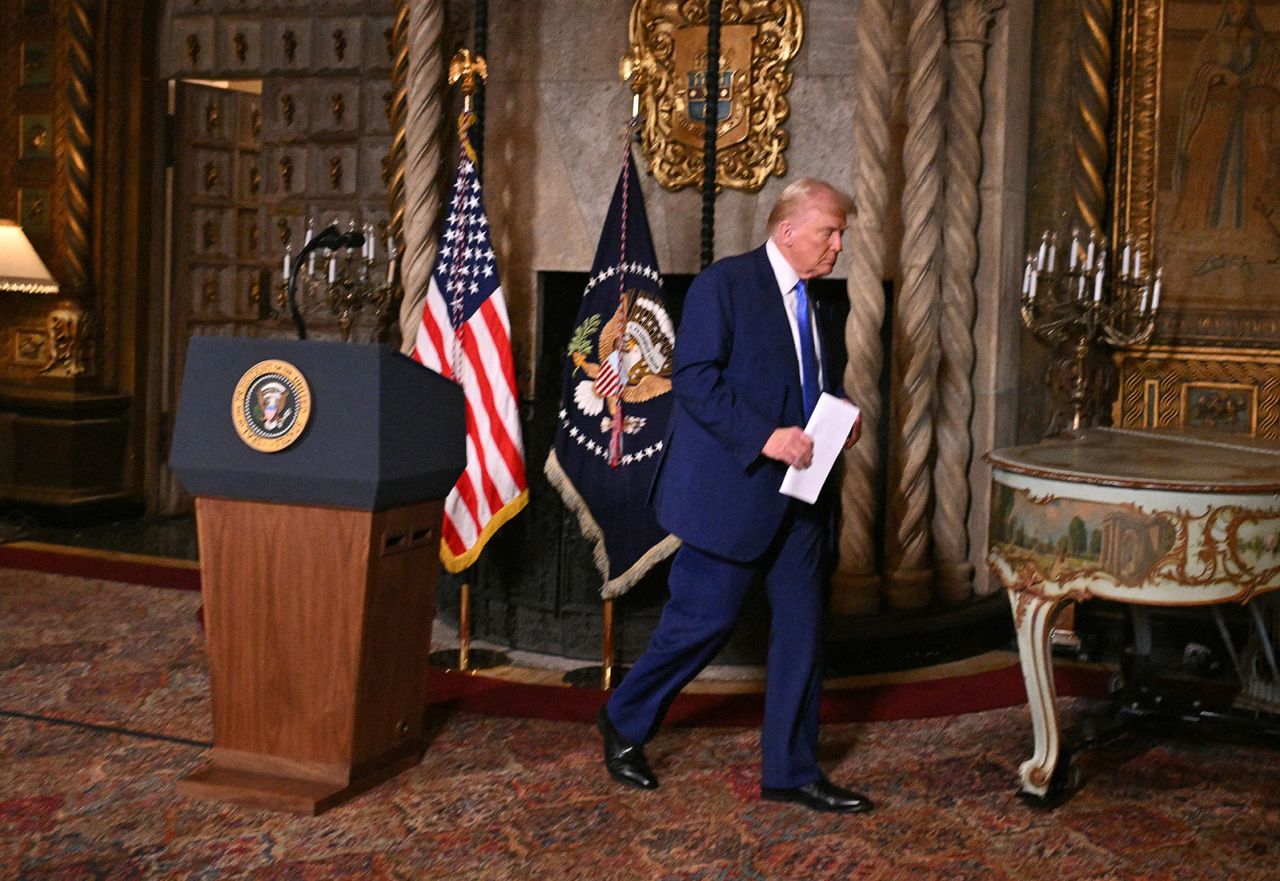
President Donald Trump leaves after speaking during the signing of executive orders at his Mar-a-Lago resort in Palm Beach, Florida, on Tuesday.
 
American officials and their Russian counterparts arranged to meet in Saudi Arabia for direct negotiations to begin, over ending the Russia-Ukraine war. Kyiv and its allies throughout Europe were left to swiftly arrive at a strategy for their own security. Which led France to call an emergency meeting of European leaders in Paris. Their first encounter with the Trump team at the Munich Security Conference over the weekend left them reeling in disbelief and confusion when senior U.S. officials including Vice-President J.D. Vance gave up mixed signals on support for Kyiv and relieved them of the expectation that Kyiv and Europe would be present for negotiations on Ukraine's future.
 
Ukrainian President Volodymyr Zelenskyy was somewhat less than pleased, responding that Kyiv would never view a deal arrived at without his presence as acceptable, and rejected an American proposal to access Ukraine's rare earth minerals which offered in return no security guarantees. In Abu Dhabi on the weekend, President Zelenskyy signed a trade deal with the UAE, meeting Sheikh Mohammed bin Zayed Al Nahyan to "maximally liberalize access to the UAE market for almost all Ukrainian goods".
 
Sheikh Mohammed spoke of "the UAE's keenness to support everything that would lead to a peaceful settlement of the Ukrainian crisis and continue working to mitigate its humanitarian repercussions." Contrast that with the White House expressing its interest in backing President Zelenskyy's bid to take possession of the US$300 billion in frozen Russian assets held in European banks, as long as Ukraine spends the money on U.S. military hardware.
 
To place matters in further perspective, contrary to Mr. Trump's claims, the U.S. has not been the primary financial contributor to Ukraine's pushback against Moscow. Over the past three years, Europe has contributed 132.3 billion euros ($197 billion,) pledging an open-ended commitment to continue for as long as it may take. As for the U.S. contribution, it totalled $114.2 euros with most of that funding remaining in the United States, representing purchases from U.S. arms manufacturers. 
 
https://i.abcnewsfe.com/a/f22c398a-cf6a-43af-826e-6a6adf45cadd/Rubio4-ap-ml-250218_1739881100519_hpMain_16x9.jpg?w=992
US, Russia agree to try to end war without Ukraine at the table High-level delegations from the U.S. and Russia held talks in Saudi Arabia on Tuesday over the fate of Ukraine, the negotiations taking place without Kyiv's participation.    Evelyn Hockstein/Pool via AP
 
https://encrypted-tbn0.gstatic.com/images?q=tbn:ANd9GcTe-rz1x3Vv_ka9MSsKUD_QMw8tI_PSsxLqXhBA7mGwLjuCQaC8k1Y5oGg2Fgb-M1M2yyMg3WMqg6ZHU65BQjB4b_JWeDoTbyH2AHi_qg
President Trump concurred with the Kremlin that Ukrainians should not have been encouraged to approach NATO for membership, that the resulting conflict was entirely Ukraine's fault, along with that of Joe Biden's offence to Russia's anti-NATO 'red line' sensitivities regarding Ukraine, which has never been a proper country with a history and culture of its very own, claimed by Vladimir Putin. And of course, the one-sixth of Ukrainian territory annexed by Russia will remain with Russia...
 
Leaving Ukrainians in an agony of anxiety over what else Trump might conceivably defer to Putin on, to Ukraine's detriment, in his quest to win accolades for ending the war, as he proposed during his presidential election campaign. And nor does he apparently feel that Russia should be responsible for war reparations after levelling Ukrainian cities, causing the death of up to 57,000 Ukrainian soldiers and civilians, with over 250,000 having been injured. 

According to President Trump, European troops should be prepared to police U.S. "security guarantees" in Ukraine, at Ukraine's expense. He proposed making it simpler for Ukraine to earn the required funding for that initiative with "the equivalent of like $500 billion worth of rare earths". Vice-President Vance did his part in destabilizing/astonishing European leaders over their harbouring of misguided fears relating to Russia and China. "What I worry about is the threat from within -- the retreat of Europe from some of its most fundamental values, values shared with the United States of America."
 
Beyond astonishing... 

https://media.cnn.com/api/v1/images/stellar/prod/20240719-trump-zelensky-split-071924.jpg?c=16x9&q=h_540,w_960,c_fill

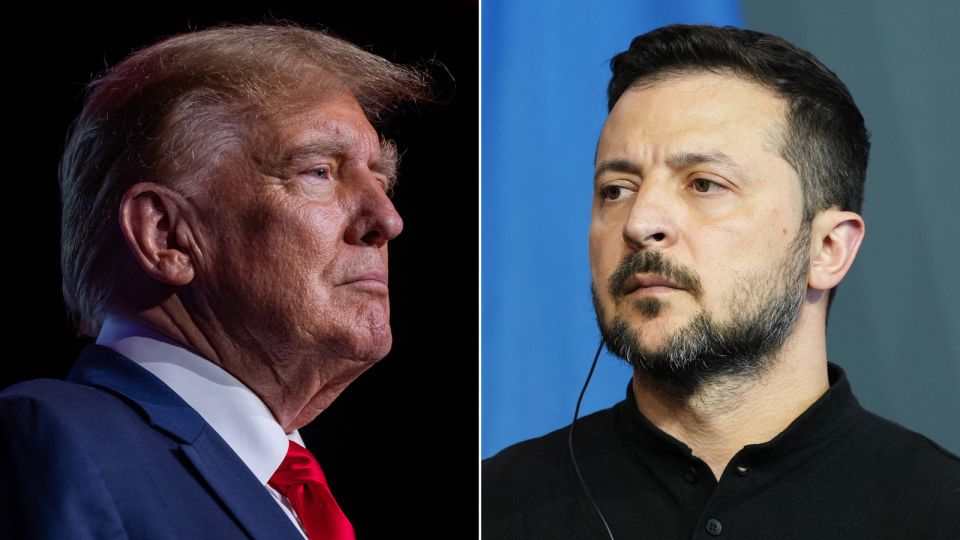
Trump falsely claims Ukraine started war with Russia CNN still from video

Labels: , , , , ,

 
()() Follow @rheytah Tweet