Blog dedicated primarily to randomly selected news items; comments reflecting personal perceptions
Tuesday, July 14, 2026
Ukraine Unsettling Russia in Crimea
"There's no place to hide in Crimea."
"The Ukrainians have the ability to touch every single place where there's an air defense weapon or a logistics hub or an airfield."
Lieutenant General Ben Hodges, retired commanding general of U.S. Army Europe
"To achieve the final objective, this blockade must be intensified."
"This situation must be maintained for a sufficiently long period of time."
Kostiantyn Mashovetz, Ukrainian military analyst
"According to announcements by Ukraine’s drone forces, the USF
(Unmanned Systems Forces), dozens of electrical substations or other
power infrastructure have been hit by Ukrainian robot aircraft across
Crimea in recent weeks, with 38+ strikes claimed in the first week of
July and 45+ in the second week of July. Besides power transmission and
generation infrastructure, attacks have hit gas distribution stations
and compressor stations."
"Most of the strikes have been carried out
by Ukraine’s workhorse FP-2 push propeller drone, a slow-flying plane
roughly the size of a large sofa. USF commanders have said attacks
against the Russia-run power grid in Crimea are succeeding because of
months of preliminary attacks that hit and destroyed Russian air
defenses. The top Ukrainian target in those preparatory drone attacks
has been Russia’s Pantsir gun/missile system, an air defense weapon
designed to shoot down drones."
Stefan Korshak, Kyiv Post Senior Defense Correspondent
Temporarily occupied Crimea (Photo: Reuters)
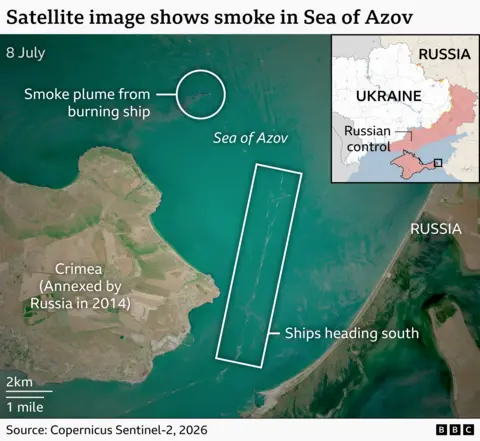
Crimea, annexed by Vladimir Putin in 2014 is being given very special attention at this point in time, a dozen years later by the Ukraine military, where attacks in recent weeks have been increased substantially for the dual purpose of returning the critical geography to its rightful owner, as well as depriving the Russian military of its supply lines. The Kerch Strait Bridge is in Ukraine's crosshairs, the sole direct link to Russia. Ukraine has targeted bridges and roads in its bid to transform the peninsula from its current status as a Russian-occupied fortress into a military nightmare for the Kremlin.
This most recent wave of attacks saw Ukraine targeting air defense and radar systems across the peninsula. The energy grid and fuel reserves have also received attention from the Ukrainian military, battered to the extent that blackouts occur, shaking life in Crimea. Causing Russian forces along the southern front to shift into defensive mode.
In the last week alone, Russia bombarded Kyiv, killing 30 people, in its own show of retaliatory force; its usual tactics, targeting civilian enclaves claiming they were aiming at military targets. A stark contrast in military priorities, where Kyiv focuses on military installations or fuel depots to deprive Russia of its critical fuel lines, and Moscow's response is to hit civilian areas.
Moscow's special attention toward its prize restoration of Crimea as part of Russia saw to it that years were spent fortifying the geography with advanced air defenses and coastal batteries, fighter jets and bomber-packed airfields -- while on land, missile launch systems abounded. Russia gave itself direct access to Crimea when it built the $3.7 billion Kerch Strait Bridge.
Even in the conflict's first years, Ukraine had targeted Russia's naval headquarters in Sevastopol, driving Russian warships from Crimean ports. They were limited however, by the weapons in Ukraine's possession at that time. According to Ukrainian officials now, their arsenal is capable of inflicting more pain, in essence sufficiently so, to convince Moscow it needed to return to the negotiating table.
The view from a Ukrainian drone during what the military says was a strike against Russian tankers in the Sea of Azov. (Commander of Unmanned Aerial Systems Force/Reuters)
Videos were posted by Ukrainian military units in June of their Crimean strikes. The clips are a vital part of Ukraine's wartime propaganda, illustrating battlefield successes against Russia. Russian forces were increasingly attempting to counteract Ukrainian drone strikes by patrolling critical southern routes with drones and interceptor units, according to Kateryna Stepanenko, analyst at the Institute for the Study of War. "But they need more mobile air defense to blunt the impact of Ukrainian strikes" she noted.
Ukrainian commanders anticipate that Russian troops would adapt, to shift their tactics in turn: "Adaptation can take days, weeks or months, but we consistently find new ways to strike in any direction, at any depth, with whatever assets we have", stated Artem Bielienkov, chief of staff of Ukraine's 412th Unmanned Systems Brigade.
Widespread blackouts in Crimea have resulted from strikes on fuel facilities. Local authorities have declared a state of emergency, gas stations have run out of fuel, and thousands fled the peninsula since the latest strikes began by Ukraine. There were Ukrainian strikes on oil and gas storage facilities, compression stations and power plants.
"The occupiers' attempts to fix the damage to key facilities -- like the Tavria and Balaklava thermal power plants, major substations and fuel terminals -- are running into complex technical and logistical problems."
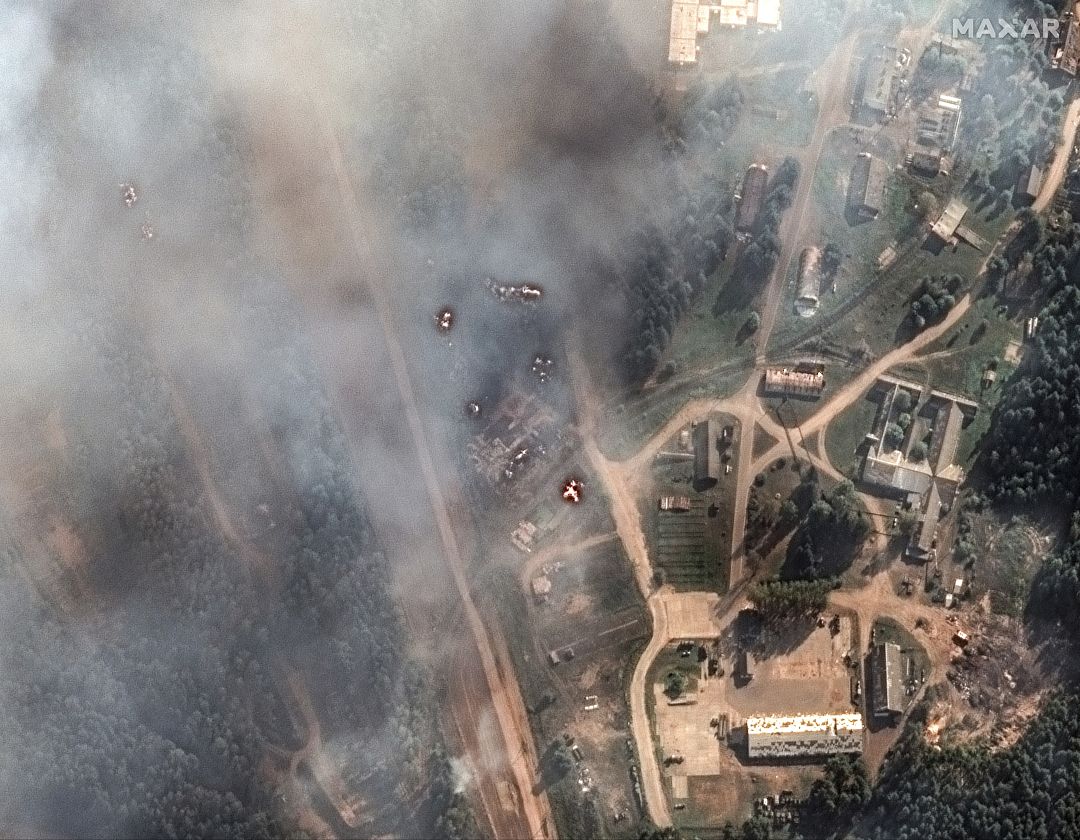
"Renovated in 2018, the facility in Toropets is estimated to have
stored tonnes upon tonnes of military goods, including explosives,
artillery shells and ballistic missiles."
"The former Russian
deputy defence minister Dmitry Bulgakov — who was arrested earlier this
year on corruption charges — said after the renovations that the site
met the 'highest international standards" and could defend weapons from
missiles and "even a small nuclear attack'."
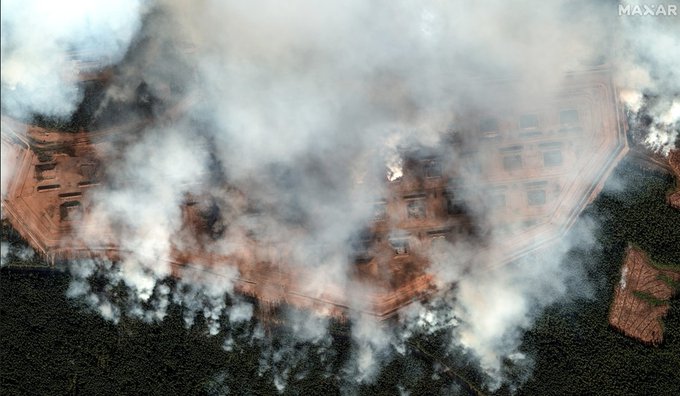
"The storage site covered an area of over 5 square kilometres in size and a perimeter of more than 12 kilometres long."
However, an earthquake-quality force has changed all that; the munitions and the storage site itself is destroyed. This is Ukraine, using whatever means at its disposal to demonstrate to Russia that it has no intention of merely watching as Russian troops occupy Ukrainian territory. For its part, Moscow never imagined that Kyiv's determination to protect itself and its people would muster their collective courage, endurance and newfound fire power to probe as deeply into Russia as Russian forces have done to Ukraine.
It can be surprising to an aggressor to be at the receiving end of attacks they felt assured would never arrive on their own territory while the aggressor state felt confident in its ability, with a larger military and far more weaponry and sophisticated military machinery, to just roll over Ukraine, flatten it, bomb its cities, its hospitals and medical centers, along with schools, shopping centers, electrical grids and apartment blocks, displace millions of people -- and its government would be incapable of responding.
Surprise, surprise, Vladimir Putin. The best-laid plans of mice and men often go astray. As when Ukrainian drones struck the military depot deep inside Russia, resulting in a huge fire, forcing some residents in the town to evacuate. Ukrainian President Volodymyr Zelensky spoke of his plan to end the war, and there's nothing that is so effective in ending a war as pounding your enemy to smithereens before its stockpile of deadly weapons can be lobbed off yet again on your territory.
Military warehouses in Toropets, in Russia's Tver region located about 380 kilometres northwest of Moscow; some 500 kilometres from the border with Ukraine, highlight that the Ukrainian military has expansive plans. That's some penetration. Ukraine has become quite skilled in producing drones and has been putting them to surprisingly good use. Certainly it's doubtful that the Kremlin visualized such scenarios, even in their wildest nightmares.
Ukraine's Security Service, in collaboration with its Intelligence and Special Operations Forces carried out the attack. According to a Kyiv security official, speaking off the record on condition of anonymity the depot housed Iskander and Tochka-U missiles as well as glide bombs and artillery shells. The Ukrainian strikes saw the facility catching fire to burn across a 6-km-wide area. Unsurprising, of course, given the size and nature of the cache. And not so invulnerable to attack as Moscow thought, after all.
North Korean-derived KN-23 short-range ballistic missiles were among the destroyed ammunition. Reflecting a pact Russia and North Korea signed in June for mutual military assistance between Moscow and Pyongyang. The Ukrainian attack employed over 100 domestically produced exploding drones.
As for Russia's side of things, RIA Novosti quoted regional authorities that air defence systems were working to repel a "massive drone attack" on Toropets, with its 11,000 residents. Russian citizens enjoying a taste of what it has been like for millions of Ukrainian citizens during the Russian invasion. As Kyiv continues o develop its drone technology, such successful Ukrainian strikes deep within Russia have been more frequent.
"The attack caused extensive damage to the facility and surrounding forested area which continues to burn."
"The imagery shows extensive smoke covers much of the area and a closer look at the ammunition storage area indicates that fires continue to burn in and near some bunkers."
"In the current context, [de-mining] is probably the job that is most in demand in Ukraine."
"You have to be well prepared psychologically and in good shape to do this work. You have to be very responsible."
Danylo Kudrlavtsev, HALO team leader
"Minefields like this, they really affect the lives of civilians who are doing agricultural work, who are just going to another village, or who are trying to go foraging, or who are trying to just go for a walk with their kids."
"Threats like this affect the life of every Ukrainian."
Olesia Fesenko, HALO Trust de-mining group
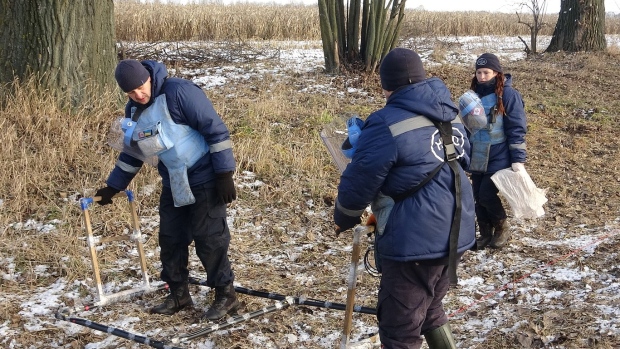
Photo: HALO Trust
Metre by metre HALO Trust workers have been trained to carefully clear mines in Peremoha, Chernihiv and other areas the Russian invasion ravaged. These are explosive devices meant for defense, and laid down by the tens of thousands by armies at war. Once they've served their defensive purpose they remain where they were laid down, lethal weapons, ready to do what they were designed for; blow up vehicles or people or both.
Each of the stakes that are put down on discovery of the location of a mine, marks a spot where de-mining teams have discovered an anti-tank mine. The village of Peremoha is located roughly an hour by car travelling east of downtown Kyiv. This was as far as Russian forces reached before they retreated in March, leaving fields of anti-tank and anti-personnel mines behind, prepared to do the same where they were being re-deployed, in east and south-east Ukraine.
Workers with the HALO Trust organization use a detector as they perform
demining operations in the village of Peremoha, on the outskirts of
Kyiv, Thursday, Dec. 1, 2022. THE CANADIAN PRESS/Patrice Bergeron
The HALO Trust, a non-governmental organization, has trained locals of the area to operate by hand and on foot to aid in the clearing of these mines. There are over 600 local people comprising 98 percent of the HALO Trust staff. Methods for identifying minefields with the use of open-source information and testimonials from citizens represents the groundwork of the organization, in a country where huge numbers of minefields challenge the skills of dedicated de-miners.
Kharkiv in particular, recently liberated by the Ukrainian military's successful counteroffensive is surrounded by huge minefields. Everywhere that battles raged, or where fighting continues, there are mines. That has led to frequent accidents, at times involving children intrigued by the metal devices. Even in the face of HALO raising awareness of the dangers among the public through organized educational events, some 530 in number. HALO teams are able to clear a few hundred square metres in a day.
The initial check by the de-miners is performed to detect the presence of small, hidden anti-personnel mines, readily triggered by a trip wire. Once they are cleared, the job of 'decontamination' to rid fields of anti-tank mines commences. A team makes use of a device resembling a large rectangular frame with a cable connected to a metal detector. The frame is moved by two people over the ground of a precise area. Should the alarm sound, the spot is investigated with use of another, more precise detector.
Once an anti-tank mine is detected, it must be carefully unearthed. That done, the army of other authorities take over the job of detonating or disarming the mine. On occasion a citizen may discover a mine on their property, and call Ukrainian emergency services. The HALO Trust performs an invaluable service in aiding the Ukrainian state apparatus stretched thin by the depth and extent of the need to respond in desperate times.
"[For immediate release]: HHS purchases drug for use in radiological and nuclear emergencies
As part of long-standing, ongoing efforts to be better prepared to save lives following radiological and nuclear emergencies, the U.S. Department of Health and Human Services is purchasing a supply of the drug Nplate from Amgen USA Inc; Nplate is approved to treat blood cell injuries that accompany acute radiation syndrome in adult and pediatric patients (ARS)."
"[The US government:] the procurement of Nplate was not in response to the war in Ukraine,”
"This
is part of our ongoing work for preparedness and radiological security.
It has not been accelerated by the situation in Ukraine."
Health and Human Services, Washington
Photo: Stephen Chernin/Getty Images
"ARS, also known as radiation sickness, occurs when a person’s entire
body is exposed to a high dose of penetrating radiation, reaching
internal organs in a matter of seconds."
"Symptoms of ARS injuries include impaired blood clotting as a result of
low platelet counts, which can lead to uncontrolled and
life-threatening bleeding.:
"To reduce radiation-induced bleeding, Nplate stimulates the body’s
production of platelets. The drug can be used to treat adults and
children."
Health and Human Services, (HSS) Washington
It is a coincidence that soon after Russia's Vladimir Putin, enraged by the West's unconditional support of Ukraine in response to Moscow's invasion of its neighbor, the president once again raised the spectre of his possible ordering of limited nuclear strikes in Ukraine, to counter the advantages seen on the battlefield in the Ukrainian military's counteroffensive, thanks largely both to their spectacular determination and courage and the advanced military technology supplied to them.
Mr. Putin's efforts to put on the face of an impervious military strike crippling Ukrainian defences simply hasn't worked in the reality of the reverse. While Russian troops have become notorious for committing grave war crimes against civilian populations in Ukraine, they have not fared so well against an army countering their stated purpose; to remove the current democratically-elected government of Ukraine, and to reinstall a puppet government faithful to Moscow.
When that initial goal failed and Russian troops reassembled in the Donbas with the stated goal of annexing Luhansk and Donetsk, then extending the annexation plans to two additional provinces, the mettle of the Ukrainian military became obvious in one routing of Russian area and village occupation after another, the Russian servicemen withdrawing in haste, thoughtfully leaving behind their own military hardware to augment the armoury of the Ukrainian military.
People gather in front of a large screen to celebrate the planned
incorporation of regions of Ukraine into Russia in Sevastopol, Crimea on
Sept. 30, 2022. (The Associated Press)
All of which has sat so poorly with Vladimir Putin that he saw fit to darkly refer once again to the potential of bringing in nuclear bombs. For once the announcement was made by Putin that Russia has formally annexed 18 percent of Ukraine in its northeast and south, any attacks there by the Ukrainian military would be interpreted by the Kremlin as an attack on Russia itself. While of course Russia feels it can attack Ukraine with impunity, it bristles with sanctimonious outrage at the prospect of Ukraine attacking inside the Russian border -- yet to be declared.
The purchase of $290-worth of a pharmaceutical to treat acute radiation syndrome (ARS) simply coincided with Putin's threat renewal of nuclear war, however limited. He would not fail to use "all the means at our disposal" in the protection of Russia and its population. "This is not a bluff", he emphasized. Leving the U.S. government to respond that the procurement of Nplate had nothing to do with the war in Ukraine.
"This is part of our ongoing work for preparedness and radiological security. It has not been accelerated by the situation in Ukraine, stated a spokesman for the HSS. The HSS partnered with Amgen along with other pharmaceutical companies for years to procure a maintenance stockpile of Leukine, a drug to treat ARS. Another partnership with Novartis was to determine whether a product used for patients with low blood platelets, known as thrombocytopenia, could be used as well as protection in the event of a nuclear incident.
Sensibly, the supply of Nplate had a well defined purpose: "to save lives following radiological and nuclear emergencies" stated the HSS.
A Sarmat intercontinental ballistic missile is launched from Plesetsk in
Russia's northwest. Russian President Vladimir Putin has warned that he
wouldn't hesitate to use nuclear weapons to ward off Ukraine's attempt
to reclaim occupied regions that Moscow is trying to absorb. (Roscosmos Space Agency Press Service/The Associated Press)