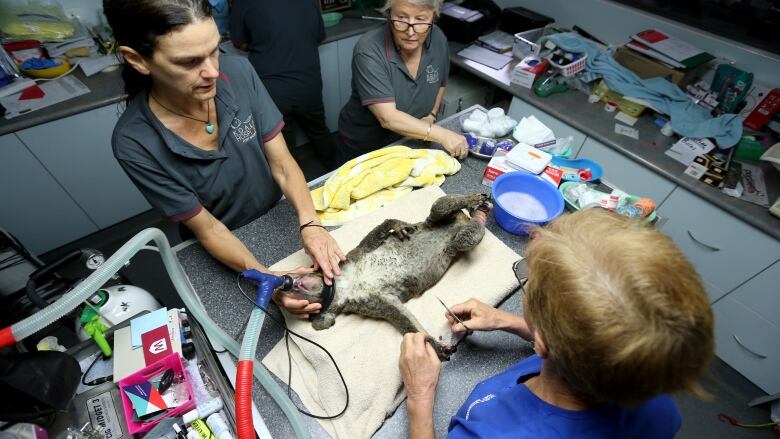
Calling In At The Veterinarian Clinic
 |
| (Credit: iStock/Getty Images) |
"[You go from] not having enough prior -- veterinarians and technicians -- to even worse during the pandemic, where everyone else has to work harder and more.""Instead of having your average emergency shift, one patient every half-hour, you now have four every hour you're trying to deliver care to. Something's gotta give, right?"Dr. Karl Jandrey, associate dean for Admissions and Student Programs, University of California, Davis"When you're dealing with food production and food safety, because of meat inspection and zoonotic disease, which are diseases that can be spread from animals to people, the need for vets] is hugely important. Especially when you think about international trade.""Some people like to go into research, and they never even dealt with an animal in a feedlot, or a pet, but they just go into biochemical research or disease control.""[It's not just about] loving animals. There's also a real intrigue or interest in biology and I think that veterinary training is probably one of the most robust ones as far as comparative medicine, because we look at all these different species.""And so the background that we have in biology, embryology and so forth is a very strong part of our training."Louis Kwantes, president, Canadian Veterinary Medical Association
 |
| Dr. Gabrielle Rosa (right) works with a Chiweenie mixed-breed dog and his owner at the Riverside Access Center in Riverside, Calif. “The challenges facing the veterinary profession are complex,” writes Zoetis CEO Kristin Peck, “but the bottom line is simple: To take care of our animal family members, we must take care of the veterinary profession.” Will Lester—MediaNews Group/Inland Valley Daily Bulletin/Getty Images |
There are reports of a global shortage of veterinarians and veterinary technicians. This did not happen overnight, there has been a long-standing shortage of these animal specialists. These are highly trained professionals trusted to know their specialty in medicine and care for animals. They are not necessarily recognized for either their training or their acquired expertise in following their professional standards of care, and nor do their salaries reflect those of others in the biomedical community.
They face frustration when diagnosing a condition inimical to the life and health of a pet, recommending appropriate treatment and citing the cost to a pet owner. Diagnostic equipment, surgeries and drugs reflect the kind of situations seen in humans under health care awaiting operations and treatment to allow them to live with chronic conditions. Costs are comparable. But people tend to balk at paying the fees associated with animal treatment, mostly because it can be viewed as an unaffordable expense on limited incomes.
 |
| Dr. Kelly Butler owns Ottawa's Vanier Animal Hospital. (Submitted by Dr. Kelly Butler) |
The issue of veterinarian shortages has become more acute, however, since the onset of the global pandemic; more people are adopting pets at a time when their lifestyles changed either temporarily or permanently and they spend more time at home. With more pet ownership, complicated by new COVID-19 social distancing and methods put in place to protect all concerned, examinations take longer to conduct, and less time is available to service everyone with appointments.
Made all the more complex by veterinarians and technicians working overtime to keep up with the calls, eventually going to shorter operating hours.
Toward the end of 2020, 18 percent of Canadian pet owners took on a new pet since the start of the pandemic where at that time 55 percent of households had a pet and since then the numbers have steadily risen. An increase in demand for pet care is the natural outcome of an increase in pet ownership.
The need to increase the number of graduating vets by 3.5 to four percent was highlighted in a study by the Canadian Veterinary Medical Association. At the current rate of 2.5 percent growth, the retirement rate about three percent, demand for greater numbers of veterinarians may peak in 2040. Veterinary medicine requires a post-secondary education before applying to any of the five accredited colleges in Canada, located in Charlottetown, Montreal, Ontario, Saskatchewan and Alberta.
The average annual wage for a veterinarian has a range of between $30,229 to $139,667. The top rate in Canada is realized in Alberta, at $145,253, and the average wage across the country tops out at $97,657. The profession includes diverse roles, such as food safety inspectors as well as those working in the farming and dairy industries in large animal practise.
 |
| Approximately half of all vet techs burn out of the field within the first five years, and 35 percent of them burn out at some point. The Covid-19 pandemic has only magnified that trend. |
Each veterinary school posts its own entry requirements, offering a four- to five-year university degree in veterinary medicine, following which a national certification examination takes place. The graduating veterinarian then requires a provincial licence to practise. And then there's human nature itself and how aspiring vets relate to animals. Dr.Kwantes points out that a high GPA does not necessarily equate with a love of animals, much less good communication skills. "A number of schools ... are looking at different entrance requirements" with a view to accommodating those who may not have the grades, but would make great vets.
According to the Canadian Veterinary Medical Association's 2020 study, close to one in five clinics scaled back hours of operation reflecting a shortage of vets to fill shifts. Open position likelihoods are highest in Quebec and Saskatchewan with the average clinic looking to hire 1.4 veterinarians and 1.8 technicians. In Alberta where 1,800 practising vets look to the province's needs, there are 370 vacancies. In British Columbia the province is anticipating a shortage of 500 vets by 2024,
 |
"Mean age at the time of graduation has increased since 1975, raising concerns that career length for veterinarians may be decreasing, potentially exacerbating veterinarian shortages.""Worryingly, a large number of board-certified veterinarians are nearing retirement within the next 15 years, which may increase the shortage of board-certified veterinarians unless there is a substantial increase in the number of younger veterinarians pursuing board certification.""Most states had a ratio of 1,000 to 1,500 housing units for every 1 veterinarian. States with the lowest number of housing units per veterinarian were mainly located in the West Central and Mountain Regions.""The motivation behind the demographic analysis was to provide information that would help policymakers improve their workforce planning and address issues such as veterinarian shortages and high educational debt among veterinarians, said Frederic B. Ouedraogo, PhD, lead author on the report and assistant director of economics in the AVMA Veterinary Economics Division. Other professions conduct similar analyses, such as a 2016 census identifying 953,695 actively licensed physicians in the United States.""In 2018, the U.S. population of veterinarians who were 65 years old or younger was 102,000, a 30% increase from 2007. More than 3,000 veterinarians graduated from the 30 U.S. veterinary colleges in 2018, and approximately 750 U.S. citizens graduate from foreign veterinary colleges every year."American Veterinary Medical Association
Labels: Global Shortages, Veterinarian Services, Veterinary Medicine, Veterinary Technicians
posted by Pieface @ 8:12 PM
0 comments