Ruminations

Blog dedicated primarily to randomly selected news items; comments reflecting personal perceptions

Thursday, July 30, 2026

Ukraine, A Nation At War Becoming a Military Power
https://www.regionalstudies.org/wp-content/uploads/2020/01/sm-iStock-498504418-300x200.jpg
"Ukraine is now capable of striking Crimea, threatening Russian supply lines."
"Ukraine is fighting. Ukraine is still suffering. Russian missiles have so long hit civilian targets that it is no longer even remarked that such were once recognized as war crimes."
"More sobering, while Ukraine fights on, it is not evident how the war might end. It is entirely possible that Ukraine may not lose, but still not win definitively."
Fr. Raymond J. De Souza, National Post 
https://assets.cfr.org/images/t_gct_w1200/v1765909329/globalconflicttracker/Ukraine_05/Ukraine_05.jpg?_i=AA
Ukrainian infantry soldier in Donetsk trench. Reuters
 
When Russia first fully invaded Ukraine in February of 2022, Poland received almost two million fleeing Ukrainians. No refugee camps resulted. The Poles welcomed the refugees into their homes. A million such Ukrainian refugees are still left in Poland, sheltering themselves from constant Russian bombardment of missiles and drones over Ukraine's cities in the Kremlin's direct targeting of civilian populations, a noted war crime. 
 
More recently, a revival of Polish right-wing populism has arisen and with it hostility to Ukraine, shifting to viewing Russia's Vladimir Putin with a measure of tolerance. Memories are not dead in Poland to the reality of Ukrainian World War II alliances with Hitler's death squads, helpfully assisting in the murder of Poles and Jews through the auspices of the Waffen SS, where an SS battalion of Ukrainian volunteers was formed, during the Nazi occupation of Ukraine. 
 
https://upload.wikimedia.org/wikipedia/commons/thumb/d/db/Nachtigall_Battalion.jpg/250px-Nachtigall_Battalion.jpg
Nachtigall Battalion in 1941
Ukrainian auxiliaries were involved in the murder of Ukraine's Jews. Some of their leaders are still heralded as war heroes in Ukraine to the present day. Poles were their victims as well, while the Soviet military eventually became their liberators from the Nazi extermination project. Russia's President Putin has used that history to explain his full-scale invasion of Ukraine; 'liberating' it from the neo-Nazis still presumably governing the country from Kyiv.
 
Even the Trump administration's soft spot for Putin expressed by President Donald J. Trump has had its influence, which  tended to view Ukraine with suspicion and Russia with a degree of admiration. There has been a levelling off of President Trump's expressed fondness for President Putin now that Ukraine's resolute self-defence has finally put Russia's plans on the back foot. No one appears to have realized that the Russian territorial grab of 2014 when it annexed Crimea and incited rebellion in the Donbas would lead to a full-scale invasion.
 
https://assets.cfr.org/images/t_gct_w1200/v1772290651/globalconflicttracker/2026-02-28T103013Z_800024804_RC2XUJAU14VO_RTRMADP_3_IRAN-CRISIS-BLAST/2026-02-28T103013Z_800024804_RC2XUJAU14VO_RTRMADP_3_IRAN-CRISIS-BLAST.jpg?_i=AA
February 28, 2026 joint strikes by U.S./Israel on Tehran, Iran.  Reuters
 
Ukraine now is recognized as an Eastern Europe military power, producing its own armaments even while it continues to rely on military aid from Europe and North America. Ukrainian President Volodymyr Zelenskyy has been welcomed as an adviser for the Gulf countries under attack by Iran in response to the U.S.-Israel 2026 aerial attacks. Ukraine's formidable counteroffensive while producing millions of advanced drones, has enabled it to hit Russian targets from Moscow right up to Siberia. 
 
Ukraine's fervent wish to become a member of NATO will be realized, post-war. There have been errors in judgement made by President Zelenskyy and he has been brought up short by public anger over them, as when his appointed defence minister and the chief of the Ukrainian military were at loggerheads, the former opting for a new approach in meeting the enemy, the latter wedded to the tried-and-true conventional responses with conventional weaponry. 
 
When given an ultimatum to make a choice, the president fired his popular defence minister only to face days of demonstrations by furious Ukrainians, forcing him to reverse his decision. And the war goes on.
 
Ukraine's President Zelenskiy meets with major general Drapatyi in Kyiv
Ukraine's President Volodymyr Zelenskiy meets with Major General Mykhailo Drapatyi, amid Russia's attack on Ukraine, in Kyiv, Ukraine. Ukrainian Presidential Press Service/Handout via REUTERS
 

Labels: , , , , ,

Tuesday, January 27, 2026

The Gallantry and Honour of the French WWII Military

Image 
 
June 27, 1940: ...But from what I've seen in Belgium and France and from talks I've had with Germans and French in both countries, and with French, Belgian, and British prisoners along the roads, it seems fairly clear to me that:  
                                       France did not fight.
 
If she did, there is little evidence of it. Not only I, but several of my friends have driven from the German border to Paris and back, along all the main roads. None of us saw any evidence of serious fighting.
The fields of France are undisturbed. There was no fighting on any sustained line. The German army hurled itself forward along the roads. Even on the roads there is little sign that the French did any more than harry their enemy. And even this was done only in the towns and villages. But it was only harrying, delaying. There was no attempt to come to a halt on a line and strike back in a well-organized counter- attack.
 
But since the German chose to fight the war on the roads, why didn't the French stop them? Roads make ideal targets for artillery. And yet I have not seen one yard of road in northern France which shows the effects of artillery fire. Driving to Paris over the area where the second German offensive began, an officer from the High Command who had missed the campaign kept mumbling that he could not understand it, that up there on that height, dominating the road and providing wonderful artillery cover with its dense woods, the French must have had the sense to plant a few guns. Just a few would have made the road impassable, he kept repeating, and he would order us to stop while he studied the situation. But there had been no guns on those wooded heights and there were no shell-holes on or near the road. The Germans had passed along here with their mighty army, hardly firing a shot. 
 
At no point in France and at only two or three in Belgium did I see a road properly mined, or, for that matter, mined at all. In the villages and towns the French had hastily thrown up tank-barriers, usually of blocks of stone and rubbish. But the Germans brushed them aside in minutes. A huge crater left by an exploded mine could not have been brushed aside in a few minutes.
 
D.B. in Paris, having seen the war from the other side, concludes that there was treachery in the French army from top to bottom -- the fascists at the top, the Communists at the bottom. And from German and French sources alike I heard many stories of how the communists had received their orders from their party not to fight, and didn't... 
 
Many French prisoners say they never saw a battle. When one seemed imminent, orders came to retreat. It was this constant order to retreat before a battle had been joined, or at least before it had been fought out, that broke the Belgian resistance.
https://www.yadvashem.org/sites/default/files/styles/main_image_1block/public/07_69.jpg?itok=nR5E1Yno
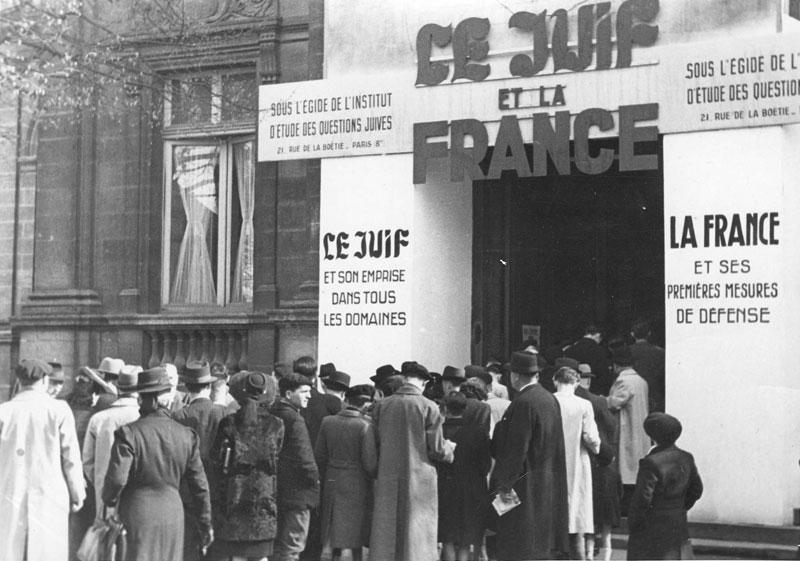
Bordeaux, 1942: the entrance to the anti-Semitic exhibition “The Jews and France”.
 
The Germans themselves say that in one tank battle they were attacked by a large fleet of French tanks after they had themselves run out of ammunition. The German commander ordered a retreat. After the German tanks had retired some distance to the rear, with the French following them only very cautiously, the Germans received orders to turn about and simulate an attack, firing automatic pistols or anything they had out of their tanks, and executing complicated manoeuvres. This they did, and the French, seeing an armada of tanks descend upon them, though these were without ammunition, turned and fled.
 
Another mystery: After the Germans broke through the Franco-Belgian border from Maubeuge to Sedan,  
they tell that they continued right on across northern France to the sea hardly firing a shot. When they got to the sea, Boulogne and Calais were defended mostly by the British. The whole French army seemed paralysed, unable to provide the least action, the slightest counter-thrust.
 
On the whole, then, while the French here and here fought valiantly and even stubbornly, their army seems to have been paralysed as soon as the Germans made their first break-through. Then it collapsed, almost without a fight. In the first place the French, as though drugged, had no will to fight, even when their soil was invaded by their most hated enemy. There was a complete collapse of French society and of the French soul. Secondly, there was either treachery or criminal negligence in the High Command and among the  high officers in the field. Among large masses of troops Communist propaganda had won the day. And its message was: 'Don't fight'. Never were the masses so betrayed. 
https://www.yadvashem.org/sites/default/files/styles/main_image_1block/public/01_314.jpg?itok=mQdXU__7
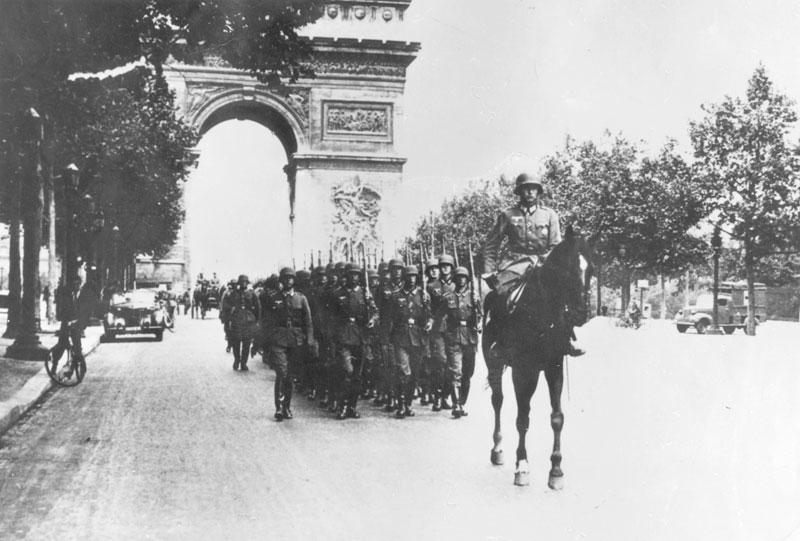
A German military unit, marching down the Champs-Élysées; Paris, 4 July 1940  Yad Vashem
 
July 8, 1940: Tomorrow France, which until a few weeks ago was regarded as the last stronghold of democracy on the Continent, will shed its democracy and join the ranks of the totalitarian states. Laval, whom Hitler has picked to do his dirty work in France -- the notorious Otto Abetz is the main go-between -- will have the French Chamber and Senate meet and vote themselves out of existence, handing over all power to Marshal Petain, behind whom Laval will pull the strings as Hitler's puppet dictator. The Nazis are laughing.
 
July 9: The Nazis are still laughing. Said the organ of the Foreign Office Dienst aus Deutschland, in commenting on Vichy's scrapping the French Parliament today: 'The change of the former regime in France to an authoritarian form of government will not influence in any way the political liquidation of the war. The fact is that Germany does not consider the Franco-German accounts as settled yet. Later they will be settled with historical realism ... not only on the basis of the two decades since Versailles, but they will also take into account much earlier times'.

July 10: Hans came in to see me. He had just driven from Irun, on the Franco-Spanish border, to Berlin. He said he could not get over the looks of Verdun, which he visited yesterday. Not a house there has been scratched, he said. Yet in the World War, when it was never taken, not a house remained standing. There you have the difference between 1914-18 and 1940.
 
William L. Shirer ... The Journal of A foreign Correspondent, 1934-1941 BERLIN DIARY   
 
https://encyclopedia.ushmm.org/images/large/0ce5f028-3213-4f95-a545-efe663fcaa34.gif
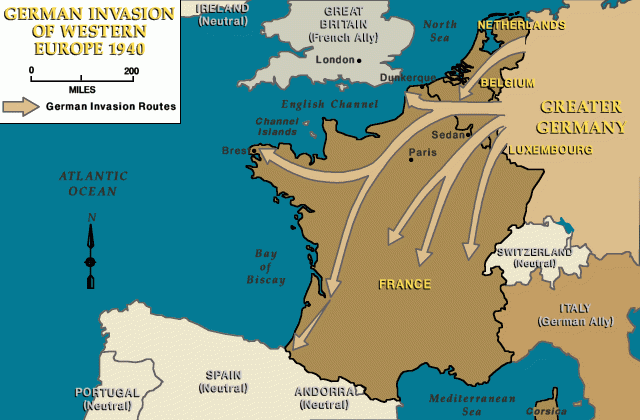
Holocaust Encyclopedia


Labels: , ,

Sunday, January 26, 2025

The Cynical Hypocrisy of the International Community

"Relatively many people survived, which for example barely happened in sites which didn't have such a forced labour component."
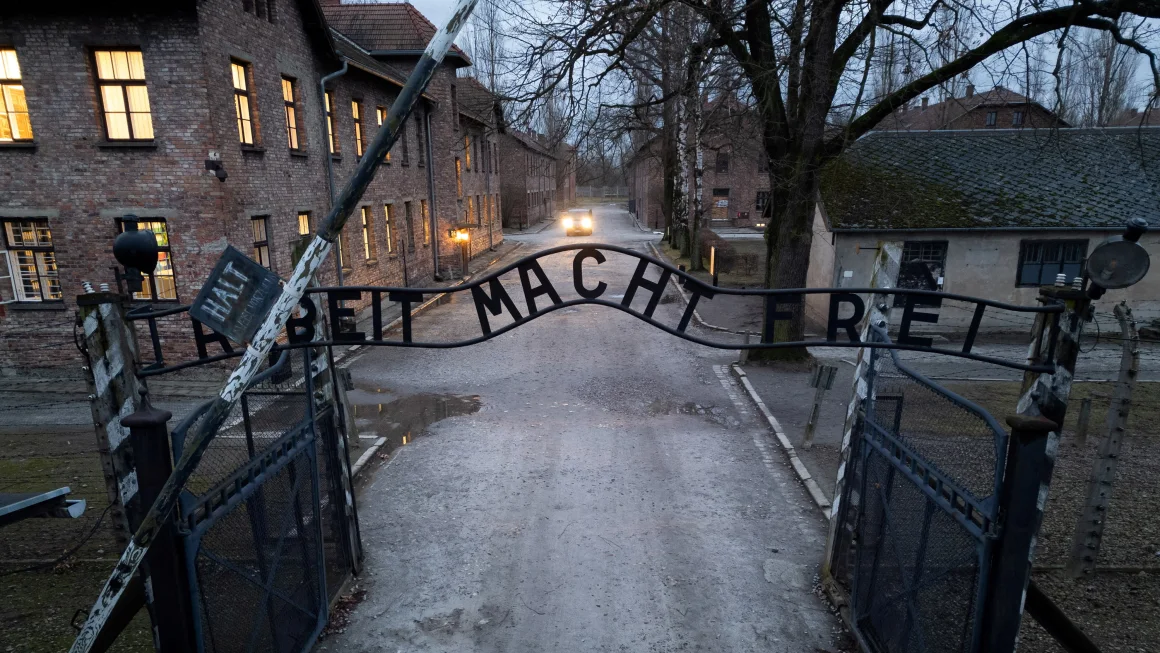
"[As testimony to the past purpose of Auschwitz, maintaining the death camp as a memorial site has its value]: You have the gate [Arbeit Macht Frei], you have the wagon [transport]. You have the incredibly long railway platform which leads to the former crematoria and gas chambers."
Thomas Van de Putte, scholar specializing in Holocaust memory, King's College London

"I saw thousands of tortured people whom the Red Army had saved -- people so thin that they swayed like branches in the wind, people whose ages one could not possibly guess."
Boris Polevoy, Pravda correspondent, eyewitness to Soviet liberation of Auschwitz Jan.27, 1945

"This is the anniversary of liberation. We remember the victims, but we also celebrate freedom."
"It is hard to imagine the presence of Russia, which clearly does not understand the value of freedom."
Auschwitz Museum director Piotr Cywinski
https://media.cnn.com/api/v1/images/stellar/prod/2025-01-23t125508z-33514047-rc2v6cacymkf-rtrmadp-3-holocaust-memorial-auschwitz-survivors.JPG?c=16x9&q=h_653,w_1160,c_fill/f_webp
 
The world is set to mark the 80th anniversary of the most dreadful mass atrocity that a country at war designed in an orgy of hatred against an ethnic population drawn from the countries of Europe whose citizenry included millions of diaspora Jews forced in antiquity from their ancestral homeland for exile abroad by a Roman occupation of the holy land that implacably put down an insurrection of Judean origin in a paroxysm of violence that millennia later was replicated with more modern and equally savage technological means of broader dimensions.

It is highly doubtful that Romans of the period felt it incumbent upon themselves to harvest the hair, skeletal remains, attire, gold dental fillings, marriage rings, to enrich themselves and produce stuffing for pillows, the production of soap from the remains of their victims as Nazi Germany felt disposed to do. The slaughter of children, women and men of all ages may be a casualty of war anywhere at any time when civilian populations bear the brunt of conflict that uproots and victimizes them in loss of home, necessities of life and life itself, but Nazi Germany brought its obsession with the extermination of Jews to a fine art.
https://cdn.theatlantic.com/thumbor/xF31tXC8yTwKZU6Gc2RuReeZB8U=/1200x1607/media/img/photo/2011/10/world-war-ii-the-holocaust/w02_05043944/original.jpg
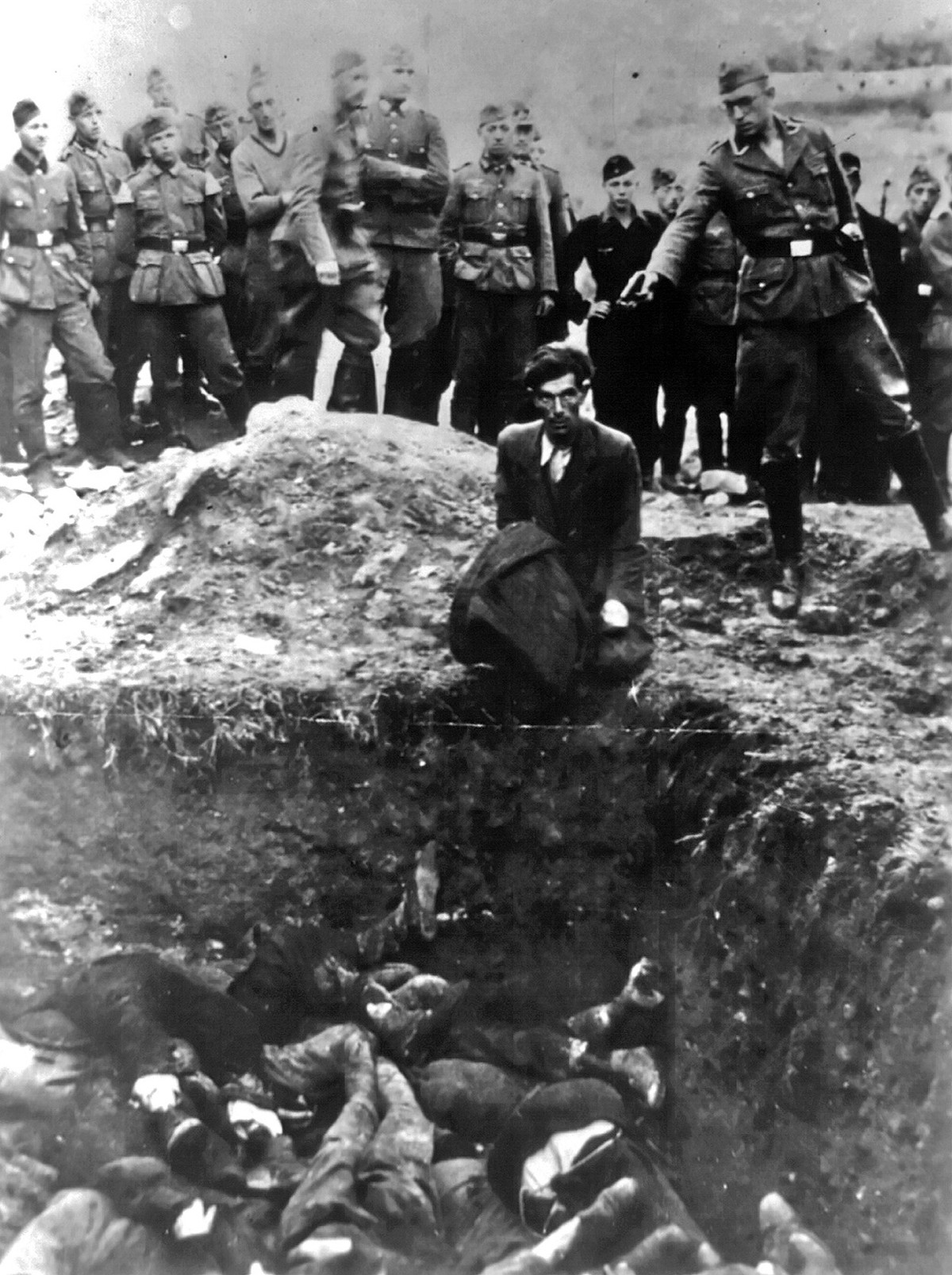
This photo provided by Paris' Holocaust Memorial shows a German soldier shooting a Ukrainian Jew during a mass execution in Vinnytsia, Ukraine, sometime between 1941 and 1943. This image is titled "The last Jew in Vinnitsa", the text that was written on the back of the photograph, which was found in a photo album belonging to a German soldier
 
It took an orgy of mass dementia to organize round-ups, persuade populations that a nest of vipers lived amongst them that German authorities prepared to save them from, infesting those non-Jewish citizens with a suspicion and loathing of Jews they had lived among for centuries to convince them that the goal of extermination would make for a more refined, pure society once the presence of Jews was eliminated. People adapted nicely and deliberately turned their faces away from the putrid agonies of exclusion and humiliation their fellow Jewish citizens suffered, glad when they suddenly vanished into slave labour camps since out of sight, out of mind was a great relief,

Now, generations after the Holocaust for most people inhabiting our familiar world the memory of mass annihilation is beyond faint and growing fainter. Just as the thousands of Jews who managed miraculously to survive have grown old and are growing older, their witness status soon to fade itself, in and out of history. To be sure, others besides Jews died; political prisoners, Poles, Roma, Sinti, Soviet prisoners of war, homosexuals, but it was Europe's Jews that comprised the target focus.
 
This year, on the 80th anniversary memorializing the Holocaust, an estimated 50 survivors are expected to be present, and they will speak to the world once again of their loss, their ordeal, their endurance, their unforgettable memories. Two-thirds of the Jews of Europe perished in that orgy of hate and demonic destruction of human life. They were murdered in the death camps established all over Europe, places like Treblinka, Majdanek, Stutthof, Auschwitz, Buchenwald, Dachau, Mauthausen and Bergen-Belsen among a plethora of others. 

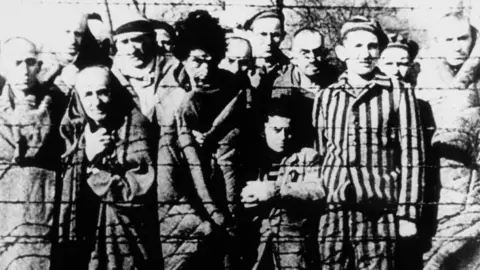
There were survivors at Auschwitz for the simple reason that though it was a death camp it also was a labour camp. Where those who survived the journey to Auschwitz in crowded train transports were separated on arrival into groups deemed sufficiently healthy to work, the others directed to groups who would enter the 'shower rooms' where they were gassed to death with Zyklon B, their remnants cremated in giant furnaces, their ashes belched out of massive chimneys to nurture the surrounding soil.

Presidents, royalty, ambassadors, politicians, rabbis and priests will be among those in attendance to memorialize the fixation of a nation and a continent on the destruction of a tiny ethnic/cultural/religious group that had lived among them for  generations, enriching those countries with their presence as artists, scientists, teachers, factory workers, lawyers, doctors, justices, soldiers, entertainment figures, industrialists, bankers and journalists, bakers and cobblers.
 
https://ichef.bbci.co.uk/news/480/cpsprodpb/ca12/live/96f3a860-db1d-11ef-a37f-eba91255dc3d.jpg.webp

The royalty, presidents, ambassadors, politicians and priests of the time who failed to exert their moral outrage over the persecution, then the demonization, then the isolation, then the ghettoization, then the imprisonment and finally the murder of six million Jews were in a very real sense complicit with the perpetrators of the vast act of genocide. Their present day counterparts are in a very real sense not much different than those during the Holocaust who couldn't be moved to make an effort at prevention and deterrence.

The rising tide of antisemitism which bears such an uncanny resemblance to that of the 1930s and 1940s and the growing calls of accusations against a tiny Jewish state established in its ancestral geography to restore pride in Judaic heritage but above all to give strength to the cry of "Never Again!" by its pledge to protect and guide Jews into the future is once again under existential threat. Collegial nations of the West, supporters of the Jewish state, have managed to remain on the sidelines once again, leaving Israel and Jews to their own defense.

https://ichef.bbci.co.uk/news/1024/cpsprodpb/b671/live/549e7b30-dbe9-11ef-99c3-d14ec5dc850f.jpg.webp
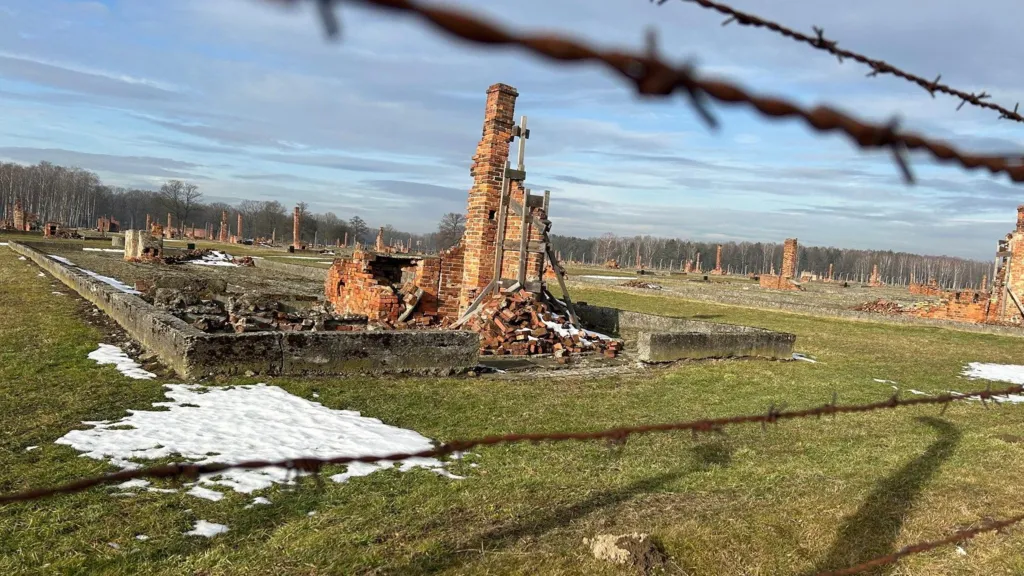
The ruins of the sprawling Birkenau site stretch far into the distance

Labels: , , ,

Thursday, October 31, 2024

Adampol Slave Labour/Death Camp, Poland

"We never had the opportunity to lay a flower for any of our beloved ones who died here. But we will mourn them today. Their souls in heaven will always be with us."
"He [his father Jack Pomeranc] had tremendous anxiety and regrets and fear. [He was] crying and apologizing to his family that he wished he [had] saved them, and he could have but he didn't and should have."
"And at that time, I understood very well that this was something I needed to put closure to for him, since he was traumatized all his life from it."
Today we bring closure to this chapter in our lives."
Michael Pomeranc, son of Holocaust survivor
https://zapomniane.org/wp-content/uploads/2020/10/ADAMPOL-1024x683.jpg
 
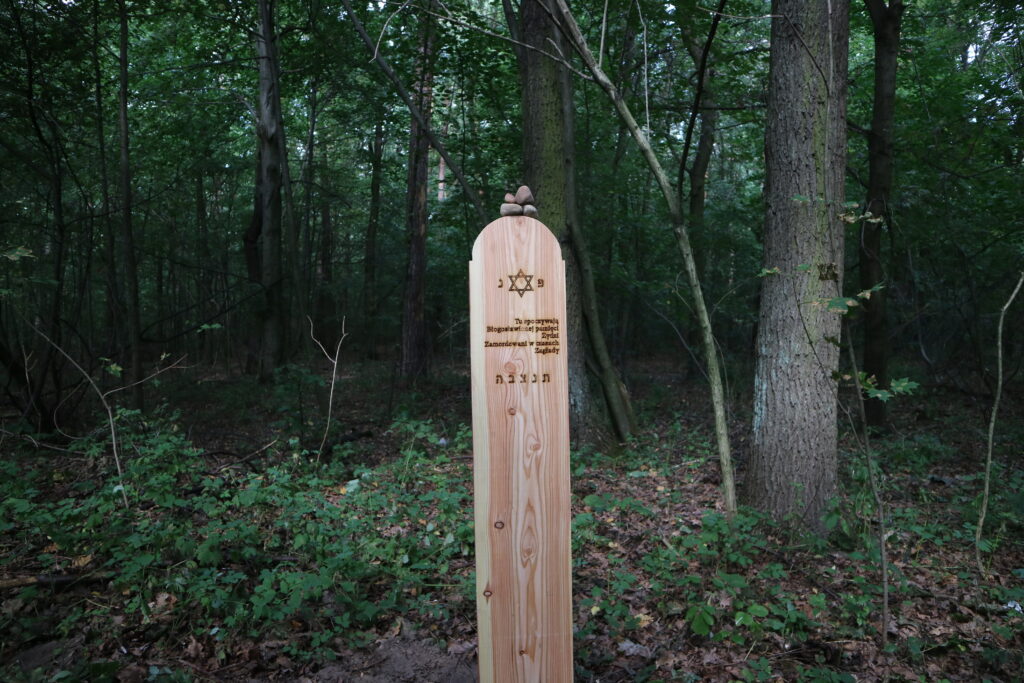
After many long years of planning, Michael Pomeranc and his close relatives fulfilled a personal mission when they took part in a ceremony to unveil memorials to murdered Jews during the Second World War. The venue was a forest in Poland. And the memorial was to honour the Jews murdered by German forces. Dozens of Michael Pomeranc's relatives among them, at a little-known German labour camp named Adampol.

During the dedication ceremony, Pomeranc spoke of his childhood in the United States. Where there were no cemeteries that held the remains of his family members, no graves to visit that held the remains of his predecessors in his family tree. Jews were forced to work as slave labourers in fields nearby the Nazi labour camp. Once their usefulness was over, when they became too weak, too ill to continue labouring, they were murdered, in 1943.

Poland, under Nazi German occupation, was the site of many such labour and death camps where Jews had value as slave labourers and when they could no longer perform the labours assigned to them they were scheduled for mass extermination in the death camps. Auschwitz is the most well-known of all such death camps, but it was only one of many, although it was responsible for the extermination of over a million Jews of all ages.
 
https://assets.editorial.aetnd.com/uploads/2020/01/auschwitz-gettyimages-89237122.jpg?width=2048&height=1332&crop=2048%3A1332%2Csmart&quality=75&auto=webp
Women in the barracks at Auschwitz, Poland, January 1945. Photo taken by a Russian photographer shortly after the liberation of the camp.
 
The event was attended by local schoolchildren in the presence of descendants of Holocaust survivors who witnessed it far from Poland, via livestream. Two living survivors of Adampol are left to contemplate their living hell during that time. Too old and frail to make the trip to Poland. New York city hotelier Pomeranc visited the site 25 years earlier with his father Jack Pomeranc. His father had been imprisoned there but was able to escape, to join Jewish partisans and took part in blowing up Nazi-occupied buildings and train tracks in efforts at war sabotage.

Jack, whose Yiddish name back then was Jankiel, along with a brother and two sisters managed to survive, but his parents and two little sisters, age 3 and 4, along with aunts,  uncles and cousins were all murdered. At the commemoration a memorial with the names of 73 of over 600 victims were included; the only identification so far of those who perished. The organizers' goal is the restoration of identities of as many victims as possible to preserve their memories.

The event is part of a more expansive effort by the Polish Jewish community to commemorate sites of mass murder of Jews during the Holocaust, neglected and unmarked a lifetime after the Second World War. Of the 3.3 million Jews who lived in Poland before the 1939 German invasion, most wee murdered. Polish Chief Rabbi Michael Schudrich along with a group named Zapomniane (Forgotten) aided by non-invasive technologies have succeeded in systematically locating sites of mass burials to mark them for posterity.

So far, witness testimony of local people and technology have aided researchers in identifying over 20 possible mass grave sites in Adampol, verified by a forensic archaeologist who has carried out years of research at the site.

https://static.timesofisrael.com/www/uploads/2024/01/AFP__19990719__SAPA990719760540__v1__HighRes__PolandAuschwitzFenceBarracks-e1706225808675-640x400.jpg
Illustrative photo of electric fences with concrete posts and insulators surrounding the barracks where deportees where held at the Auschwitz concentration and death camp established by the Nazis. (Jack Guez/AFP)

Labels: , , , , ,

Sunday, October 13, 2024

Nuclear Winter : Nihon Hidankyo, Nobel Peace Prize

"[The award was made as the] taboo against the use of nuclear weapons is under pressure."
"[The Nobel Committee] wishes to honour all survivors who despite physical suffering and painful memories have chosen to use their costly experience to cultivate hope and engagement for peace."
Jorgen Watne Frydnes, chair, Norwegian Nobel committee

"We are partners in this fight."
"[The survivors of Hiroshima and Nagasaki] know nuclear weapons the best."
"They know how it feels like, how it looks like,  how it smells when your city is burning from nuclear weapons use."
Beatrice Fihn, past executive director, International Campaign to Abolish Nuclear Weapons
 
Nihon Hidankyo was awarded the Nobel Peace Prize on Friday. This is a Japanese organization comprised of survivors of the wartime U.S. atomic bombing of Hiroshima and Nagasaki in 1945. Nihon Hidankyo won the award in recognition of their tireless activism against nuclear weaponry. The organization's branch chairperson, Yoshiyuki Mimaki had been standing by awaiting the announcement, and when it was given, he cheered: "Is it really true? Unbelievable!", he exulted.

A month ago, yet again, Russian President Vladimir Putin put the world on notice that he had decided to shift his country's nuclear doctrine. This had a defined purpose; to deliver a message to the Democratic West supporting Ukraine's courageous counteroffensive against its neighbour's unilateral move to destroy its independence and reduce the country once again to an appendage of Greater Russia -- Vladimir Putin's yearning for a return of the power of the USSR. 

Russia, he implied, would not hesitate to make use of its vast stockpile of nuclear weapons should those NATO nations supplying Ukraine with defensive weaponry allow it to strike inside Russian borders with longer-range weapons; effectively reducing its measure of the threshold for the potential use of Russian nuclear weapons as a blackmail-deterrent. Simply put, the Kremlin would not tolerate nations sympathetic to Ukraine's courageous response to a full-scale invasion enabling Ukraine to return to Russia the scope of its assault in self-defence.

The International Campaign to Abolish Nuclear Weapons had won the prize in 2017 for its like-minded campaign. As did Joseph Rotblat and the Pugwash Conference on Science and World Affairs in 1995 for "their efforts to diminish the part played by nuclear arms in international politics and in the longer run to eliminate such arms."
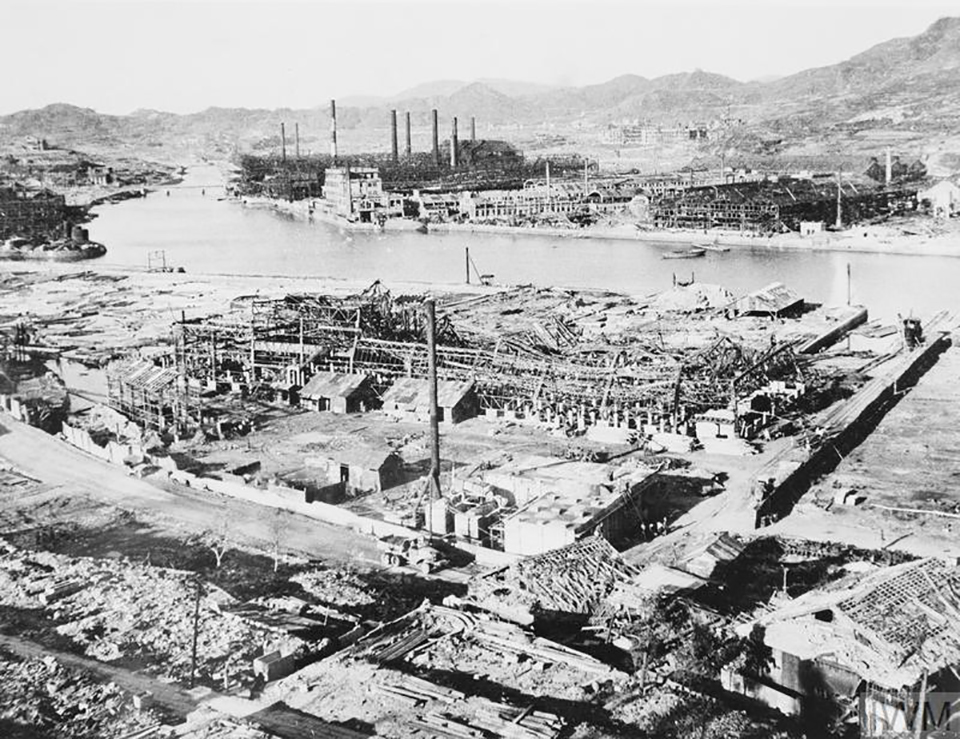
"The two atomic bombs dropped on Japan in 1945 killed and maimed hundreds of thousands of people, and their effects are still being felt today."
"By the end of 1945, the bombing had killed an estimated 140,000 people in Hiroshima, and a further 74,000 in Nagasaki. In the years that followed, many of the survivors would face leukemia, cancer, or other terrible side effects from the radiation."
International Campaign to Abolish Nuclear Weapons
https://www.nationalww2museum.org/sites/default/files/2020-08/N4%20-%20Edward%20Lengel.jpg
Devastation in Nagasaki, 1945. Courtesy Imperial War Museums.
"It is very clear that threats of using nuclear weapons are putting pressure on the important international norm, the taboo of using nuclear weapons."
"And therefore it is alarming to see how threats of use is also damaging this norm."
Jorgen Watne Frydnes, Nobel Committee

Labels: , , , ,

 
()() Follow @rheytah Tweet