Ruminations

Blog dedicated primarily to randomly selected news items; comments reflecting personal perceptions

Sunday, January 26, 2025

The Cynical Hypocrisy of the International Community

"Relatively many people survived, which for example barely happened in sites which didn't have such a forced labour component."
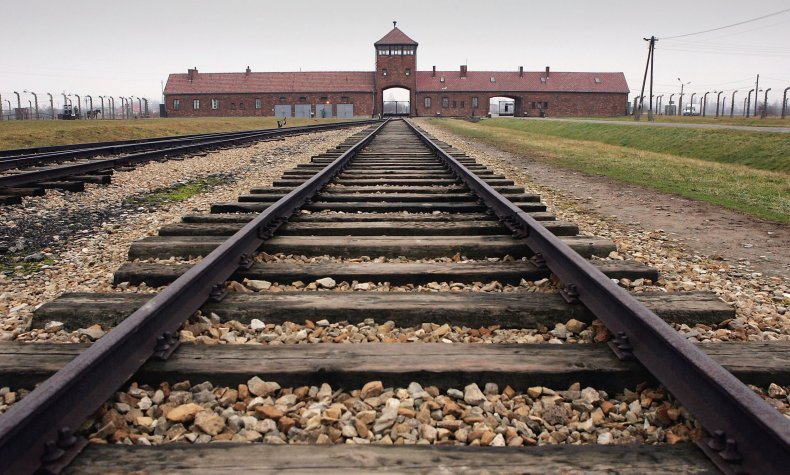
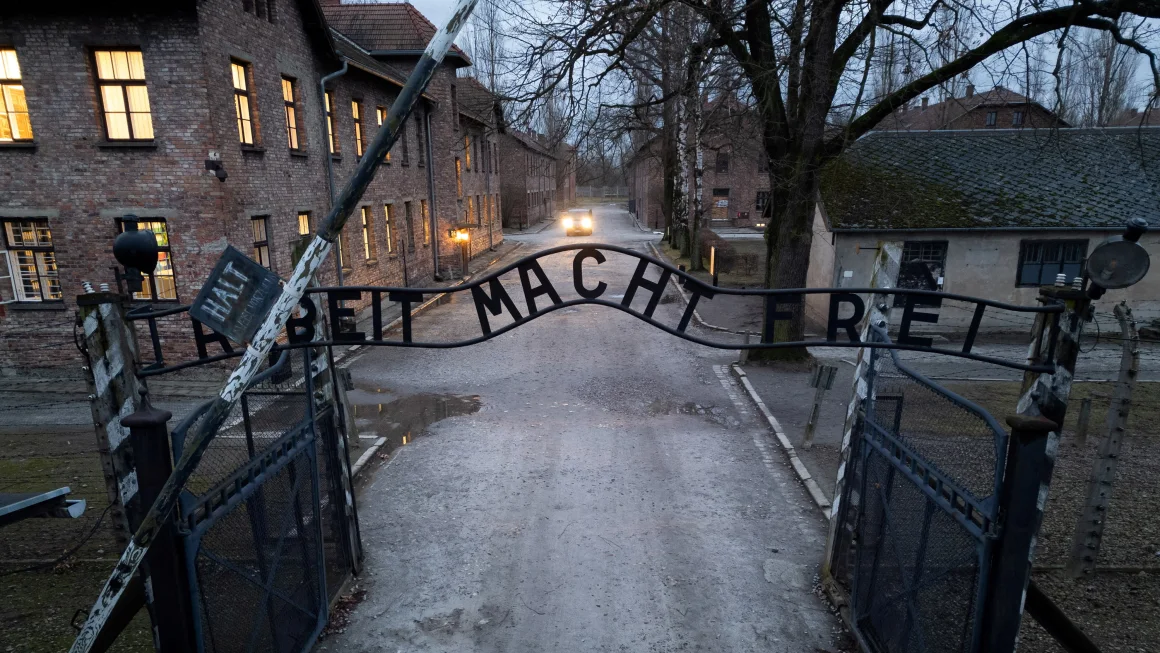
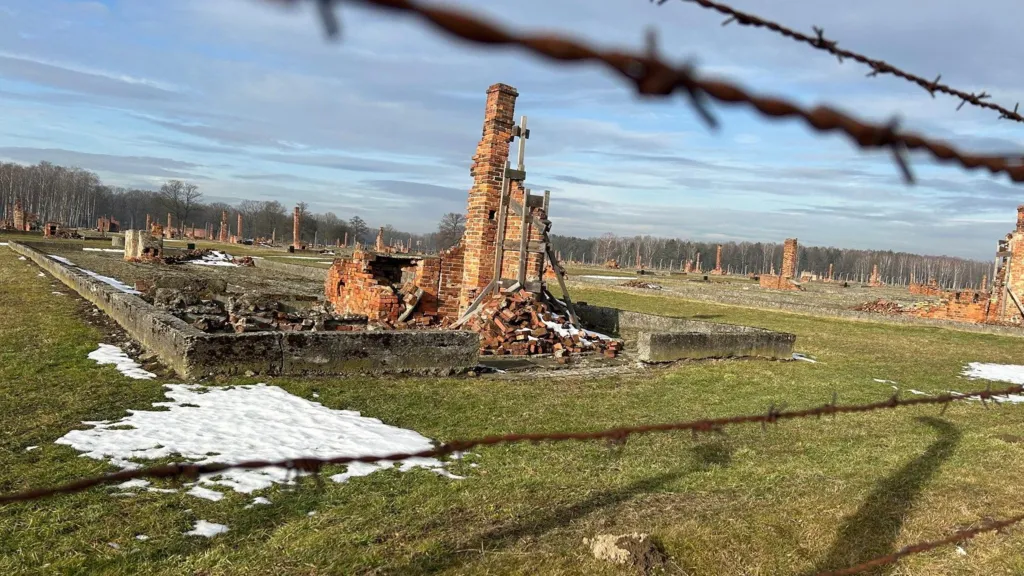
"[As testimony to the past purpose of Auschwitz, maintaining the death camp as a memorial site has its value]: You have the gate [Arbeit Macht Frei], you have the wagon [transport]. You have the incredibly long railway platform which leads to the former crematoria and gas chambers."
Thomas Van de Putte, scholar specializing in Holocaust memory, King's College London

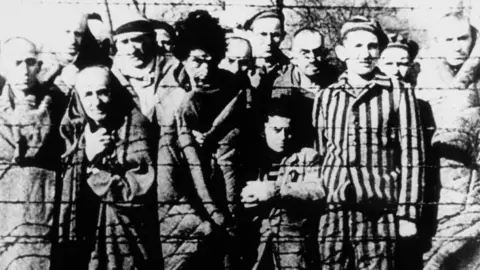
"I saw thousands of tortured people whom the Red Army had saved -- people so thin that they swayed like branches in the wind, people whose ages one could not possibly guess."
Boris Polevoy, Pravda correspondent, eyewitness to Soviet liberation of Auschwitz Jan.27, 1945

"This is the anniversary of liberation. We remember the victims, but we also celebrate freedom."
"It is hard to imagine the presence of Russia, which clearly does not understand the value of freedom."
Auschwitz Museum director Piotr Cywinski
https://media.cnn.com/api/v1/images/stellar/prod/2025-01-23t125508z-33514047-rc2v6cacymkf-rtrmadp-3-holocaust-memorial-auschwitz-survivors.JPG?c=16x9&q=h_653,w_1160,c_fill/f_webp
 
The world is set to mark the 80th anniversary of the most dreadful mass atrocity that a country at war designed in an orgy of hatred against an ethnic population drawn from the countries of Europe whose citizenry included millions of diaspora Jews forced in antiquity from their ancestral homeland for exile abroad by a Roman occupation of the holy land that implacably put down an insurrection of Judean origin in a paroxysm of violence that millennia later was replicated with more modern and equally savage technological means of broader dimensions.

It is highly doubtful that Romans of the period felt it incumbent upon themselves to harvest the hair, skeletal remains, attire, gold dental fillings, marriage rings, to enrich themselves and produce stuffing for pillows, the production of soap from the remains of their victims as Nazi Germany felt disposed to do. The slaughter of children, women and men of all ages may be a casualty of war anywhere at any time when civilian populations bear the brunt of conflict that uproots and victimizes them in loss of home, necessities of life and life itself, but Nazi Germany brought its obsession with the extermination of Jews to a fine art.
https://cdn.theatlantic.com/thumbor/xF31tXC8yTwKZU6Gc2RuReeZB8U=/1200x1607/media/img/photo/2011/10/world-war-ii-the-holocaust/w02_05043944/original.jpg
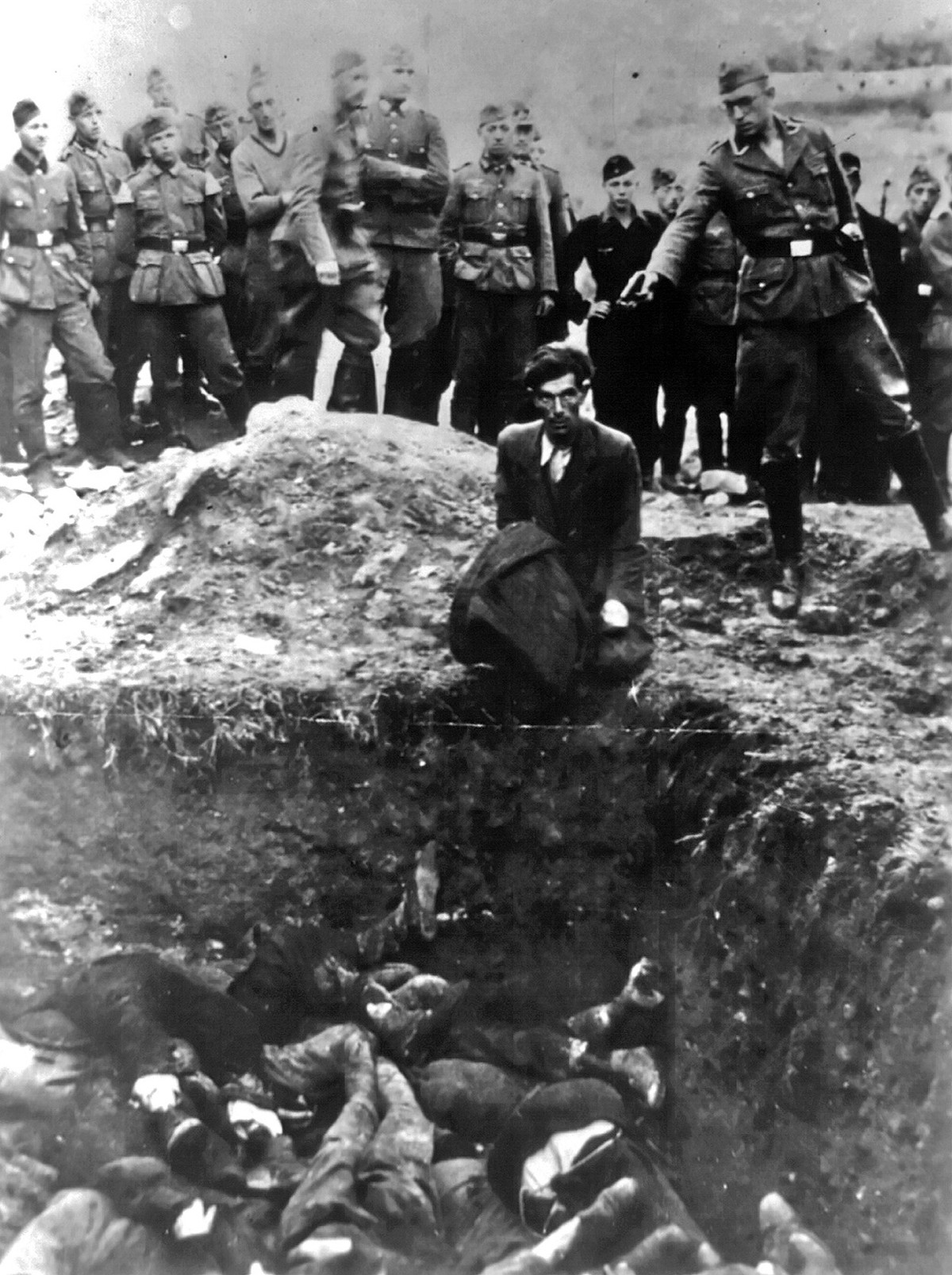
This photo provided by Paris' Holocaust Memorial shows a German soldier shooting a Ukrainian Jew during a mass execution in Vinnytsia, Ukraine, sometime between 1941 and 1943. This image is titled "The last Jew in Vinnitsa", the text that was written on the back of the photograph, which was found in a photo album belonging to a German soldier
 
It took an orgy of mass dementia to organize round-ups, persuade populations that a nest of vipers lived amongst them that German authorities prepared to save them from, infesting those non-Jewish citizens with a suspicion and loathing of Jews they had lived among for centuries to convince them that the goal of extermination would make for a more refined, pure society once the presence of Jews was eliminated. People adapted nicely and deliberately turned their faces away from the putrid agonies of exclusion and humiliation their fellow Jewish citizens suffered, glad when they suddenly vanished into slave labour camps since out of sight, out of mind was a great relief,

Now, generations after the Holocaust for most people inhabiting our familiar world the memory of mass annihilation is beyond faint and growing fainter. Just as the thousands of Jews who managed miraculously to survive have grown old and are growing older, their witness status soon to fade itself, in and out of history. To be sure, others besides Jews died; political prisoners, Poles, Roma, Sinti, Soviet prisoners of war, homosexuals, but it was Europe's Jews that comprised the target focus.
 
This year, on the 80th anniversary memorializing the Holocaust, an estimated 50 survivors are expected to be present, and they will speak to the world once again of their loss, their ordeal, their endurance, their unforgettable memories. Two-thirds of the Jews of Europe perished in that orgy of hate and demonic destruction of human life. They were murdered in the death camps established all over Europe, places like Treblinka, Majdanek, Stutthof, Auschwitz, Buchenwald, Dachau, Mauthausen and Bergen-Belsen among a plethora of others. 

There were survivors at Auschwitz for the simple reason that though it was a death camp it also was a labour camp. Where those who survived the journey to Auschwitz in crowded train transports were separated on arrival into groups deemed sufficiently healthy to work, the others directed to groups who would enter the 'shower rooms' where they were gassed to death with Zyklon B, their remnants cremated in giant furnaces, their ashes belched out of massive chimneys to nurture the surrounding soil.

Presidents, royalty, ambassadors, politicians, rabbis and priests will be among those in attendance to memorialize the fixation of a nation and a continent on the destruction of a tiny ethnic/cultural/religious group that had lived among them for  generations, enriching those countries with their presence as artists, scientists, teachers, factory workers, lawyers, doctors, justices, soldiers, entertainment figures, industrialists, bankers and journalists, bakers and cobblers.
 
https://ichef.bbci.co.uk/news/480/cpsprodpb/ca12/live/96f3a860-db1d-11ef-a37f-eba91255dc3d.jpg.webp

The royalty, presidents, ambassadors, politicians and priests of the time who failed to exert their moral outrage over the persecution, then the demonization, then the isolation, then the ghettoization, then the imprisonment and finally the murder of six million Jews were in a very real sense complicit with the perpetrators of the vast act of genocide. Their present day counterparts are in a very real sense not much different than those during the Holocaust who couldn't be moved to make an effort at prevention and deterrence.

The rising tide of antisemitism which bears such an uncanny resemblance to that of the 1930s and 1940s and the growing calls of accusations against a tiny Jewish state established in its ancestral geography to restore pride in Judaic heritage but above all to give strength to the cry of "Never Again!" by its pledge to protect and guide Jews into the future is once again under existential threat. Collegial nations of the West, supporters of the Jewish state, have managed to remain on the sidelines once again, leaving Israel and Jews to their own defense.
https://ichef.bbci.co.uk/news/1024/cpsprodpb/b671/live/549e7b30-dbe9-11ef-99c3-d14ec5dc850f.jpg.webp
The ruins of the sprawling Birkenau site stretch far into the distance

Labels: , , ,

Friday, January 10, 2025

"Auschwitz. Not long ago. Not far away"

"I had no idea where we were. It was unreal and beyond my imagination."
"After being tattooed [133628] and inducted as a prisoner and losing my identity, I thought this was hell on Earth, from which I had little or no hope of getting out. I was in total despair."
"Only my father's presence gave me some hope."
Nate Leipciger, 96, from Sosnowiec, Poland
 
"[The artifacts, augmented by survivors' recorded testimonies], are the traces of genocide, the remnants of a murdered people, and the material evidence of crimes against humanity."
"They are what remain despite the perpetrators' attempts to conceal their crimes."
Paul Salmon, curator, exhibit catalogue, "Auschwitz. Not long ago. Not far away" 
 
"It's not easy to go to a museum to learn about the particular story of Auschwitz, but sometimes the things that are more difficult are the ones that are more necessary."
"We knocked on many doors. I never got no for an answer."
 Luis Ferreiro, director, Musealia, Spain
 
"[The Royal Ontario Museum's mission is] to help people understand the past, make sense of the present, and come together to shape a shared future."
"[With the Auschwitz exhibit], we could not imagine an exhibition that more materially fulfilled our mission."
"[There is a deliberate attempt to avoid] gratuitous depictions of violence." 
Josh Basseches, museum director and CEO, ROM
Auschwitz
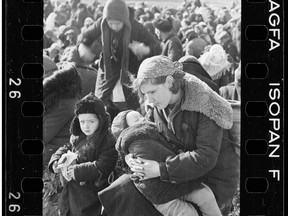
Jews from Lubny, Ukraine, shortly before their murder by an Einsatzgruppe, 1941. This photo is one of the items in the exhibit Auschwitz: Not long ago. Not far away. Photo by Musealia

In 2008, Luis Ferreiro, director of his family's Spanish company Musealia, in mourning after the death of his 26-year-old bother, read psychotherapist and philosopher Viktor Frankl's book, Man's Search for Meaning. It gave him comfort. Viktor Frankl was a survivor of Auschwitz. It was there that his pregnant wife, parents and his brother perished in Nazi Germany's campaign to extinguish all Jewish life in Europe. The book's story of survival and finding purpose in life despite the worst possible circumstances, resonated with Mr. Ferreiro.

Although not a Jew, he took inspiration from the writer's message and decided to pursue "a moral necessity to do something. It was always about Auschwitz for me". He collaborated with the Auschwitz Museum and spent time tracking down other potential involvement in a long but rewarding process to showcase human survival in the most obscene, inhumane period of modern human history. His decision to dedicate himself to this project gave purpose to his own life, through his grief.
 
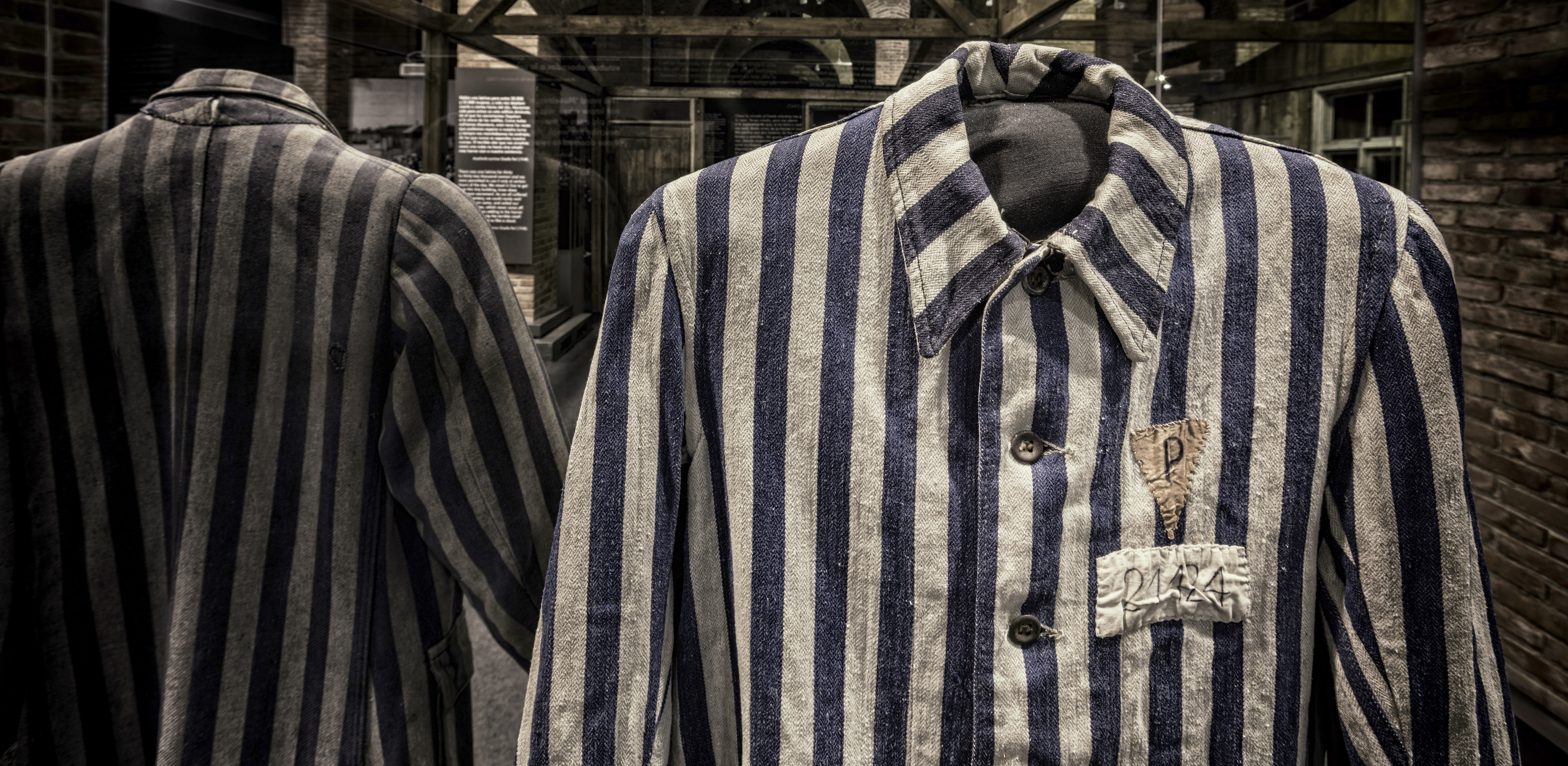
A blue and white striped uniform jacket. There is an upside-down triangle with the letter P on it stitched onto the left breast.
The end product of his research and organizing of an exhibit to feature the Auschwitz death camp during the years of the Holocaust, in the Second World War, opened in 2017 in Madrid. Since then the exhibit has toured in New York, Kansas City the Ronald Reagan Library in Simi Valley, Malmo, Sweden, and Boston. Between 1.4 and 2 million people have viewed the exhibit, according to Mr. Ferreiro's estimation. During his search for collaborators for his project, Mr. Ferreiro discovered Robert Jan van Pelt, professor at the University of Waterloo, among the world's leading experts on Auschwitz, who became the exhibit's chief curator.

At Birkenau, the largest of the nearly fifty sub-camps collectively known as Auschwitz, 96-year-old Toronto resident, Nate Leipciger, Holocaust survivor, who has over the years dedicated himself to educating the public about the Holocaust, had lost his mother and sister, murdered along with eight other members of his extended family. Their lives were taken in the gas chambers of Birkenau.

Of the Nazi death camps scattered throughout Europe, Auschwitz was the largest, most notorious and deadliest. At liberation, photographs of skeletal inmates in striped uniforms and dazed eyes, many too weak to rise from their serried bunks, were  seen worldwide as examples of the Nazi atrocities perpetrated against Europe's Jews in the slaughter of six million of Europe's Jewish communities. 

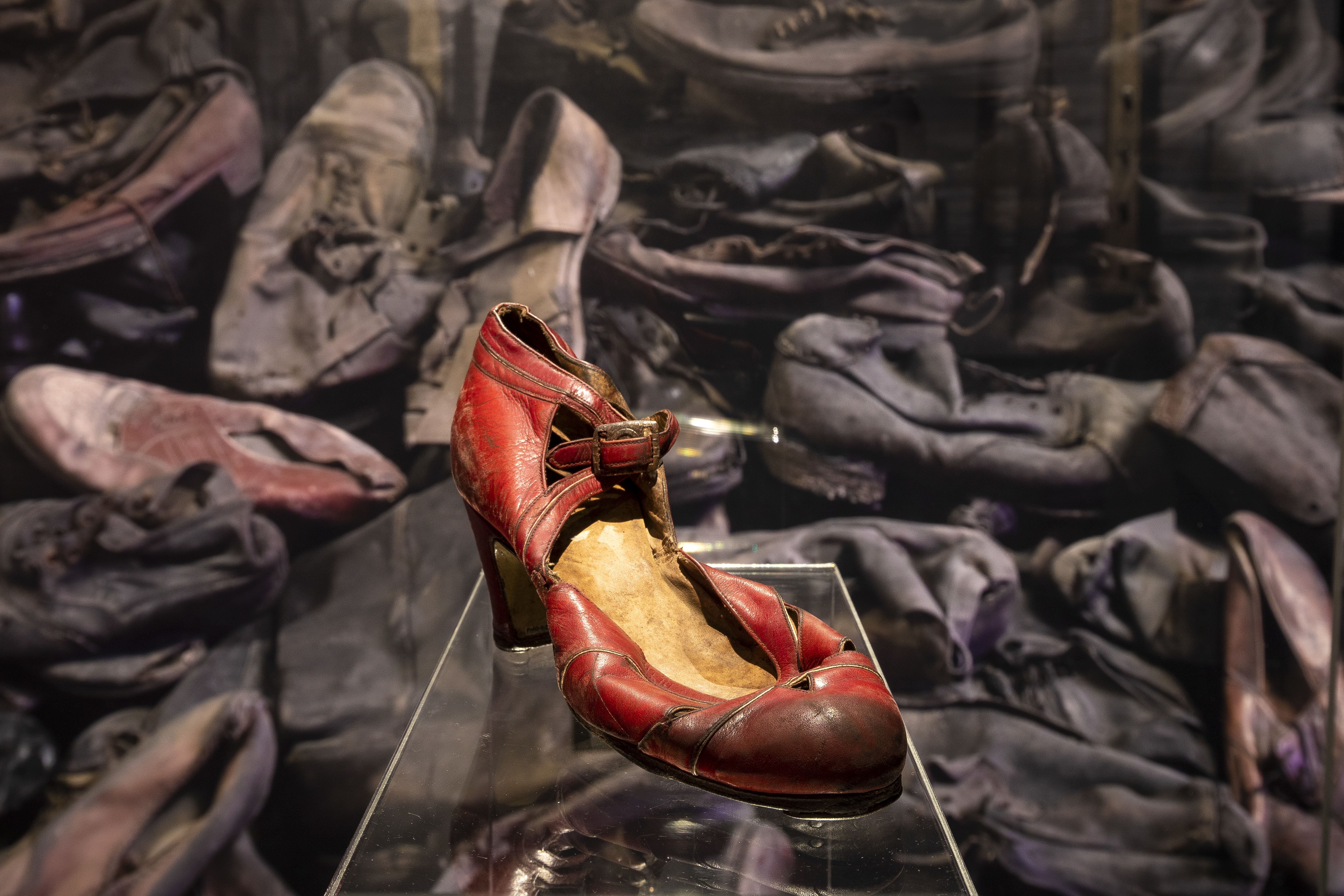
A battered and worn red high-heel shoe, shown in front of a pile of hundreds or other shoes.
Details like crammed boxcars, crematoria, belching chimneys of human ash, barbed wire enclosures, a gate whose legend read "Arbeit Macht Frei" have become symbolic of the Holocaust. 1.3 million people were deported to Auschwitz in the four years of 1940 to 1944; 1.1 million were Jews. 900,000 were gassed soon after their arrival in packed rail boxcars. Others were used for slave labour until they died of exhaustion and malnutrition. Some 75,000 non-Jewish Poles, 21,000 Roma, 14,000 Soviet prisoners of war and up to 15,000 of other categories including criminals, homosexuals, Jehovah's Witnesses and "undesirables", were also murdered there.

On January 10, preceding the 80th anniversary of the camp's liberation on January 27 (annual International Holocaust Remembrance Day), the exhibit will open at the Royal Ontario Museum in Toronto. Over 500 original artifacts, along with hundreds of photographs, charts, drawings, correspondence and diagrams will be shown at the exhibit, most of them on loan from the Auschwitz-Birkenau Memorial and Museum, and from over 20 other institutions.

Among many other items are receptacles that once contained Zyklon B pellets. Belongings of newly-arrived prisoners of the time, are heaped within a large glass case, comprised of everyday common personal items such as shaving material, perfume bottles, eyeglasses, hair brushes, bowls and buttons. Personal property items of the victims were in such abundance they were stored within 30 barracks, referred to as "Kanada", a country imagined to be brimful of wealth.
 
During the Holocaust an estimated 1.5 million Jewish children were murdered or died of deprivation. At a time of steeply rising antisemitism all over the world, a time when knowledge of the Holocaust is fading, the exhibit strives to reawaken a disinterested world's memory and conscience. The exhibit will be on display until September 1. The ROM is its only Canadian destination. The museum has suspended an admission charge for Grades 6 - 12 students in organized school visits.
 
 https://www.rom.on.ca/sites/default/files/styles/hero_image_xl_x2_2812x1580/public/2024-08/AUSCHWITZ_CARTEL_FLAT_CMYK_AF_Web.png?h=1c57675e&itok=_fF7L0mE


Labels: , , , , , ,

Wednesday, November 08, 2023

White-Washing the 14th Waffen SS Galicia

"I don't understand this upside-down universe where people here admire the Waffen SS and somehow that's OK."
"It doesn't embarrass the people at my university very much that they have a [group] that has been laundering Waffen SS reputations and funds for years now."
Karyn Ball, professor, Holocaust scholar, University of Alberta

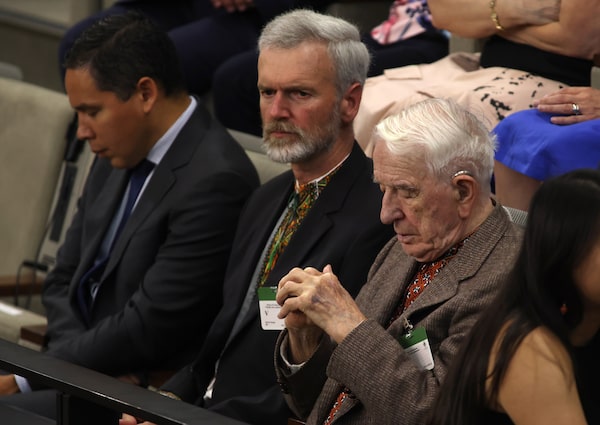
Yaroslav Hunka, right, waits for the arrival of Ukrainian President Volodymyr Zelenskyy in the House of Commons in Ottawa on Sept. 22. The University of Alberta is returning endowment funds from the family of Hunka, a Ukrainian man whose military service was linked to the Nazis.Patrick Doyle/The Canadian Press

After professors at University of Alberta lodged complaints that the University continues to engage in white-washing Nazi crimes, a panel scheduled to discuss the Waffen SS was quietly cancelled. A number of online discussions have been held at the university since an episode involving Ukrainian-Canadian veteran Yaroslav Hunka who served in the Waffen SS was invited to the House of Commons on September 22 on the occasion of Ukraine's Jewish President addressing Parliament. The-then Speaker of the House, ignorant of the Nazi connection, invited the man, characterizing him as a Ukrainian 'hero'.

Despite reality, speakers at the online discussions claim that the 14th Waffen SS Galicia was never involved in Nazi war crimes, attributing such claims to Russian disinformation. When, once again the Canadian Institute of Ukrainian Studies at the university planned another online discussion for October 14, university professors launched yet another protest. Complaints were filed to the university's administration charging the CIUS in whitewashing Nazi collaborators and war crimes. 

The Hunka family had endowed the organized event with $30,000, before it was cancelled. The Waffen SS Galicia was involved in massacres of civilians during the Second World War, and used as well by the Nazis to crush an uprising in Slovakia. The university's vice-president of academics announced the Hunka family funding would be returned to them. "On behalf of the university, I want to express our commitment to address antisemitism in any of its manifestations, including the ways in which the Holocaust continues to resonate in the present", she stated.

Laurie Adkin, a political scientist at the university, called for an investigation of funding and activities of the Canadian Institute of Ukrainian Studies. Recently an article in  media outlet Progress Report revealed that the university took money from Hunka, as well as from other Waffen SS members, accepting as well funds from the estate of Volodymyr Kubijovyc, a Nazi collaborator who founded Waffen SS Galicia, advocating for ethnic cleansing, for a Ukraine without Jews or Poles.
 
Monument to the people slaughtered by the 14th Waffen-SS at Huta Pienacka. Image via Stako
 
Another veteran of the Waffen SS Galicia division, Peter Savaryn, had served at the University of Alberta as chancellor from 1982 to 1986. He helped to fund the CIUS and had been awarded the Order of Canada in 1987. Among nationalist Ukrainian-Canadians, members of Waffen SS Galicia are viewed as heroes, reflecting their battles against Soviet forces, at that time in the war fighting the Nazis with the Allied coalition. Oakville, Ontario and Edmonton, Alberta both host monuments in honour of the Ukrainian SS troops.

There is a sharp distinction from that group to the 40,000 Ukrainian-Canadians who were members of Canada's military, fighting the Nazis, for whom no monuments have ever been erected in honour of their loyalty to democratic values and Canada. A 1980s study of war criminals in Canada found 600 former members of SS Galicia still resident in Canada. "The Division was an SS division and technically all of its officers and senior NCOs are liable for trial as war criminals", a 1948 British government report noted.
"The University of Alberta says it is reviewing other donations it has received after returning $30,000 from the family of Yaroslav Hunka, a Waffen SS veteran who got a standing ovation in Parliament during a visit by Ukrainian President Volodymyr Zelensky last month."
"The university is facing calls to return hundreds of thousands of dollars in endowments in the names of Ukrainians linked to the Waffen SS Galicia division, who were admitted to Canada after the Second World War. They include an endowment of about $430,000 in the name of Volodymyr Kubijovych, who played a key role in the SS unit’s establishment in 1943."
The Globe and Mail
https://assets.nationbuilder.com/progressalberta/pages/3095/attachments/original/1696476361/STORY_ART.jpg?1696476361
Left image: Peter Savaryn (left standing) and Volodymyr Kubijovyč (center sitting) pictured here at the 1976 contract signing between the Canadian Institute of Ukrainian Studies and Shevchenko Scientific Society of Europe to collaborate on the Encyclopedia of Ukraine. Right image: Volodymyr Kubijovyč (circled in red) gives a Nazi salute at the 14th Waffen-SS recruitment ceremony in 1943.

Labels: , , , , ,

Saturday, April 18, 2020

Witness To Genocide : Margit Buchhalter Feldman

"Margit [Buchhalter Feldman] devoted her life to telling her inspiring story and touched the hearts of thousands of students, educators and members of the community."
"Her goal was to inspire people to stand up for one another and fight against all forms of prejudice and hate."
Obituary, Margit Buchhalter Feldman, 90, Somerset, New Jersey, COVID victim
Holocaust survivor Margit Buchhalter Feldman, 90, died Tuesday of 
the coronavirus.
Holocaust survivor Margit Buchhalter Feldman, 90, died the coronavirus. (Twitter)

"It is important for me to remember that 6 million of my fellow Jews were slaughtered, and a million and a half of those victims were children."
"I am here and I firmly believe it is because God wanted me to survive and be here and tell the free world what an uncaring world did to its fellow human beings."
"You were put into a barrack, where people died. The straw that you laid down [on] was full of whatever came out of their bodies -- vomit or excretions. It didn't take 24 hours for your body to get covered with lice."
"I rose from the ashes of Auschwitz, Krakow, Greentsery, Bergen-Belsen as a child of 15 years of age from the Holocaust to rebirth and a new life."
Margit Buchhalter Feldman
"Her legacy is best captured in her work to ensure that the world never forgets the horrors of the Holocaust."
"Margit gave us so much hope over her 90-plus years."
New Jersey Governor Phil Murphy

"She was just an extraordinary human being, to have lived through all that, to have lived that life and to have suffered through those camps, yet to be grateful for life, to see the promise of tomorrow, she was just such an exceptional person."
"After living through that hell, she was blessed with the gift of authenticity. She lived fearlessly and she loved fearlessly."
"It's like there was nothing that the world could do that would cause Margit to live anything less than with full authenticity and the full measure of her being."
Jim McGreevey, former Democratic State Assemblyman, former New Jersey Governor 
A photo dated April 1945 of women prisoners of the Bergen-Belsen concentration camp gathering dead fellow inmates before burying them. BRITISH ARMY HANDOUT

This courageous woman who defied the intention of the Third Reich to slaughter her as they had done her close and extended family, her parents and her relatives, lived to make a full life for herself, to raise a family of her own and to become a valued member of the society in which she lived. She was born in June of 1929 in Budapest as an only child. She and her family were forced to leave their home in the agricultural town of Tolcsva, all that they owned no longer theirs. Imprisoned nearby temporarily, then shipped off to Auschwitz.

There she no longer was to know herself as Margit Buchhalter, but A23029, the tattooed number burnt into her flesh as a concentration camp inmate destined for extermination. She was only fifteen, but passed herself off as 18, a life-saving decision on her part, which ensured she would be sent to slave labour camps before being sent to a death camp. She recalled "big heaps and mounds of dead bodies laying all around", as people died of hunger, exhaustion and disease, during her time as a forced labourer.

She was liberated on April 15, 1945, alone and deathly ill, suffering from pneumonia and pleurisy, seriously injured as well, when the Germans attempted to destroy the camp with the use of explosives. She was nursed back to health in Sweden, recovered, and chose to move to the United States in 1947 where she was received an education as an X-Ray technician. Her work led her to meet her future husband who was recovering from tuberculosis, at a hospital in New York.

She and Harvey Feldman married in 1953 and raised two children together, who eventually gave them three grandchildren. On Tuesday, Margit Buchhalter Feldman died of the effects of COVID-19. Her husband Harvey remains hospitalized with the novel coronavirus. Their son is now a doctor, and he works on the front lines of the New Jersey pandemic where over 75,000 confirmed cases of coronavirus have been identified, causing over 3,500 deaths.

Although this Holocaust survivor spoke nothing of her painfully wrenching experiences for many years, there was an occasion when she had agreed to speak to young students in her Bound Brook, New Jersey neighbourhood whom she introduced to the unspeakable catastrophe that had befallen  her family of 70 related Jews, and of her incarceration in a number of concentration camps as a slave labourer. The children's reaction inspired her to continue her work as a witness to genocide.

In 1991 the-then state assemblyman Jim McGreevey collaborated with this survivor to promote Holocaust Education in New Jersey through the formation of a special commission. She went on to help pass a bill mandating a Holocaust and genocide curriculum in public schools in the state, while speaking to classrooms of children for years, and finally releasing a 2003 book detailing her life as a teenage survivor: "Margit: A Teenager's Journey Through the Holocaust and Beyond".

Holocaust
The railway tracks leading to the main gates at Auschwitz II - Birkenau Scott Barbour/Getty

Labels: , , , , , ,

Friday, May 11, 2018

Asperger's Unfortunate Connections

"Asperger managed to accommodate himself to the Nazi regime and was rewarded for his affirmations of loyalty with career opportunities."
"The [child euthanasia] program served the Nazi goal of eugenically engineering a genetically ‘pure’ society through ‘racial hygiene’ and the elimination of lives deemed a ‘burden’ and ‘not worthy of life’."
Herwig Czech, medical historian, published paper

"There were at least 42,000 camps across German-occupied Europe: 980 concentration camps, 1,150 Jewish ghettos, 500 forced brothels, 1,000 camps for prisoners of war, and 30,000 slave labor camps, in addition to unknown thousands of transit centers and lethal medical facilities. Millions were involved in their staffing. Each place required administrators, guards, maintenance crews, cooks, insurers, truck drivers, food sellers and suppliers. Each required people in the community to look the other way."
"In contrast to mechanized images of the Holocaust, child-killing involved personal deliberation of individual cases. This was intimate, done by the very doctors and nurses who cared for the children’s daily needs. Asperger and his colleagues had a godlike autonomy to determine a child’s worthiness to exist. They were not following a clear rulebook, but deciding life and death on a case-by-case basis — talking to the children directly, meeting their parents and studying them closely over time. Far from his postwar reputation as a resister, Asperger worked within a system of mass killing as a conscious participant, very much tied to his world and to its horrors."
Edith Sheffer, Senior Fellow, Institute of European Studies, University of California, Berkeley, author  Asperger’s Children: The Origins of Autism in Nazi Vienna

"As an organization, we do not want to be aligned with someone associated with the Nazi regime. At the same time, we support a community that is resistant to change and have to take this into consideration."
Asperger's Society of Ontario

"[Future use of the term 'Asperger'] is a discussion that must incorporate the views of autistic people."
Simon Baron-Cohen, editor, Molecular Autism
Hans Asperger, Austrian pediatrician at the University Pediatric Clinic, Vienna, about 1940
Hans Asperger, Austrian pediatrician at the University Pediatric Clinic, Vienna, about 1940    Pictorial Press Ltd / Alamy Stoc

An Austrian pediatrician by the name of Hans Asperger studied and treated children who exhibited symptoms of mental abnormality. His clinical observations identified these children as functionally 'disabled'. He enlisted and offered his expertise in the 1940s Third Reich purification scheme to rid society of any it judged to be "genetically inferior". He became a functionary of the Nazi regime by referring disabled children to the Am Spiegelgrund clinic in Vienna.

There, hundreds of children were murdered, poisoned in a program that was labelled Aktion T4.  Historian Herwig Czech documented Dr. Asperger's collaboration with the Nazi regime, publishing his findings in the journal Molecular Autism. His article outlined Hans Asperger's connection to German WW-2 era National Socialism, linked to "race hygiene". In addition, historian Edith Sheffer provided even more details in her newly published book, Asperger's Children: The Origins of Autism in Nazi Vienna.

In both published accounts, the experience of two children, Herta Schreiber and Elizabeth Schreiber, children unrelated to one another, were identified as having been signed over to the extermination program, his personal comments distinguishing them as 'unbearable burdens'. This professional man of science who viewed children on the autism spectrum who are classified as "mildly affected" relative to the most autism-impacted, signed their death warrants with little trouble to his conscience.

The present day revelations about the actions and responsibilities in mass murder undertaken by the Nazi regime in cleansing societies of malfunctioning members as useless drags on the public weal has placed the name 'Asperber's' in huge disrepute. No one relishes having a medical condition named after a fascist totalitarian scientist who happened to have an identified condition named after him.

In 2013 the diagnosis of Asperger's syndrome was removed as a stand-alone condition from medical books, and placed within the autism spectrum. As it is, those representing the best interests of people identified as suffering from Asperger's and advocating for their interests, have been struggling with a public perception of such people as being pathologically disturbed and potentially dangerous.

Whereas in reality people with Asperger's syndrome are often victims in society, not its predators and criminals. Mental illness is far likelier to produce vulnerabilities taken advantage of by others, than disturbed people acting out as perpetrators of criminal activity. Autism Spectrum Disorder has a branch devoted to Asperger's and these are basically people experiencing difficulties in adjusting to the social mainstream.

That individuals must countenance awkward public attention brought to bear through misunderstanding of the condition is one thing; adding to it an inglorious history with a connection to the health professional who first identified the symptoms and named the condition as one of mental inferiority and had the honour of it being named after him, is quite a lot to bear.

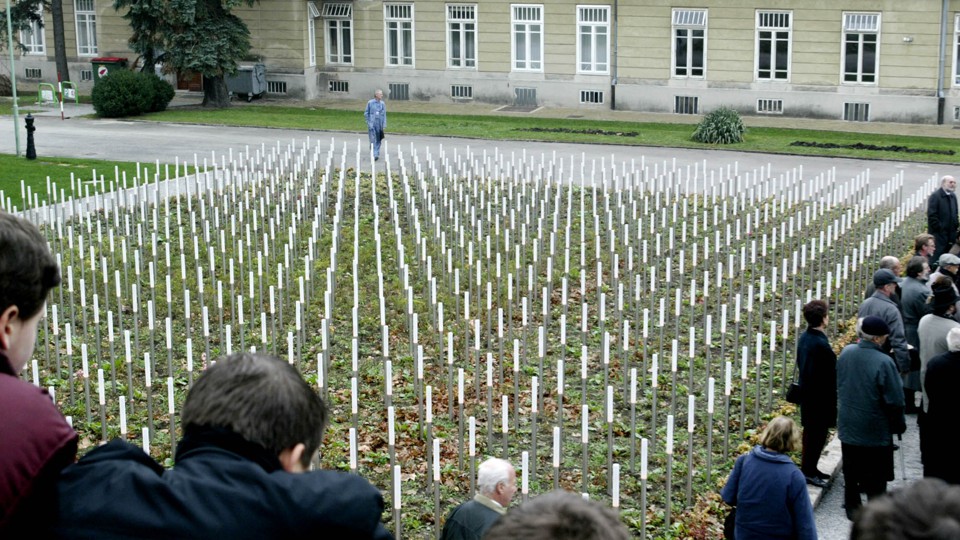
A memorial for children murdered at Am Spiegelgrund
Ronald Zak, AP   A memorial to children murdered at Am Spiegelgrund, including those referred by Hans Asperger

Labels: , ,

Wednesday, August 31, 2016

Who Knows What Evil Lurks in the Heart of Men?

"Is it bad, is it egoistic when people who have been placed in certain positions try to do something that is beneficial for them, even when they know that by doing so they end up harming someone else?"
"[No one] could have been better than he [Joseph Goebbels] at transforming from a civilized, serious person into that ranting and raving hooligan."
"I just didn't listen [to Goebbels's 'total war' declaration of 1943]. Because it didn't interest me. That was a stupidity within me, I know this now."
"No, I wouldn't see myself as being guilty. Unless you end up blaming the entire German population for ultimately enabling that government to take control. That was all of us. Including me."
"The people who today say they would have done more for those poor, persecuted Jews, I really believe that they sincerely mean it. But they wouldn't have done it, either. By then, the whole country was under some kind of a dome. We ourselves were all inside a huge concentration camp."
Brunhilde Pomsel, shorthand writer, Nazi propaganda minister Joseph Goebbels

Having reached the ripe old age of 105, Ms. Pomsel has had a long time to muse upon her enabling role as a cipher in the machinery of Nazi Germany; more than that, she aided and abetted the process of diminishing Europe's Jews from human beings to disposable scum. In introspection she feels she did no more and no less than anyone else in her place might have done. Thinking of her need to be employed, to be comfortable and accepted, knowing that there was a cost in what she pursued and it was a cost borne by millions of persecuted, ultimately exterminated Jews.

She is considered to be the last witness of the processes by which the Nazi regime focused on its goal of genocidal intent, the mass extermination of a despised 'race' to whom all the ills of the world were attributed. This institutionalized, bitter racism took second place to nothing; given equal treatment to the equally vital work of leading the Axis powers to eventual victory over the Allies. Nazi Germany succeeded to a surprising degree in its annihilation of Europe's Jews, but the victory of conquest on the world stage eluded it.

Ms. Pomsel was born in 1911 Berlin, and for a while she was a stenographer working for a Jewish lawyer, then went on in her early 20s to work as a typist for a right-wing nationalist. Soon afterward connections helped her land a position in the broadcasting station of the Third Reich from which, nine years later, she transferred to the Ministry of Public Enlightenment and Propaganda where she worked under Goebbels. Goebbels, she recalled, was the mastermind, "an outstanding actor", the mastermind of denigration and hatred.

She had never, she insists, had any inkling of the plan to exterminate Jews en masse for she was not privy to that information. Her eyes and ears were busy elsewhere. Knowing nothing about Nazi war crimes let alone mass killings she was simply a hard-working woman hoping to achieve some measure of success in her working life. She remains a still-living participant in a historical event of immense significance representing the capacity of ordinary people to live in an era of bloody murder on a vast industrialized scale, but seeing nothing, hearing nothing, knowing nothing.
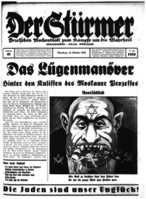
Der Stuermer caricatureTitle: Insatiable
The lead article is on the Moscow show trials. The cartoon caption: “Far be it from the Jews to enslave a single people. Their goal is to devour the entire world.”
October 1936 (Issue #41)

Accepting whatever their government instituted, willing themselves to believe that Germany was fighting a just war against nations seeking to destroy it; living their lives with no curiosity whatever related to business that didn't touch them personally because they would not let it and to remain untouched one must know nothing. So that later, in self defence the 'nicht schuldig' response could exonerate one from any and all responsibility, even though their acceptance of what they felt they could not change meant that they were enablers of evil.

A film produced by four directors is the venue and vehicle in which Ms. Pomsel describes her experiences and her thoughts. "A German Life" premiered in June in Germany, full of archival material, quotes from the propaganda minister, and interviews with Ms. Pomsel. Its purpose, meant to remind the world of the barbarity that proceeded with utter impunity to rid the world of a pestilence masquerading as an ethnic, cultural, religious, historical group of people who refused to go gently into that dark night but succumbed nonetheless.
"The dangers are still alive. It could happen again."
"One of the main aims of the film is to have the audience question: How would I have reacted? What would I have done in her situation for a new step in my career?"
Olaf Muller, film director

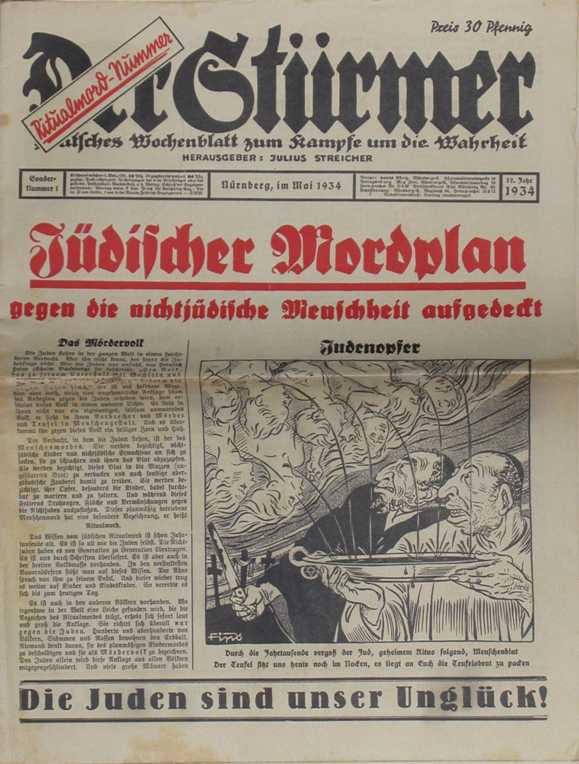
May, 1934 Issue of Der Stürmer

Labels: ,

Friday, December 04, 2015

Due Recognition of Outstanding Moral Courage

"Master Sgt.Roddie Edmonds seemed like an ordinary American soldiers, but he had an extraordinary sense of responsibility and dedication to his fellow human beings."
"The choices and actions of Master Sgt.Edmonds set an example for his fellow American soldiers as they stood united against the barbaric evil of the Nazis."
Avner Shalev, chairman, Yad Vashem Holocaust museum and memorial, Jerusalem
Sgt. Roddie Edmonds, who refused to designate Jewish soldiers in German POW camp -- AP

"It's a matter of five minutes and that is it. When he tells the German, 'No,' that is something that can kill him. It is something very dangerous that is happening in one moment. ... But it is very heroic."
Irena Steinfeldt, director, Holocaust memorial's Righteous Among the Nations department
The Reverend Chris Edmonds had no idea that his father had been faced with a moral dilemma of immense proportions when he was a prisoner of war in late 1944, captured at the Battle of the Bulge conflict. His father left several diaries where he recorded his experiences during one hundred days of captivity by German soldiers in the gasping years of the Second World War. Curiosity led him to the Internet, and what he found there led him to discover his father's courage under extreme duress.

A newspaper article he read online about Richard Nixon during his search for a home in New York after his presidency connected some dots. Mr. Nixon had bought an upper East Side townhouse from a prominent New York lawyer. That lawyer, Lester Tanner, spoke to Mr. Nixon of his experience during the war, how his commanding officer had saved not only Mr. Tanner to live another day, but dozens of other Jewish American servicemen during the war.

When Reverend Edmonds was able to interview Mr. Tanner, he spoke as well with another Jewish prisoner of war, Paul Stern, both of whom informed the younger man what they had personally seen to occur on January 27, 1945 at Stalag IXA POW camp nearby Ziegenhain, Germany. The Wehrmacht, in line with the Third Reich's program of European Jewish extermination, sought to segregate Jewish POWs from their non-Jewish peers.

Captured Jewish soldiers in the Russian army on the eastern front were sent to extermination camps. When Master Sgt. Edmonds had been captured the most notorious of the Nazi death camps were no longer fully in operation. Jewish-American POWs were sequestered to be sent to slave labour camps where survival rates were abysmally low; those incarcerated there died of starvation, disease of physical breakdown, or worked to death if they weren't directly shot by their guards.
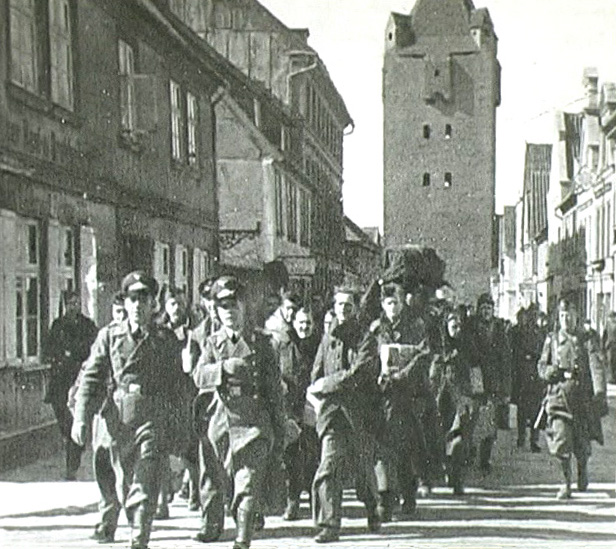
Prisoners of war marched through Barth, Germany
POWs are marched to Stalag Luft I from the railroad station through the town of Barth. En route they pass through the Dammtor Gate, as seen in the background of this photo. The gate was built in the middle of the 14th century and is 35m in height and has an entrance of 4m in width.
 Photo courtesy of Roy Kilminster - RAF POW

It was well known among American soldiers that the Jewish fighters among them, if captured, would face existential danger; they were urged to destroy their dog tags along with any other evidence identifying them as Jewish. No one, needless to say, could destroy the results of circumcision. And if only Jewish servicemen destroyed identification, that alone would lead to their detection. When Master Sgt. Edmonds' group was assembled before the German camp commander, they were ordered to identify who among them was Jewish.

Master Sgt.Roddie Edmonds turned to his comrades to tell them: "We are not doing that, we are all falling out". They all stood forward, identifying themselves as Jews. Turning to Master Sgt. Edmonds the German commander stated: "They cannot all be Jews". The response from Master Sgt.Edmonds was a firm: "We are all Jews here". The Nazi officer put his pistol to Master Sgt. Edmonds's head for a last chance to amend his attitude.

Master Sgt.Edmonds spoke up at that point, giving his name, rank and serial number in compliance with the Geneva Conventions which did not require him to say anything more as a prisoner of war. "And then my dad said: 'If you are going to shoot, you are going to have to shoot all of us because we know who you are and you'll be tried for war crimes when we win this war'."

He had been the highest ranking non-commissioned officer held at that camp and his order galvanized over one thousand American captives to take a moral stand declaring: "We are all Jews here". Belatedly and posthumously, Master Sgt. Roddie Edmonds has been recognized with Israel's highest honour for non-Jews who dared to risk their lives in an effort to save Jewish lives during the Second World War, the first American serviceman to be so honoured.


Labels: , , , , ,

 
()() Follow @rheytah Tweet