Ruminations

Blog dedicated primarily to randomly selected news items; comments reflecting personal perceptions

Tuesday, December 13, 2022

Failed Policies Home to Roost

"Hospitals bore the brunt of zero-COVID, and are now overwhelmed by an unprecedented outbreak."
"Patients who visit the fever clinic have grown several times compared with last week, and it's likely to go on for weeks or even months more."
Yan, eye surgeon, Beijing
"{China’s overall vaccination rate is high by global standards, but with underperforming domestically produced vaccines, a lack of focus on immunizing the elderly, and the time elapsed since the average person’s last shot, real immunity is almost non-existent in the population."
"Experts are predicting a difficult winter. But already, a sharp reduction in government testing is making the course of infection in China harder to track and predict. Official numbers suggest that new cases have dropped in the past three days, after slowly declining through the preceding week. But a week ago, asymptomatic new cases were reported at nearly eight times the rate of symptomatic ones. The current ratio is only half that, suggesting that many asymptomatic cases are now being missed."
"Anxious citizens and enterprising retailers rushed to stockpile drugs and personal protective equipment following the vice premier’s announcement, even before the formal lifting of restrictions. Sales of face masks were 682% higher in the first week of December 2022 than the same week a year earlier, according to online retail giant JD.com."
"Sales of cough, cold, and fever drugs rose 18-fold. Many of these products had been restricted until this week as authorities feared they could be used to mask COVID symptoms. The search volume for Lianhua Qingwen pills, a traditional Chinese medicine which the government has said is effective at treating COVID-19, was 2000 times higher than a year ago."
"Even as it downplays the severity of omicron, on 8 December state owned China Newsweek quoted government experts predicting a large scale outbreak in the next one to two months. Feng Zijian, a former official of China’s Centre for Disease Control, told the China Youth Daily that up to 60% of the population could catch COVID-19 in that initial wave. 'Ultimately, around 80% to 90% of people will be infected'."
Winter Surge feared as China lurches away from zero-COVID, Owen Dyer, British Medical Journal

Workers wear protective gear in a Beijing neighborhood placed under lockdown in November. China had raised hopes by slightly relaxing its zero-COVID policy, but cities have been contending with a surge in cases. Bloomberg via Getty Images

Emerging outbreaks across China have swamped hospitals, leaving them desperate to contain admissions following the decision of Chinese authorities to relax and roll back three years' worth of COVID controls. Public anger leading to unprecedented protests across the country by citizens fed up with China's stern controls, called for the resignation of Premier Xi and the dismantling of the Chinese Communist Party.

Beijing's unrelenting zeo-COVID policies finally enraged the population to the point of revolutionary fervour. And authorities blinked, announcing a dramatic loosening of testing requirements, of digital health passes, and quarantining and tracking. The predictable resulted. Medical scientists have warned that China's insistence on maintaining a hard control on the public in avoidance of COVID infections left the population with scant antibodies against the virus, unlike other countries where a significant proportion of the population were either inoculated with mRNA vaccines, or had COVID, or both.

China's vaccination record has been sub-par for the simple reason that their vaccines were hugely ineffective and they refused to import the international community's more successful mRNA vaccines. And just as most countries sought to immunize their elderly population first and foremost as the most vulnerable to serious COVID consequences leading to death, China did the opposite, leaving too great a number among its elderly demographic unshielded by vaccination.

With hospitals now reporting patient surges, medical staff themselves have contracted the virus in huge numbers. Sixteen times the daily average of a week ago were reported to have gone to fever clinics.       China's health services system placed its focus on contact tracing and quarantines for the past three years instead of building capacity for COVID outbreaks. With 4.5 intensive care unit beds for every 100,000 population, the country is vastly underprepared to face imminent and ongoing case counts.

Major county-level  hospitals are stocking up on medical supplies and intensive care unit equipment with hospitals ordered to expand their staff by 20 to 30 percent, along with establishing infection diseases departments by month's end. According to the National Health Commission, 90 percent of rural hospitals are to install fever clinics. Temporary quarantine centres are to be converted into hospitals.

Workers removing a tent at a residential community in Beijing that lifted a lockdown on Friday.
Credit...Noel Celis/Agence France-Presse — Getty Images

Labels: , , , ,

Tuesday, September 13, 2022

The Success of China's "Zero-COVID" Policy

"We've been locked up in our home for more than 40 days. We are short of everything, especially food."
"There are so many difficulties, I feel like crying just by mentioning them."
"We only eat naan and congee [flatbread and porridge]. There is no milk or vegetables."
Gulnazar, resident of Ili, Xinjiang region, China

"All supermarkets and small stores where you can buy groceries are closed."
"The online shopping platforms designated by the government are also having shortages and you cannot buy stuff or receive deliveries."
Guiyang resident posted on Weibo
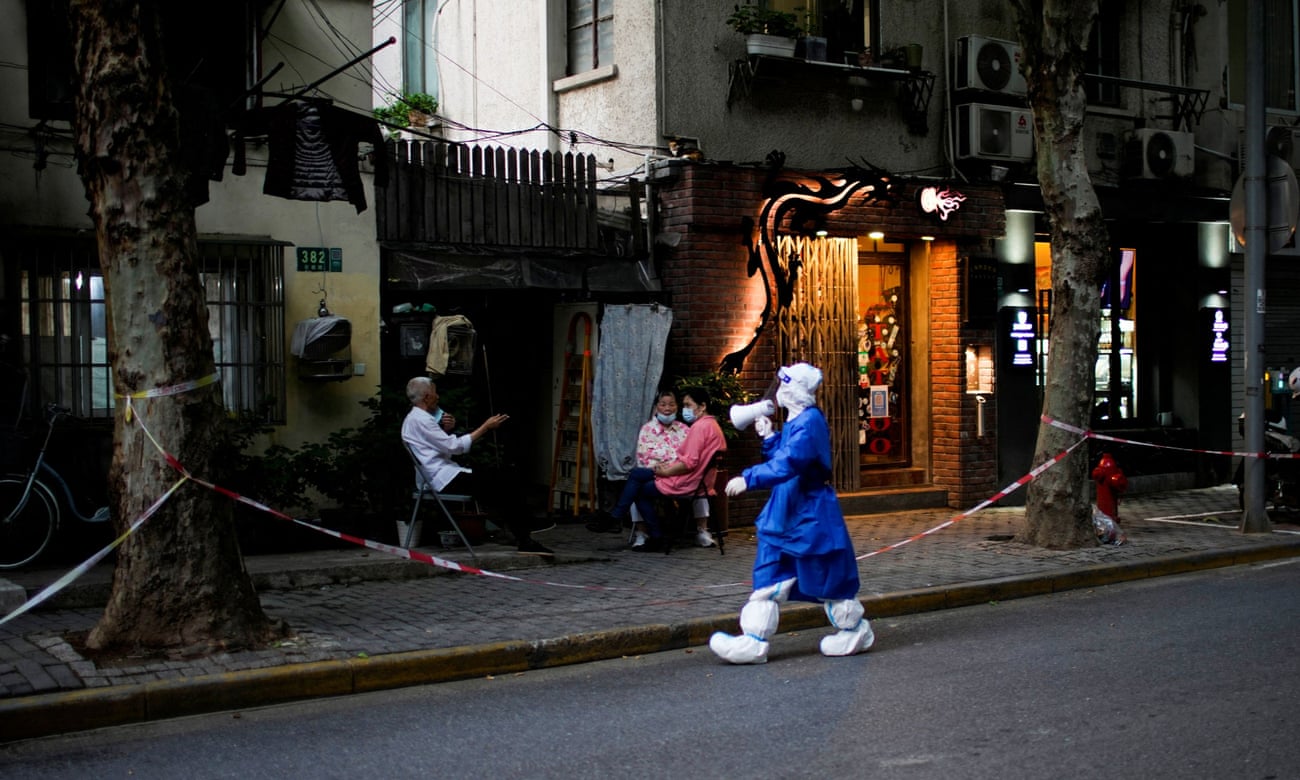
health worker in protective gear speaks to people through a megaphone
Millions of migrant workers in Shanghai were unable to earn any income during the months-lockdown as China pursued a zero-Covid policy. Photograph: Aly Song/Reuters
 
China, the very place where the pandemic raised its head, remains fixated on a "zero COVID" policy, no exceptions and no complaints permitted. But there have been and continue to be plaintive messages posted on social media from people desperate for food and medical care. Tens of millions of people are once again under weeks-long coronavirus lockdowns. And they're there, locked into a now-too-familiar scenario of SARS-CoV-2 punishment they can do nothing about, while a meeting of the Communist party is set to begin. 

There will be no relief for these people hit with this misfortune until that key meeting has been concluded -- if then. By orders of Communist Party leader and President of the country, Xi Jinping; "zero COVID" must be maintained and protocols upholding that goal are not to be questioned. Localized outbreaks are kept from spreading through these lockdowns at a tremendous economic and psychological toll on a long-suffering population.

This is a momentous occasion for President XI as he prepares to launch a third five-year term in office in October, irrespective of the precedent of stepping down following two terms in executive office. So at least through that meeting, the 20th National Chinese Communist Party Congress is over, lockdowns are to continue. Some faint hope is offered that post-meeting some of the sweeping COVID controls may be rescinded.

Ili prefecture in northwestern Xinjiang region is where some of the most serious reports are emanating from. One woman who gives only one name, explains that local authorities locked their apartment door from the outside, opening it only when medical workers appear to perform coronavirus tests. Neighbourhood committees in some cities deliver free groceries to those in lockdown. But this woman says the neighbourhood committee where she is locked down offers only to sell food at higher-than-normal prices and even that not frequently enough.
 
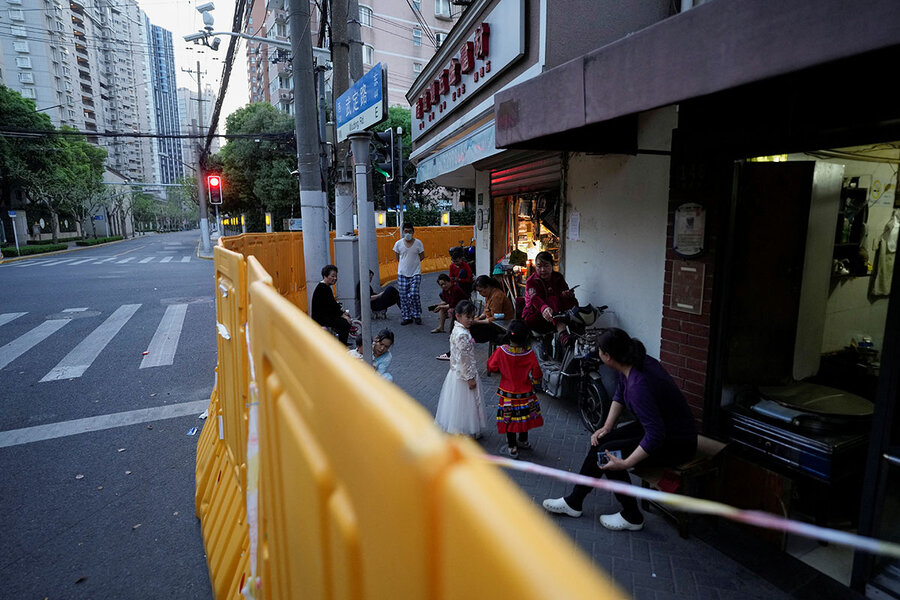
Residents stand behind barricades in a sealed-off portion of Shanghai   Aly Song/Reuters
 
Online postings in Ili speak of an inability to take their sick children to hospital. Some post of the death of elderly family members during lockdown. Widely reported on Chinese social media leading the Ili government to apologize for problems in the lockdown response while also rejecting reports as mere rumours. Four people were punished with five to ten days' detention each for "spreading rumours" about the lockdown. Residents are warned to watch their words.

The official case count in the entire population would cause joy in any other country, but not China. A mere 949 locally transmitted cases were reported nationwide on Sunday, within an immense population of 1.4 billion people. Residents in lockdown are unable to work to sustain themselves through a regular income, ending up surviving on fast-disappearing savings. President Xi projects an image of himself as a populist leader who has declared elimination of poverty central to his administration.

In Guiyang where a lockdown in parts of the city commenced on September 5, a wildlife park published a public plea for food to keep its tigers, pandas and other wild animals from starvation. In Lhasa, the capital of occupied Tibet, parts of the city began locking down a month ago.  Shanghai's earlier months-long lockdown echoes what is occurring once again in parts of China. In Shanghai, supply chains were disrupted in the wealthy city, leaving residents begging for food, pleading for ill family members to be permitted to go to hospital.

Beijing maintains China is unable to halt lockdowns since a substantial number of the population, in particular the elderly who were not given priority status, remain unvaccinated. The country's refusal to import the most effective foreign vaccines against coronavirus, relying totally on domestic vaccines that provide much less immunity explains in part its predicament. Censorship and detentions aid the government in suppressing domestic criticism of its "zero COVID" policy.

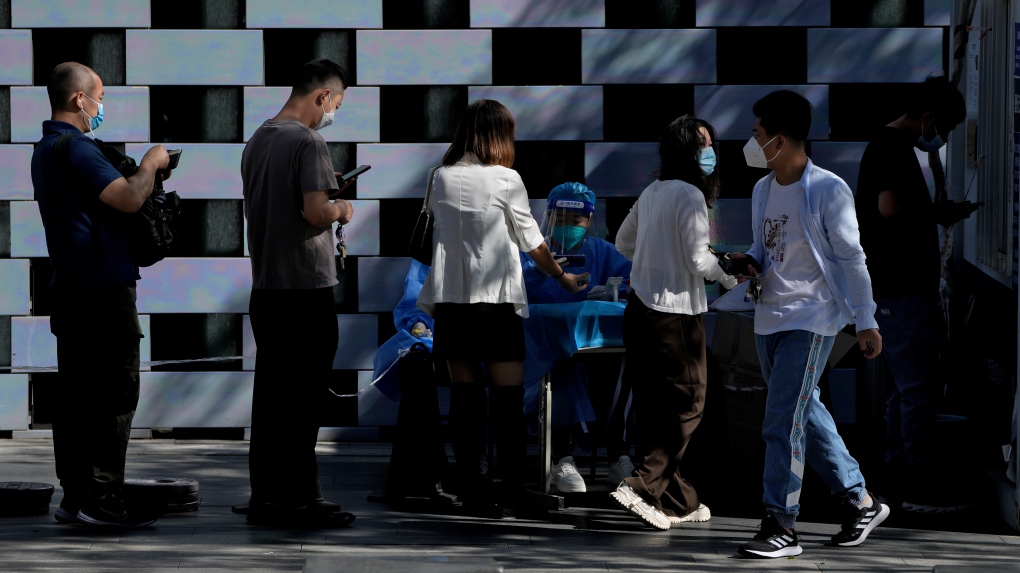
Residents line up to register to get their routine COVID-19 throat swabs at a coronavirus testing site in Beijing, Monday, Sept. 5, 2022. (AP Photo/Andy Wong)

Labels: , , ,

 
()() Follow @rheytah Tweet