Europe: Preparing for War
"Russia emptied four brigades out of the Leningrad district to Ukraine, most of them actually killed.""The reality is that when this war ends, Russia will start building up its soldiers on our border. But this is nothing new, it's not problematic.""I'd ask people to stay cool, calm and collected. We know exactly what we're doing. We have full control over what's going on."Finnish President Alexander Stubb"The long term is just that Russia needs to take defence on the border with Finland more seriously now that Finland is a NATO member.""If NATO and Russia go to war in the Baltics, the Finns aren't going to just sit there. They're likely going to counterattack and annex the Murmansk Peninsula – and the Russian nuclear forces and the Northern Fleet are all based in Murmansk.""So the Finns can do quite a lot in terms of disrupting that by cutting the supply lines between St Petersburg and Murmansk."Ed Arnold, senior research fellow for European security, International Security department, Royal United Services Institute defence think tank, United Kingdom
 |
| Before and after images from the Russian bases. Photo: Planet Labs PBC/Airbus /screenshot from SVT |
Earlier this month Finland's public broadcaster, YLE reported the presence of a garrison being built for an artillery brigade by Russia, in a town close by the two countries' frontier. Half of the North Atlantic Treaty Organization's (NATO) land border is guarded by Finland against NATO's well-known adversary. A border that stretches out along over 1,300 kilometres.
There is a long history of conflict between Finland and Russia. As such, it is not surprising that Finland has been among the most dedicated European supporters and providers of military aide to Ukraine. In the face of Moscow's future intentions against Finland, its president states that his country remains "calm and collected", knowing through long experience what may be presenting for the not-too-distant future.
According to NATO Secretary-General Mark Rutte, such preparations are of no surprise to NATO as well. The Kremlin, suggested Mr. Rutte, may be counting on a five-year opportunity when Russia's war imposed on Ukraine has been concluded, to turn its attention elsewhere, and Finland appears the most likely initial target.
Nordic officials have their own version of a potential timeline before such an attack takes place, giving it a shorter window, hastening preparations in the knowledge that Russia will focus on rebuilding its capacity to carry out a conventional attack on yet another of its neighbours.
"Before 2022 there was an unmanned aerial vehicle regiment somewhat operating in the field – so it wasn’t totally abandoned. But it wasn’t being used for larger equipment such as helicopters.""But now, after 2022, they have been refurbishing it, renovating it, clearing the overgrown areas – so it seems that they are intending to also ramp up their activities in that area too.""We are seeing military activity, and we are seeing the Russians developing their military infrastructure and most likely training new soldiers. But it's not anything too radical at the moment.""It's really difficult to say yet, because the war in Ukraine is still heavily ongoing, and achieving a truce seems to be extremely difficult. The future will show just how heavily the Russians will invest in all of this – military bases, new units, soldiers and so on. But as far as we know now, it's going to be significant."Finnish military historian Emil Kastehelmi
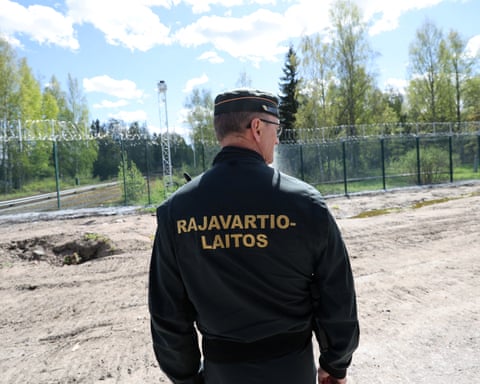 |
| Finland’s border guard has completed the first 35km of a planned 200km fence on its eastern border with Russia. Photograph: Leonhard Föger/Reuters |
Last week Finland's parliament approved a withdrawal from the Ottawa Convention, banning anti-personnel landmines. The vote was 157 to 18 in Helsinki, when lawmakers firmly committed to back the government's proposal. The release from the convention was a political decision taken in April while addressing risks from Russia.
NATO leaders had agreed on a massive increase in defence spending for its member-states, each to pledge honouring a five percent gross domestic product to boost the 32-member-organizational military capacity in mutual defence against a common enemy. At the same time the group reiterated its "Ironclad commitment" to respond as a unified military group in defense of any of its members coming under attack.
Some 175 kilometeres from the border, three large storage halls have been built in Petrozavodsk, each of which is judged to have the potential to hold around fifty armed vehicles. As of April 2025, a fourth facility has been under construction. The new structures, according to analysts, may be intended to conceal an accurate number of the military vehicles to be stationed there.
"[The developments appear to confirm earlier Russian statements about] military-technical measures [in response to NATO’s enlargement].""When we applied [Finland and Sweden] for NATO membership, Russia said it would take such steps. We are now seeing that happen."Sweden’s Chief of Defence Michael Claesson"[The Russian government in April 2023 when Sweden and Finland jointed NATO, vowed to take] counter-measures.""The enlargement of NATO is an encroachment on our security and on Russia’s national interests.""We’re going to be following what happens in Finland closely … and how it threatens us."Kremlin spokesperson Dmitri Peskov
"[The Finns’] whole position was … we need to be ready to be able to face the Russians on our own.""So that's their mindset, and it's how their military is configured. They can get 284,000 troops on declaration of war. That's significant.""That’s probably more than the UK can get together, probably more than Germany, more than France – probably more than anyone else bar Poland at the moment."Ed Arnold, senior research fellow for European security
Labels: Baltic Nations in Russia's Crosshairs, Finland, Kremlin Military Buildup, Moscow/Helsinki Border, NATO, Russian Invasion of Ukraine, Sweden
posted by Pieface @ 8:06 PM


0 Comments:
Post a Comment
<< Home