Ruminations

Blog dedicated primarily to randomly selected news items; comments reflecting personal perceptions

Friday, June 27, 2025

Europe: Preparing for War

"Russia emptied four brigades out of the Leningrad district to Ukraine, most of them actually killed."
"The reality is that when this war ends, Russia will start building up its soldiers on our border. But this is nothing new, it's not problematic."
"I'd ask people to stay cool, calm and collected. We know exactly what we're doing. We have full control over what's going on."
Finnish President Alexander Stubb
 
"The long term is just that Russia needs to take defence on the border with Finland more seriously now that Finland is a NATO member."
"If NATO and Russia go to war in the Baltics, the Finns aren't going to just sit there. They're likely going to counterattack and annex the Murmansk Peninsula – and the Russian nuclear forces and the Northern Fleet are all based in Murmansk."
"So the Finns can do quite a lot in terms of disrupting that by cutting the supply lines between St Petersburg and Murmansk."
Ed Arnold, senior research fellow for European security, International Security department, Royal United Services Institute defence think tank, United Kingdom
https://www.helsinkitimes.fi/images/2025/05/screeenshot.png
Before and after images from the Russian bases. Photo: Planet Labs PBC/Airbus /screenshot from SVT
 
Earlier this month Finland's public broadcaster, YLE reported the presence of a garrison being built for an artillery brigade by Russia, in a town close by the two countries' frontier. Half of the North Atlantic Treaty Organization's (NATO) land border is guarded by Finland against NATO's well-known adversary. A border that stretches out along over 1,300 kilometres.
 
There is a long history of conflict between Finland and Russia. As such, it is not surprising that Finland has been among the most dedicated European supporters and providers of military aide to Ukraine. In the face of Moscow's future intentions against Finland, its president states that his country remains "calm and collected", knowing through long experience what may be presenting for the not-too-distant future.
 
According to NATO Secretary-General Mark Rutte, such preparations are of no surprise to NATO as well. The Kremlin, suggested Mr. Rutte, may be counting on a five-year opportunity when Russia's war imposed on Ukraine has been concluded, to turn its attention elsewhere, and Finland appears the most likely initial target.
 
Nordic officials have their own version of a potential timeline before such an attack takes place, giving it a shorter window, hastening preparations in the knowledge that Russia will focus on rebuilding its capacity to carry out a conventional attack on yet another of its neighbours. 
"Before 2022 there was an unmanned aerial vehicle regiment somewhat operating in the field – so it wasn’t totally abandoned. But it wasn’t being used for larger equipment such as helicopters."
"But now, after 2022, they have been refurbishing it, renovating it, clearing the overgrown areas – so it seems that they are intending to also ramp up their activities in that area too."
"We are seeing military activity, and we are seeing the Russians developing their military infrastructure and most likely training new soldiers. But it's not anything too radical at the moment."
"It's really difficult to say yet, because the war in Ukraine is still heavily ongoing, and achieving a truce seems to be extremely difficult. The future will show just how heavily the Russians will invest in all of this – military bases, new units, soldiers and so on. But as far as we know now, it's going to be significant."
Finnish military historian Emil Kastehelmi 
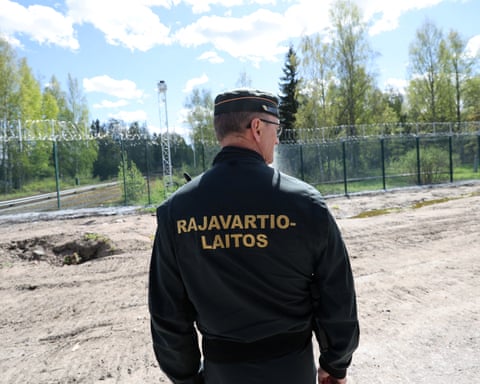
Rear of a border guard standing in front of the fence on the Finnish-Russian border
Finland’s border guard has completed the first 35km of a planned 200km fence on its eastern border with Russia. Photograph: Leonhard Föger/Reuters
 
Last week Finland's parliament approved a withdrawal from the Ottawa Convention, banning anti-personnel landmines. The vote was 157 to 18 in Helsinki, when lawmakers firmly committed to back the government's proposal. The release from the convention was a political decision taken in April while addressing risks from Russia.
 
NATO leaders had agreed on a massive increase in defence spending for its member-states, each to pledge honouring a five percent gross domestic product to boost the 32-member-organizational military capacity in mutual defence against a common enemy. At the same time the group reiterated its "Ironclad commitment" to respond as a unified military group in defense of any of its members coming under attack. 
 
Some 175 kilometeres from the border, three large storage halls have been built in Petrozavodsk, each of which is judged to have the potential to  hold around fifty armed vehicles. As of April 2025, a fourth facility has been under construction. The new structures, according to analysts, may be intended to conceal an accurate number of the military vehicles to be stationed there.  
"[The developments appear to confirm earlier Russian statements about] military-technical measures [in response to NATO’s enlargement]."
"When we applied [Finland and Sweden] for NATO membership, Russia said it would take such steps. We are now seeing that happen."
Sweden’s Chief of Defence Michael Claesson 
 
"[The Russian government in April 2023 when Sweden and Finland jointed NATO, vowed to take] counter-measures."
"The enlargement of NATO is an encroachment on our security and on Russia’s national interests."
"We’re going to be following what happens in Finland closely … and how it threatens us."
Kremlin spokesperson Dmitri Peskov
"[The Finns’] whole position was … we need to be ready to be able to face the Russians on our own."
"So that's their mindset, and it's how their military is configured. They can get 284,000 troops on declaration of war. That's significant."
"That’s probably more than the UK can get together, probably more than Germany, more than France – probably more than anyone else bar Poland at the moment."
Ed Arnold, senior research fellow for European security
 

Labels: , , , , , ,

Tuesday, January 16, 2024

The Hypochondriacs Among Us Die Earlier

"It's kind of a paradoxical finding isn't it? They [hypochondriacs] worry so much about health and death, and then they end up having a higher risk of death anyway."
"They experience a lot of suffering and hopelessness."
"There's a tendency to perhaps debase their worries about their health as being made up."
David Mataix-Cols, research neuroscience and psychiatry professor, Karolinska Institutet, Stockholm, Sweden
An external file that holds a picture, illustration, etc.
Object name is jamapsychiatry-e234744-g002.jpg
A recent study out of Sweden, published in the JAMA Psychiatry journal last month concluded that people diagnosed with hypochondriasis were 84 percent likelier than those free of the disorder, to die of many health disorders, particularly those related to heart, blood and lung diseases. Throw in for good measure, death by suicide. Researchers in Sweden undertook a study of people with and without hypochondiasis, a diagnosis given to people paranoid over their health. (Hypochondriases, is identified also as illness anxiety disorder.)
 
 Research previously independently undertaken found that those diagnosed with mental disorders are more likely to die younger than those without the afflictions. Which led Dr. Mataix-Cols to ponder whether that situation of early death might apply as well to people with hypochondria, which prompted him to research the matter. Even if doctors assure people diagnosed with hypochondriasis that they're quite healthy, these patients remain in a paranoid condition and their Internet searches only make them more so.

Leading the professor of neuroscience and psychiatry to begin gathering data from Swedish census and health databases from the years 1997 to 2020 from which his team of researchers identified 4,129 individuals diagnosed with hypochondriasis, then set about comparing each of these people against a group of ten without hypochondriasis. What they had in common was sex, birth year and country of residence. Some nine months of observation later 268 hypochondriacs and 1,762 people without hypochondriasis had died, with the hypochondriacs dying about five years earlier on average than those without the disorder.

Other associated observations were that having the condition of hypochondriasis impacts quality of life, to the extent that those without the malady tended to achieve higher education, to marry, and to earn higher salaries in their employment field than hypochondriacs. The risks of death due to the disorder, stated Dr. Mataix-Cols, could be higher still, when accounting for a high suspected number of undiagnosed cases. 

Professor Mataix-Cols has a few theories of his own, that hypochondriacs' lives could be truncated as a result of chronic stress. They might self-medicate with alcohol and drugs, and some patients might take to avoiding doctors' appointments for fear of an unwanted diagnosis with a serious illness. More attention and resources, he feels, should be invested in caring for those with hypochondriasis, treatable through cognitive behavioural therapy and antidepressant medication.

"We have good treatments, and most people don't get them", he added.

https://dims.apnews.com/dims4/default/52a2a91/2147483647/strip/true/crop/4500x2998+0+6/resize/980x653!/format/webp/quality/90/?url=https%3A%2F%2Fassets.apnews.com%2Fcf%2F74%2Fc8fa0ef65dfe0dbee4eac1b51cb9%2F3039d29312ca4e219d758f37217afac3
A large Swedish study, published Dec. 13, 2023, in JAMA Psychiatry, has uncovered a paradox about people diagnosed with an excessive fear of serious illness: They tend to die earlier than people who aren’t hypervigilant about health concerns. (AP Photo/Brynn Anderson)

Labels: , ,

Wednesday, December 20, 2023

Turkey, Bridge Between Europe and the ME

"Positive developments from the United States regarding the F-16 issue and Canada keeping its promises will accelerate our parliament's positive view on [Sweden's membership]."
"All of these are linked."
"If we operate this simultaneously, we will have the opportunity to pass this through the parliament much more easily."
Turkish President Recep Tayyip Erdogan
https://dims.apnews.com/dims4/default/43add6c/2147483647/strip/true/crop/5500x3667+0+0/resize/1440x960!/format/webp/quality/90/?url=https%3A%2F%2Fassets.apnews.com%2F59%2F02%2F20885b2982976546d96c5fd90499%2F28e6f8b8663c472cb9f6990a62ce6a2d
Erdogan shakes hands with Sweden's PM

The country seen as a link between East and West has been enormously altered under Recep Tayyip Erdogan, leader of the Justice and Development party. The country that Turkey is now, an Islamist, not an emerging democracy patterned after the West in the spirit of Mustafa Kemal Ataturk, leading to an enlightenment where Islam was secondary to democratic rule, has been completely transformed. Turkey no longer has anything much in common with the West, and its membership in NATO seems contrarian, given its change.
 
Once again Erdogan is threatening Europe, playing the empowered bully as an Islamist authoritarian state. As he did when he warned Europe that he would only take steps to limit the numbers of refugees from Syria and elsewhere in the Arab/Muslim world seeking haven and economic advantage through illegal migration into Europe, by way of Turkey, by extracting huge sums of money from the European Union. Presumably, to compensate for and ameliorate its internal burden of giving haven to his brothers in Islam.
 
The millions that flooded Europe had the effect of diluting the indigenous German population when they settled in large numbers in towns and villages, upturning traditional values and customs, ignoring the historical heritage culture precious to Germans, and committing criminal acts out of proportion to their numbers. Most were single males, and among them jihadi infiltrators creating a problem of unruly demographics for whom the justice system was never recognized above that of sharia law.
 
https://www.cnn.com/interactive/uploads/20230404-20230404-nato-members-w-finland-nato_europe_map_780px.png
 
Now, an Islamist petty dictator whose country is a NATO member dictates whether other European nations are fit to join NATO, since a total consensus must agree to the acceptance of new recruits to the alliance. Erdogan has withheld his consent for Sweden to join NATO, over issues of pecuniary and military value to himself and his country using his heft to insist that arms embargoes imposed on Turkey be lifted by other members of NATO.
 
Hungary, another member of NATO, from eastern Europe, one that distinguishes itself from other eastern European countries fearful of Russia's intentions, sides with Russia in its war against Ukraine, and it too is holding up formal approval of Sweden's bid to join the transatlantic military alliance. Erdogan has delayed the ratification of membership for Sweden for over a year, accusing the country of giving shelter to Kurdish militants along with other groups Ankara names as security threats to itself. 

Both Sweden and Finland, who up to the point where Russia invaded Ukraine had no interest in joining NATO, suddenly recognized that membership in the alliance would provide a good measure of security against Russia turning its military intentions on them as well as the Baltic states. Both countries lifted their traditional neutrality, then applied to join NATO, their application accepted swiftly by other NATO allies with the exception of Turkey.

The consummate expert in blackmail, Recep Tayyip Erdogan now links Sweden's membership with forcing the United States to agree that Congress must approve Turkey's intention to buy 40 F-16 fighter jets and kits, intending to modernize its existing air fleet as the second largest and most powerful military in the Alliance. 

https://www.fpri.org/wp-content/uploads/2023/03/turkey-nato-e1678279796166-1500x480.jpg
The Turkish Veto: Why Erdogan Is Blocking Finland and Sweden’s Path to NATO  Foreign Policy Research Institute

Labels: , , , , ,

Thursday, July 06, 2023

Justice Sought in the Downing of Ukraine International Airlines Flight PS752

https://i.cbc.ca/1.5423647.1624483756!/fileImage/httpImage/image.JPG_gen/derivatives/16x9_780/iran-crash.JPG
Family members who lost loved ones on Flight PS752 almost two years ago conducted their own probe into the aircraft's destruction. (Social media video via Reuters)
"Today's legal action reflects our unwavering commitment to achieving transparency, justice and accountability for the families of the victims."
"[Canada, the U.K., Sweden and Ukraine argue that Iran] failed to conduct an impartial, transparent, and fair criminal investigation and prosecution consistent with international law."
"[Iran withheld or destroyed evidence, blamed other countries and low level Revolutionary Guard personnel], threatened and harassed the families of the victims seeking justice [and failed to report details of the incident to the International Civil Aviation Organization."
Joint statement, Canada, United Kingdom, Sweden, Ukraine
A case was launched against Iran at the highest court of the United Nations over the 2020 downing of an Ukrainian passenger jet causing the death of all 176 passengers and crew. The four countries involved now urge the International Court of Justice to rule that Iran shot down the Ukraine International Airlines plane illegally, and to order an apology from Tehran in addition to paying compensation to the families of the victims, many of them Iranian-Canadians.

Travelling from Tehran to Kyiv on January 8, 2020, Flight PS752 was shot down soon after takeoff from Tehran's international airport. There had been flights earlier in the day and none had experienced anything out of the ordinary. Everything appeared to be in order, the airport functioning as normal even though Tehran itself was on guard, awaiting a potential strike from the United States. Yet the skies were not shut down as a temporary caution and matters proceeded as normal.
 
For that matter, Russia has never been called to account for its role in shooting down a Malaysian passenger jet in 2014 while it was flying over eastern Ukraine. Ethnic Russian Ukrainians supported by the Russian military in the Donbas in a conflict with Ukraine. The Dutch-led team of investigators reported in 2016 that a Buk surface-to-air missile launched from separatist-controlled east Ukraine       originated from the 53rd Anti-Aircraft Missile Brigade of the Russian Federation, transported from Russia on the day of the crash, fired from a field in a rebel-controlled area and the launch system returned to Russia afterwards.
 
Tehran had denied responsibility for the mid-air explosion of the Ukraine Airlines flight for days, until indisputable evidence was presented forcing Iran to admit to having 'inadvertently' shot the plane down by two missiles, finally claiming its paramilitary Revolutionary Guard had thought the passenger jet was an incoming U.S. missile, though the directions were in complete opposition; the plane in flight away from Tehran, whereas a missile would be approaching Tehran from the opposite direction.
 
A total of 175 people lost their lives, among them 55 Canadian-Iranian citizens, another 30 were permanent residents of Canada, plus dozens of Iranian students travelling to Canada on student visas. In Iran, Iranian citizens reacted with fury at their government, mourning the loss of innocent lives. Protests were quickly put down by the government in Tehran. Iranian authorities' insistence that an air defence operator mistook the Boeing 737-800 for an American cruise missile was less than palatable.

This year an Iranian court sentenced an air defence commander they claim was responsible for the loss of so many lives, to 13 years' imprisonment. The four countries that filed the case with the world court in The Hague consider that prosecution nothing less than "a sham and opaque trial". Last week, Iran filed a case against Canada linked to the shooting down of the Ukraine passenger jet, where it accused Canada of flouting state immunity when it permitted relatives of terrorism victims to seek reparations from the Islamic Republic.

Iran is such a law-abiding country under its theocratic regime, which nurtures proxy terrorist groups that act on its behalf. But it is not itself above criminal acts, readily identifiable as when this week alone it attempted to seize two oil tankers near the Strait of Hormuz, firing shots at one of the tankers. Iranian naval vessels backed off once the U.S. Navy intervened. It has, in the last two years, seized five commercial vessels in and around the Strait of Hormuz, which it claims is not international waters, but its sovereign territory.

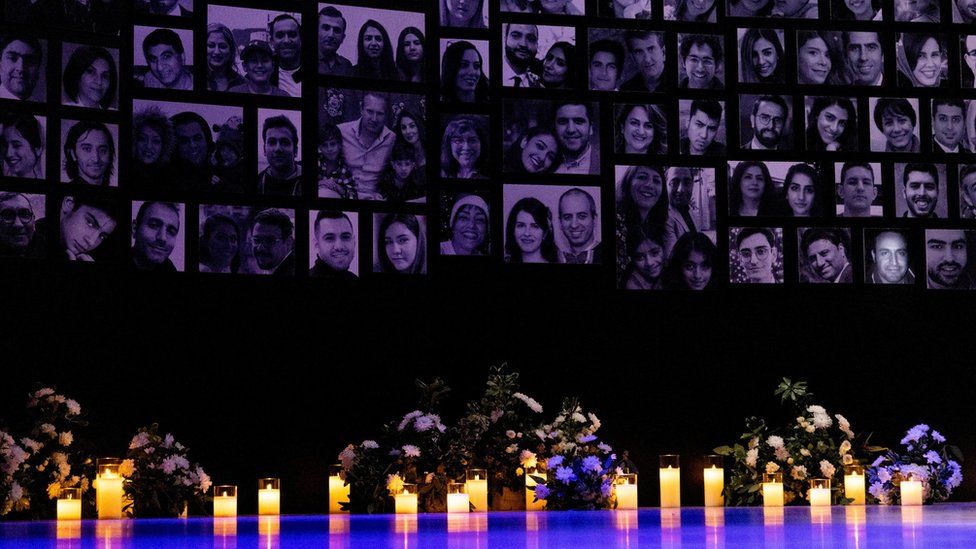
Candles are lit in front of the photos of the victims of the downing of Ukraine International Airlines flight PS752, in Toronto, Canada (8 January 2023)
A vigil  in Toronto, Canada, on the anniversary of the tragedy   Reuters


Labels: , , , , ,

Thursday, May 19, 2022

"Russia has earlier indicated that it is placing for example these S-400 anti-aircraft missiles in the Kola Peninsula, and it has earlier said it’s placing these missiles in Crimea."
"This is normal practice. Russia is using these systems to replace the older S-300 rockets."
"The reporting was a bit surprising. There was a tinge of foreign policy in the Moscow Times piece that cited President Putin’s comments on (potential Finnish membership of) NATO."
"The positioning of S-400 Triumf missiles near Saint Petersburg is evidence that Saint Petersburg is an important metropolis for Russia."
Finnish Defence Minister Jussi Niinistö
Russian Iskander-M missile launcher on display during Victory Day parade Photograph:( AFP

 A convoy is shown on a video  obtained by Reuters, comprised of over a dozen military vehicles, some thought to be carrying Iskander missiles en route to Vyborg, a Russian city adjacent the border with Finland.The deputy chairman of Russia's Security Council, Dmitry Medvedev -- a close colleague of Vladimir Putin who once played musical chairs with Putin, occupying the presidency while the prime ministership was temporarily taken by Putin in a bid to return to the presidency legally under the Russian constitution which he later manipulated to make it legal for him to continue as President -- warned should Finland and Sweden join NATO, Russia would undertake to move nuclear weapons closer to the two countries whose move to join NATO the Kremlin viewed as threatening.
 
"There can be no more talk of our nuclear-free status for the Baltic", he remarked on April 14.

Traditionally neutral, Finland and Sweden decided to break with that Cold War convention, in favour of defending themselves against a neighbour whose moves of aggression could be anticipated on the basis of the example before the eyes of the world, where Ukraine is now in active conflict forced upon it by Moscow's 'special military operation'. Neither Finland nor Sweden have any aspirations to test their own military's mettle facing off against a potential Russian invasion without an additional bit of defence; the combined strength of the North Atlantic Treaty Organization.

This represents somewhat of a miscalculation on the part of Vladimir Putin, consumed with rage over NATO expansion within the Russian Federation's 'near abroad', taunting Moscow as it were, with its too-close-for-comfort presence. An already-suspicious Putin arrived to a state of paranoia, a state which possibly inured him to the kind of introspection that might have warned him that he would be risking a great deal by launching into a conflict with Ukraine whose reaction to being occupied on a larger scale than the Donbas was obviously underestimated.
Putin seated at a desk, facing a televised video conference.
Vladimir Putin chairs a meeting via teleconference on May 17.   EPA
 
The scenario that Mr. Putin envisioned and was intent on forestalling, was in fact accelerated by his very actions in bringing war to Ukraine with its burden of civilian and military deaths, destroyed cities, millions of displaced homeless and refugees and Russia's own massive losses in dead commanders as well as servicemen, and the destruction of war machines resulting from Ukrainian defence and bold counter-attacks. The missiles were reportedly parked inside Russia's borders next to Ukraine before the February24 invasion before the decision was made to move them at this juncture.

Now that NATO acceptance of Finland and Sweden is assured, Mr. Putin finds it useful to move the nuclear-capable-warhead missiles to locations close to its borders with Finland. Finland appears to be calmly assessing the situation, finding nothing too much out of the ordinary by the move taken by its mercurial neighbour. And taking it all in stride as far as its reaction can be seen and analyzed by the outside world looking in. What is being discussed and analyzed within Finland in the security of government and military chambers may be another story.
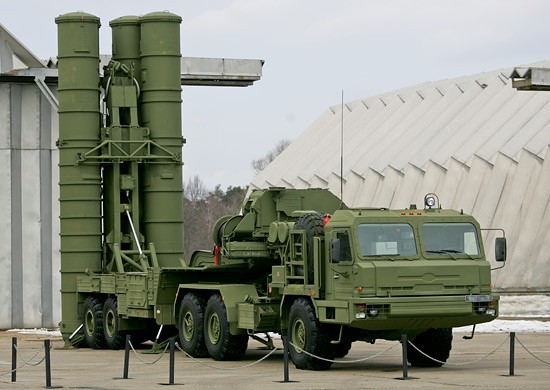
S-400 Triump is an anti-aircraft weapon system. Photo: mil.ru
 
From NATO's perspective, the organization stands to gain by taking Finland and Sweden under its protective wing in the sense that they would become instant "net contributors" to European security. The two countries' absorption into the group would simplify defence of NATO's Baltic members, increasing the alliance's borders with Russia with the addition of 1,900 kilometers representing the border between Russia and Finland.

Turkey, which has long since become a liability politically within NATO, balanced against the immense size of its military, is the fly in the ointment with Recep Tayyip Erdogan threatening to weigh in against their accession. The Nordic countries, demands Ankara, must stop its support for Kurdish militant groups on their soil. Their bans on arms sales to Turkey must also be lifted. This, from a NATO member-country which contracted the purchase of Russian weapons for its military, disrupting the interoperability of NATO member groups' military hardware.
 
vyborg
 

Labels: , , , ,

Sunday, February 06, 2022

Crows to the Rescue!

"By teaching the crows to exchange butts for food, they can help clean our streets and squares."
"Crows are basically the most intelligent wild animals that we have in Sweden, and probably in Britain, too. They will understand the difference between some trash and a rock or a leaf, which they will not be rewarded for, obviously."
"Crows learn from each other, so once the first birds learn it at our location, the other birds at that location will copy the first ones."
Christian Gunther-Hanssen, behaviour strategist, Corvid Cleaning

"We can teach crows to pick up cigarette butts but we can't teach people not to throw them on the ground."
"That's an interesting thought."
Tomas Thornstrom, waste strategist, Sodertalje municipality, Sweden
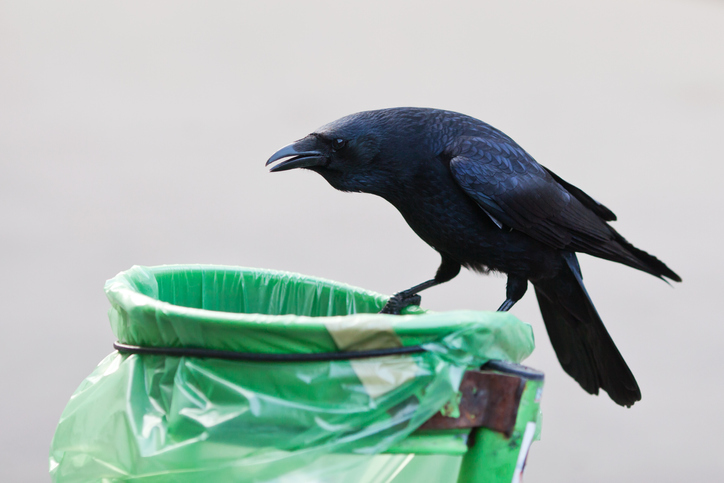
A crow sits on a garbage can in this file photo.
A crow sits on a garbage can in this file photo. iStock / Getty Images Plus
 
So much for the superior intelligence of human animals as opposed to that of a highly intelligent bird species. The crows appreciate edible rewards. Human litterers' rewards should be stiff fines. Humans think nothing of littering, spoiling their natural environment, yet we see the profit to be gained in teaching other animals to clean up human trash. Crows reason that a bit of effort and discipline gains them the profit of being fed, while humans are oblivious to their obligation to maintain order and respect and assume responsibility for their actions.

It might seem that the 'lower order' on the intelligence scale is more attuned to the survival imperative than the animals that pride themselves as being gifted with a high degree of intelligence. The introduction of a pilot project in Sodertalje, Sweden this spring seems like a brilliant idea; engaging crows as a municipal work crew; reliable, dependable workers whose wage demands are fundamental and modest.

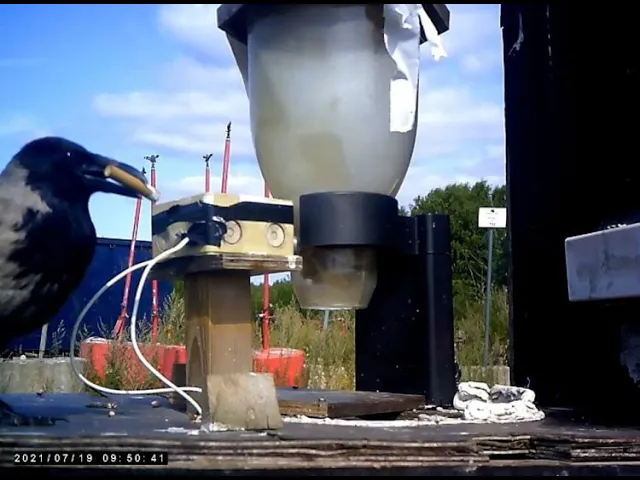
Crows are to be taught to pick up litter and take it to a device fitted with an image recognition camera, enabling it to reward the crow for each piece of trash, with an edible treat. Gunther-Hansen, the self-styled behaviour strategist, spent months training crows at a recycling centre located in nearby Stockholm to launch his start-up, Corvid Cleaning.
 
There is no need to convince the crows to be involved in a public clean-up scheme. Their natural sense of curiosity attracts them and they 'volunteer' to take part in the process. Evidently a billion cigarette butts are discarded on the streets of Sweden annually, a statistic that the Keep Sweden Tidy Foundation has provided, to give an idea of the scale of the problem. 

Each discarded piece of trash comes with a clean-up cost, up to two kronor (about 28 cents) to gather up, by conventional municipal street-cleaning means. The crows' intelligence speaks for itself, with no need for a human to teach and monitor the corvid; they learn through observation and on their own initiative how the collection device operates, a process that takes an estimated two months' familiarity.

The dispenser is programmed to dispense free peanuts in return for an object before the final stage of peanuts in exchange for cigarette butts. The Corvid Cleaning entrepreneur plans to study the impact a diet of peanuts might have on the crows' nutritional needs. With that information in mind, he plans to develop a reward that will not only appeal to the crows, but might represent more healthy natural fare for the birds.

https://i.ytimg.com/vi_webp/-aHEV2nVOrI/sddefault.webp
Still from video on FaceBook

Labels: , ,

Saturday, July 04, 2020

Waiting on Time To Tell

Sweden's state epidemiologist Anders Tegnell
Anders Tegnell, Public Health Agency Sweden. (Pontus Lundahl/TT FILE via AP)
"I'm looking forward to a more serious evaluation of our work than has been made so far. There is no way of knowing how this ends."
"Maybe [a stricter lockdown would have been preferential], I don't know. But you have to consider whether there are other tools that work just as well."
"In the same way that all drugs have side effects, measures against a pandemic also have negative effects. At an authority like ours [in Sweden], which works with a broad spectrum of public-health issues, it is natural to take these aspects into account [the avoidable cost of lockdowns]."
Anders Tegnell, Swedish State epidemiologist
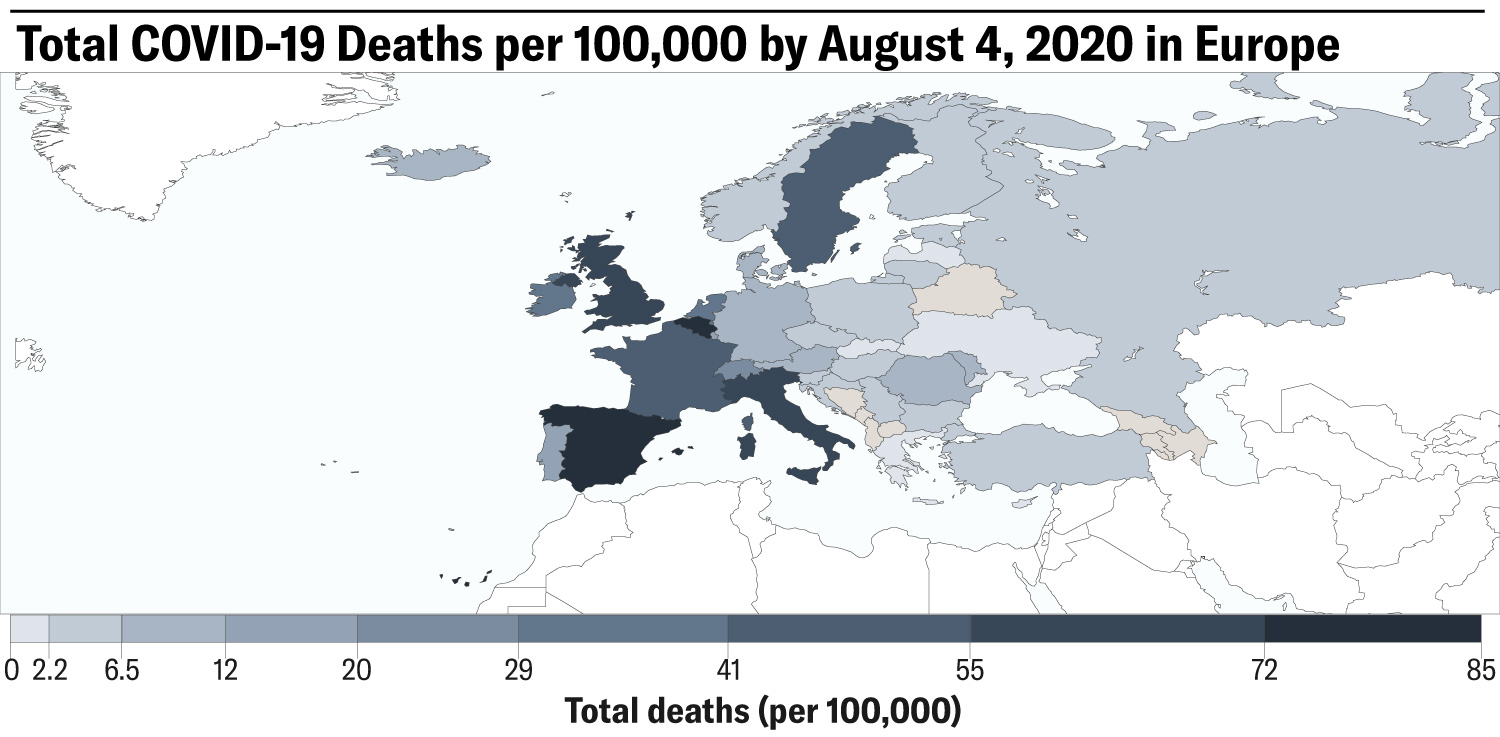
Figure shows the Total COVID-19 deaths per 100,000 by August 4, 2020 in Europe

"Sweden's policy is unusual in that it took a much less stringent approach to preventing transmission, but interestingly it implemented those measures at a very early stage in the pandemic, before large amounts of community spread had occurred."
"Sweden's approach may be sustainable in ways other countries have not proven to be. It should be noted that lockdowns are a response to an imminent surge into health care, with the goal of stopping as many transmission chains as quickly as possible."
"The full accounting will only be possible after the pandemic."
"[In Sweden, it is] bluntly not clear how the vulnerable are expected to be protected. Once you get a very large outbreak in one age group, it becomes more difficult to protect others."
"Sweden's approach has been widely misrepresented as doing nothing. It's not. Given a starting point in which it has been decided an outbreak is inevitable, the question becomes how to mitigate it and preserve health care, and the earlier on in the outbreak you take action to slow transmission, the less intense that action needs to be -- initially."
"Sweden's strategy, in that sense, has been smarter than those countries that encouraged transmission until shutdowns became necessary. However, it has come at a great cost in terms of mortality in vulnerable groups ... It also needs to be flexible and responsive; if a surge is building, you need to be able to detect it and know what you will do to avert it."
"As for the overall outcome. Time will tell."
William Hanage, associate professor of epidemiology, Harvard School of Public Health, Boston
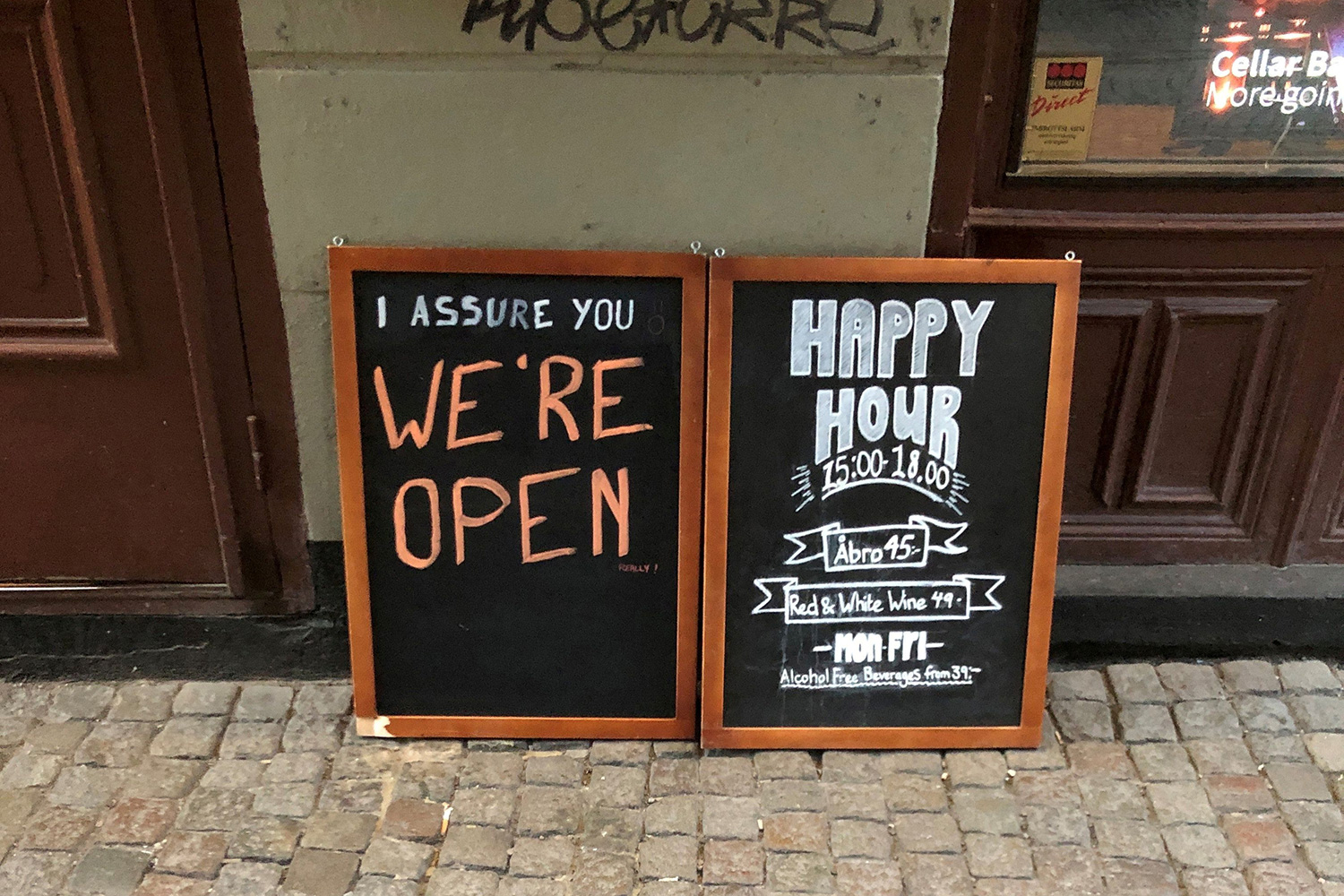
The photo shows a chalk sign in front of a bar that reads, "We're Open."
Sign outside a pub in Stockholm, Sweden.  REUTERS/Colm Fulton
Several weeks ago -- shaken by the number of deaths overall suffered in Sweden resulting from the SARS-CoV-2 virus leading to COVID-2, Sweden's state epidemiologist whose decision not to lock down the country, but to rely on the good sense of the Swedish population to take recognized self-distancing steps, persuaded the government to go counter to the measures undertaken by its neighbours and most of the rest of the world, of locking down their economies -- declared himself semi-remorseful, uncertain that he had reached the right decision.

Those lockdowns brought absolute havoc to societies whose health system was unprepared and who feared the breakdown of their medical-hospital personnel ability to cope with a flood of serious respiratory syndrome cases requiring emergency treatment. That decision led to  mass unemployment as business activity was frozen and economies went into a deep dive. And while people perished from the dire effects of the disease, those countries were able to control the situation, balancing lives saved against a ruined economy.

Sweden has now been excluded for the time being from the European Union's recently declared safe-travel lists, a penalty exercised resulting from his decision to advise his government against a lockdown in Sweden. Which brought that country the distinction of having one of the world's highest mortality rates for COVID-19. Dr.Tegnell appears now to have reversed himself on his statement of uncertainty, expressing a new opinion that he likely did, after all, make the right decision for Sweden.

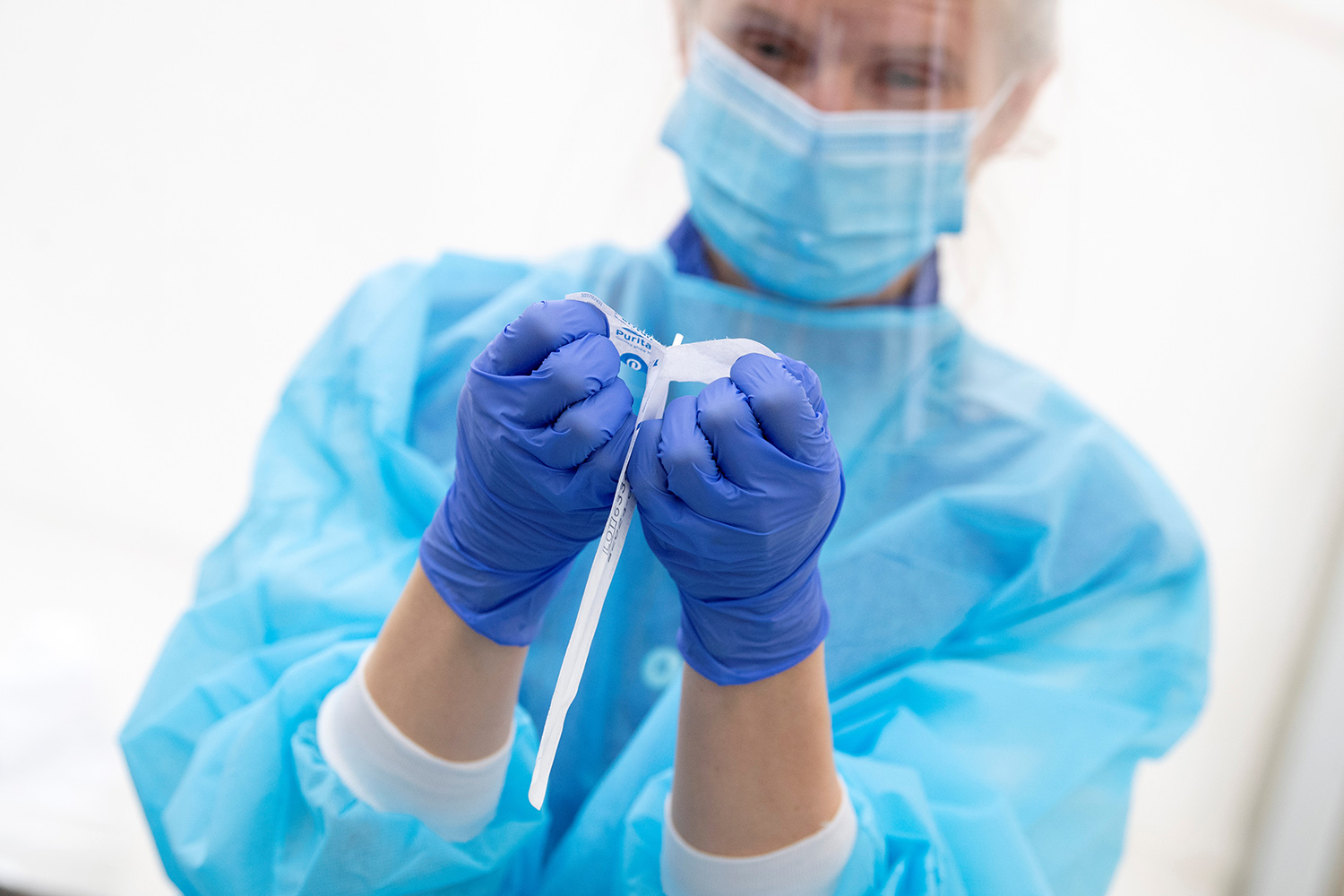
The photo shows a health worker in blue protective gear opening a sterile package.
 Skane University Hospital, Lund, Sweden. TT News Agency Johan Nilsson via REUTERS

He has convinced himself that all other nations reached a self-destructive decision in deciding for lockdown. The world, he now argues, has passed only the first of many stages of dealing with COVID-19; there is certain to emerge further, ongoing outbreaks, perhaps with mutating strains more highly infectious than the original. By maintaining normal life rhythms, choosing to believe that people are capable of behaving rationally and self-protectively, with concerns for the welfare of their communities, he is convinced Sweden embarked on the correct course of action.

He also feels vindicated that the WHO, which had originally been critical of the Swedish decision,  naming Sweden on a list of 11 European countries where "accelerated transmission has led to very significant resurgence that, if left unchecked, will push health system to the brink", has now decided to proclaim that contagion rates in Sweden are "stable", linking the high case numbers to a testing increase.

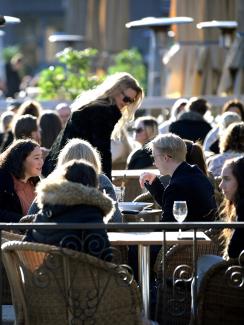
The photo shows a large number of people sitting close together in an outdoor eating area.

"There are several very positive trends in Sweden, notably, a continued decrease in new cases presenting with severe disease, a gradual decrease in patients admitted into intensive care since April, and continued decreasing numbers of new COVID-19 deaths."
"Sweden has involved the community in the response, and has been able to keep transmission to levels that can be managed by the Swedish health system."
World Health Organization

There was a high cost associated with the Swedish approach, however. Its death toll per 100,000 population represents five times that of neighbouring Denmark. The Danes imposed a strict lockdown in mid-March that has since been wound back, following the virus being brought under control. In Sweden, nursing homes saw a death rate that has been brutal, and at least one criminal investigation has resulted from that misfortune.

Now, Dr. Tegnell has backtracked his earlier mea culpa, declaring himself uncertain whether in hindsight he would have chosen to impose a stricter lockdown. Strict lockdowns, he feels, may have the effect of seeming to contain the virus temporarily, but the virus would return and that wouldn't have been prevented. Lockdown has its absolute deficits, and he lists among them, domestic abuse, loneliness and mass  unemployment.

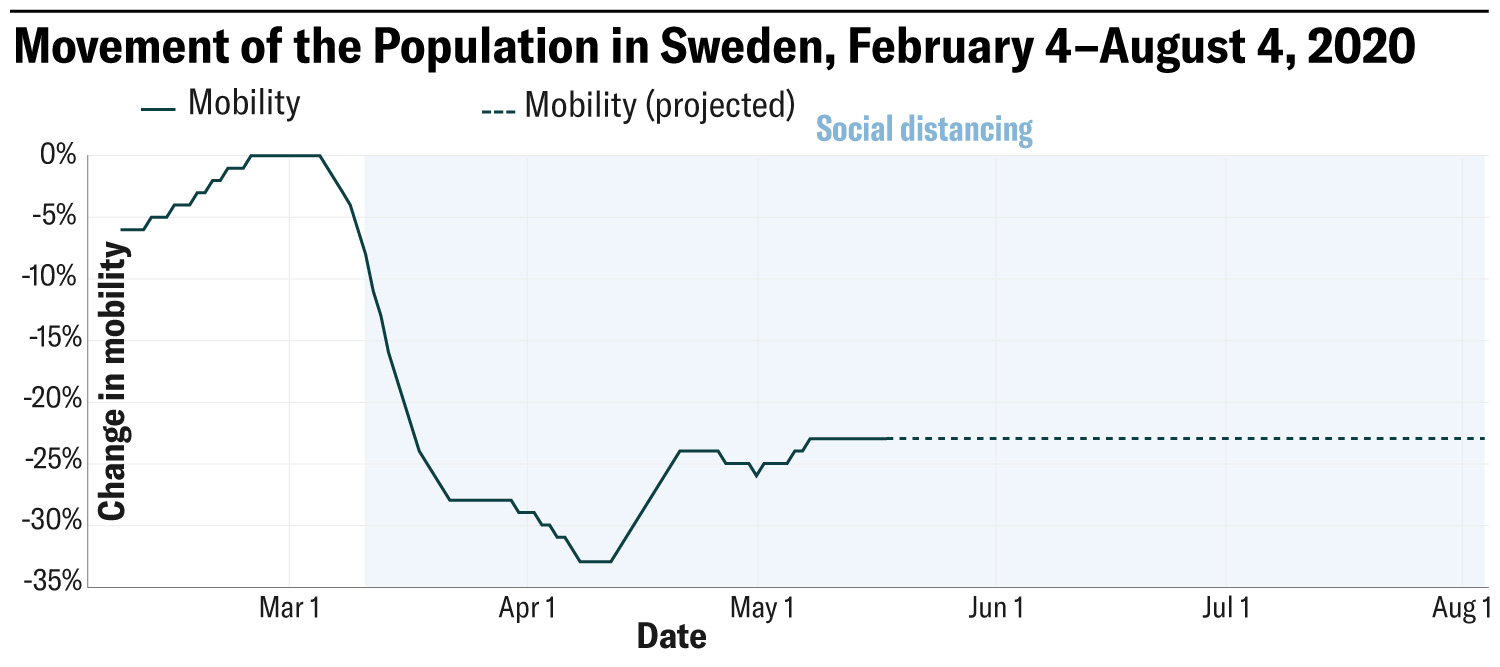
Figure shows the Movement of the population in Sweden, February 4 – August 4, 2020
In response to government guidelines on social distancing, Sweden's mobility dropped 33 percent in April—not as dramatic as neighboring countries. View latest: https://covid19.healthdata.org/sweden. IHME

Labels: , , , ,

Monday, March 11, 2019

Employment: Salary With Benefits :Effort, None

"The position holds no duties or responsibilities, other than that it should be carried out at Korsvagen."
"Whatever the employee chooses to do constitutes the work."
Job description for "Eternal Employment"

"In the face of mass automation and artificial intelligence, the impending threat/promise is that we will all become productively superfluous."
"We will all be 'employed at Korsvagen', as it were."
Artistic proposal and social experiment
In this concept illustration, the presence of the eternal employee will flood Korsvägen station with light.
In this concept illustration, the presence of the eternal employee will flood Korsvägen station with light. Visualization: Anna Heymowska


For the fortunate individual who will eventually be chosen, this might represent the ultimate "perfect job". A salary guaranteed for life, just clock in and clock out daily. The list of tasks to be performed is slight, so slight as to be non-existent, but for that clocking in, morning and evening. Hardly exhausting. On the other hand, perhaps not very inspiring, either. If it is regarded as a conventional employment opportunity. If, however, it is considered a living wage enabling the employee to do whatever else truly represents for that person the opportunity to relish the freedom of time and freedom from concerns over living expenses so they can get on with a beloved avocation, perhaps this job as a means to an end is ideal.

They'll have to wait, though until 2026 rolls around to begin this brave new experiment in lifetime employment. This is a conceptual art project fully funded by the Swedish government in Gothenburg. The sole "Eternal Employment" worker must report daily to a train station, Korsvagen, still under construction. For that person's time clocking in and out, a salary of roughly $2,320 monthly with annual wage increases, vacation time and a retirement pension will more than adequately recompense for dedication to this job.
Swedish experiment to pay you for doing nothing
Show up at the train station in the morning and punch the time clock: 'I'm here!'. And then you're free to turn about, and leave. Your time henceforth your own, to do with as you wish, you fortunate individual. Punching that time clock triggers a bank of fluorescent lights over the platform so travellers and commuters understand that the employee has performed their function and all, presumably, is well. Wait! not so quick, there's more; the need to clock out so the lights turn off when the station closes. As for that wide space of time between clocking in and out, go anywhere you like.

To qualify simply apply. No previous anything required. Application open to anyone the job happens to appeal to. Public Art Agency Sweden and the Swedish Transport Administration had opened an international competition available for artists who might have an interest in contributing to the station's physical allure. Whoever won the contest on the quality of their conceptual design would have the 7 million Swedish krona that came with success (the equivalent of about $750,000).

This gave the winning artists, Jakob Senneby and Simon Goldin food for thought. These Swedish artists suggested that the typical murals and sculptures so frequently seen in transit hubs be dispatched with. They would, instead, use the prize money, they explained, to pay a salary for a single worker, in the process giving them the opportunity to be gainfully employed in exchange for performing precisely no duties whatsoever other than showing up twice a day.

Their proposal was that by creating a foundation which would bypass taxation on the prize money, it would be invested in the market and in so doing it would fund on a continual basis an "eternity" salary for a single employee whose presence alone represented the pivot of their project. Lars Hjalmered, a member of Swedish parliament, felt the artwork as described represented sheer "stupidity", and his unkind opinion was evidently echoed by many other Swedes when the contest winner and the description of the art project was publicly announced.
A train at Gothenburg Central Station, currently the main pipeline for transportation in the city.
A train at Gothenburg Central Station, currently the main pipeline for transportation in the city. Andrzej Otrębski/Wikimedia Commons/CC-BY-4.0


Labels: , ,

Wednesday, October 29, 2014

Proverbial Grains of Salt

"Our results may question the validity of recommendations to consume high amounts of milk to prevent fragility fractures. A higher consumption of milk in women and men is not accompanied by a lower risk of fracture and instead may be associated with a higher rate of death."
Prof. Karl Michaelsson, Uppsala University, Sweden

"There may be another factor causing the increased mortality and fracture rate in women. Milk is a convenient source of calcium as well as many other vitamins and minerals. One such study is insufficient to base public health decisions on."
Gaynor Bussell, British public health nutritionist
Current dietary recommendations about milk consumption are unchanged
"The authors advise caution in interpreting the results and are not recommending that anyone stops drinking milk or eating dairy products."
Dr. Louis Levy, Public Health England

The controversy here is whether milk consumption should be considered an aid to building healthy bones in adults, or whether it controversially presents as yet another health risk. Popular health wisdom has it that drinking and eating dairy products with their high calcium content help to maintain healthy bone structure. Of course, it isn't just a consumption matter, but a lifestyle matter as well, in maintaining a robust, healthy body.

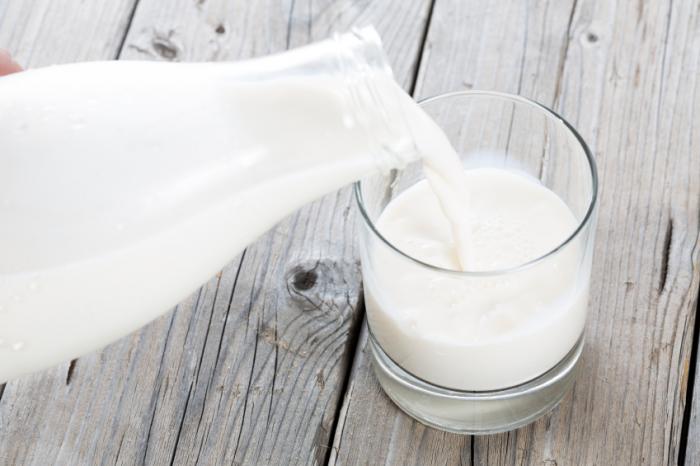
glass of milk
A study claims that an intake of three or more glasses of milk a day could perhaps do more harm than good.

Exercise from an early age onward into maturity and continuing the types of exercise appropriate for advancing age with a daily regimen is also a useful assist in maintaining health. Those who lead sedentary lifestyles lose their stamina, flexibility and enduring strength as their physiques languish due to under-use. That old adage of 'use it or lose it' is never so true as when connected to the mechanics of physical lubrication and muscular usage.

The new research referred to above, was published in the British Medical Journal, reflecting the results of a study undertaken by lead author Prof. Michaelsson and his colleagues in Sweden. Theirs was a study tracking 61,000 women and 45,000 men for a twenty-year period. During the course of the study the subjects' milk-consumption habits were tracked, the end result being that the conclusion was that there was no benefit to drinking milk.

The study's authors found no reduction in broken bones for those who consumed milk the most frequently. Instead, for women milk was associated with an increased opportunity of suffering a fracture. Women who drank three or more glasses of milk daily (680 ml) were found to be twice as likely to die at an earlier age than those who consumed less than one glass of milk on a daily basis.

Researchers arrived at the belief that the fat in milk cancels out the positive effects of calcium. Instead of helping to build healthy bones and keep them that way, they feel that milk consumption triggers inflammation, increasing the risk of heart attacks, because of the fat content. Low-fat dairy products, on the other hand; cheese and yogurt for example, produced a beneficial effect in reduction of early death and promoting bone health.

British experts, examining the study and its results, feel that something may have been overlooked, or not adequately factored in when the researchers compiled and examined their data. They feel the conclusions arrived at through the research should be viewed with caution since Sweden fortifies its milk with vitamin A, which might conceivably have tilted toward the result.

Just incidentally, citing a Cochrane Review, the Mayo Clinic in the United States reached a conclusion of their own in acknowledging that the ingestion of too much beta-carotene or Vitamin A may be injurious to peoples' health:
The same review found large doses of vitamin A supplements were also associated with an increased risk of dying prematurely. Supplementation with beta-carotene, a compound that's converted to vitamin A by the body, was also shown to increase risk of death, especially for smokers or former smokers. Since vitamin A deficiency is rare in the U.S., it's probably not worth the potential risk to take this supplement.

And then there are growing cautions against trusting everything one reads even in respected scientific journals. The editor of the British Medical Journal, Richard Smith, spoke of problems with peer review, a process of pre-publication where papers to be published are circulated among scientists with knowledge of the topic at hand who may verify or query some of the assertions concluding a research project.

He found the peer review process to be inconsistent; two reviewers of the same paper can arrive at astonishingly opposite conclusions. Sometimes the process can result in dishonesty (when on a rare occasion a reviewer appropriates parts of a paper to use it in his own work, while rejecting the original). But review of this nature, he said, rarely catches fraud. Peer review, he felt (the standard scientific 'guarantee' of trustworthiness in scientific paper publishing) was "little better than tossing a coin".

Which makes it all the more important that when a research project is concluded and the findings arrived at don't appear to reflect prevailing scientific opinion and recommendations based on a wide range of other research supporting the opposite of a random conclusion, others in the field speak up to express their doubts in the presumed accuracy of the conclusion.
Medical News Today
Milk contains 18 out of 22 essential nutrients. The relationship between the dynamic duo of calcium and vitamin D in milk and their importance in maintaining bone health has long been promoted in nutritional education, especially in terms of child development.
The United States Department of Agriculture (USDA) recommend a daily dose of 3 cups of dairy to support good health and improve bone mass. An intake of three or four glasses of milk a day has been suggested to save at least 20% of health care costs related to osteoporosis.
Milk is also presented to have many other benefits, including:

Labels: , , , , , ,

Tuesday, November 20, 2012

The Moveable City


"LKAB will buy my house within ten years from now.  After that, I will still stay there as a tenant.  LKAB is seeking a mining permit in my area, which means they must buy all of the houses in that area.  When they eventually start mining, it will probably take ten to fifteen years for the ground to be affected to such a degree that I have to move."
Anders Lindberg, information officer, LKAB
"We have looked at how much of the city will be affected when we go down to that level (1,365 meters).  It will take us between twenty and twenty-five years, and three thousand houses will be affected during that period."

When, at the turn of the 20th Century the first managing director of state-owned mining company Luossavaara-Kiirunavaara Aktiebolag (LKAB) had the idea to create a city in the middle of nowhere, he decided he would create a community so appealing in the subarctic wasteland that he would have no trouble persuading workers to move there, so they could operate the largest iron ore mine in the world.

Hjalmar Lundbolm is long dead, but his memory as the founder of Kiruna is not.  His house, as the first managing direct of LKAB where he lived from 1855 to 1926 is one of the historic places scheduled to be moved to a new site.  To retain the hallowed historic component of this picture-perfect tourist town with its immense mining installation in its background. 

Located at the northern tip of Sweden, and home to 23,000 people, its adjacent location to the mine reflecting a worldwide demand for that resource dictates the entire city now be moved to allow for better access to that ore.  The city is planned to move over a long period of time, in stages.  The first stage will affect the city centre itself.

"We're not quite sure about how it will happen, and this is because LKAB has to negotiate separately with everyone who owns a building in the area", explained the company's information officer for the municipality of Kiruna.  The company is scheduled to open a new main level at the mine, the depth of which has finally forced the city to move from its mining-inconvenient location.

At the present time an area in which 140 households are located is being emptied as a result of their proximity to cracks that have formed in the mountain from the mining operation.  In anticipation of the moving of all those buildings the company has built new roads, a new railroad, and utilities.  Six billion SEK (about C900-Million has been set aside for this colossal enterprise.

And how might people who have lived all their lives in this city feel about their forced move?  They have, after all, little recourse to object and to insist that they will remain where they have always been, that this is their human right.  "Sure, we give you another nice place to live, but you will never be able to walk around in the area where you grew up, or where you raised your children."

It is never easy to casually inform people that their homes will no longer be theirs; that the property on which their homes sit are to be state-expropriated, that they will be obliged to come to terms with the reality of leaving the geography they are familiar with and love. 
Kiruna

Labels: , , ,

 
()() Follow @rheytah Tweet