Ruminations

Blog dedicated primarily to randomly selected news items; comments reflecting personal perceptions

Saturday, August 04, 2018

The Profoundly Affecting Grief of Animals

"There's evidence that cetaceans such as dolphin and whales are often attending to dead bodies. Sometimes, it's because of curiosity or exploration and not necessarily emotion. Other mother dolphins and whales have kept their calves buoyant."
"What's different about J35 is her persistence. How resilient can she be? How long can she keep this up? Is she eating? Is she taking care of herself?"
Barbara King, professor emerita, anthropology, College of William and Mary

"There's an optic that's more powerful than any other statistic."
"It's a picture of what we can assume is a heartbroken mother who herself is necessary and precious to this population [of orcas]."
Jason Colby, professor, environmental history, University of Victoria
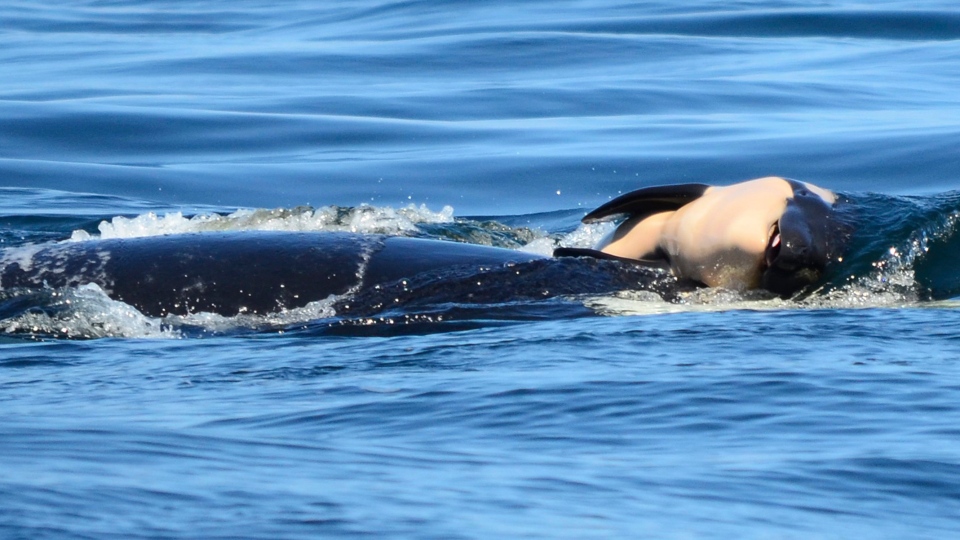
In this photo taken Tuesday, July 24, 2018, provided by the Center for Whale Research, a baby orca whale is being pushed by her mother after being born off the Canada coast near Victoria, British Columbia. (Michael Weiss/Center for Whale Research via AP)

Orcas have been listed for the past decade in both Canada and the United States as an endangered species. There is an alarming deficit of Chinook salmon comprising the black-and-white orcas' main diet. Other threats ranging from toxic contamination to disturbing noise and other troubling potential threats from boat traffic -- interfering with their foraging or communication -- that contribute to their threatened status.

Lacking the essential fat and energy required to ensure their health status lends itself to reproduction, female orcas have been seen to experience problems with pregnancy due to nutritional stressors that biologists link to a critical shortage of salmon. Last year, University of Washington and other researchers undertook a multi-year study that indicated two-third of the orcas' pregnancies have failed for the last seven years.

In mid-July, a 20-year-old whale tagged as J35 gave birth to an orca calf. The baby whale failed to survive, dying just days after its birth. Its grieving mother has since been seen clinging to her dead calf, off the Gulf Islands of British Columbia. Other members of her pod are travelling alongside the bereaved mother, helping her to keep her baby afloat. She quite obviously is not prepared to discard her dead calf.

The scientific community might have been elated at the birth, finally, of an orca calf, only to discover that promising sign was short-lived for a species moving along the endangered scale of existence. The mother orca appears to have been devastated by the loss of her baby, taking extraordinary measures to keep the calf afloat, while knowing it is dead.

She and the members of her family have been pushing the dead calf along, propping it up, swimming with it for miles upon end in the waters of Washington State and British Columbia. According to experts, grief at the loss of any pod member, much less a calf, is part of the species' mourning ritual; what is unusual, they say, is the lengths the orcas have gone to, to try to support the mother refusing to let her baby go.

Researchers at the Whale Museum on San Juan Island have collected fecal samples from the group in the interests of knowing more about the situation. They plan to attempt a recovery of the dead calf, in an effort to examine it to determine why it failed to thrive after birth. The situation is of high concern for the preservation of these killer whales since there is now a total of only 75 of the southern resident whales that typically spend spring to fall in Pacific Northwest waters.
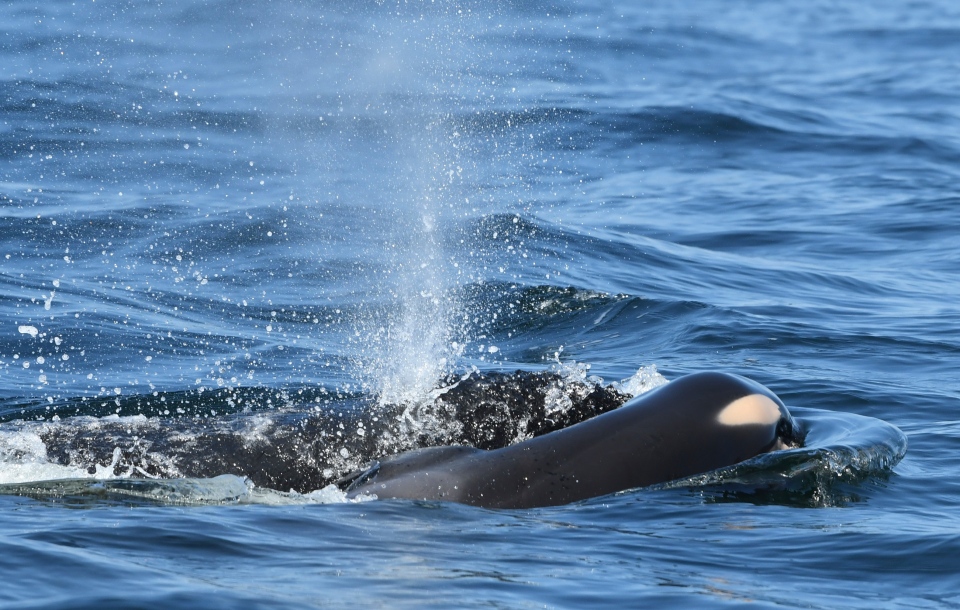

In this photo taken Tuesday, July 24, 2018, provided by the Center for Whale Research, a baby orca whale is being pushed by her mother after being born off the Canada coast near Victoria, British Columbia. (Michael Weiss/Center for Whale Research via AP)

Labels: , , ,

Thursday, July 05, 2018

The Thrill of a Lifetime

"We have been seeing regular activity of our white sharks up there [Atlantic Canada], moving up there this time of year, staying through 'til late fall. We believe that this has been happening since the beginning of time."
"[The presence of] Lots of sharks [as the natural balance keeper at the top of the food chain] means lots of fish sandwiches, lots of clams, lots of oysters, lots of lobsters."
"The mere presence of the apex predator, the large sharks, modifies their behaviour so they can't just wipe out the resource [fish populations]."
"Thousands of people die every year from drowning. Single digits have had fatal interactions with sharks."
Chris Fischer, founding chairman, Ocearch (shark research group)
While shark attacks are exceedingly rare, the East Coast is emerging as a popular spot for great whites during their mating season. As seen in this Toronto Star file photo, a white shark was captured off Prince Edward Island in 1983.
While shark attacks are exceedingly rare, the East Coast is emerging as a popular spot for great whites during their mating season. As seen in this Toronto Star file photo, a white shark was captured off Prince Edward Island in 1983.  (Jack Woolner and Tom Hurlbut / Toronto Star File Photo)

"I looked down, and I think, in my mind, I still wanted to see that porpoise shape."
"The girth around this thing was gobsmackingly huge. I can't even describe it -- it felt like I was coming up to a submarine."
"It was terrifying. I thought I was going to die. I thought that was it."
Pat Barker, canoeist, Passamaquoddy Bay, New Brunswick


Out for a pleasant day's paddling on a tranquil mid-June day, a pair of avid canoists, Pat Barker and her husband paddled toward Deer Island through Passamaquoddy Bay when they noticed that their 24-foot canoe had attracted a dorsal fin. Initially assuming a porpoise had taken a liking to their presence, then re-assessed the situation when they realized the dark grey creature with its white underbelly was enormous, at least 4.5 metres in length.

They took a spontaneously swift decision to leave the area because both surmised that this was no extraordinarily large porpoise at all, but far more likely a great white shark whose reputation both were more than aware of and felt little inclination to view up close and personal. When they saw the animal turn as it swept past their boat and begin moving again toward them, dipping further under the water, then circling around the back of the boat, they felt an immediate urge to disassociate themselves from the creature.

They hadn't come out for a fishing expedition, nor were they expecting that they would end up being involved in a dramatic excursion  they were unprepared for. The shark, according to Pat Barker, kept in close communion with their boat, and with them, as they paddled as vigorously determinedly as they could manage. It seemed clear to them that the predator -- for that was certainly what it was -- was entirely focused on them and had no intention of losing contact.

They paddled, the shark aggressively followed. Afterward, on dry land and the shark nowhere in sight, Pat Barker was unable to say how long the shark remained in hot pursuit because as it happened, she was in such a state of fright she struggled not to look back to assess its progress. Once they reached the shore and safety they contacted a local expert on sharks who assured them that they must indeed have come into close quarters with a great white shark; their description of the animal was spot-on.

The shark research group Ocearch operates a live global shark tracker on their website. According to them, the East Coast has become a popular area for great white sharks during mating season. According to their tracker, at the present time a few sharks are swimming about in Atlantic Canada waters. A mature male is known to be lingering around the Grand Banks of Newfoundland, and a young female has remained off the coast of Canso, Nova Scotia.
A great white shark seen in Isla Guadalupe, Mexico.    Getty Images
Groups of blue sharks, mako sharks and tiger sharks have also been spotted on the tracker further offshore, while a 600 kilogram great white is swimming about off the coast of North Carolina, but last year made an extended trip to Atlantic Canada. According to Mr. Fischer, that last great white is on its way back toward Atlantic Canada. People there can anticipate more sharks in August, stated Mr. Fischer; the one that the Barkers came across was an early arrival.

This shark expert takes pains to explain that despite peoples' fears about the predatory nature of sharks, their presence is a healthy sign that nature attains a good balance in the biosphere. Sharks feed on the aquatic animals in the food chain below them, helping to ensure those populations are kept under control to maintain a healthy ecosystem. Seals, as averse to the presence of sharks as are people, are kept on beaches in the presence of sharks.Which means the seals are restrained from consuming too deeply into the fish population.

About five people are known to perish as a result of shark attacks annually, according to National Geographic. "Sharks don't know statistics", wryly responded Pat Barker on hearing that assurance. And she has no intention of poking about in their canoe any time soon, heading back toward Deer Island to see if their erstwhile companion misses their presence.

A U.S. coast guardsman from the Atlantic Strike Team looks out over Passamaquoddy Bay during a U.S. and Canadian cross-border contingency exercise September 12, 2007 in St. Andrews, New Brunswick, Canada. Luke Pinneo/U.S. Coast Guard via Getty Image

Labels: , , ,

 
()() Follow @rheytah Tweet