Ruminations

Blog dedicated primarily to randomly selected news items; comments reflecting personal perceptions

Thursday, July 29, 2021

Settling The Science of General Relativity

Researchers observed bright flares of X-ray emissions, produced as gas falls into a supermassive black hole. The flares echoed off of the gas falling into the black hole, and as the flares were subsiding, short flashes of X-rays were seen – corresponding to the reflection of the flares from the far side of the disk, bent around the black hole by its strong gravitational field. (Image credit: Dan Wilkins)
"Fifty years ago, when astrophysicists started speculating about how the magnetic field might behave close to a black hole, they had no idea that one day we might have the techniques to observe this directly and see Einstein's general theory of relativity in action."
Professor Roger Blandford,  Luke Blossom Professor, School of Humanities and Sciences, Stanford professor of physics and SLAC professor of particle physics and astrophysics

"Any light that goes into that black hole doesn’t come out, so we shouldn’t be able to see anything that’s behind the black hole."
"The reason we can see that is because that black hole is warping space, bending light and twisting magnetic fields around itself."
"This magnetic field getting tied up and then snapping close to the black hole heats everything around it and produces these high energy electrons that then go on to produce the X-rays."
"I've been building theoretical predictions of how these echoes appear to us for a few years. I'd already seen them in the theory I've been developing, so once I saw them in the telescope observations, I could figure out the connection."
"It's [Wide Field Imager detector] got a much bigger mirror than we've ever had on an X-ray telescope and it's going to let us get higher resolution looks in much shorter observation times. So, the picture we are starting to get from the data at the moment is going to become much clearer with these new observatories."
Dan Wilkins,  research scientist, Kavli Institute for Particle Astrophysics and Cosmology, Stanford and SLAC National Accelerator Laboratory
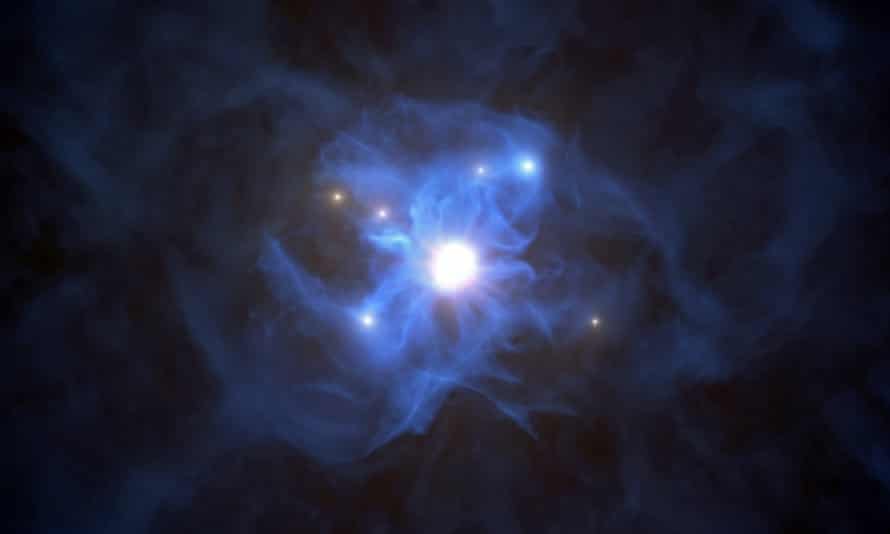
An artist’s impression of a supermassive black hole.
An artist’s impression of a supermassive black hole. Photograph: ESO/L Calçada/EPA

Predicted in 1915, Albert Einstein's theory of general relativity has undergone many challenges to its accuracy but in the final analysis there has been no question that his theory has been upheld time and again. And now, yet again irrefutable proof of that theory has emerged with the detection of light being emitted from the back end of a black hole. His prediction was that the gravitational pull of black holes warp the fabric of space to such a degree that they twist magnetic fields and bend light.
 
It should be possible, he predicted, to witness the emergence of light waves as they eject from the far side of black holes resulting from the distorted magnetic fields that act as a mirror. The theory, while accepted by experts in the field, remained untested. The phenomenon was never directly observed. Now, however, given modern telescopes and the development of technologies to produce sensitive instruments, the spectacle was indeed witnessed.
 
The result of which is that an international team of researchers made use of X-ray telescopes in their study of a massive black hole some 800 million light years distance from Earth, located at the centre of a distant galaxy. The expected and frequently observed black hole hallmarks were seen but now researchers also were able to detect light in the form of X-rays being emitted by the far side of the black hole under scrutiny.
 
An astrophysicist at Stanford University, Dan Wilkins was in the process of studying the mechanics of a black hole ripping atoms and electrons apart which subsequently produces X-rays. Inspecting the accumulated data, he expected and saw X-rays spewed directly toward Earth from the black hole's core. Then he also saw shortly following this, unexpected echoes which he identified as X-rays flung out in the opposite direction to Earth, reflected by the black hole's mangled magnetic field.
 
That finding described in a release published in the journal Nature proved again, in supporting Einstein's theory of general relativity, how correct a theory Albert Einstein gifted to science. This celestial giant's immense gravitational pull, ingesting everything and anything in its near vicinity into its great maw was assumed to be insatiable in appetite, its interior a dense mysterious darkness emitting no light. 
 
Now an international team of researchers, with the use of X-ray telescopes revealed that light is indeed emitted as X-rays, in the opposite direction to which the black star swallows all it surveys. 
 
An orange ring with twisted stripes.
Credit: CCO Public Domain


Labels: , , , , ,

Saturday, September 21, 2019

Unpeeling the Mysteries of Nature

"We're excited about this because ... it shows that we can start doing this more precise test and start to understand black holes in a deeper sense."
"We all expect general relativity to be correct, but this is the first time we have confirmed it in this way. This is the first experimental measurement that succeeds in directly testing the no-hair theorem."
"What we've done in this study is go back to the data from the first detection of gravitational waves ... and we reanalyzed it to look for a different kind of 'ringing' that has been all but ignored in previous analyses, and we were able to identify it."
"We were very surprised by this because the common wisdom was that this should not work. We were ecstatic."
Maximiliano Isi, NASA Einstein fellow, Kavil Institute for Astrophysics and Space Research, Massachusetts Institute of Technology
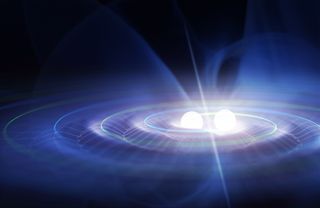
gravitational waves from two merging black holes.
Image: © Shutterstock)

Published just a few days ago in Physical Review Letters, a study led by an MIT researcher in tandem with colleagues, managed to decipher the 'ringing' of an infant black hole, producing gravitational waves in a manner reminiscent of a bell producing sound. This permitted the researchers to predict the mass and spin of the black hole, an advance in understanding the phenomena of evolving matter and its gravitational impact in a way never before realized, and running counter to all expectations of success.

When two black holes collided they produced a new black hole whose waves resulting from the violent collision had been detected in 2017; while isolating the ringing from the baby black hole, the scientists have recognized a new method of studying the mysterious objects whose celebrated gravitational pull is so robust even light is incapable of escaping, held fast to the dark interior.

The research team headed by Dr. Isi in collaboration with a five-person team included the study co-author Matthew Giesler of the California Institute of Technology. Support was given to the Albert Einstein theory about gravity, now a century old, when the research team was enabled by their observation and its startling result, to demonstrate that ringing of gravitational waves can be utilized in the prediction of mass and spin of black holes.

Dr. Einstein theorized the existence of gravitational waves, how they might be useful in finding the composition of the objects that create them. His original theory of general relativity explains how it is that space, time, matter and energy interact in various ways. Black holes are "hairless", a theoretical term used by scientists to indicate a black hole has mass, spin and electrical charge but no other characteristics; it was the scientists' discovery of the ringing that supported that theory.
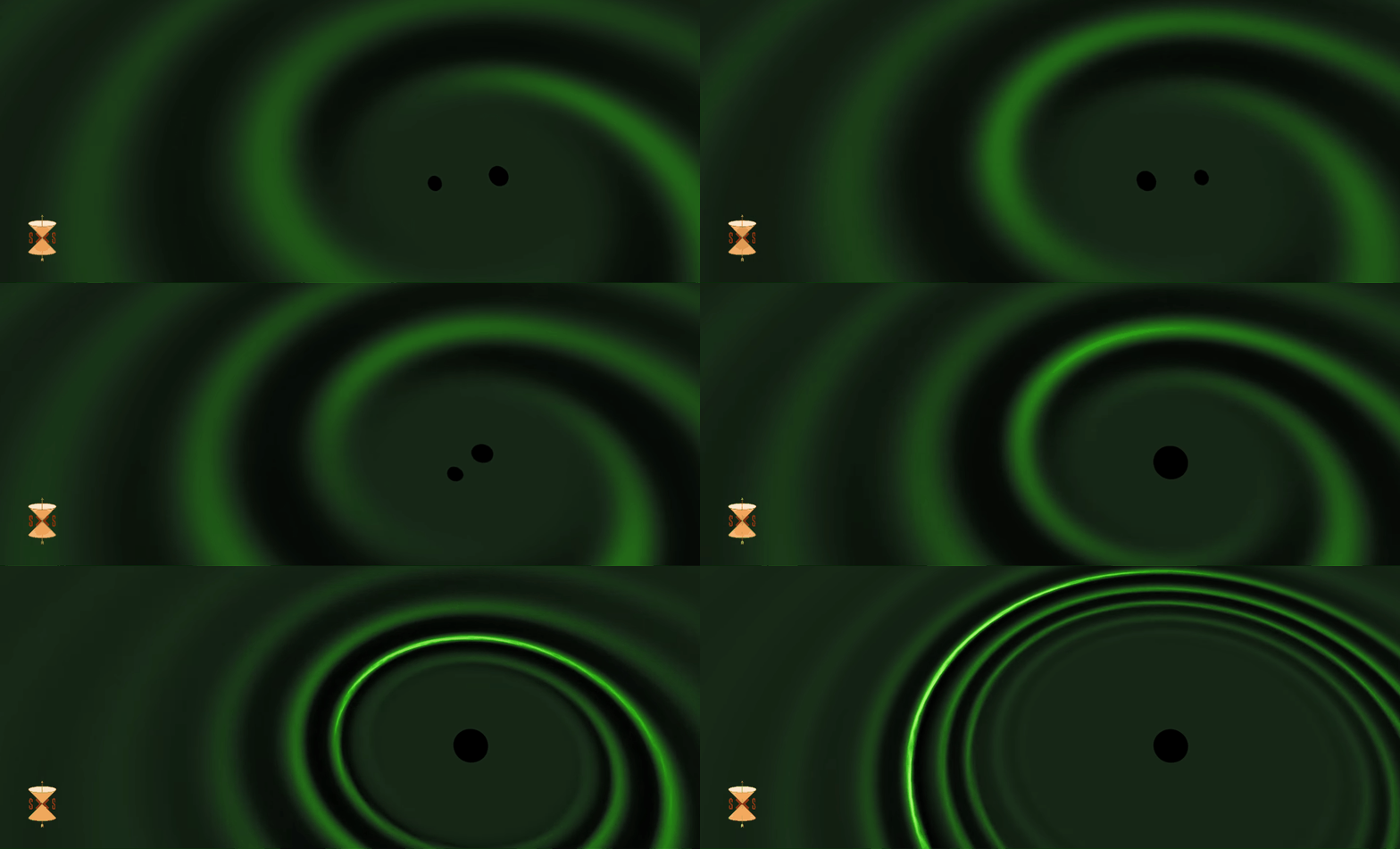
light swirls around two black points in space, one larger than the other
An artist’s impression of two black holes as they’re in the process of merging.
LIGO

Data was derived from LIGO, the Laser Interferometer Gravitational-Wave-Observatory, a scientific collaboration led by MIT and Caltech, including the participation of global institutions. In 2015 the organization first discovered gravitational waves resulting from the collision of the two black holes. A chirping sound was heard when the waves were translated into sound.

It was the focus on the last few milliseconds of the "chirp" that led the researchers to isolate waves specific to the newly-created black hole from the much more robust waves produced by the collision, allowing them to identify a specific "tone" of the ringing, in turn permitting the accurate prediction of the black hole's mass and spin.

This revelation represented a hitherto-unattainable goal that evaded scientists, to the point it was considered that making the breakthrough would demand technology that would only be developed some time in the next several decades. This new discovery has clearly resulted in an acceleration of the process, advancing the science enormously.

main article image

Dr. Isi enthuses over the opportunity to witness what the scientific community can construct of this new method of studying black holes at a time when new black hole collisions are being detected every week. "The dark universe", that surrounds us is on the cusp, it would seem, of becoming more explicable, opening the potential in identification and study of waves from mystifying astrophysical objects such as wormholes.

"This is very exciting. We're going to be learning all types of things. It's a good time to be a gravitational scientist", the astronomer enthused, thinking of future revelations that will bring the secrets of our encircling, universal environment and nature's bewitching blueprint for existence all the more closer to human understanding even in the face of a vast universe reluctant to reveal all the hidden details of its evolving and often puzzling realities.

20190410-78m
Scientists have obtained the first image of a black hole, using Event Horizon Telescope observations of the center of the galaxy M87. The image shows a bright ring formed as light bends in the intense gravity around a black hole that is 6.5 billion times more massive than the Sun. This long-sought image provides the strongest evidence to date for the existence of supermassive black holes and opens a new window onto the study of black holes, their event horizons, and gravity. Credit: Event Horizon Telescope Collaboration

Labels: , , , ,

 
()() Follow @rheytah Tweet