Blog dedicated primarily to randomly selected news items; comments reflecting personal perceptions
Thursday, February 17, 2022
Stem Cell Transplants From Umbilical Cord Blood
"This is now the third report of a cure in this setting, and the first in a woman living with HIV."
"[The report] confirms that a cure for HIV (Human Immunodeficiency Virus) is possible and further strengthens using gene therapy as a viable strategy for an HIV cure."
"It was previously thought that graft versus host disease might be an important reason for an H.I.V. cure in the prior cases."
"Taken together, these three cases of a cure post stem cell
transplant all help in teasing out the various components of the
transplant that were absolutely key to a cure."
Dr.Sharon Lewin, president-elect, International AIDS Society
"The fact that she’s mixed race, and that she’s a woman, that is really
important scientifically and really important in terms of the community
impact."
"Umbilical stem cells are attractive. There’s something magical about these cells and something magical
perhaps about the cord blood in general that provides an extra benefit."
Steven Deeks, HIV researcher, University of California, San Francisco
A
colored scanning electron micrograph of H.I.V. particles, in yellow,
infecting a host cell. The patient received cord blood from a donor with
the mutation that blocks H.I.V.’s entry into cells. Credit...Thomas Deerinck, NCMIR/Science Source
Worldwide, approximately 38 million people are infected with and live with H.I.V. Some 73 percent of these H.I.V.-infected individuals receive treatment through antiretroviral therapy. Of that staggering number of people afflicted with the virus that causes AIDS, three people having undergone novel new surgeries have now been declared cured of the virus. The latest is an American woman with leukemia, the first woman and only the third person to the present cured after receiving a stem cell transplant, the donor of which was naturally resistant to the virus.
This breakthrough case of a middle-aged woman of mixed race was announced at the Conference on Retroviruses and Opportunistic Infections taking place in Denver, Colorado. The case study also represents the first involving umbilical cord blood, an emerging approach with the promise of expanding such treatment to greater numbers of H.I.V.-infected people.
The woman has been in remission, free of the virus, for 14 months, no longer requiring potent H.I.V. treatments known as antiretroviral therapy, since she received the cord blood treating her acute myeloid leukemia. This is a type of cancer that begins in blood-forming cells located in bone marrow. Before this case, there were two previous ones that occurred in H.I.V.-infected males. They too had received adult stem cells, more frequently used in bone marrow transplants.
The newly reported case outcome is part of a large U.S.-supported study with the intention of following 25 patients with H.I.V. who undergo transplants with stem cells taken from umbilical cord blood for cancer treatment and other serious conditions. At this point, doctors transplant stem cells from individuals having a specific genetic mutation where they lack receptors utilized by the virus to infect cells.
These individuals, scientists believe, then go on to develop an immune system that has become resistant to H.I.V. infection. While a considerable number of H.I.V. patients will go on to take advantage of this therapy, bone marrow transplants do not represent a viable strategy as a curative for most people living with H.I.V. But it is a building block that may lead to additional therapies whose treatment may have similar results.
This scanning electron microscopic image shows the presence of numerous
HIV virions. Since receiving umbilical cord blood to treat her acute
myeloid leukemia a 64-year-old woman from the U.S. has been in remission
and free of the virus for 14 months, researchers said. (C. Goldsmith, P. Feorino, E. L. Palmer, W. R. McManus/CDC/Reuters)
"I’m not aware of data showing that there is efficacy beyond two months
of the first dose. In the past few weeks, we’ve seen
different studies come out showing that the response to the first dose
of the vaccine in the people who are elderly, in the people who are
immuno-compromised is actually not that good and it wanes quite
rapidly."
"I’m sure they’re following this [updated findings] and they may well be looking at perhaps modulating the recommendation as we go."
"As data emerges about what it takes to protect [seniors and
immune-compromised people], we need to be reviewing what we’re doing."
"[As long as there aren’t issues with the vaccine supply,
reverting to the original recommendations from the pharmaceutical
companies] would be the ideal approach."
"The very people we want to protect the most require that we give them
the second dose using the shorter interval, originally as done by the
manufacturer in the clinical trials."
"The one-size-fits-all approach really needs to be modulated in terms of who we need to be protecting."
Canada’s chief science adviser Dr. Mona Nemer
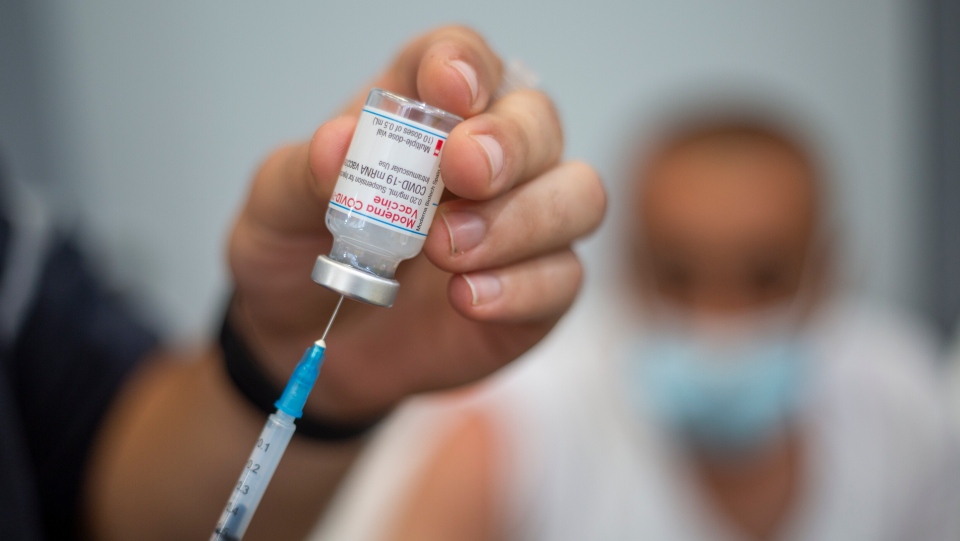
A health care worker prepares a first dose of the Moderna COVID-19
vaccine to administer to a Palestinian laborer who works in Israel at a
coronavirus vaccination center set up at the Gilboa checkpoint crossing
between Israel and the West Bank city of Jenin, Monday, March. 8, 2021.
(AP Photo/Ariel Schalit)
"One size does not fit all."
"Cancer treatments have profound effects on the immune system and cancer patients' immune mechanisms are inferior."
"We need to be concerned about other vaccines [in addition to Pfizer's] for this population, too. They do need a second dose quickly."
Dr.Sheeba Irshad, lead researcher, study, King's College London/Francis Crick Institute
"The National Advisory Committee on Immunization (NACI) is an External
Advisory Body that provides the Public Health Agency of Canada (PHAC)
with independent, ongoing and timely medical, scientific, and public
health advice in response to questions from PHAC relating to
immunization."
"In addition to burden of disease and vaccine characteristics, PHAC
has expanded the mandate of NACI to include the systematic consideration
of programmatic factors in developing evidence-based recommendations to
facilitate timely decision-making for publicly funded vaccine programs
at provincial and territorial levels."
NACI has considered evidence from recent scientific studies on
efficacy and effectiveness of COVID-19 vaccines in preventing various
health outcomes such as infection, symptomatic disease, hospitalizations
and death from COVID-19.
While studies have not yet collected four months of data on vaccine
effectiveness after the first dose, the first two months of real world
effectiveness are showing sustained high levels of protection.
Short term sustained protection is consistent with immunological
principles and vaccine science where it is not expected to see rapid
waning of a highly effective vaccine in adults over a relatively short
period of time. Extending the interval between doses was shown to be a
good strategy through modelling, even in scenarios considering a six
month interval and in theoretical scenarios where waning protection was
considered.
NACI recommends that in the context of limited COVID-19 vaccine
supply, jurisdictions should maximize the number of individuals
benefiting from the first dose of vaccine by extending the interval for
the second dose of vaccine up to four months.
Extending the dose interval to four months allows NACI to create
opportunities for protection of the entire adult population within a
short time frame. This will not only achieve protection of the adult
population, but will also contribute to health equity.
NACI will continue to monitor the evidence on effectiveness of
extended dose intervals and will adjust recommendations as needed.
Government of Canada, National Advisory Committee on Immunization
The Government of Canada found itself -- through a series of decision misadventures -- in difficulties procuring sufficient vaccine doses to inoculate the most vulnerable among its population, which led to an issue of maximizing the doses available. The United Kingdom had decided to space out the time between the first and second dose of its vaccines to enable vaccinating a greater number of people, and Canada made the decision to go the same route. Both Pfizer and Moderna whose vaccines were the first Canada received, recommend on the basis of their research no more than 21 or 18 days respectively between doses.
Health Canada and the National Advisory Council on Immunization agreed that it would be feasible to stretch the time between doses to 105 days, the delay enabling the dosages to go further so that greater numbers of people could be vaccinated. This was seen as a critical intervention for several reason, the first being that more people would be protected against the virus; it would give a boost to Canada's economic recovery; and concerns over the emergence in Canada of three COVID-19 variants, from the UK, South Africa and Brazil were spurring a third wave which they hoped to be able to arrest.
Despite the decision to leave a greater space between inoculations for each individual in the belief that sufficient protection would arise from the protective effects of the first shot, many medical experts profess unease at the decision, warning that the vaccines' efficacy would be compromised, The manufacturers themselves feel the decision to be unwise, given the results of their own research; those very results which led to the vaccines' authorized use by Health Canada to begin with.
Now, a new study conducted by a team of researchers at King's College London and the Francis Crick Institute has discovered how inimical delays in administering the second dose turns out to be on the mortality rate among cancer patients. Lengthening the time between doses being administered to cancer patients renders them far more vulnerable to contracting COVID-19 and suffering morbid effects as a result of that delay and consequential vulnerabilities.
According to the study, those with cancer or who have had cancer are considerably less "protected" should they be placed in the position of waiting longer to receive their second dose of vaccine following the administration of the first. Dr.Sheena Irshad, lead scientist on the project, informs that a prolonged wait for the second dose leaves people unprotected, during which time opportunistic new variants have emerged that are more contagious.
Canada sees about 225,800 new cancer cases annually, while two million Canadians currently suffer from cancer or have had cancer.Three weeks following one dose of the Pfizer vaccine, according to the study, an antibody response was found in only 39 percent of people with cancer, in comparison to 97 percent for those without cancer. Should a second dose be administered three weeks later, cancer patients' antibody responses rise sharply, matching those of non-cancer patients. Delayed, the response remained around 39 percent.
Britain's 12-week gap (Canada's is 15 weeks) should be immediately reviewed, urges Dr.Irshad. Breast Cancer Now has recommended the U.K.'s vaccine committee to "urgently review the evidence presented in this study and consider adapting its strategy", to ensure that people with cancer receive both doses within the recommended three-week period. A spokesperson noting: "Anyone undergoing cancer treatment should continue to follow the advice of their doctors and we encourage all who can to take up the vaccine".
Guerina
Morra, 81, gets her first dose of the Pfizer-BioNTech COVID-19 vaccine
at Caboto Terrace in Toronto on Thursday. Experts say the confusion
around vaccine safety recommendations is unfortunate given the number of
unvaccinated seniors in Canada at risk of severe COVID-19
complications. (Evan Mitsui/CBC)