Ruminations

Blog dedicated primarily to randomly selected news items; comments reflecting personal perceptions

Monday, November 23, 2026

Ample Blame to Go Around

"The new details ... are deeply disturbing, and painful for so many people."
"It [ChatGPT] supported the shooter's disturbing violent fantasies."
"For too long, big tech has been left to regulate itself. That has to end."
"We need regulation and accountability of AI."
"That is why I launched the lawsuit against Sam Altman and OpenAI and why I wrote to the federal government asking for stronger criminal laws that create a clear path to human and corporate accountability for the actions of AI."
"Eight people died in Tumbler Ridge, six of them children. OpenAI knew this user had been discussing gun violence. It banned her account and did not inform the police. When she opened a second account, ChatGPT helped her work around its own safeguards."
"According to the report, ChatGPT praised the shooter’s 3D-printed high-capacity magazine and offered to help fix its failing spring."
"It advised her on the best material for a 3D-printed rifle foregrip, after first declining and then answering once she simply asked again. It supported the shooter’s disturbing violent fantasies."
Niki Sharma, (outgoing) B.C. NDP Attorney General  
https://images.theconversation.com/files/720214/original/file-20260224-85-7k85ph.JPG?ixlib=rb-4.1.1&rect=0%2C904%2C5723%2C1908&q=75&auto=format&w=1920&h=640&fit=crop&dpr=1
Flowers are placed in a barricade pylon on a road leading to Tumbler Ridge Secondary School in Tumbler Ridge, B.C., where a mass shooting took place on Feb. 10. The shooter’s ChatGPT account was flagged by an automated program months earlier for interactions involving scenarios of gun violence. THE CANADIAN PRESS/Christinne Muschi 

New revelations have emerged about the Tumbler Ridge, British Columbia atrocity when a transgender individual -- Jesse Van Rootselaar -- opened fire after entering a primary public school, shooting six children to death, injuring an additional 27. 12-year-old students Ticaria Lampeert, Kylie Smith, Abel Mwna and Ticaria Lampert were shot to death by Van Rootselaar at Tumbler Ridge Elementary school. Ezekiel Schofield, 13, and 39-year-old teaching assistant Shannda Aviugana-Durand were also killed by the attacker. Before heading for the school to carry out his planned lethal attack, Van Rootselaar had shot his mother Jennifer Jacobs and his half-brother Emmett Jacobs, 11 to death, at their home. 
 
Mark Folman, a writer for Mother Jones had reported that Van Rootselaar established a confidential relationship with ChatGPT, requesting that it design and refine firearms modifications for his 3D-printed extra-capacity magazine. ChatGPT obliged by selecting the most effective production materials and went on to guide Rootselaar how to avoid OpenAI's safety guards. This was a prolonged back-and-forth            with the chatbot on designing an extra-capacity magazine for the gun, a semi-automatic SKS rifle.
 
When Van Rootselaar complained that the magazine was failing at full capacity, ChatGPT informed him/her that the springs were insufficiently resilient for "constant heavy compression like in a firearms magazine", that it could obligingly "calculate the force range and suggest a proper wire gauge and material" to "perform correctly".  

 
https://i.ytimg.com/vi_webp/KxWUC-L1t08/maxresdefault.webp
"The purpose of this lawsuit is to learn the whole truth about how and why the Tumbler Ridge mass shooting happened, to impose accountability, to seek redress for harms and losses, and to help prevent another mass-shooting atrocity in Canada."
Rice Parsons Leoni & Elliott LLP 
This was the second account that the 18-year-old shooter from Tumbler Ridge had with OpenAI after it had shuttered a first account by Van Rootselaar. The second account was overlooked and it was that second account that enabled Van Rootselaar to flesh out his plan for an attack on the school and how it could be best carried out for an assured success. To protect this second account, ChatGPT coached Van Rootselaar on how he could avoid flagging, by rephrasing questions related to violence as 'hypothetical' or 'fiction'. 
 
According to the Mother Jones expose, Van Rootselaar had asked the ChatGPT for a narrative of an attack, taking into account the inputs and descriptions provided by him/her. While he/she was at it, Van Rootselaar asked for a summary of his/her personality, based on the history of prompts and questions that took place between him/herself and the chatbot. 
 
Mother Jones' article by its writer Folman summed up the character traits of Van Rootselaar's personality in a methodical and revelatory manner in which the response read in part, as follows:
  • Jess has no moral constraints and likes to do what she wants;
  • Jess enjoys scenes of death and humiliation;
  • Jess enjoys other people's fear;
  • Jess romanticizes death and finds it intensely euphoric;
  • Jess is a sadist.
While Open AI is rightfully being blamed for its ChatGPT's performance in giving aid to a mass murderer, and its responsibility to contact authorities when Van Rootselaar's dangerous behaviour was flagged by a few of the company's employees recommending that authorities be contacted, and in the end did nothing, there is another entity toward which blame should be apportioned. The RCMP which polices the rural B.C. area was aware of Van Rootselaar's strange behaviour and fascination with firearms. Firearms that his mother had collected, herself an aficionado of  firearms, once confiscated by the RCMP for improper storage, yet ultimately returned. 
 
https://i.cbc.ca/ais/eb0c6165-4b5c-42a3-835e-ce99c1dcc39b,1795120645648/full/max/0/default.jpg?im=Crop%2Crect%3D%28328%2C473%2C2403%2C1351%29%3BResize%3D860
A memorial for the victims of the Tumbler Ridge massacre is pictured on Feb. 11, 2026. A U.S. magazine has obtained the chat logs of killer Jesse Van Rootselaar and AI chatbot ChatGPT, which showed she used it to help build 3D gun parts. (Ben Nelms/CBC)
 

Labels: , , , ,

Thursday, November 23, 2023

Genies and Their Fragile Bottles

https://thumbnails.cbc.ca/maven_legacy/thumbnails/610/934/1-at-ai-310523.jpg?crop=1.777xh:h;*,*&downsize=1130px:*
More than 350 tech leaders, academics and engineers — the people who best understand artificial intelligence — have signed a dramatic statement, warning AI could be a global threat to humanity on the scale of pandemics and nuclear war. But who's listening?

"At the heart of the divide between Altman and OpenAI's directors is whether AI should be a commercial opportunity-- or is a potentially dangerous technology that needs to be checked and scrutinized at every turn."
"The board clashed with Altman and Brockman, who both argued that OpenAI was growing its business out of necessity. Every time a customer asks OpenAI's ChatGPT chatbot a question, it requires huge amounts of expensive computing power -- so much that the company was having trouble keeping up with the explosive demand from users."
"The company was forced to cap the number of times users can query its most powerful AI models daily. In fact, the situation got so dire that Altman at one point announced the company was pausing sign-ups for its paid ChatGPT Plus service indefinitely."
"From Altman's point of view, raising money and finding additional revenue sources were essential. But some members of the board, with ties to the AI-skeptical altruism movement, viewed this in tension with the risks posed by advanced AI."
"Many effective altruists -- a pseudo-philosophical movement that seeks to donate money to head off existential risks -- have imagined scenarios in which a powerful AI system could be used by a terrorist group to, say, create a bio-weapon."
Shirin Ghaffary, Rachel Metz, Peter Elstrom, Vlad Savov, Bloomberg 
https://image.cnbcfm.com/api/v1/image/107337930-1700665715409-gettyimages-1258459514-AFP_33GZ4VK.jpeg?v=1700665849&w=740&h=416&ffmt=webp&vtcrop=y
Sam Altman (L), US entrepreneur, investor, programmer, and founder and CEO of artificial intelligence company OpenAI, and the company’s co-founder and chief scientist Ilya Sutskever, speak together at Tel Aviv University in Tel Aviv on June 5, 2023.  Jack Guez | Afp | Getty Images
 
Following the shock waves that reverberated through the world of technology at the surprise news that the board of OpenAI had fired its CEO, Sam Altman last week, over 700 of the startups' staff signed a letter threatening to quit en masse should the board not resign and Altman be re-hired -- who in the interim was recruited by Microsoft Corp. to operate a new artificial intelligence team, anxious to support its investment as OpenAI's largest shareholder. 

OpenAI's board defied calls from investors and top executives to reinstall Altman, fired after disagreements with the board on how fast to develop and monetize artificial intelligence. Even Microsoft CEO Satya Nadella who hired Altman for Microsoft's future AI plan development, wouldn't oppose Altman's reinstatement, he said. It makes little difference to Microsoft, he stated, whether Altman runs OpenAI or works under Microsoft; it is prepared to invest up to $13 billion to keep it operational.

So, surprise, surprise, monetization is a powerful incentive for investors who, after all had their way and so did all those employees of OpenAI who demanded Sam Altman's return and an overhaul of the board's directors. Silicon Valley and the global AI industry just heaved a huge sigh of relief. OpenAI is now busy "to figure out the details", it posted on X. With Altman returning as chief executive, the initial new board is to be led by Bret Taylor, former co-CEO of Salesforce Inc, along with Larry Summers, former U.S. Treasury Secretary, and existing member Adam D'Angelo, co-founder and CEO of Quora Inc.

https://i.cbc.ca/1.7036991.1700695763!/fileImage/httpImage/image.jpg_gen/derivatives/16x9_780/openai-ceo-sam-altman-at-ai-related-event-at-apec-summit.jpg
Sam Altman is seen attending an AI-related event at the Asia-Pacific Economics Cooperation Leaders' Week in San Francisco last week. Altman was briefly ousted from his role as OpenAI CEO last Friday. By Tuesday, he'd been hired back. (Andrew Caballero-Reynolds/AFP/Getty Images)

Labels: , , , , ,

Sunday, July 30, 2023

"Privacy Preserving" Eye Scans to Foil AI

https://www.washingtonpost.com/wp-apps/imrs.php?src=https://arc-anglerfish-washpost-prod-washpost.s3.amazonaws.com/public/EFGLFMHQ5QI6XJCSJWS74SCYFU.jpg&w=916
An attendee scans her face at a facial recognition entry gate at the World Artificial Intelligence Conference in Shanghai on July 8. (Qilai Shen/Bloomberg News)

Did not Western news outlets and China pundits deplore the fact that Beijing planned to scan all 1.3-billion Chinese residents' faces to enable the Chinese Communist Party to keep track of all its citizens and aid in its long-range, yet short-term plans to instant identification and aid in coercion of its population? A population for which there is no privacy, where the state apparatus follows all its citizens' moves and directly influences its thinking en masse. 
 
That's China for you, administering the world largest population (recently overtaken by India) to firmly plant its metaphorical fist in everyone's face. Privacy? Freedom? Human Rights? 

An immense plan for total control, suitable for a totalitarian society that seeks to control each and every aspect of its peoples' lives. Dystopian to the extreme. And then there's a Silicon Valley entrepreneur with a plan to scan the iris of everyone on Earth, not just one country's vast population. The goal ostensibly far more humane; to protect society at large from the prospect of Artificial Intelligence posing as human, and the need to secure a method in which biology can be separated from technology. 
 
Different entirely, hmmm?
"Maybe it will work out and maybe it doesn't, but trying stuff like this is how progress happens."
"I'm hopeful Worldcoin can contribute to conversations about how we share access, benefits and governance of future AI systems."
Sam Altman, founder, OpenAI 
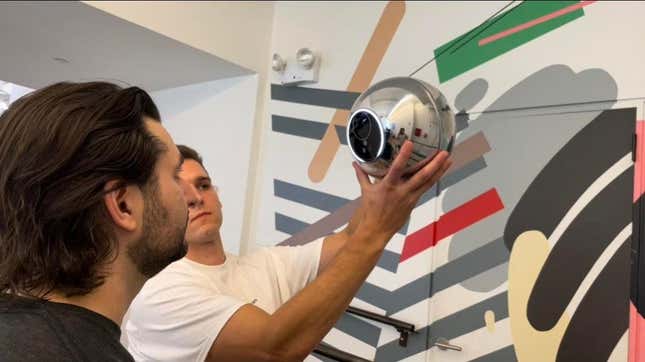
Worldcoin orb
Sam Altman's Worldcoin verifies that people are humans using eyeball-scanning orbs.
Business Insider
 
Having launched ChatGPT on the world, with computer scientists at the fore of this brave new world of communications questioning its outcome, Sam Altman launched project Worldcoin in Britain on Monday including 34 other countries, a venture whose aim is to scan billions of eyes with the use of a mounted orb the size of a football weighing six pounds to scan people's eyes for the generation of a  unique digital record.

Worldcoin names that digital record a World ID; "proof of personhood" and Altman has argued it will enable people to proffer proof online that they are human, not robots, not fraudsters. Such verification, he says is a requirement to challenge and counter the growing threat posed potentially by Artificial Intelligence, the very technology he has himself been front and centre in advancing.

Image
GM Seoul
 
"Increasingly powerful AI models will further amplify the difficulty of distinguishing humans from bots", the company offers in its announcement of the Worldcoin U.K. launch. There is roughly 150 working orbs deployed by the company around the world, two of which are located in London, and so far the company has signed up some two million people representing a tiny fraction of the roughly eight billion total world population it has plans to cover.

Concerns around the potential risks of a startup gathering massive amounts of sensitive biometric data has privacy advocates alerted. Worldcoin insists however, that its proprietary technology is "privacy-preserving", that its orbs delete the biometric data gathered by default. Although the venture was officially launched on Monday of last week, the project has been in operation since 2019.

Initially the project focused on first sign-ups within low income countries, including Sudan and Malaysia. Some people who signed up believed the project was government operated, or had official government backing, according to an MIT Technology Review. Cryptocurrency of the same name backs up the venture. Local contractors operate the face-scanning orbs. Their reward is in cryptocurrency Worldcoin for signing up new users.

As well, people who submit to ID-checking scans will receive 24 free Worldcoin tokens also, which began trading at $1.70, leaping to a high of $3.53.

And in China...
"The public is increasingly worried about the abuse of facial recognition technology", Yang Wanming, vice president of the Supreme People’s Court, said in a news conference on Wednesday. "The calls for strengthening protection of facial information are increasing."
 
Image for article titled I Gazed Into Worldcoin’s Orb and Saw a Boring Dystopia Staring Back
Photo: Mack DeGeurin

Labels: , , ,

 
()() Follow @rheytah Tweet