Ruminations

Blog dedicated primarily to randomly selected news items; comments reflecting personal perceptions

Thursday, July 23, 2020

Emergent Planets in the Immensity of the Universe

"Even though astronomers have indirectly detected thousands of planets in our galaxy, only a tiny fraction of these exoplanets have been directly imaged."
"Direct observations are important in the search for environments that can support life."
Matthew Kenworthy, Associate Professor, Leiden University

"This discovery is a snapshot of an environment that is very similar to our Solar System, but at a much earlier stage of its evolution."
"The possibility that future instruments, such as those available on the ELT, will be able to detect even lower-mass planets around this star marks an important milestone in understanding multi-planet systems, with potential implications for the history of our own Solar System."
Alexander Bohn, PhD student, Leiden University, Netherlands

"These multi-planet systems are intriguing laboratories to study dynamical interactions and scattering events between several planetary-mass companions, which is crucial for understanding the formation and dynamical evolution of planetary systems."
Paper, The Astrophysical Journal Letters 
undefined
First ever image of a multi-planet system around a Sun-like star   ESO/Bohn et al
The paper titled the Young Suns Exoplanet Survey, reports results related to a research group led out of the Netherlands' Leiden University. The research team produced new images taken by the Very Large Telescope of the European Southern Observatory in Chile. The announcement was made of the first detectable evidence of a "baby planet", in its birthing stages. In fact, there were two planets. And the images presented are those of a double exoplanetary system, the first time ever such a phenomenon has been observed, of the pair estimated to be 17 million years old.

As time lines go, that can be compared to our Sun, which is estimated to be four billion years old. Two other such systems have previously been discovered; one having four giant planets, another with two "accreting protoplanets". Witnessing their orbits through telescopes capable of removing surrounding starlight has afforded a rare opportunity to test prevailing theories of planetary formation dynamics. What this also holds out promise for in allied observations and research is the potential to explain the origin of Earth itself, thought to have been created from a whirling dust disc in solar orbit which over endless time absorbed infalling asteroid masses.

It is also hypothesized that another planet called Theia collided with the infant Earth knocking its centre off orbit by 23 degrees and in the process creating the Moon as rock splashed upward, expressing the sheer dynamic force of the collision. Theia's fate was sealed when most of it shattered and clung to Earth's orbit which absorbed its shattered mass within its own. The process revealed by this new telescopic sighting has presented researchers with an opportunity to observe the formative stages of a planet, an event never before seen.

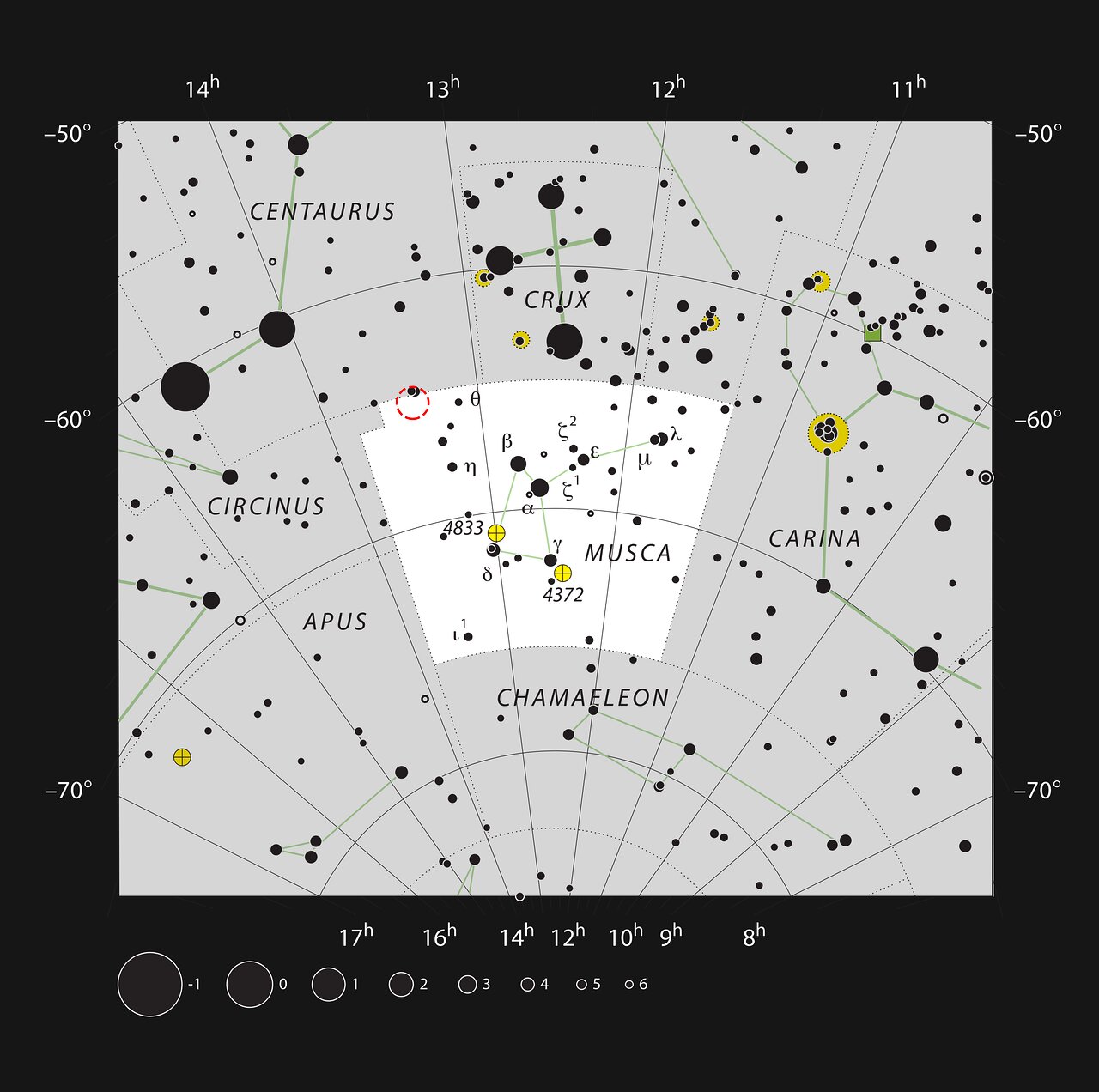
A subtle "twist" where two spirals intersect to become a whirling disc of dust and gas orbiting around a young star titled AB Aurigae, located 520 light years' distance from Earth, was detected by the four linked mirrors of the Very Large Telescope, in a constellation identified as The Charioteer. Theory has it that the cosmic maelstrom birthing a future planet coalesced into an expanding mass that attracted other orbiting masses -- attaining sufficient gravity over the eons to become a spherical planet.

Publication of this new research from the VLT illustrating the first images ever seen of a pair of immature twin planets -- two gas giants -- in distant orbit around a young star, represents the first time such a celestial event has been directly imaged, ever. Both these exoplanets are larger than gas giants Jupiter or Saturn, in our own Solar System. They orbit  the star called TYC 8998-760-1 at a distance far greater than Jupiter and Saturn orbit our own Sun, at 150 and 320 times the distance between Earth and the Sun, in comparison to about five and ten times for Jupiter and Saturn; both as well six and 14 times a greater mass than that of Jupiter.
Labels: , , , , ,

Thursday, December 10, 2015

Making His Mark

"We only have one shot at this. We need to pay our dues to live on this Earth; we need to pay the rent and I'm doing that with the work we are carrying out here in Patagonia."
"Within the few hours that it took to read the book [Living as if Nature Mattered by Bill Devall], I experienced a powerful epiphany. Everything suddenly made sense."
"[I finished with] selling people countless things that they didn't need."
Douglas Tompkins, American entrepreneur, environmentalist, philanthropist
North Face Co-Founder Doug Tompkins Dies in Kayak Accident
Doug Tompkins founded The North Face in 1968.    Photo: Courtesy of The North Face

Known as the co-founder of two American clothing companies, North Face and Esprit, he was a much admired figure as a businessman. His companies' marketing campaigns were hugely favoured by fashion magazines and eager buyers within the outdoors fashion-conscious public. But, as he noted, he became environmentally aware, inspired by a book he read on society needing to be more in step with nature, a philosophical point of view that transfixed him.

As the philosophy which he took to so immediately took shape in his mind, his former enterprises as a business tycoon appeared without value, and he set them all aside. He left San Francisco to become an eco-warrior, dead set against pointless development, and a champion of conservation. And where he chose to make his mark was in a region of Chile so remote that it represents the jump-off spot to the remotest point on the planet: Antarctica.

He grew up in New York, his parents fashionable social aristocrats conjoining decor and antiques. As a boy he tended to think differently and to verge away from social conservatism. He attended a prestigious boarding school in Connecticut but his precocious spirit didn't quite mesh with their standards and he was expelled at age 17 for rules infractions. He was a high-school drop-out, and became a free soul as a climber, ski bum and adventurer.

Then with his first wife, he opened a shop selling high-end climbing and camping gear imported from Europe; that shop named the North Face. Better known for fleece jackets and outdoor equipment, the company was sold in 1969 enabling him to move on to filmmaking to produce a film about Patagonia, Mountain of Storms, which became a climbing cult classic after winning an international adventure film award.

Then came another business, with a clothing line that became Esprit de Corps, then shortened to Esprit, an enterprise that led to millionaire status. "It was 20 years of a wild ride", he said in an interview with a writer who wrote extensively about him. Esprit became a multibillion-dollar business with factories located globally. Douglas Tompkins, the company's 'image director' valued the wealth his enterprise brought him to fund and promote environmental causes.

Eventually he flew back to Patagonia for good; he resolved to dedicate himself to "the end of the world", in a geographical sense, for that is what Patagonia's geographic position is considered; the farthest reaches beyond which lies only Antarctica. He bought over 16,000 hectares of forest and fiords that cost him $600,000 and that preserve became his home and his focus as a preservation project. And he kept acquiring more land.
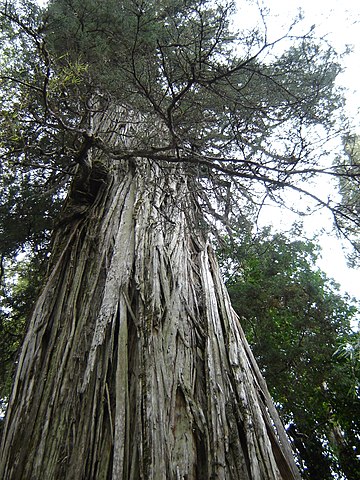
Alerce Milenario
Alerce (Fitzroya cupressoides), or lahuán, as called by the native Mapuche people. It is a huge sized tree, frequently surpassing 50 m. tall. It belongs to the conifer family and its look is similar to the North American sequoias. It is evergreen, the leaves being small and scale-shaped. The trunk has an average diameter of 1 to 1.2 m, but in some specimens can reach up to 3 m. It is an extraordinarily long-lived tree, some specimens found in the park have reached the amazing age of 4,500 years.

Parque Pumalin, a project beloved of Douglas Tompkins, represents 283,000 hectares and within it is a nature sanctuary where pumas roam, and gigantic alerces trees grow, considered to be some of the oldest organisms on Earth. Mr. Tompkins and his second wife founded the Conservation Land Trust to buy up hundreds of thousands of hectares of land in both Chile and Argentina, meant to be maintained as wilderness, a gift to the planet.

Pumalin Park, Palena Province | X Region | Chile

Some of the land was handed over to local governments to be transformed into national parks, while some of the land remains in the estate of the Tompkins family. Previously, wealthy foreign interests bought such land to log, to mine, and to install hydroelectric projects. Chileans are suspicious that such huge areas have been set aside and the forest simply left intact. Which does much for the preservation of the environment and natural surroundings, but not much for the local economy.

Pumalin Park, Palena Province | X Region | Chile

Mr. Tompkins gambled on his intuition that in time, over generations the children of Chileans now opposing those parks would come to value their wilderness preservation. He died on Tuesday while kayaking on the General Carrera Lake in Chile with five others. Strong waves capsized their kayaks and tossed them into the frigid, roiling waters. While a military patrol boat rescued three and a helicopter lifted others out, suffering from severe hypothermia from exposure, Mr. Tompkins died.

Labels: , , ,

Tuesday, April 01, 2014

Tsunami alert after 8.2 quake strikes off Chile

BBC News online -- 2 April 2014
Geologist Patrick Moore in the Atacama Desert: "I was lying on my bed and the room was shaking"
An earthquake of 8.2 magnitude has struck off northern Chile, triggering a tsunami alert and sparking the evacuation of tens of thousands.

The US Geological Survey said the quake was very shallow, striking 86km north-west of the mining area of Iquique.

Waves of up to 2.1m (6ft) have hit some areas in Chile, and there have been power cuts, fires and landslides.

Two people are reported to have died, possibly from heart attacks, and a number of people have been injured.
The quake struck at 20:46 local time (23:46 GMT).

Chilean TV broadcast pictures of traffic jams as people tried to evacuate.
Iquique Governor Gonzalo Prieto told local media that in addition to the two deaths, several people had been seriously injured.

A number of adobe homes were reported destroyed in Arica.
A man stares at a restaurant by the sea shore burning after a powerful earthquake hit Chile's Pacific coast     A fire broke out at a restaurant on the shore at Iquique
 
The quake shook modern buildings in Peru and in Bolivia's high altitude capital of La Paz - more than 470km (290 miles) from Iquique.

At least eight strong aftershocks followed in the few hours after the quake, including a 6.2 tremor.
The tsunami warning in Chile will last at least until 08:00 GMT.

The Chilean interior ministry told the BBC that one of the main roads outside Iquique was cut off because of hillside debris.

The ministry says that partial landslides have also taken place between the towns of Putre and General Lagos.
 
The interior minister also told Chilean TV that some 300 women inmates had escaped from a prison in Iquique. The authorities are reported to have deployed a planeload of special forces to guard against looting.

Chilean Interior Minister Rodrigo Penailillo said President Michelle Bachelet was being kept informed.

"We have taken action to ensure public order in the case of Iquique, where we've had a massive escape of more than 300 female prisoners, so that the armed forces and police can coordinate and provide security to the residents," he said.

The Pacific Tsunami Warning Center (TWC) issued an initial warning for Chile, Peru, Ecuador, Colombia and Panama.
However, all warnings, watches and alerts were later lifted except for Chile and Peru.
Map
Tsunami watches - in which the danger of tidal waves is deemed to be less serious - had been in place for Costa Rica, Nicaragua, El Salvador, Guatemala, Mexico and Honduras.

"Everyone along our coast should be alert and ready," Ecuadoran President Rafael Correa said on Twitter.

Ecuador later reduced its alert but maintained a high level of vigilance for the Galapagos Islands.
High waves hit parts of the Chilean coast within 45 minutes of the quake. Pisagua, Patache and Iquique all saw big waves.

"We have asked citizens to evacuate the entire coast," Chilean home office minister Mahmud Aleuy said.

Evacuations were also ordered in Peru, where waves 2m (6.5ft) above normal forced about 200 people to leave the seaside town of Boca del Rio near the Chilean border, police said.
People take refuge in the Chilean coastal city of Antofagasta, 1 April People take refuge in the Chilean coastal city of Antofagasta
 
A British expatriate near the northern Chilean city of Antofagasta told the BBC that there had been several tremors since the last quarter of last year.

"But this earthquake, even with the increased distance, seemed to last a lot longer," Patrick Moore said.

"I was just sitting on my bed and normally these tremors usually last at the very longest about 40 seconds - this one felt like it lasted about two minutes.

"I knew it was bad so I immediately went online to see what had happened and saw a tsunami warning that's been put in place which confirmed my fears that it was a big one."

Kurt Hertrampf, a hostel owner in Arica, told the BBC there was a big blackout in the town after the quake and he was surprised the telephone line was still working. He added: "Downtown looks like a ghost town."

The area close to the epicentre is mineral rich, but none of the major copper companies reported any break in production.
Chile is one of the most seismically active countries in the world.

Central and southern areas of the country were hit by a powerful earthquake of 8.8 magnitude quake followed by a tsunami that devastated scores of towns in February 2010.

In 1960 an area of Chile south of Concepcion was hit by a 9.5 magnitude which caused about 1,655 deaths and a tsunami in Hawaii and Japan.

The 9.0 magnitude quake that struck Japan on 11 March 2011 caused a devastating tsunami and left more than 15,000 people dead, with more than 3,200 missing.

Labels: ,

 
()() Follow @rheytah Tweet