Ruminations

Blog dedicated primarily to randomly selected news items; comments reflecting personal perceptions

Thursday, March 15, 2018

The Late, Great Star of Hypothetical Astrophysics

“I heard him lecture. We were in the same room together several times but we didn’t converse, because you’d have to wait a long time for each sentence. As a scientist, he was one of the greatest of our time, with his series of discoveries in the field of Einstein’s theory of gravity, black holes, the origin of the universe, and the connection between them and quantum theory."
"His disease and his struggle with it captured everyone’s imagination. It was amazing to see how in his condition he established a family, wrote books, and always continued to work."
"On one occasion we went out, several scientists, [at Stanford University] to a restaurant in Los Angeles. [Hawking] really loved steak and this time too he ordered steak, which they would put in a blender for him so he could eat it. He usually would listen to the conversations around him because of his difficulty in talking to people, but when he finally did speak, people waited on every word out of his mouth, even if it took time. And on his part, he would choose the right words and try to squeeze as much meaning as possible into every word."
"I thought it was wrong to mix up politics and science because science is universal. Of course, I also wasn’t happy with a boycott of Israel, it is opposed to the spirit of science and doesn’t help anything. Therefore I was at the top of a letter from Israeli scientists that was sent to him on the issue. We asked him to take it back and we never received a reply."
Professor Barak Kol, head, Physics Department, Hebrew University
British physicist Stephen Hawking answers questions during an interview in Orlando, Florida, April 25, 2007. Photo: Reuters / Charles W Luzier / File.
"[Finding a] theory of everything [would allow humankind to] know the mind of God. A complete, consistent unified theory is only the first step; our goal is a complete understanding of the events around us, and of our own existence."
"...But one can't help asking the question: Why does the universe exist? I don't know an operational way to give the question or the answer, if there is one, a meaning. But it bothers me."
"Asking what happens before the Big Bang is like asking for a point one mile north of the North Pole."
"We are in danger of destroying ourselves by our greed and stupidity. We cannot remain looking inwards at ourselves on a small and increasingly polluted and overcrowded planet."
"If aliens ever visit us, I think the outcome would be much as when Christopher Columbus first landed in America, which didn't turn out very well for the Native Americans."
British scientist, astro-physicist, cosmologist, Stephen Hawking

Nature was both kind and unkind to this extraordinary man in gifting him with a mind capable of thinking in a manner that few others who have existed on Earth have done. However, though this man was so gifted with genius, he was given the cruel blow of a mind existing in a thoroughly incapacitated body that over time failed catastrophically. On the other hand, most people diagnosed with amyotrophic lateral sclerosis (ALS) -- a dread degenerative disease that eventually destroys the nervous system -- die in relatively short order, this man lived for 55 years with ALS.

He lived to astound the scientific community with the capacity of his mind and the unique quality of his analytical capabilities, his thoughts and hypotheses. He has been acclaimed as the greatest living scientist during his lifetime, one among a very few that have graced this planet over the millennia. Where Albert Einstein brought science forward with his great leaps into the universal unknown of time and space in his own time, Stephen Hawking followed in that great scientist's universe-explicating wake.

Just as Albert Einstein's avuncular face and electrified hair was familiar to the larger world, so too was Stephen Harking's disease-contorted face.
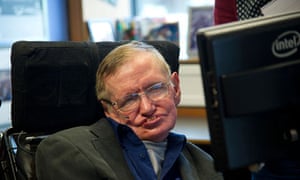
Stephen Hawking
British physicist Stephen Hawking, whose decision to boycott a conference in Israel has been described as hypocritical. Photograph: AFP/Getty Images

"Although I cannot move and I have to speak through a computer, in my mind I am free", he assured any who might have contemplated feeling sorry for a man who had no such feelings for his own plight. He was elevated to academia's most prestigious scientific post as Lucasian Professor of Mathematics at Cambridge University and remained throughout his long life to age 76 -- 55 of those years with ALS -- fixated in a search for physics' ultimate goal, the "unified theory" of "everything". Despite his great acclaim, he never won a Nobel prize in science, since none of his theories have yet been proven.

Even so, his place in science and history and his remarkable capacity to endure the disease that destroyed his body leaving his mind untouched and vibrantly alive to the need to reach his full intellectual potential second to none he was, when all is said and done, all too human. His decision to abandon the wife of his early years with whom he had three children was not of her choosing, when his decision was to marry another woman, a woman married to an expert who helped him acquire a computerized 'voice', and who acted as a nurse to him.

That this man of science and universal acclaim as the world's premier living scientist decided to boycott Israeli academia and Israeli scientists for a social political movement that was based on a veneer of slanderous intent to condemn and demonize the State of Israel without taking into account the complexities woven into the Israeli-Palestinian relationship in its own way goes a distance to identifying his intellectual brilliance with historical laziness that confuses slander with justice. Pity, that.
"Hawking's decision to join the boycott of Israel is quite hypocritical for an individual who prides himself on his whole intellectual accomplishment. His whole computer-based communications system runs on a chip designed by Israel's Intel team."
"I suggest if he truly wants to pull out of Israel he should also pull out his Intel Core i7 from his tablet."
Nitsana Darshan-Leitner,  Shurat HaDin, Israeli law centre (2013)
black-hole-stephen-hawking-abhas-mitra
The biggest mystery. (Courtesy Robin Dienel/Carnegie Institution for Science/Handout via Reuters


"In my 2000 paper, I pointed out the fact that experimental physicists had failed to find any evidence for Hawking Radiation, and I predicted neither will be there any such evidence in [the] future because there could not be any exact horizon, any exact black hole in the first place."
"Accordingly, I exerted that there is really no Black Hole Information Paradox."
Abhas Mitra, former senior scientist, Bhabha Atomic Research Centre (BARC), Mumbai, India

Labels: , , ,

Monday, February 15, 2016

 Culture and Cultivation

"She had few friends. She never married. She came to a strange country and did us the honour in that all her progeny were named after our early explorers. Her descendants are her Canadian Explorer roses."
"She was born in Vienna and that imprints a person, doesn't it? The Viennese manners, the Germanic culture -- she fit it to a T. She suffered no fools. To her friends she was extremely loyal. She was invariably polite, but the average person meeting her wouldn't find her warm."
"Canada has lost a national treasure. She is valued highly all around the circumpolar countries, a ring right around the Earth. When she started, she admitted that she knew nothing about roses. That's a good place to start. She had to learn without any preconceptions of what roses were all about. She started observing: which ones could withstand cold; which ones could withstand black spot. The Department of Agriculture suggested that she do something impossible. They wanted her to develop roses that would defy cold in Zone 2 -- this is cold -- but also to flower regularly through the summer."
"To defy cold you have to get your flower into being, pollinate it, make seed and curl up for winter. This means turning your leaves orange, then yellow, then drop them off and then take on Old Man Winter."
Harry McGee, (retired) National Research Council physicist

"Martin Frobisher takes a special place because it was the first rose. It was 1961 and it was already fall. I knew nothing about roses, but I loved them."
"Of the first batch of seedlings -- 2,000 in all -- two fitted the bill with a long flowering period and produced enough flowers to be showy."
Felicitas Svejda (former) researcher, rosarian, Department of Agriculture
Felicitas_Svejda

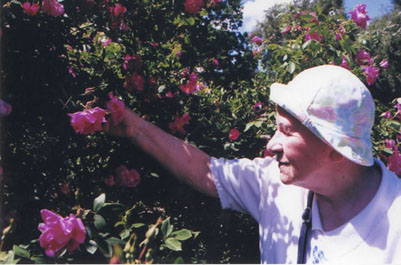
Born in Vienna in 1920, Felicitas Svejda is the creator of the Explorer roses
and of many hardy ornamental shrubs cultivated
in private and public Canadian gardens -- Montreal Botanical Garden Library

Tributes to this pioneer in hybridizing rose stock to withstand extreme cold have been pouring in since her death on January 19 in Ottawa, aged 95. Acknowledgement of her exalted place in the world of ornamental plant genetics have arrived from Russia, Iceland, the United Kingdom, Germany, Austria, Finland and Poland; every geographic place on the planet where rose lovers are now able to indulge in planting cold-hardy roses that will give them pleasure in beautiful blossoms throughout the garden growing season.

When Felicitas Svejda arrived in Ottawa in the early 1950s she came to an unsophisticated backwater compared to Vienna, the culture capital of Europe. Of course at that time in the historical fairly recent past, the Second World War had just concluded five years earlier and European cities were heavily damaged, their economies in dire straits, and guilt hung heavy over many Europeans for having hosted however unchosen, the charnel factories whose chimneys blasted the dry-waste effluvient of human remains during the Holocaust.

To choose to emigrate from Austria, a country aligned with fascist Germany and other Axis powers, to make her future in Canada, one of the Allied countries whose troops fought against those of the perpetrators of that mass conflict and genocidal extermination of Jews, must have represented a deliberate spurning of the dread social atmosphere in which fascism had thrived, in favour of finding her destiny in breeding living things of surpassing grace and beauty.

She was originally tasked with researching cereal grains, as an employee of the Department of Agriculture. Within a decade she had transferred her professionalism and interest to ornamental plants, focusing on rose bushes she had seen in the gardens of the Experimental Farm, the huge tract of treasured farmland set aside within the City of Ottawa as an untouchable preserve for experimentation in a country where the fundamentals of agriculture and animal breeding are taken seriously.

She learned the exacting science of hybridization, taking meticulous records of her observations, displaying the patience required to succeed. Patience is an obvious and fundamental requirement, since it can take a decade to determine whether a new variation will be successful. She sent her hybrid-bred roses around the world to be tested in the most inclement of climates, for example halfway up New Zealand's Mount Cook.

"She taught herself a lot. She talked to other people. As a scientist, she read the literature. Then she started to work crossing. If she wanted these results she'd cross a rose that showed [desired characteristics] with a rose that showed another kind of performance. She worked her way through it. And she was not too proud to admit that there were a lot of people on the Prairies who had gone before her with quite good results", explained Harry McGee, himself a renowned rosarian and author, as well as life-long friend of Felicitas Svejda.

Ms. Svejda's initial success came with a soft pink rose whose seed parent was a German-bred Schneezwerb shrub, developed from the hardy rosa rugosa native to northern Japan, and which she named after Martin Frobisher, the Arctic explorer. It wasn't only roses that this genetic engineer focused on, though they were her primary concern. She also bred mock oranges, forsythias and 'dancing' weigelas.

Once she retired, the program was given over to the Agriculture Canada laboratory in L'Assomption Quebec, eventually finding its way to the private sector. But the Svejda Explorer Roses are a hardy and lovely staple of nurseries. They appear in public gardens throughout Canada. And in private gardens where gardeners take pride in their hardy beauty. Like my own which over the years have hosted a number of the Explorer Series of Ms. Svejda's wonderful shrub and climbing roses.


Labels: , ,

Thursday, December 10, 2015

Making His Mark

"We only have one shot at this. We need to pay our dues to live on this Earth; we need to pay the rent and I'm doing that with the work we are carrying out here in Patagonia."
"Within the few hours that it took to read the book [Living as if Nature Mattered by Bill Devall], I experienced a powerful epiphany. Everything suddenly made sense."
"[I finished with] selling people countless things that they didn't need."
Douglas Tompkins, American entrepreneur, environmentalist, philanthropist
North Face Co-Founder Doug Tompkins Dies in Kayak Accident
Doug Tompkins founded The North Face in 1968.    Photo: Courtesy of The North Face

Known as the co-founder of two American clothing companies, North Face and Esprit, he was a much admired figure as a businessman. His companies' marketing campaigns were hugely favoured by fashion magazines and eager buyers within the outdoors fashion-conscious public. But, as he noted, he became environmentally aware, inspired by a book he read on society needing to be more in step with nature, a philosophical point of view that transfixed him.

As the philosophy which he took to so immediately took shape in his mind, his former enterprises as a business tycoon appeared without value, and he set them all aside. He left San Francisco to become an eco-warrior, dead set against pointless development, and a champion of conservation. And where he chose to make his mark was in a region of Chile so remote that it represents the jump-off spot to the remotest point on the planet: Antarctica.

He grew up in New York, his parents fashionable social aristocrats conjoining decor and antiques. As a boy he tended to think differently and to verge away from social conservatism. He attended a prestigious boarding school in Connecticut but his precocious spirit didn't quite mesh with their standards and he was expelled at age 17 for rules infractions. He was a high-school drop-out, and became a free soul as a climber, ski bum and adventurer.

Then with his first wife, he opened a shop selling high-end climbing and camping gear imported from Europe; that shop named the North Face. Better known for fleece jackets and outdoor equipment, the company was sold in 1969 enabling him to move on to filmmaking to produce a film about Patagonia, Mountain of Storms, which became a climbing cult classic after winning an international adventure film award.

Then came another business, with a clothing line that became Esprit de Corps, then shortened to Esprit, an enterprise that led to millionaire status. "It was 20 years of a wild ride", he said in an interview with a writer who wrote extensively about him. Esprit became a multibillion-dollar business with factories located globally. Douglas Tompkins, the company's 'image director' valued the wealth his enterprise brought him to fund and promote environmental causes.

Eventually he flew back to Patagonia for good; he resolved to dedicate himself to "the end of the world", in a geographical sense, for that is what Patagonia's geographic position is considered; the farthest reaches beyond which lies only Antarctica. He bought over 16,000 hectares of forest and fiords that cost him $600,000 and that preserve became his home and his focus as a preservation project. And he kept acquiring more land.
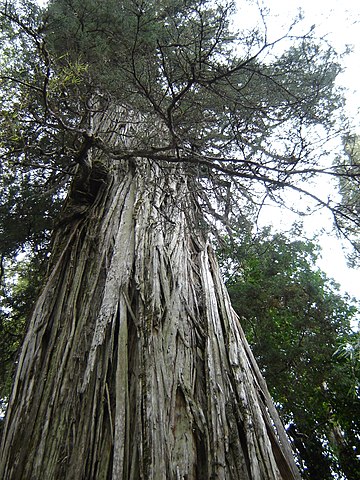
Alerce Milenario
Alerce (Fitzroya cupressoides), or lahuán, as called by the native Mapuche people. It is a huge sized tree, frequently surpassing 50 m. tall. It belongs to the conifer family and its look is similar to the North American sequoias. It is evergreen, the leaves being small and scale-shaped. The trunk has an average diameter of 1 to 1.2 m, but in some specimens can reach up to 3 m. It is an extraordinarily long-lived tree, some specimens found in the park have reached the amazing age of 4,500 years.

Parque Pumalin, a project beloved of Douglas Tompkins, represents 283,000 hectares and within it is a nature sanctuary where pumas roam, and gigantic alerces trees grow, considered to be some of the oldest organisms on Earth. Mr. Tompkins and his second wife founded the Conservation Land Trust to buy up hundreds of thousands of hectares of land in both Chile and Argentina, meant to be maintained as wilderness, a gift to the planet.

Pumalin Park, Palena Province | X Region | Chile

Some of the land was handed over to local governments to be transformed into national parks, while some of the land remains in the estate of the Tompkins family. Previously, wealthy foreign interests bought such land to log, to mine, and to install hydroelectric projects. Chileans are suspicious that such huge areas have been set aside and the forest simply left intact. Which does much for the preservation of the environment and natural surroundings, but not much for the local economy.

Pumalin Park, Palena Province | X Region | Chile

Mr. Tompkins gambled on his intuition that in time, over generations the children of Chileans now opposing those parks would come to value their wilderness preservation. He died on Tuesday while kayaking on the General Carrera Lake in Chile with five others. Strong waves capsized their kayaks and tossed them into the frigid, roiling waters. While a military patrol boat rescued three and a helicopter lifted others out, suffering from severe hypothermia from exposure, Mr. Tompkins died.

Labels: , , ,

Sunday, October 18, 2015

Farewell, Dr. Bill

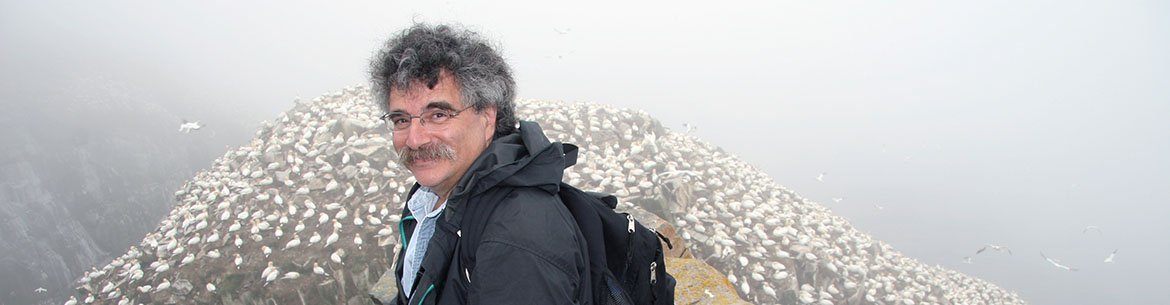
Dr. Bill Freedman, Cape St. Mary's, NL (Photo by Sheldon Bowles)

"Dr. Bill Freedman passed away Saturday, September 26, 2015 at his home in Halifax at the age of 65. He was a retired ecologist, former Chair of the Department of Biology and professor emeritus at Dalhousie University."

"The author of over 100 refereed scientific papers and publications, he received a Career Achievement Award from the Canadian Council of University Chairs (2007) and a Canadian Environment Award, Gold Medal Level, in the category of Community Awards for Conservation from the Canadian Geographic Society (2006)."
"Dr. Freedman was a 25-year volunteer with the Nature Conservancy of Canada, having served as National Board Chair from 2008 to 2009 and as Atlantic Regional Board Chair for two terms.
The Nature Conservancy of Canada is honouring a long-time volunteer and major contributor to conservation in Atlantic Canada and across the country."
"It has announced the Dr. Bill Freedman Science in Conservation Internship."
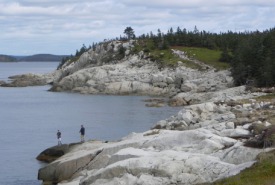
Dr. Bill Freedman Nature Reserve at Prospect High Head, NS (Photo by NCC)Dr. Bill Freedman Nature Reserve at Prospect High Head, NS (Photo by NCC)
"The Dr. Bill Freedman Nature Reserve is located at Prospect High Head, 23 kilometres southwest of Hallifax. It is 10 kilometres east of Peggy’s Cove, a popular tourist spot."
"Prospect High Head is a popular coastal location for hikers, photographers and people who enjoy birdwatching! The Nature Conservancy of Canada has been working here since 2001, protecting 372 acres (151 hectares) for the area's important coastal barrens and coastal forest. The property provides habitat for native species and also migratory birds. The coastline is used by a variety of sea ducks, including eye-catching harlequin ducks, black scoters and long-tailed ducks."
The Nature Conservancy of Canada

A distinguished Canadian scientist has received recognition in the form of having his name memorialized academically and ecologically; just due for a lifetime in academia as a professor of botany, scientific writing, ecological activism, and love of nature expressed in a variety of experiences both personal and professional. In the waning days of 2014, a hale and healthy 64, with no symptoms to warn of impending health disaster, he was diagnosed with inoperable cancer. The cancer that had established itself in his abdominal cavity had metastasized.

Nothing could be done through medical/surgical intervention to save his life, though it could be prolonged through recommended chemotherapy, considered a part of his palliative care. The secondary cancerous tumours did respond to his first round of chemotherapy, as the radiologist and the oncologist looking after Bill explained to him. But the mass of tumours that represented the initial onslaught remained as they were, at diagnosis; formidable and death-delivering. Another round of chemotherapy was attempted, but to no avail.

This jovial man who so loved nature and avian life in particular which led him to exotic global places to expand the list of birds he had seen and noted, was anticipating his retirement from the workforce. He had experimented with signing on to Arctic cruises, acting in the capacity of scientific adviser to the passengers who appreciated explanations for the phenomena they were observing. He thought he might take that challenge on as a regular schedule, on retirement. He enjoyed the social aspect of being with others, and the usefulness of his experience and knowledge in advancing theirs.

And he was also in the process of completing several manuscripts for publication; one of the history and biological diversity of Sable Island, a second a series of personal stories based on his varied experiences. He was able to complete his Sable Island manuscript. And, with the editorial assistance of a few of his many close friends, he completed the collection of short stories. Both would add to his lifetime of published work, quite apart from the 100-some-odd scientific papers he was responsible for publishing in whole or in part.

He and his wife continued to enjoy the company of their many friends. Many of whom brought over dinners for them, leaving his wife, George-Anne Merrill, free to continue looking after her husband whose condition slowly deteriorated. Initially he reacted well physically; no nausea, no pain, no weight loss, no loss of appetite.

But he could no longer play his fiercely competitive games of squash, could no longer go for trips outside Halifax, let alone prolonged nature walks which he so loved. He did manage some brief excursions with his wife, along with some friends. His son who lives in California, came home. His daughter, who lives in Vancouver, gave birth to her parents' first grandchild, a week before her father Bill died. He was cared for throughout the period of his palliative care by his wife. Living in a three-story house with their bedroom on the third floor, a bed was moved for him to the ground floor.

In 1989, he'd had his first Canadian environmental science textbook, Environmental Ecology published. He later wrote Environmental Science: A Canadian Perspective; the sixth edition is soon to be published. He contributed to two encyclopedias; as well as a book on the 50-year history of the Nature Conservancy of Canada (NCC), a charitable organization dedicated to sustaining Canada’s plants and wildlife. And he was himself dedicated to furthering the work of the Nature Conservancy.

That smile seen on his face in the photograph above was a permanent fixture. He found amusement everywhere he looked. He was, however, serious about the preservation of nature's gift to all her creatures, and the need to be aware of our natural surroundings and to respect them, but life for this man was a constant source of amused inspiration. His mind rarely rested without some ideas kicking in that would lead him later to explore where they might lead him.

He was my brother.

Professor Bill Freedman advised anyone with influence over children to encourage them to serve as stewards of nature. (Mike Dembeck/THE CANADIAN PRESS)

Labels: , , , , , ,

Thursday, September 10, 2015

Honouring Seasonal Farm Workers

"Eight years, me and my family go through this. It was a hard time. I don't want anybody to go through this difficult time again."
"Both stories are the same. I was very upset. Both drivers did not follow the law. I think too much -- day and night. I was very upset, then I made a decision. I wanted to do something for awareness."
Jagjeet Sidhu, Abbotsford, British Columbia

"The concept was all about how to transform such a horrific event into something that would be a monument to farm workers and not a memorial to tragedy."
"The three women -- the maid[en], the matron, the matriarch -- which roughly represent the three women [killed in the crash], came into it really powerfully as well. We really felt like we were on a sacred wave to do this...."
"It is a living, nurturing, sustaining entity. This was a terrible, devastating loss for them, so it means a lot for us to have some form of healing in this memorial.... Instead of the memorial being about mourning and devastation, it's about looking to the future."
Christine Lauze, creative artist

"I think the design's beautiful. I think that people spend a lot of money focusing on safety -- as in keeping terrorists out of the country. Why is there not so much safety concern regarding things that are happening inside the country?"
"This is not an angry daughter speaking from her perspective. This is just a citizen saying that justice was not served."
"I hope that when this tree is built that people will not just admire its beauty but will also understand why it's there... a reminder of the hard work of farm workers, and as a reminder to passersby that their lives are just as important."
Avneet Sidhu, 16, daughter of Sarabjit Sidhu, Abbotsford

"She was a healthy person who went to work and never came back. It's still really hard for the families. Everything comes back again to face us every year."
"When he's having a hard time, my father can sit there and relax under the memorial."
"When you see that tree there, with its arms up to the sky, it's like they're saying, 'Look at us, we are the ones who work on farms to bring food to your homes'. They should be treated as human beings. It's a great memorial and a good message to all the other employers who treat their workers like animals."
Harsharan Bal, son of Amarjit Kaur Bal
Golden Tree to honour B.C. farm workers
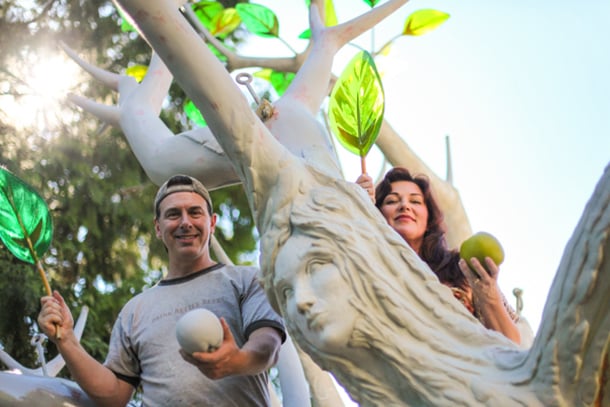
 Sukhman Sidhu, 7, left, and Avnoor Sidhu, 9, look out at a model of a sculpture which is being created in memory of their mother Sarabjit Sidhu and two other women farm workers who were killed after their overloaded van crashed March 7, 2007. Photograph by: Ric Ernst Ric Ernst , PNG

There really wasn't enough room in the van into which 17 women farm workers were crowded. They sat crammed together, and of course there wasn't a seat belt for everyone; in fact there were no seat belts. The women were on their way to work in a van whose seats had been exchanged for wooden benches, driving on bald tires with a fraudulent inspection permit ... and no seatbelts and the driver was not properly licensed.

Three women were killed when the overloaded van rolled over as they drove along Highway 1 near Abbotsford, British Columbia. There was Sarabjit Sidhu, wife of Jagjeet Sidhu, a 31-year-old mother of three young children; a 13-month-old boy and two daughters. The crash in 2007 killed two other farm workers, Sukhvinder Kaur Punia, 46 and Amarjit Kaur Ball, 52.Their families were distraught, bereft, devastated.

The 2007 crash of a van transporting farmworkers killed three people and sparked a push for safety that continues to this day. - File photo
The 2007 crash of a van transporting farmworkers killed three people and sparked a push for safety that continues to this day.— image credit: File photo
Several months after the loss of his wife, Jagjeet, travelling along a B.C. highway witnessed a tractor-trailer travelling at high speed passing him and smashing into a deer, then racing off. Jagjeet stopped his vehicle, saw an uninjured deer walk toward the dying animal, to nudge it back into life. He approached the deer and it seemed evident to him that it was a nursing doe. He held a water bottle to the deer's lips, and felt helpless and newly bereaved.

And then he went on to spend the next eight years struggling to inform the public about the rights of workers and the lack of safety standards on their behalf that made them so vulnerable. His campaign led him to speak to mayors, to radio hosts and to labour leaders. The most visible manifestation of his efforts now is set to be installed next to the Clearbrook Library in Abbotsford in a month's time when the Golden Tree, a monument to farm workers, is to be unveiled.

The sculpture is seven-metres in height, of an apple tree into which has been incorporated three female figures within the gilded trunk and branches. Artists Christina and Dean Lauze took on the challenge of creating a monument that would speak to human rights, the vulnerability of blue--collar and farm workers, and the hopes of the future.  Sculpted fibreglass covers the 1.5 tonnes of steel in the tree's creation. Its upper branches will be covered in 23.5-karat gold leaf to symbolize both lofty aspirations and earthly realities.

The BC Federation of Labour and its member unions along with the provincial government collaborated to largely fund the $310,000 memorial, the first of its kind in Canada to commemorate seasonal farm workers. Last year the provincial government in British Columbia stated it had implemented many of the coroner's key recommendations, following the 2007 crash. Random inspections of 15-passenger vans were increased and they were reclassified as "high risk vehicles" ensuring each passenger has a seatbelt.

The province replaced 40 kilometres of concrete freeway barriers in the Fraser Valley, Delta and Surrey with flexible steel cable, with the intention of reducing impacts on passengers in the event of a crash.The B.C. Federation of Labour remains to be impressed. Its president, Irene Lanzinger, points out that other key recommendations were ignored. And though there was a recommendation to change legislation so agricultural business recognizes seasonal workers as full employees, they are still treated as second-class in employment standards, living conditions, and health and safety.

"Vigilance around health and safety just has to be constant," she says. "There are many good employers out there, but there are always employers who want to cut corners or cut costs, who don't put the safety of their employees at the top of their lists."

GoldenTree_610px.jpg
Memorial bears fruit: artists Dean and Christina Lauzé bring together families of killed farmworkers. Photo by David Ball.

Labels: , , , , , ,

Saturday, May 23, 2015

True North/erner

"We were a family of four kids. There would be a certain amount of talk that we would allow him to get away with at home, but then it was like, 'OK, come on, Dad!"
"He ... really loved the landscape, the wide-openness, the wildness of it. It got in his blood."
"Fairly soon after he started with the GSC [Geological Survey of Canada], he started going up north, to the Arctic."
Linda Hobson

"George cared passionately about mentoring young scientists and supporting science in the north, and involved northerners as best he could in that."
"[George consulted with northern communities] and as a result he built up a group of contacts in most if not all communities in the Arctic, because he really made a point of reaching out to northerners. A lot of scientists don't have that background, don't know how to talk to people. But George really made an effort in that."
"This included younger scientists, [he] brought them into the fold and made sure they had someone to work with."
Michael Schmidt, Geological Survey of Canada

"My attitude was to get the job done. I got my knuckles rapped a few times, even at the Treasury Board level."
"I just wanted to share what I've been able to see. The Arctic is about one-third of our [Canada's] land mass. Most Canadians live along a narrow strip and have never been able to see the North."
"It's just in me."
George Hobson, Canadian Geographic Magazine interview

George Hobson photographed on an ice island in the Arctic Ocean. Hobson died in April at age 92.

George Hobson, trained in geophysics began his career in the Edmonton and Calgary areas in the late 1940s and 1950s, heading seismic crews during oil exploration expeditions. In 1958 he moved to eastern Canada to join the Geological Survey of Canada, located in Ottawa. His daughter Linda recalls being terrified that polar bars and the darkness would spell danger for her father.

By 1972 he was appointed director of the Polar Continental Shelf Project, and he remained in that position until his retirement in 1988. The Polar Continental Shelf Project began as an initiative for Canada to explore, in the modern era, the country's northern continental shelf. It was later transformed into an agency supporting broad-based northern research.

It functions as a base where some services [time on the base or in a helicopter] were provided free of charge [or subsidized] to visiting scholars and scientists to enable them to study the land, the sea and the life that prevails there. George Hobson's position was to control the logistics involved in arranging for academics and government scientists to travel to the Arctic for study and experience.

He was a man fully committed to what he loved to do, and what he loved to do was, in essence, the job he undertook with the Polar Continental Shelf Project. He arranged for annual meetings to take place in Ottawa where Arctic researchers could meet and confer and trade ideas and remain connected with each other's research projects. The Internet makes all the contact and transmission of ideas and data more readily accessible now.

He was a down-to-earth, practical man who used the barter system to enable himself to get work done. This casual kind of exchange, hugely practical in its setting, but anathema to accounts-dependent bureaucrats often landed him in hot water. He was advised it was critical to lock up oil drums to avoid pilfering. An Ottawa functionary recommended chaining drums to a tree. A practical suggestion but not in a treeless landscape.

This intrepid northerner-at-heart operated for years  on an ice island on the Arctic coastline that had broken away from the Ward Hunt Ice Shelf at Ellesmere Island. On the ice island there were wood buildings and a runway for aircraft. But it was a solid ice foundation, floating on the Arctic ocean, however stable; not a tree has yet been seen that could grow on ice.

After retiring, Mr. Hobson took up the position of base commander for the Royal Canadian Geographical Society's expedition to climb the highest peak in Canada, Mount Logan. The expedition, taking place in 1992, was a success, enabling the intrepid scientist-summitteers to accurately measure the height of the Yukon's Mount Logan.

George Hobson received recognition in being awarded the Massey Medal in 1991, for his extensive Arctic work. The Sir Christopher Ondaatje Medal for Exploration was added last December. This was a man, the geophysicist with an extraordinary fascination for the North, who was also involved in the search for the Franklin Expedition's missing ships; he joined three such expeditions.

Mr. Hobson died on April 16, at age 92. That date also was the birthdate of Sir John Franklin. And yet another search was undertaken with divers looking for the wreck of Sir John Franklin's flagship Erebus the very same day. "The one thing he wanted to know before he died was to know where the ships were", noted his daughter.

This photo has become nearly emblematic of the Royal Canadian Geographical Society, the non-profit educational organization that publishes Canadian Geographic magazine. Fun fact: it was taken on this day 20 years ago on the 150th anniversary of the Geological Survey of Canada, when a group of climbers took celebrations to a new level.

They had decided to climb Mount Logan in the Yukon, whose actual height had never been measured. Surveyors had previously used a theodolite, a type of telescope, to measure the mountain’s height. To get a more accurate measurement, the climbers lugged two GPS systems to the summit.

Sponsored by the RCGS, Michael Schmidt (who took the photo), Lisel Currie, Leo Nadeay, Charlie Roots, J-C. Lavergne, Roger Laurilla, Pat Morrow, Karl Nagy, Sue Gould, Alan Björn, Lloyd Freese, Kevin McLaughlin and Rick Staley flew to Quintina Sella Glacier to set up their base camp in May 1992. On May 12th, the team of GSC members, surveyors, mountain guides and park wardens began to climb.

They faced steep slopes, battled storms and bore the brunt of heavy loads that included climbing and scientific equipment. GPS was not as developed in 1992 as it is today, so they needed two sets of GPS units in case one failed. They also carried nearly half a ton of food for the entire climb. 

On June 6, the first of four parties strapped on their skis and headed for Mount Logan’s summit with one of the GPS systems. Their original plan was to set up the system at the summit and descend and then have a second party return four hours later to check the GPS readings. The weather was so good that day that the first party stayed on the summit for four hours. That’s when one of the climbers pulled out the RCGS flag and posed for this photo.

It turns out Mt. Logan is 5,959 metres high, making its summit Canada’s highest peak.
Canadian Geographic Magazine

Labels: , ,

Saturday, February 28, 2015

A Distinguished Life

"He had the wits about him to realize he had to get the damn bag off his head if he was going to live. He crawled across the floor to where he knew there (were) some scissors and cut the thing off. He had a good deal of presence of mind for someone who's just been attacked by a much younger man. He didn't panic. He did what was necessary. Even at 101, he was not intimidated."
"He was a remarkable man with a sharp mind and a strong will to live."
Blair Seaborn, friend and neighbour of Canadian WWII veteran Ernest Cote

"Life is such that when you see these things happen to you, you try to get out. The important thing is to concentrate on how to get out of the position in which you happen to be. If you're afraid and paralyzed, you don't move. I was never afraid. I was not afraid of the landing, the D-Day landing. I was not afraid (of his attacker)."
"I was madder than a wasp, and I couldn't do a damn thing, and that's all I could do until he left. I was never afraid. I was madder than a wasp. Wasps ain't afraid; they're mad ."
"I met the British beach group. They were having elevenses. Morning tea. I asked them to have the dead bodies removed from the beach. Not a good sight for morale. I'd been told by Corps headquarters that we had to take a lot of wooden crosses over (on the landing craft). I told them to stuff it."
Ernest Cote, former soldier, civil servant, diplomat, 101
Canadian WWII veteran Ernest Cote poses on June 5, 2014 in Courseulles-sur-mer, Normandy.    JOEL SAGET / AFP/Getty Images
Born in 1913, third son of a Canadian Senator, he studied at Edmonton's Jesuit College, obtained a B.Sc from Universite de Laval, then entered the University of Alberta to study law and was called to the Alberta Bar in October 1939 mere weeks after the outbreak of the Second World War. He was shipped to England as a lieutenant in the Royal 22e Regiment, the Van Doos. Appointed to General Andrew MacNaughton's staff, rising in rank to quartermaster general to the Third Canadian Division in preparation for the D-Day invasion.

With the army as it fought through France and into Holland, he was promoted to colonel, eventually sent back to Canada to a staff position at National Defence Headquarters, in Ottawa. He left the military in 1945, was appointed second secretary to External Affairs where a 30-year career in the diplomatic service followed. He took part in the first meetings of the United Nations General Assembly, and became an adviser to the Canadian delegation involved in putting together the charter for the World Health Organization.

Ernest Cote receives Legion of Honour Award in 2004
Ernest Cote received his Legion of Honour Award from the Ambassador of France, Phillippe Guelluy at the French Embassy to Canada in Ottawa on Thursday, May 27, 2004. (Tobin Grimshaw/Canadian Press)

His ongoing career spanned various government departments and levels of personal position attainments from Deputy Solicitor General, to deputy minister in Indian and Northern Affairs and Veterans Affairs and an ambassadorship to Finland. He became governor at the University of Ottawa, and regent at the University of Sudbury. He was also a director, governor, secretary and vice-president of the Royal Canadian Geographical Society in the 1960s and 70s. Retired in 1975, he continued to live in Ottawa.

And it was in his Ottawa apartment in New Edinburgh on December 14 that a home invasion took place and he was attacked by a robust man half his age, who tied the aged veteran up and placed a plastic bag over his head, leaving him to die of asphyxiation. Ernest Cote felt unwilling to die at the hands of a vicious assassin; he had experienced the worst that war could throw at him, learned to negotiate his talented way around the world at the highest echelons, and decided he would go in his own good time.

That time arrived this week, and his departure is mourned by those who knew him, worked with him, befriended him, admired him and his intellectual brilliance and his courage. His assailant, as it turns out, has been identified. And, it would seem the man's attack against this noble figure was not the only time he had turned himself into a catalyst of brutal violence. That very man is now charged with the murders of three other elderly people; a retired judge and his wife and their neighbour.

Labels: ,

Sunday, November 09, 2014

An Exemplary Life -- An Extraordinary Individual

"Orthopedics in the future will not be simply surgery, or medicine, but a combination of both plus knowledge of the whole area of skeletal structure, its biology, chemistry, and bio-mechanics."
"Nature has evolved this magnificent substance [bone]. It has mechanical properties just beautifully designed to do the job, to carry you around."
Dr. Melvin J. Glimcher, orthopedist, professor emeritus, Harvard Medical School
Stephanie Mitchell / Harvard

"He was a father of the bone field. [He showered younger colleagues with praise]. That was his modus operandi: He was very supportive of young people in the sciences. That's the part of him not everybody knows about."
"He was a very rigorous man. He was a great leader that people admired. He was always honest in telling people what he thought. That's very useful in a scientist."
Dr. Henry Kronenberg, Massachusetts General Hospital

There is an individual who knows intimately the care that Dr. Glimcher, a pioneer in his field of expertise, took to encourage and advance the careers of young scientists. His daughter, Dr. Laurie Glimcher of New York City, as an example, Both she and her father had been alumni of Harvard Medical School; each in their turn had become a tenured professor at age 39 at Harvard. Now, she is dean of Weill Cornell Medical College, in New York.

And she, and other family members, medical colleagues and patients are mourning this exemplary man of science and medicine. He had originally been trained in mechanical engineering and physics. Those disciplines under his belt he headed off for medical school, fascinated by what he considered to be the elegance of bone composition. Medical degree in hand, he spent the next fifty years of his life in research, introducing new practices.

His studies led to a more precise knowledge about the manner in which bones and teeth develop, about the mechanics of walking and running, and he was a leading developer of the "Boston Arm", an artificial limb that responds to commands from the brain. Professor emeritus at Harvard Medical School, formerly chief of orthopedic surgery at Massachusetts General Hospital and Boston Children's Hospital he died in May of this year at his home in New York, at age 88.

One of his early research discoveries was collagen, a long chain protein, organized in bones in a manner that provides places for calcification, an integral step in bone hardening. In collaboration with other researchers he helped to create the artificial limb, unveiled to the public in 1968. Dr. Glimcher described the operation of the arm as an interaction of two computers: the brain, which he described as "the greatest computer of them all", and the electronic equipment in the arm.

His study of skeletal disorders and rehabilitation succeeded in aiding the furtherance of medical science and related treatments. His daughter, Laurie Glimcher recalls her father helping her with endless instruction, not only related to their mutual medical interests, but in caring for her children while she was involved in medical training. "I was the fastest diaperer in the East", he boasted.

At age 17, during World War II, he attempted to join the U.S. Marines. His mother tracked him to the recruiting office and he recalled how he tried to talk his way out of the predicament by informing a Marine sergeant that "I've never seen this woman in my life." In his college years he had a chance to serve in the Marine Corps where the Marines sent him to study at Purdue University.

Graduating from Purdue in mechanical engineering and physics, he went on to receive his medical degree in 1950, winning research awards along the way. One of which his daughter was also to win 26 years on. He later studied biochemistry, biophysics and engineering as a PhD student at MIT. His hunger for knowledge and his application of that knowledge to benefit patients was of enormous benefit to society.

At age 39 in 1966 he became the first person to hold a tenured orthopedic surgery chair at Harvard, Twenty-two years later he won a distinguished achievement in orthopedic research award. His students held him in particularly high regard for his skills in explaining sophisticated concepts in a simple manner easy to understand, though he was himself a perfectionist.

"Our entire life was one fun science experiment", his daughter Susan recalled.


Labels: , ,

Saturday, November 08, 2014

Tomorrow's Other Life

"He said [in a video] he didn't want us to cry. He said we'll see each other tomorrow."
"He always wanted to be in the military. Since he was a  young boy."
"When he decided to join after secondary school, we didn't like it at all -- he's my only son. But later on we thought, 'If I don't let my son join the military, and others and others don't let their sons join, then who is going to protect this country?"
"We came from a city of 800,000 people to a town of 15,000. We didn't know the market here. We didn't know if the people would like our food. But Marc gave his life, and we said we're going to do it for him. There was no question in my mind that we would do this, and we've had no regrets at all."
Hani Diab, proprietor, Madameek restaurant, Petawawa, Ontario
Marc Diab died in Afghanistan in 2009. His family has fulfilled his wish to open a restaurant in Petawawa.
A 22-year-old member of the Canadian military, among the 158 that died in Afghanistan during Canada's time in Kandahar Province in the dozen years Canada was a member of the NATO-led coalition battling the Afghanistan Taliban and attempting to help the country bring order, security and modernity to its embattled nation, died an untimely death. On March 8, 2009 the military vehicle that  Marc Diab was travelling in along with other soldiers hit an IED, a roadside bomb, and he died.

Jihan Falah, Marc Diab's mother, her husband Hani Diab and their family of three young children emigrated to Canada from their home in Lebanon, in 2000, when Marc, the youngest of the family was 13. The day before he died he had written: "The military definitely changed my life for the better". Soon after his death while serving with the Royal Canadian Dragoons, a friend of Marc's gave his parents a video he had made of his wishes in the event of his death.

While he loved being a soldier, serving in the military, he also became attached to the military environment where he received his training. His parents were in the restaurant business in Mississauga, and Marc began to think about how he would like himself to open a similar Lebanese-food restaurant in Petawawa, to treat those with whom he worked to authentic Lebanese dishes.

On his death, his grieving parents, looking for some way to assuage their grief, focused on their son's wishes.
Maya Diab-Ghanem prepares shawarmas at Petawawa's Madameek restaurant, which she and her family opened in 2010, a year after her brother, Trooper Marc Diab, was killed in an IED explosion in Afghanistan.
Maya Diab-Ghanem prepares shawarmas at Petawawa’s Madameek restaurant, which she and her family opened in 2010, a year after her brother, Trooper Marc Diab, was killed in an IED explosion in Afghanistan.    Bruce Deachman / Ottawa Citizen
They sold their Toronto properties and moved to Petawawa. And there they opened their Madameek restaurant. Inside the restaurant a framed commemoration of the 158 Canadian soldiers who died in Afghanistan is hung, among them the likeness of Marc Diab, listed as "number 112". The Madameek restaurant has become a favourite place to eat in Petawawa. And the extended, close family has all moved there.

"It's close to where Marc was, and it also gives us closure. It makes us feel that we are still close to him, that he's with us", explained his sister Maya. "Marc was very family-oriented. In one email I got from him, he told me that he always loves to see our family close, and live close together. So after he passed away and my family came here to open the restaurant, my husband and I decided to follow."

Mr. Diab, Marc's father, was asked by the Department of National Defence if he would consider hiring the four soldiers who had been with his son when the IED explosion took place. This would  be related to the Canadian Armed Forces Transition Program meant to help in preparing members of the military return to civilian life.

"They were friends of Marc's and the military wanted to put them in a warm, family setting. They thought that putting them with us would make a difference, and it did. They were lost when they started here, and now each of them has a business; one of them owns a golf club, another one runs a paintball field, and a third is a fitness instructor.

"We feel that Petawawa is our home now, and we would do anything for the military. We never felt that Marc left us, and when his colleagues come in here in uniform, we see Marc in them, all the time. He gave his life for Canada, for every kid and every man and woman in Canada. We think that God had his wisdom when he picked Marc up."

PETAWAWA -When he retired from the military, Trooper Marc Diab planned to open a Lebanese restaurant in the community he adopted as his second home.

Labels: , , , , ,

Tuesday, May 20, 2014

But ... Why?

"At Health Mart 2000 we believe that the road to optimal health may be achieved thru a natural approach, using Herbs and Natural products given to us by GOD, as our inheret (sic) right as his adopted children; and a continued daily effort to know our Lord and Saviour Jesus Christ, the way to Salvation and ever Lasting Life."
Health Mart 2000, St. Paul, Alberta website

"We'll probably be grappling with this for a long time, because I don't know if anybody can make sense of what happened. To me [Mr. Quadros] was an ordinary person, a businessman, a father and a husband, and to have this happen, I can't explain it. It's just unexplainable. So there's something else that we are missing, whether it can be identified through autopsy, or some other stressor in his life that put him in this situation. I've never seen him like this, so I don't know what pushed him to this. Right now it makes no sense at all."
"All of the community should be thinking of everybody who is affected by this incident and trying to help them all out."
Glenn Anderson, mayor, St.Paul, Alberta
St. Paul Cathedral
St. Paul Cathedral   The funeral for Gilbert Dasna was held at the St. Paul Cathedral, St. Paul, Alberta on Monday, May 19, 2014 .
 
The slain and the slayer are both dead. Whatever was the motivation for the surprise attack and resulting suicide-by-police, both are beyond reach of enquiry. If there was a logical reason for what happened in this small town of six thousand souls located northeast of Edmonton, or even a remotely explicable one beyond the blank mystery that presents itself, it may have died with the two men. Unless somehow who has special knowledge decides to step forward and clear up the confounding mystery.

From the website quotation the owner of the town's local health food store was a religious man of great devout conviction. He had in his life the kind of stability that a self-owned business, a spouse, children and familiarity of his peers along with respect in the town provides. If there were mental health issues aside from what is generally known in a small town atmosphere where everyone seems to know everyone else's business, it presents as an issue no one seems to have been aware of.

The man whose life this health food store owner destroyed had been living in the town for the past three years. A young missionary priest from Cameroon whose sister, a nun, raised him. He had briefly returned to his native Africa when his sister was killed in a car crash. She had been his inspiration to the priesthood and his firm belief in the presence of an Almighty God; had taken her little brother under her protective and nurturing care on the death of their parents.

When Father Gilbert Dasna responded to a knock at the door of his rectory on May 9, he was confronted by John Carlos Quadros, 55, who owned the alternative health food store on the main street of the town, located a mere block distant from the St.Paul Cathedral and its rectory. It's doubtful that he was given much time to react, seeing himself standing in the doorway of the rectory, before him a familiar face holding in his hands a firearm. At that close range, Father Dasna was shot multiple times in the chest.

Police shot Mr. Quadros dead as he sat in his truck. First,  however, he had sped away from the rectory with three constables of the local RCMP detachment after him, and a high speed pursuit ensued, gunfire reverberating through the town's residential streets. The female RCMP officer at the wheel made a decision to stop the rampage, and back on the main street again, drove directly into the path of the speeding truck. Mr. Quadros's black Dodge truck rammed into the police truck, crushing it, crushing his own vehicle and with Mr. Quadros in the driver's seat, he was shot by police.

The RCMP officer at the wheel suffered badly crushed legs necessitating immediate surgery. She is expected to recover. While the two male officers in the confrontation received treatment for less serious wounds, one gunshot injury included. Inside Mr. Quadros's truck an investigative search revealed multiple weapons. "It could have been way worse, with the gunfire through residential areas and into the downtown core. People heard it across town", said Mayor Anderson.

Father Dasna's remains are scheduled to be returned to the cemetery operated by his religious order in Nigeria. Father Dasna is returning to the place of his birth. His work in Canada is over. He is known for having said at a funeral for a local 11-year-old girl: "We are the people of faith, we are the people of hope."

Labels: , , , ,

Friday, December 06, 2013

Nobility and Grace

"It will not be long now before we, as South Africans, stand up to proclaim that the apartheid fountainhead of racism throughout the world is no more and that political power has passed into the hands of the whole people."
"Never should racism in our country, from whatever quarter, raise its ugly head again. All of us as South Africans, both blacks and white, must build a common sense of nationhood in which all ideas of vengeance and retribution are impermissible."
Nelson Mandela, 1990, Canadian House of Commons
We must have our heroes. And some of those proclaimed as heroes truly are such. Their presence in times of great national need and their actions and calls to action of their fellow citizens proclaim them national heroes. Some national heroes' exploits are so remarkable that their celebrity status and the awe and respect they inspire in ordinary people looking for role models cross national lines, and the figures of such huge repute become international idols.

Nelson Mandela, who died yesterday after a prolonged illness and weariness of life at age 95, was one of those ineluctable heroes, a man whose reputation went before him, a man revered for having retained a sense of moderation and reasonableness despite a 27-year incarceration of hard labour resulting from his political activities in resistance to the South African Apartheid regime. The regime eventually fell under the weight of its disrepute, and Nelson Mandela rose to heroic heights.

Nelson Mandela speaks to the press in Lusaka, Zambia, about a month after his release from prison Feb. 11, 1990. Op-ed contributor Kurt Shillinger writes of Mandela: 'Pressing his wardens for garden pots was one of his many smaller battles behind bars to compel the apartheid regime to acknowledge the dignity of its political prisoners. Yet he gladly graced his wardens’ tables with the vegetables he grew.'
Neal J. Menschel/The Christian Science Monitor/file

He was uniquely capable as a thinking intelligence to recognize that there are two sides to every story, and he wanted to hear the other story, he wanted to weigh it, consider it, and then continue to advance his agenda of anti-racist justness. And he prevailed. On the way bringing people to the cause, because it wasn't merely his cause, it represented a universal cause of the brotherhood of man.

He was a man of noble bearing, reflecting his noble birth. He thirsted for knowledge and he hungered for fair treatment. The deplorable institutionalization of racism through officially administered Apartheid rested on the theory that blacks were by nature inferior to whites. The Boers, an amalgam of people originally from France, Holland, Germany and Denmark, felt entitled to govern the hugely more numerous and native blacks of South Africa.

Their union of minority populations prevailed over the majority of indigenous people whose tribal antipathies ensured they were never unified adequately in opposition. As a young black lawyer educated in the British system Nelson Mandela helped to found the youth wing of the African National Congress. And when their civil disobedience tactics netted them a viciously violent response from government troops he helped to found a militant AFN group.

It was his activities in attempting to rouse people to a national civil war against oppression and racism which brought the country teetering to the brink of bloody divisional violence that had him convicted and sentenced to death. He was, instead, given a life sentence on Robbin Island, installed in a tiny cement cell, sent out daily to perform backbreaking manual labour, and there he stayed, for 27 years of his life.

Mandela in Canada
He was utterly committed to freeing his people from the humiliating slavery of Apartheid; third-class people in their own country, brutally ruled by white colonialists. In the end, the white colonialists relented, peace was attained and a changeover to black majority rule resulted finally with Mr. Mandela at the helm, where black Africans, Indians and whites learned to live for a common purpose; the betterment of South Africa.

That might have been the joyous end, and it was for a while. Mr. Mandela was too old and infirm to run again for re-election and his vice-president, Thabo Mbeki was elected president of South Africa after Mr. Mandela stepped down and into retirement from politics. Promises made to poor black South Africans that their lot in life would be improved; housing provided, land for farming, poverty extinguished was easier to pronounce than to produce.

AIDs made horrible inroads in the country. South Africa, always a violent country, became even more lawlessly crime-ridden and violent. It is now known as the rape capital of the world. There, endemic poverty remains a blot on the government. Last year government soldiers shot to death dozens of striking miners, asking for better working conditions and better pay. Mr. Mbeki, as president, was a disaster for his ignorance about AIDs prevention.

His successor, Jacob Zuma, was elected because tribal Zulus insisted it was their turn to govern. Mr. Zuma has five wives, but that didn't stop him from raping a young woman who had HIV, and who trusted him as an 'uncle'. He had taken the precaution of showering immediately after the rape, to ensure he wouldn't be infected with HIV/AIDs. He was never held to account for the rape, but he was enthusiastically elected as head of the ANC and then President of South Africa.

He is now being investigated for having misappropriated millions in state funds to improve the housing dedicated to each of his five wives, and to his own tribal home, a palace away from the capital, where he insisted the millions he invested were for security purposes, which goes a long way to explaining why the place is now palatial by any standards.

When Mr. Mandela was still president, he had invited former Liberian ruler Charles Taylor, accused of war crimes and crimes against humanity, and of blood diamonds infamy to dinner where there were also present as guests Naomi Campbell and Mia Farrow. Graca Machel, Mr. Mandela's third wife, cautioned Ms. Campbell to have nothing to do with Mr. Taylor, as he was a nasty man; rather an understatement leading to the question: what was he doing there to begin with?

Another question might be why did Nelson Mandela not publicly, loudly, condemn Zimbabwe's tyrannical ruler Robert Mugabe for the dreadful damage he has done to the country, for beggaring it and inflicting poverty on his nation, forcing it to import food to feed the population when Zimbabwe was once an African breadbasket of plenty?

And then there is Mr. Mandela's loyalty to Palestinian strongman Yasser Arafat, and his commitment to Libya's tyrannical Moammar Ghaddafi whose links to terrorism was well enough known that Mr. Mandela himself sat on a commission relating to the Lockerby bombing. If there's an accounting ledger up in heaven and Saint Peter has any doubts, a smile from Nelson Mandela will put them to rest.


Labels: , , , ,

Sunday, November 10, 2013

A Poem For The Ages

At the age of 22 a young Ottawa man, Ewart J. Taylor, commanded a tank in Normandy during the Second World War. He survived the D-Day landing, and was one of the fortunate men in arms with the Canadian army, returning to Canada after the war ended, to marry and to raise a family.

He worked at a journalist, but he didn't, in fact, spend too much of his time raising his family. He was severely emotionally wounded by his exposure to the misery and rigours of combat, to the dreaded sight of death in all its horrible forms, to fear and constant exposure to personal annihilation.

Little was understood then about the dreadful emotional toll that war takes on sensitive souls. Because of his unrecognized emotional turmoil, a plight shared by many other returning combat veterans, his interaction at the most intimate of levels was flawed. His family remembers of him "a path of relational destruction".

He suffered a heart attack at age 35 and survived for a few more years, before dying. When he was 27 he wrote a poem, discovered much later by his oldest son. The pain expressed in the poem, the grace of its writing, may have helped his family understand a little more clearly how, why and when he suffered so grievously he was never quite there for them.

"We, his family, would have loved to see more of the sensitive side as opposed to this hurt, bitter, angry side that we were most privy to", his son remarked ruefully, during a newspaper interview.

The Prayer of the Beaches

     On cold, now silent, sacred
beaches
    We rest, while wrinkled
waters cleanse our hands
    For all that death can ever
teach us
    Lies deep within these
burdened sands.

    Oh God -- help those whose
tongue cannot reach us
    To cast the venom from
their speeches.
     Hatred's voice twists man's
sense
    And made our couch these 
blood-wet beaches.

    And -- Lord this lesson of
the sands --
    Herald it into the many
lands,
    Take it to Earth's far-flung
reaches --
    Sift it through world's 
calloused hands.


    Their grains of truth, they
need not reach us
    For we -- the dead -- are the
soil of the beaches.

Labels: , , , , ,

 
()() Follow @rheytah Tweet