Ruminations

Blog dedicated primarily to randomly selected news items; comments reflecting personal perceptions

Tuesday, November 11, 2025

Poor Stewardship of the Amazon Rainforest = Dwindling Coffee Crops

"The ecologically destructive way we grow coffee is going to result in us not having coffee."
"Deforestation for coffee cultivation is killing the rains, which is killing the coffee."
Etelle Higonnet, with nonprofit industry watchdog Coffee Watch 
 
"We had some recovery from the frost, but in the last two years we have had a very irregular climate, with dry periods during the rainy season and more rain than usual during the dry season." 
"This irregular weather affects coffee flowering and the growth of coffee beans, having a negative impact on crop volume."
"It’s not as bad as the frost we had in 2021, but it has resulted in lower than expected production."
Marcelo Vieira, Head, Coffee Department, Brazilian Rural Society agriculture group  
https://www.gcrmag.com/wp-content/uploads/2024/10/Brazil-frost-2.jpg
The impact of the extreme weather on the Cerrado region in August 2024. Image: Antonio Sergio
 
 According to the latest report from industry watchdog Coffee Watch published last month, the destruction of forests leads to an interruption of the natural weather cycle of rain, leaving long-term prospects of coffee bean harvests in a severely compromised position. The group mapped Brazil's deforestation in its southeastern coffee belt, linking it to changes in rainfall and resulting crop failures. Local forests, destroyed for the land to be given over to plantations, has seen rainfall in those areas decreased, driving lower yields and ultimately crop failures resulting in higher coffee prices for consumers.
 
Should the situation go on, Etelle Higonnet with Coffee Watch, warns that fewer crops will materialize while more forests are destroyed to answer to producers' calls for expanding farmland for coffee crops. Clearing forests to meet the demand for coffee production, according to the report, will exacerbate normal rainfall patterns creating shrinking yields for farmers, since coffee crops are not drought-resilient.
 
The report relied on Brazilian scientists' findings, and saw publication in September in Nature Communications. Deforestation in Brazil's Amazon Rainforest was found responsible for roughly 75 percent of rainfall decreases in the Amazon catchbasin.  According to the data, deforestation affects rainfall and other related growing conditions. Advanced mapping techniques and analytical tools are now used to identify and quantify these deleterious connections. 
 
https://www.gcrmag.com/wp-content/uploads/2024/10/Brazil-frost-2-1.jpg
Lack of rain in Brazil is causing significant stress to coffee trees. Image: Jonas Ferraresso
 
 A European Union law meant to force Brazil and other coffee-producing countries like Vietnam to provide information whether coffee sold in the bloc had been grown on recently deforested land now validates concerns much to the consternation of Brazil and others. As the world's most productive coffee grower, Brazil's concern is focused on cultivation. Once, Brazil's main southeastern growing regions' conditions saw coffee thrive with reliable rains and fertile soil -- now degraded as a result of deforestation.
 
Yet, despite the report's definitive results, forest felling in Brazil is ongoing. A 2014 drought in Brazil was a turning point, when rain shortage spurred the reality of an annual repeat. Condition-sensitive coffee crops have not responded well since then, with rain falling haphazardly, its timing misaligned with growing requirements. Intense drought in 2024 contributed to wild spikes in global coffee prices, reflecting shortages.
 
Recent strides by Brazilian authorities to reduce the pace of deforestation in some areas will fail to have an impact with more severe pricing crises that may yet result should annual rain cycles collapse. Much of Brazil's coffee belt will become less reliable and the projection by Coffee Watch is that by 2050 prices could begin to soar. 
 
It is not only coffee growing's future that will be impacted by environmental changes led by deforestation. Cattle ranching and  soy farming expansion are also related to forest felling in Brazil. High demand for major commodities drive deforestation worldwide. Yet in a world concerned with climate change and a pending environmental catastrophe, the role of forests in tempering these changes is vital since forests absorb carbon and aid in the regulation of global climate. 


https://www.gcrmag.com/wp-content/uploads/2024/10/brazil-frost-3.jpg
Drought-damaged coffee trees in Brazil in October 2024. Image: Maria Laura Simoni


Labels: , , , , , ,

Friday, May 14, 2021

Invasive Forest Species' Damage

Gypsy moth egg masses at Elmhurst Forest in Ottawa, May 12, 2021.
"Our forests are suffering from cataclysmic insults these days."
"This year it's gypsy moths. And it was just a few years ago we were hit by the forest tent caterpillars. The trees have recovered somewhat from that, but there's going to be long-term issues."
"Each egg mass can contain 300 to 500 eggs. If you do that math, if each survives, that's a lot of foliage [consumed]."
"If there's two years of gypsy moth defoliation in a row, those trees will probably die. It is more catastrophic for conifers than hardwoods. It doesn't mean hardwoods just shake it off, it just means they have a better chance of recovery."
"On a quiet day you can actually hear the frass [caterpillar poop] that's raining down from the tree tops. There can be so much that cottage owners are sweeping it up into dustbins."
"If you have an outbreak and you're wondering 'How did they get here?' That's the answer. People brought them."
"The virus [that the caterpillars are susceptible to] is a lot like COVID. When people are living crowded and closer together, the virus expresses itself. It's the same for caterpillars."
"[If it's impractical to spray, scrape, trap] Then all you can do is wait it out and hope that nature comes to the rescue."
Eric Boysen, Forester, woodlot owner, Maberly, Lanark county, Ontario
Eastern Ontario is experiencing the worst outbreak of Gypsy moths since the mid-1980s. MNRF IMAGE
Eastern Ontario is experiencing the worst outbreak of Gypsy moths since the mid-1980s. MNRF IMAGE SunMedia
 
A fact sheet produced and circulated by Eastern Ontario Model Forests in collaboration with the Invasive Species Centre and the Early Detection and Rapid Response Network warns that "Should all of these eggs hatch successfully and develop through all of their larval stages, we should expect 'severe defoliation' [in many parts of eastern Ontario]". As much as we would wish to protect our forests as green sinks, air fresheners, and natural resources for any number of reasons, free agents infiltrate and cause considerable damage, with no way to protect an entire forest from their depredation.
 
In 1869, a failed silkworm breeding experiment in Massachusetts brought gypsy moths to North America. A hundred and fifty years ago, the researchers who hatched this scheme and imported the gypsy moths obviously had no idea what this would mean for the forests of the future in North America. Well beyond their lifetime the imported moths have thrived and now threaten natural woodlands. This didn't happen overnight, it took a century before the moths which had escaped their original laboratory confines, made their way to the forests of Ontario.
 
Gypsy Moth Adult Female
Adult female Gypsy moth
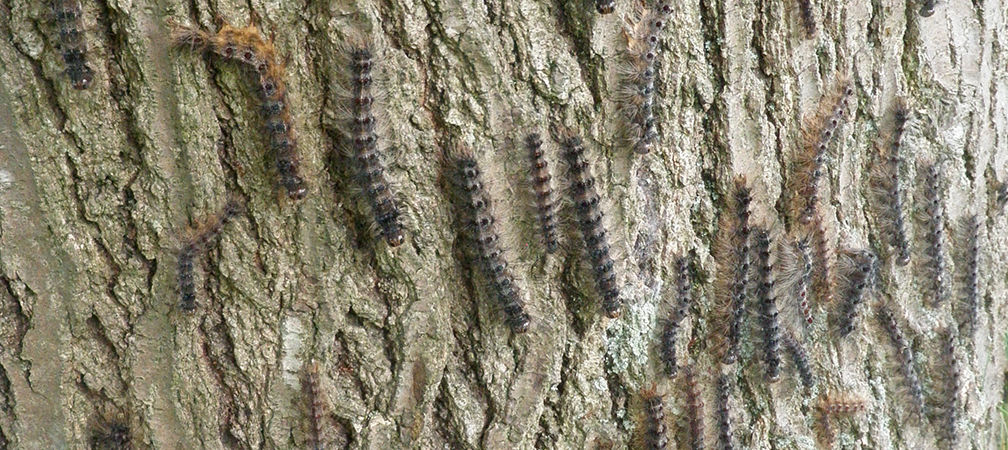
Once settled in an area, they lay their eggs, the pupae go through the life cycle, starting off by consuming foliage; the greater the number of eggs laid, the more hungry caterpillars will emerge from them to cover a tree from base to crown with dark, wriggling caterpillars focused on eating all the tree's foliage and consigning the tree to a struggle for survival. Repeated infestations will kill trees and if the invasion is sufficiently wide-spread, what will remain is the bleak remnants of a once-green forest.
 
This has led to warnings throughout Eastern Ontario of the peril their forests will face this summer for the second year in a row. Millions of gypsy moth caterpillars are set to hatch and they'll find their way to the tops of trees to begin munching their way from top to bottom, in a feeding frenzy. When July arrives, the sight of stripped=bare trees in a wide swath of forests will evidence itself.
 
Tiny gypsy moth caterpillars emerge from an egg mass on a maple tree in Elmhurst Forest near Lincoln Fields on Wednesday, May 12.
Tiny gypsy moth caterpillars emerge from an egg mass on a maple tree in Elmhurst Forest near Lincoln Fields on Wednesday, May 12. Photo by Jean Levac
 
 According to the Ontario Ministry of Natural Resources and Forestry, gypsy moth defoliation increased by 1,200 percent last year, from 47,203 hectares in 2019 to 586,385 hectares in 2020. This year's infestation may turn out to be far more severe, revealed by aerial surveys and ground searches for gypsy moth egg masses. Hardwoods like oak and maple, bass and poplar, and conifers such as white pine, hemlock and blue spruce represent prime feeding grounds for the moths.

Mid-May is when they hatch and the caterpillars; bristly with a double row of blue and red dots down their backs, grow to over six centimetres in length. One single caterpillar is capable of devouring one square metre of foliage before it pupates. Emerging in midsummer to mate, the small grey-brown moths lay eggs for next year's brood. A single tree, in badly infested areas, can be covered in hundreds of egg masses, top to bottom. 

A foliage-stripped deciduous tree will use whatever energy reserve it may be left with in attempting to regrow new leaves. That capability however, is not endowed to evergreens; once their needles are gone, they perish, particularly vulnerable to the devastation the gypsy moth leaves in its wake. They spread through many means, and so readily that they earned their name of 'gypsy'. Tiny young caterpillars cling to silken threads carried by the wind into neighbouring trees.
 
Lymantria, aka gypsy moth caterpillars
L. d. dispar caterpillars © Jon Hayes
 
Beyond which, the female gypsy moth will lay her eggs just about anywhere; cars, camper vans, firewood; which become 'vehicles' which spread the eggs when they move on, vast distances. In some instances the egg masses can be destroyed by scraping them into warm soapy water or burned in a fire. Aerial spray with a non-toxic natural bacteria can be effective. Burlap can be wrapped around tree trunks where caterpillars find shelter during the day. They can be collected in the burlap, and destroyed.

There is also a virus and bacteria that provide for natural-occurring controls of the caterpillar population, most of which control is actually part of nature's scheme, when by chance there can be an existential encounter between the caterpillar, and the virus or bacteria.
This Ministry of Natural Resources and Forests map shows the extent of the 2020 gypsy moth outbreak in Ontario, with the hardest hit areas being Lanark and Frontenac counties in Eastern Ontario. MNRF is warning of “severe” defoliation in 2021
 

Labels: , , ,

Sunday, November 10, 2019

Misled by the Allure of Chocolate

"The companies have always done just enough so that if there were any media attention, they could say, ‘Hey guys, this is what we’re doing'."
"We haven’t eradicated child labor because no one has been forced to... How many fines did they face? How many prison sentences? None."
"There has been zero consequence."
Antonie Fountain, managing director, Voice Network

"The truth is that consumers today have no sure way of knowing if the chocolate they are buying involved the use of slavery or child labor. There are many different labels on chocolate bars today, such as various fair trade certifications and the Rainforest Alliance Certification; however, no single label can guarantee that the chocolate was made without the use of exploitive labor. In 2009, the founders of the fair trade certification process had to suspend several of their Western African suppliers due to evidence that they were using child labor. Chocolate companies, however, continue to certify their products to tell consumers that they source their cocoa ethically. But in 2011, a Danish journalist investigated farms in Western Africa where major chocolate companies buy cocoa. He filmed illegal child labor on these farms, including those certified by UTZ and Rainforest Alliance. Despite the industry’s claims, child labor still plagues cocoa farms in Western Africa."
Food Empowerment Project
cocoa bean harvest in Cameroon
 ICCFO – Cocoa bean harvest in Cameroon
"Consumers believe that by buying certified cocoa they are doing something good for the environment, or children, or farmers."
"But that is a fiction."
Francois Ruf, Ivory Coast-based researcher
There are two outstanding issues in the growing of cocoa plants; that in West Africa where most cocoa plantations are located, the use of child labour is rampant. The second issue is the critical deforestation of rainforests, degrading the environment and threatening the larger global ecosystem. These issues, when they are addressed, alarm the world's chocolate industry, alerting prominent chocolate makers to a potential withdrawal of appetite for chocolate on a world scale. Not to worry: their hurried responses of assurances, lull chocolate lovers into the belief that nothing is as bad as it seems, and the chocolate industry is in the process of addressing the situation.

Chocolate wrappers come complete with traceability and sustainability certificates and manufacturer assurances that all is well, they're on top of the situation. The situation? That two and a half million children work in miserable and occasionally dangerous conditions on plantations in Ghana and Ivory Coast where most of the global supply of cocoa beans come from. And where the widespread rainforest clearing with their threatened biodiversity is increasingly imperilled. Mars and Nestle among other well-known manufacturers -- to the rescue! Despite which, somehow, the situation has managed to accelerate.

Ivory Coast is losing its rainforests even more rapidly than elsewhere. According to an article in the Yale School of Forestry & Environmental Studies Yale Environment 360 publication, rainforests in Ivory Coast have been reduced by at least 80 percent already. The depletion rate in both Ghana and Ivory Coast last year alone was higher than elsewhere on the planet. "Any time someone bites on a chocolate bar in the United States, a tree is being cut down", environmental activist Eric Agnero warned, from Abidjan, Ivory Coast.

Utz "has had significant lapses in its compliance reviews", found an investigator for the Washington Post. The Dutch organization held to be authorized to inspect most of the cocoa supply globally appears to have slipped its watchdog moorings. Its verification of approximately two-thirds of the world's total supply of certified cocoa in 2017 alone, failed to catch breaches. "Tackling child labour is at the core" of Utz's mandate, states its website, yet the Washington Post revealed that in two reports co-sponsored by the certifier, a higher rate of child labourers were found in Utz-approved plantations.

Child labourers working on such plantations are exposed to danger, as they put "in more work deemed dangerous, such as working with machetes and insecticides". Close to 5,000 previously certified Utz farmers were in fact, located in purportedly protected areas, according to a spokesperson with Utz, which belatedly decertified them. Yale Environment 360 was informed by Richard Scobey, president of the World Cocoa Foundation "very few international companies directly source from protected areas" even as those sources indirectly supply a dozen companies acquiring 85 percent of the cocoa harvest through intermediaries.
child labourers on cocoa farm in Côte d’Ivoire
Men and young boys working on a small cocoa farming commune near Abengourou, Côte d’Ivoire  Racounteur

Labels: , , , , , ,

 
()() Follow @rheytah Tweet