Blog dedicated primarily to randomly selected news items; comments reflecting personal perceptions
Wednesday, September 20, 2023
IPBES Invasive Alien Species Report
"We are seeing unprecedented increases in the numbers of alien species worldwide."
"It's about 200 new alien species every year. And, yes, with those kinds of numbers, we will also see the impacts increasing."
"There’s a feeling that invasive species contribution to biodiversity
loss is being vastly underestimated. This is an opportunity to really
highlight the huge threat that invasive species pose to nature and to
people."
"The accelerating global economy, intensified and expanded land- and
sea-use change, as well as demographic changes are likely to lead to
increases in invasive alien species worldwide. Even without the
introduction of new alien species, already established alien species
will continue to expand their ranges and spread to new countries and
regions. Climate change will make the situation even worse."
Helen Roy, professor, UK Centre for Ecology and Hydrology, ecologist, entomologist, British Ecological Society member, study leader
"Usually the poor communities are the ones that suffer the most."
"At the same time, with climate change, you're going to have mosquitoes going higher, you know."
"So getting, for example, to New York."
Anibal Pauchard, study assessment leader
"It is a perfect storm."
"It is the intersection of global warming with invasive species that is creating these terrible, terrible, feedbacks."
Dawn Bazely, professor of Biology, York University, Toronto
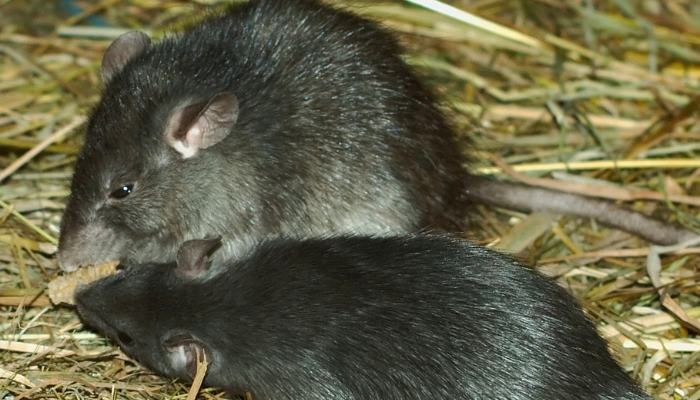
Black rats are the third most widespread invasive species according to the IPBES report
The key findings of the report include: • More than 37,000 alien species have been introduced by many human activities worldwide, of which around 3,500 are harmful
• These invasive species play a key role in 60% of global extinctions of plant and animal extinctions
• They pose a challenge to people in all regions of the world,
particularly indigenous peoples and local communities which have greater
direct dependence on nature
• The global annual cost to economies has quadrupled every decade
since the 1970s, to at least US 423 billion dollars, though the actual
figure is likely to be much higher
• 83% of countries do not have national legislation to tackle
Invasive alien species and 45% of countries do not invest in the
management of biological invasions.
Intergovernmental Science-Policy Platform on Biodiversity
According to the conclusions reached by the authors of a new study produced by the Intergovernmental Science-Policy Platform on Biodiversity and Ecosystem Services for the United Nations -- which expands on a wide-sweeping 2019 report produced by the same panel finding up to 1 million plant and animal species at risk of extinction -- invasive non-native species are recognized as a major factor in 60 percent of recorded extinctions of plants and animals.
Over $424 billion in estimated losses to the global economy annually results from thousands of invasive species introduced to new ecosystems globally by harming nature, damaging food systems and threatening human health, according to the scientific report presented on Monday. Since 1970, the costs have quadrupled each decade, based on 2019 data. Of the 37,000 species introduced unintentionally and intentionally by human activity, over 3,500 are considered invasive as a result of the harm they prove in their new ecosystems.
The report represents the most exhaustive view to the present on how invasive non-native species drive biodiversity loss. 86 experts from 49 countries compiled the report, drawing on thousands of scientific studies and contributions from Indigenous people and local communities. The report points out that species have been introduced with intention in view of perceived benefits, and then have spread out of control, a situation, write the researchers, for which solutions must be found.
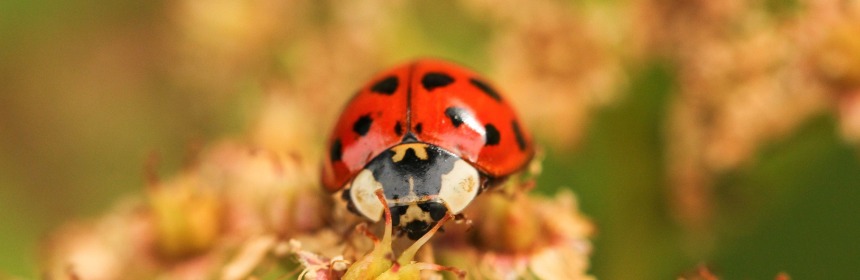
Invasive species like this Harlequin Ladybird (Image Credit: PJ Taylor, Pixabay)
The study cites non-native species that are benign, such as chickens and potatoes, which have been successfully domesticated, playing vital roles in agriculture and food supply. It is unchecked non-native species that become invasive that can severely damage food systems. As an example, the European shore crab invades commercial shellfish beds in New England, while key fisheries in India have been damaged by the introduction of the Caribbean false mussel.
Human health can be directly impacted by invasions when mosquitoes transmitting diseases such as malaria, dengue fever and the Zika virus become invasive world-wide. Ecosystems that have been disturbed may then be incapable of delivering services humans are dependent upon, like the maintenance of fisheries, regulation of rain patterns, and purificiation of drinking water. Ecosystems are made more vulnerable through invasive species reducing the biodiversity that makes them resilient to diseases and other threats.
In over a quarter of the world's islands, invasive non-native species out-number native species. A target set in 2010 for countries to reduce invasions has failed. Almost every country in the world in December of 2023 agreed to protect biodiversity as part of a sweeping agreement to reduce the introduction and establishment of invasive species by at least 50%. The most important way to fight the growing crisis of invasive non-native species, according to the researchers, is to prevent their arrival in new regions -- calling for the assessment of risks prior to moving species, or adopting biosecurity measures that can be quite simple to mount protectively.
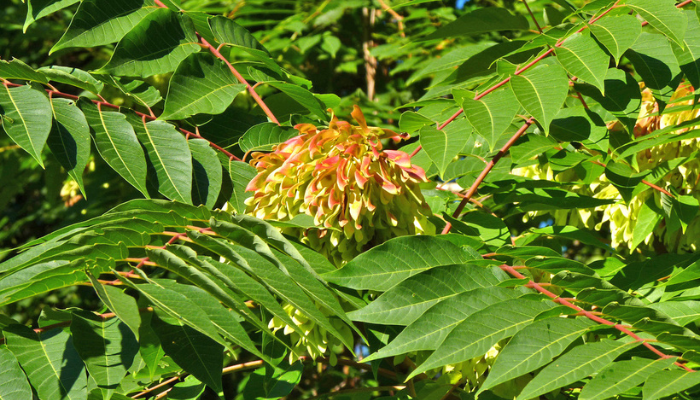
A tree-of-heaven, another widespread invasive species mentioned in the IPBES assessment.
"Our forests are suffering from cataclysmic insults these days."
"This year it's gypsy moths. And it was just a few years ago we were hit by the forest tent caterpillars. The trees have recovered somewhat from that, but there's going to be long-term issues."
"Each egg mass can contain 300 to 500 eggs. If you do that math, if each survives, that's a lot of foliage [consumed]."
"If there's two years of gypsy moth defoliation in a row, those trees will probably die. It is more catastrophic for conifers than hardwoods. It doesn't mean hardwoods just shake it off, it just means they have a better chance of recovery."
"On a quiet day you can actually hear the frass [caterpillar poop] that's raining down from the tree tops. There can be so much that cottage owners are sweeping it up into dustbins."
"If you have an outbreak and you're wondering 'How did they get here?' That's the answer. People brought them."
"The virus [that the caterpillars are susceptible to] is a lot like COVID. When people are living crowded and closer together, the virus expresses itself. It's the same for caterpillars."
"[If it's impractical to spray, scrape, trap] Then all you can do is wait it out and hope that nature comes to the rescue."
Eric Boysen, Forester, woodlot owner, Maberly, Lanark county, Ontario
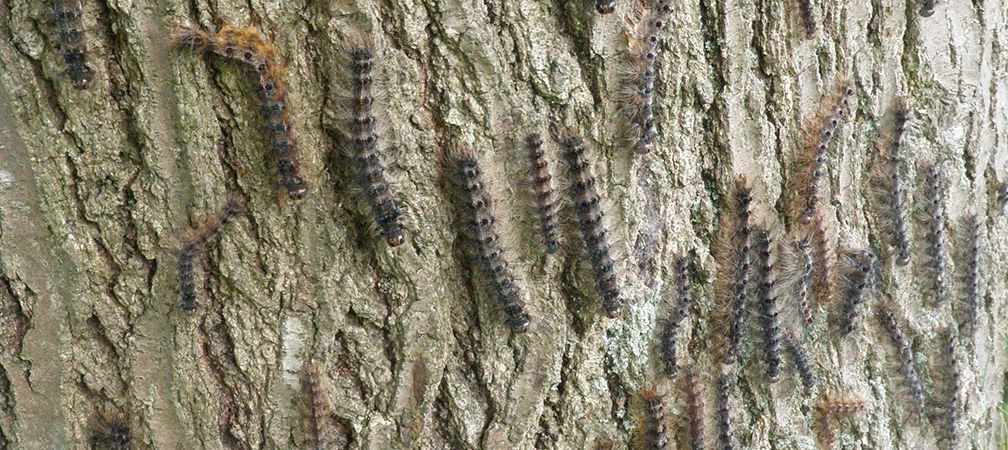
Eastern Ontario is experiencing the worst outbreak of Gypsy moths since the mid-1980s. MNRF IMAGESunMedia
A fact sheet produced and circulated by Eastern Ontario Model Forests in collaboration with the Invasive Species Centre and the Early Detection and Rapid Response Network warns that "Should all of these eggs hatch successfully and develop through all of their larval stages, we should expect 'severe defoliation' [in many parts of eastern Ontario]". As much as we would wish to protect our forests as green sinks, air fresheners, and natural resources for any number of reasons, free agents infiltrate and cause considerable damage, with no way to protect an entire forest from their depredation.
In 1869, a failed silkworm breeding experiment in Massachusetts brought gypsy moths to North America. A hundred and fifty years ago, the researchers who hatched this scheme and imported the gypsy moths obviously had no idea what this would mean for the forests of the future in North America. Well beyond their lifetime the imported moths have thrived and now threaten natural woodlands. This didn't happen overnight, it took a century before the moths which had escaped their original laboratory confines, made their way to the forests of Ontario.
Adult female Gypsy moth
Once settled in an area, they lay their eggs, the pupae go through the life cycle, starting off by consuming foliage; the greater the number of eggs laid, the more hungry caterpillars will emerge from them to cover a tree from base to crown with dark, wriggling caterpillars focused on eating all the tree's foliage and consigning the tree to a struggle for survival. Repeated infestations will kill trees and if the invasion is sufficiently wide-spread, what will remain is the bleak remnants of a once-green forest.
This has led to warnings throughout Eastern Ontario of the peril their forests will face this summer for the second year in a row. Millions of gypsy moth caterpillars are set to hatch and they'll find their way to the tops of trees to begin munching their way from top to bottom, in a feeding frenzy. When July arrives, the sight of stripped=bare trees in a wide swath of forests will evidence itself.
Tiny gypsy moth caterpillars emerge from an egg
mass on a maple tree in Elmhurst Forest near Lincoln Fields on
Wednesday, May 12.Photo by Jean Levac
According to the Ontario Ministry of Natural Resources and Forestry, gypsy moth defoliation increased by 1,200 percent last year, from 47,203 hectares in 2019 to 586,385 hectares in 2020. This year's infestation may turn out to be far more severe, revealed by aerial surveys and ground searches for gypsy moth egg masses. Hardwoods like oak and maple, bass and poplar, and conifers such as white pine, hemlock and blue spruce represent prime feeding grounds for the moths.
Mid-May is when they hatch and the caterpillars; bristly with a double row of blue and red dots down their backs, grow to over six centimetres in length. One single caterpillar is capable of devouring one square metre of foliage before it pupates. Emerging in midsummer to mate, the small grey-brown moths lay eggs for next year's brood. A single tree, in badly infested areas, can be covered in hundreds of egg masses, top to bottom.
A foliage-stripped deciduous tree will use whatever energy reserve it may be left with in attempting to regrow new leaves. That capability however, is not endowed to evergreens; once their needles are gone, they perish, particularly vulnerable to the devastation the gypsy moth leaves in its wake. They spread through many means, and so readily that they earned their name of 'gypsy'. Tiny young caterpillars cling to silken threads carried by the wind into neighbouring trees.
Beyond which, the female gypsy moth will lay her eggs just about anywhere; cars, camper vans, firewood; which become 'vehicles' which spread the eggs when they move on, vast distances. In some instances the egg masses can be destroyed by scraping them into warm soapy water or burned in a fire. Aerial spray with a non-toxic natural bacteria can be effective. Burlap can be wrapped around tree trunks where caterpillars find shelter during the day. They can be collected in the burlap, and destroyed.
There is also a virus and bacteria that provide for natural-occurring controls of the caterpillar population, most of which control is actually part of nature's scheme, when by chance there can be an existential encounter between the caterpillar, and the virus or bacteria.
"Prussian carp pose threats to native fish populations by
out-competing native species for food and habitat, as well as spreading
new diseases and pathogens. They are easily spread from one water body to another, and it is
extremely costly and difficult to try and manage, contain and destroy
them once they have become established. It is also illegal to move live
fish from one water body to another. Penalties for illegally
transferring fish can be up to $100,000 and/or a year in prison."Jess Sinclair, spokesperson, Environment and Parks Ministry, Alberta
"This might be a little shocking, but males are not actually
needed for reproduction for this species. This is a bit unusual in the
fish world. The females can reproduce clonally. They can clone themselves over and over and over again. The females lay the eggs and actually take sperm from another
species, so another species will fertilize the eggs but they won't
actually contribute any genetic material. This
allows them to reproduce in huge numbers. It also means that all the
individuals, and we've done some preliminary genetic work, they're all
clones. They're all identical to one another." "Goldfish are found throughout the province and people do
release them. And we think that's how this little guy got in here and
now they're really starting to take over. We
think they first came here in 2000 and the reason it took so long to
find them is that people misidentified them as goldfish. They
first arrived in Medicine Hat and since then, we find them all the way
up to the city of Red Deer, and they are literally everywhere."Mark Poesch, researcher, assistant professor, Faculty of Agricultural, Life and Environmental Sciences, University of Alberta
Non-native Prussian carp, which are closely related to goldfish, are
being found in “significant” numbers in the Red Deer River and its
tributaries. (Contributed photo).
Yet another invasive species causing consternation in Canada. This time it's another fish. Not as gruesome as the snakehead, but doing its best to give conservationist, environmentalists and the governments of Alberta and Saskatchewan a headache. "Catch it, kill it", a notice on the Alberta government website urges. "If you catch Prussian carp while angling, please kill it and either take it home to eat or properly dispose of it in the garbage."
It is edible; a relative of the species goldfish, it can weigh up to three kilograms at full maturity, and it presents an existential danger to native fish due to its amazingly rapid reproduction, meaning that the food sources for fish undergo a highly competitive race for survival. In sheer numbers this invasive carp is capable of out-fishing native species.
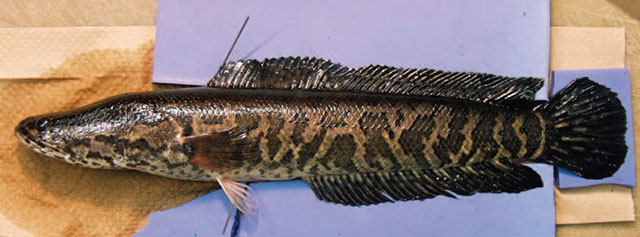
Northern snakehead. Photo: U.S. Geological Survey
Like the snakehead fish that has proven to be a concern for the Great Lakes, and which can be found throughout large swaths of the United States, gradually moving into Canada, these fish out-compete native species for habitat and for a finite food supply. The Prussian cap has been seen n Alberta since 2015, but how it entered the province's waterways is not known. And it is able to survive on land, searching out new habitat "for relatively long periods of time".
A government fact sheet dating from 2015, updated in 2018, points out that "Many invasive carp were imported as pond or aquarium species of sold in Asian food markets". Some obviously found their way into waterways at the hands of people who released them there. And the rest is, as one says, history. "It's a little freaky. They're very opportunistic fish. We believe humans are also picking them up and moving them around", commented Nicole Kimmel, invasive species expert with the Alberta government.
Invasive species become a real existential danger to native species; boring insects from abroad threaten tree species in Canada, fungi, aquatic creatures and vegetation that reproduce exponentially, taking the place of native species. What invasive species mostly have in common aside from their threat to native species is that, removed from their home territory, they thrive because they have been geographically separated from the presence of other organisms that normally keep them in control.
Wild boar have become a problem in the Prairie Provinces; they're habitat destructive, difficult to control. A variety of invaders such as bloodsucking sea lampreys have established themselves in Lake Erie. The alarm has been sounded on some species known to inhabit waterways in Ontario, such as the Weis Catfish one of the largest freshwater species, named The European Maneater, on the "prohibited" list.
British Columbia enacts fines of up to $250,000 for anyone caught releasing snakeheads, nicknamed Frankenfish, able to grow to a metre in length and to move overland in search of new waterways to establish themselves in. The Central Park Lagoon in Burnaby was drained when a snakehead was spotted in it, to be able to catch and kill it, in 2012.
A snakehead fish captured from Central Lake pond in Burnaby, B.C., June 9, 2012.Nick Procaylo/Postmedia/File
"I don't think anyone's betting against the coyote getting to South America eventually. They have to be one of the most adaptable animals on the planet." "Is this something we should view as a natural expansion that's a good thing, or that we should view as an invasive species that's a bad thing?" "In some ways that's a philosophical question, because in the end, there's nothing we can do about it." Roland Kays, ecologist, North Carolina State University
There are some species that are so specialized in what they will eat that when their food source disappears so will they. Take giant pandas, as an example; the absolute mainstay of their diet is bamboo. Monarch butterflies dine exclusively on milkweed, while koalas eat only eucalyptus, and a bird called a kite has been species-selected for dining out on snails. Should those specialized foods no longer be available those animals would soon become extinct.
Not so for other animals, which eat omnivorously, like goats as an example, and raccoons. Raccoons have adapted themselves to urban living because they long ago discovered that what people living in cities discard tastes pretty good to them and they thrive on what they can pick out of compost piles and other discarded foodstuffs in our wasteful society. And then there's the ultimate animal adapter, coyotes who have become ubiquitous on the margins and beyond, of human habitation.
They distinguish themselves as a species by breeding swiftly, eating just about whatever they find and adjust to living anywhere that they find haven for themselves, living in fields and forests, parks and even backyards (albeit somewhat discreetly) all around North America, surprising people by their sudden presence and their willingness to pick off very small family pets on occasion. They are bold and not given to bolting in a brief and sudden encounter with people.
Dr. Kays, associated with the North Carolina Museum of Natural Sciences, along with a graduate student studied reams of museum specimens, fossil records, peer-reviewed reports and wildlife agency records tracing coyotes' pathways on their migratory journeys up to ten thousand years ago. They produced maps published recently in the journal ZooKeys demonstrating that the historical range of North America's adaptable canids were previously incorrect.
The study established that coyotes lived in grasslands, prairies and deserts those thousands of years ago, headed east to the Mississippi and Ohio Rivers and west as far as California in the United States until 1900 when coyote packs moved into forested habitat making their way in the early quarter of the 20th century into Alaska and many decades later, to the East Coast of the U.S. They expanded their range by mid 20th century at least twice that of any other North American carnivore since 1950.
Maybe we should leave them alone. iStock
With the expansion of agricultural lands leading to forest fragmentation destroying the habitat of predators such as wolves, cougars and jaguars, the coyotes thrived and hybrids of coyotes and wolves or dogs (breeds like German Shepherds) were aided in adaptation by developing traits receptive to adapting to new environments. The rapidity of their expansion, however, remains a mystery; that they entered Alaska and the Northwest where intact forests host wolves and mountain lions, a conundrum.
Coyotes are now expected to keep expanding their presence. In 2010 they crossed the Panama Canal. Should they appear in South America it would rank as the first time predators have been exchanged between the continents in three million years.
Coyotes in densely populated areas (a Los
Angeles suburb) can be alarming. But wildlife experts say they fill a
niche in the urban ecology.(Troy Boswell / Los Angeles Animal Services)
"Researchers recently studied three islands to
record the effects of rabbit invasion [on the Kerguelen Islands]. The island of Grande Terre has
many rabbits, while Ile Guillou’s rabbits were eradicated in 1994, and
Ile Australia never had to contend with the beasties at all. In areas
where rabbits thrived (and they did, without predators) native plant
diversity declined and burrows made the land susceptible to erosion. In
particular the researchers noted that soil fungi were very different on
the two islands that had or have rabbits. Even 20 years after the
rabbits left, Ile Guillou’s plant and fungal communities resembled that
of Grande Terre."
"The
long-lasting effects could have come from disturbance of the soil
through burrowing, rather than any specific rabbit-additions such as
feces. A different disturbed soil site on Ile Australia showed some
similarity to the soil fungal communities on the rabbit-affected
islands. Native plants might be slow to grow back after such
disturbance."
"However, the study does point out that
some subtle effects of an invasive species can persist for a long time
after the problem animal or plant is gone. Helping an ecosystem recover
from such a change may be trickier than previously thought."
Smithsonian
"The big lesson is that sometimes we can have a strong human impact even in places that are very, very isolated." "Our research shows that we absolutely have to act immediately. There is no lag time between the arrival of these invasives and the impact." G. Francesco Ficetola, biologist, University of Milan
The European rabbit looks harmless, but in the Kerguelen Islands, the
species became invasive. A new study finds that the effect of the
rabbits on soil fungus lasts even long after they are gone.
There is remote and isolated and then there is truly and really isolated-remote on this planet of ours. At one time Antarctica was the sole place left on Earth, an entire continent, that hadn't been 'discovered'. Its presence was known to whalers, but explorers from Britain and Norway had not yet set their sights on travelling to that remote region and undergoing privation in the extreme South Pole geography to map it out and discover the lay of the terrain, its mountains, glaciers and environmental conditions.
As it happens, there is a geographic area, one of isolated islands, discovered by a French expedition in the late 16th Century, acknowledged to be a French possession now, that was once a way-station for sealers and whalers and their hardy crews. Whales were once hunted for their baleen, the long bone-like structures through which they sift the marine life they scoop up as fodder for those great beasts; the baleen used for Victorian-era ladies' undergarment stays. Seals were traditionally hunted for food, household oil and sealskin garments by the Inuit, and in the 19th Century represented a much-in-demand European trade item.
On the Kerguelen Islands, literally at the world's end in the southern Indian Ocean between Madagascar and Antarctica, there is a research field station, and not much more, for its climate is extreme, and the landscape is unremittingly harsh and windswept. The islands’ average daytime high temperatures nudge at 11.5° C (about 50° F) including during the summer. It experiences, 300 days a year, rain, snow or sleet, and
sustained winds of up to 150 kilometers per hour (93 mph). The environment is, to say the least, unforgiving. But rabbits found it to their liking; once brought to the islands, purportedly in an effort to make the landscape more interesting, and possibly also to provide an alternate fresh food source for sealers and whalers, who made the islands a way-station; rabbits thrived and proliferated, and in so doing, like any introduced species alien to the environment, found no natural enemies and sufficient nutrition growing out of the soil to sustain their colonies, and then some.
( Worm That Turned (CC BY 3.0 via Wikimedia Commons)) Scientists, in 1974, who felt the remote archipelago represented a promising spot from which to observe the transit of Venus as it regularly passed before the sun, installed an observatory on the 93-mile-wide Grande Terre, the main island. They too were linked with bringing rabbits with them, an estimated five; again as a potential food source for the future. By the time the researchers left the island, the rabbits had begun their work of reproducing in sufficient numbers to alter the ecosystem.
That, in any event is what a report recently published in the journal Science Advances, has noted, based on sediment cores drilled from a small lake in Grande Terre's central plateau. The question of how invasive species change ecosystems intrigued the scientists who examined those cores, and the Kerguelen Islands represented a natural laboratory, distant from civilization and its presentation perfect for investigation.
The biologists extracted DNA from the sediment cores and pieced together a timeline of what lived on the island over the course of hundreds of years, with the genetic data indicating the central plateau of Grande Terre with a stable ecosystem until about 1940, when the rabbits reached that area on the main island. A cushion-like plant named Azorella Selago dominated the area originally, but with the introduction of rabbits, the presence of native plants diminished and erosion began its destructive work.
Now, to add to the severely deleterious effect of the exploding rabbit population, climate change has also entered the picture, to impact doubly negatively on the original ecosystem. Dr. Kerguelens points out that what happens on an isolated group of islands is reflected by alterations in ecosystems throughout the entire planet; with the arrival of invaders, normalcy and stability erode.
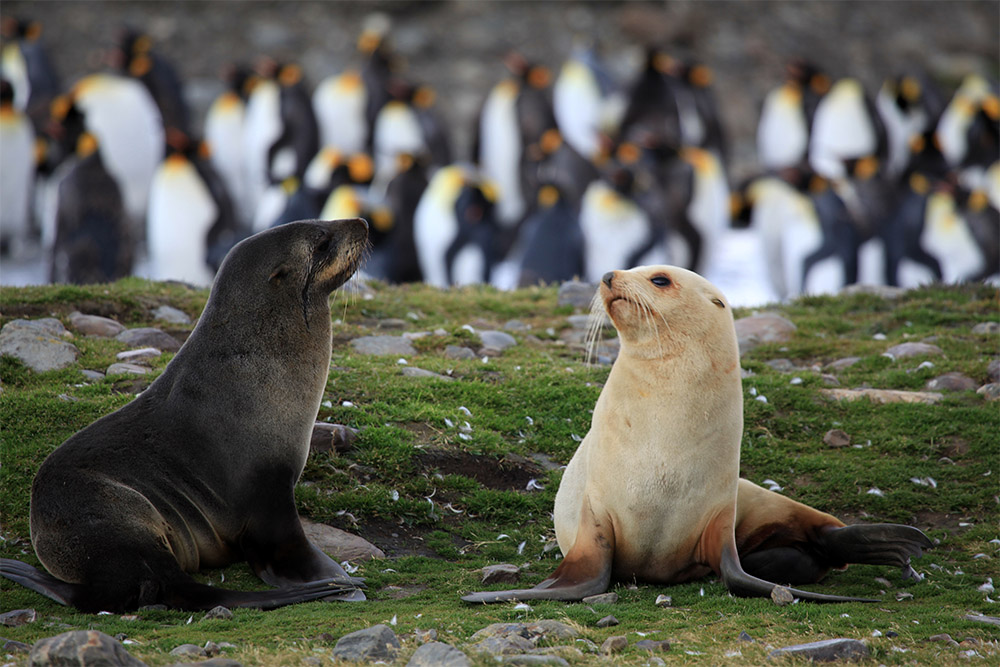
The Kerguelen Islands are an important breeding ground for Antarctic Fur Seals. Credit: Liam Quin