Ruminations

Blog dedicated primarily to randomly selected news items; comments reflecting personal perceptions

Sunday, October 07, 2018

Nature's Gift and Curse of Tusks to Elephants

"Tooth development has been very conserved during evolution."
"Elephants are no more different from humans than mice are, so it's quite possible that the same gene or genes are involved [in tusklessness in elephants and human toothlessness]."
Irma Thesleff, developmental biologist, University of Helsinki, Finland

"We know tusks play an important role in obtaining food, so if individuals don't have that tool, are they using the environment differently, and could those changes have consequences for other animals dependent on elephants as ecosystem engineers?"
Shane Campbell-Staton, assistant professor of ecology and evolutionary biology, University of California, Los Angeles

"They're [the tuskless elephants of Gorongosa, Mozambique] in fantastic condition, this is a very good habitat [Gorongosa national park] for them, and there's no indication they're suffering nutritionally."
Joyce Poole, scientific director, Elephant Voices research and advocacy group, Gorongosa 
Gorongosa Blog

Science has not yet unravelled the mystery of what causes tusklessness in elephants, but through slow and steady research some progress has been made deciphering the genetic program of mammalian tooth development in general, where scientists have discovered an ancient, widely-shared genetic code. Mutations linked with tooth abnormalities in mice show up as well through genetic studies of humans who have missing or malformed teeth.

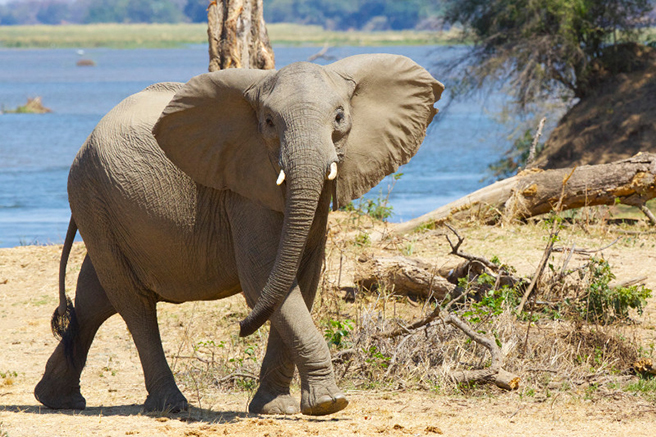
Elephant tusks are overgrown upper lateral incisors -- those teeth located right beside the front teeth, before the canines. Tuskless elephants, therefore, don't have lateral incisors. Throughout Africa tuskless elephants are anomalous, found in discrete numbers. Gorongosa is an exception; there a sizeable population of tuskless elephants occur. The tusked elephants were victims of a remorseless civil war which incidentally saw elephants slaughtered for ivory. The tusklessness of those surviving elephants without ivory represented their Darwinian advantage.

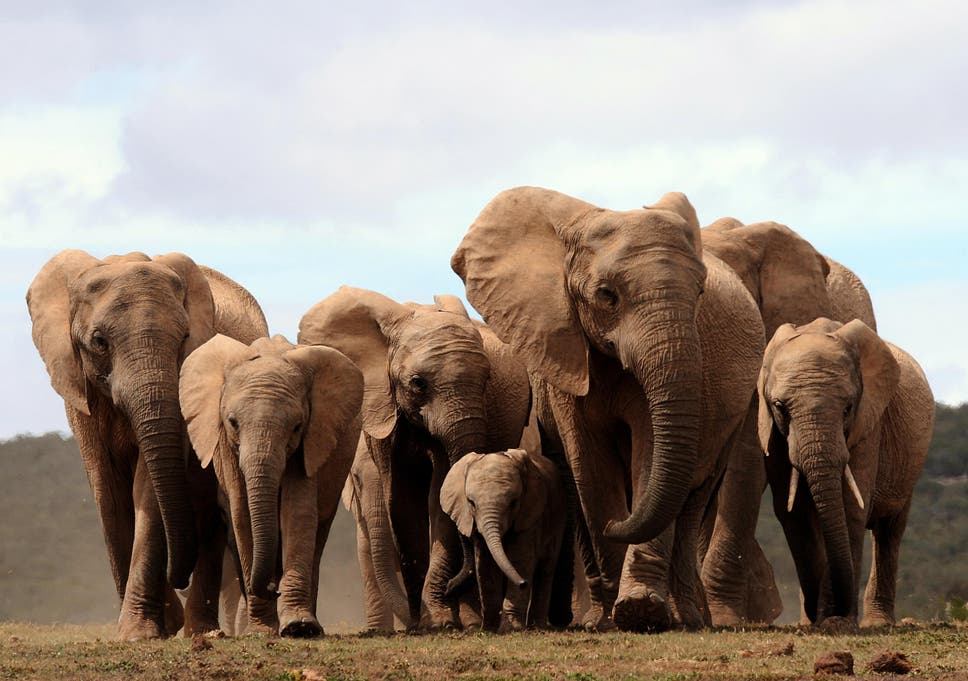
The result of that ravaging of the park's tusked elephants is that roughly a quarter of the 700 elephants living in the park are tuskless females. Among humans, missing lateral incisors represent the second most common form of tooth agenesis of which the normal rate of the condition lies between two to four percent, roughly analogous to the rate of tusklessness among African elephants.

Generally speaking, tusks are canines curving to the side and upward in wild boars and warthogs, or they droop downward in walruses, while in narwhals of the Arctic the tusk is a single overgrown canine penetrating through the left upper lip of the animal giving them their iconic 'unicorn' appearance. As multipurpose aids tusks are useful implements. Those incisors are used by elephants to dig for salts and minerals; break off branches to reach foliage; they're used to pry and peel off tree bark; to scoop a calf from a mudhole or lift a resting one to its feet.

Bull elephants contest one another by locking their tusks in combat. Those tusks can each weigh up to and over 45 kilograms, seven times the weight of an average female tusk. Those naturally-endowed implements so useful to the elephants have led to their deaths in enormous numbers by poachers setting out to harvest valuable ivory which has always been in high demand as a beautiful material used to carve detailed pieces of artful objects.

International efforts to have the trade banned have had only partial success, with the ivory so valuable that no amount of protection suffices entirely to acutely limit a billion-dollar illicit and inhumane trade. A situation that has led researchers to consider whether elephants would be better off without those mighty tusks, imagining the loss to the trade should the tuskless trait spread throughout the African population with a little bit of help from scientific human intervention.

This intriguing conundrum has the attention of Dr. Campbell-Staton and his colleagues at University of California who have been comparing tusked and tuskless elephants in Gorongosa, hoping to identify and isolate the genes involved in tusklessness, and to solve the patterns of inheritance. As for example, why it is that almost all the tuskless elephants of Africa are female.

Gorongosa Blog

Labels: , , , , ,

Tuesday, July 10, 2018

Elephant Poachers and Trunkless Cows

"Addo elephants might be the biggest success story anywhere."
"Trunklessness has helped protect them."
John Adendorff, conservation manager, Addo Elephant National Park

"Maybe tusklessness is the future."
"Our [elephant-] cows have gone a hundred years without tusks and they've done O.K."
Michael Paxton, ranger, Addo Elephant National Park, South Africa
Africa's elephant population has decreased by an estimated 110,000, down to 415,000, since 2006
Africa's elephant population has decreased by an estimated 110,000, down to 415,000, since 2006 ( Getty )

"[Tusklessness is a natural trait in elephant populations. Because poaching takes out elephants with tusks, more tuskless females survive. So a population] ends up with a higher proportion of tuskless animals who then reproduce and tend to produce tuskless offspring."
"In this day and age, with all the poaching going on, tuskless elephants are at an advantage because they are not being targeted for their tusks."
"[But, given that there is also] genetic variability with regard to tusk length and thickness, with some older males having smaller tusks, [heavy poaching of large-tusked elephants can influence the biology of future generations of elephants]. Assuming that poachers select according to tusk size, they will tend to kill older males with very large tusks, thereby taking out of the population of breeding-aged males who also happen to have very big tusks. Those males then no longer pass on their genes for large tusks."
"When these young males grow older they are killed for their tusks before they reach breeding age. In this manner, heavy poaching will select out genes for large tusks."
Joyce Poole, co-founder, non-profit Elephant Voices

As few as two percent of elephant cows in most populations of elephants in African countries, are without tusks. This places these elephants at a disadvantage in searching for food, according to some experts, since tusks are used to dig for and to manipulate vegetation for an elephant's diet. Without what can be referred to as a vital tool, tuskless elephants risk malnutrition and illness. On the other hand, they are seen as being of no value whatsoever to poachers hunting ivory for the illicit black market trade in Asia.

In the Addo Elephant National Park, the females are 90 percent to 95 percent without tusks. And when they breed, their offspring reflect similar genetic markings and are also tuskless. This is what poaching has achieved; it has stripped natural preserves of African elephants of these great majestic beasts of high intelligence of the tusked among the species, leaving behind those elephants that never grow tusks. A kind of lightning-swift-in-evolutionary-time trait that would take countless generations to achieve through natural selection.

While the prevalence of tuskless elephants is notable in Addo, the phenomenon of poaching resulting in a vastly reduced tusked population of elephants has been seen elsewhere as well in Africa. In Zambia, Tanzania, Uganda and Mozambique tuskless elephants have become the majority in some areas. In Gorongosa National Park in Mozambique the 1970s-90s civil war incited the killing of large herds of tusked elephants. Which sees as a result 53 percent of newborn females with no tusks, explains elephant biologist Joyce Poole.

Tusklessness, however, appears to be gender-linked, rarely occurring among male elephants. Almost all bull elephants have tusks in Addo; granted smaller in size than elsewhere but tusks nonetheless. On the world ivory market, a pair of tusks weighing 49 kilograms each from a 50-year-old bull can bring a profit of $100,000. The trade, not only in elephant tusks but rhinoceros horn for Eastern medicinal purposes, is viciously pernicious, killing countless animals, bringing species to the brink of endangerment of extinction.

The Addo elephant population was almost wiped out in the early 1900s, sealing the reputation of Major P.J. Pretorius as the "great white hunter" of the Eastern Cape. A mere 11 elephants were left, within the group a remaining eight cows. The present hundreds of elephants thriving in the Addo are all descendants of those eight cows, among whom four to five had been without tusks. Dr. Poole's theory has its challengers -- Anna M. Whitehouse, elephant expert among them.
Elephant with small tusks

Decades of poaching and overhunting of large tusked elephants may be leading to generations of elephants with smaller tusks—or no tusks at all    African Wildlife Federation


Ms. Whitehouse speaks of the increase of tuskless elephants after 1931 when the park was founded, and that by the early 2000s, 98 percent represented tuskless cows descended from the original 11. The tusklessness  has resulted, according to Ms. Whitehouse. from inbreeding, known as "genetic drift". Addo park has never, as it happens, since its opening, had to cope with poaching, not one instance of poaching has been attempted. Poachers simply are disinterested in elephants lacking tusks.

Aside from which the park employs 80 rangers, armed, with military training in weaponry use, a small air wing, and high-tech infrared and motion-detecting sensors installed throughout the park. Watering holes and game trails, the likeliest place for would-be poachers to come across animals are regularly staked out by the rangers, camping in the thickets overnight to interrupt any possible incidents of poaching-in-progress should they ever occur.

Graham Kerley, from the Nelson Mandela University in South Africa and an expert on the Addo elephants, speaks of yet another factor in safeguarding the elephants at Addo. The landscape's vegetation makes ingress into the area close to impossible with the presence of impenetrable vegetation; what is known as valley thicket, spiky and thorned. The female elephants double every 13 years, standing now at over 600 individuals.
"As the greatest living targets for poachers, great tuskers are extremely rare in Africa today. Big elephants carry genes for survival and are preferred by females, living proof that they have been successful to survive so long."
"[If left alone, these big elephants, which typically bear the larger tusks, normally father the majority of calves but constant poaching and overhunting have depleted large elephants at the apex of their reproductive power, leaving an observable impact on size and weight of elephant tusks]."
"Unless the relentless pressure against bearing ivory is curbed, the African elephant may easily be reduced both in the weight of ivory and in its overall fitness to survive. There is evidence that this has happened already, with mean tusk weights lower today than in Victorian times."
Dr. Iain Douglas-Hamilton, founder and CEO, Save The Elephants
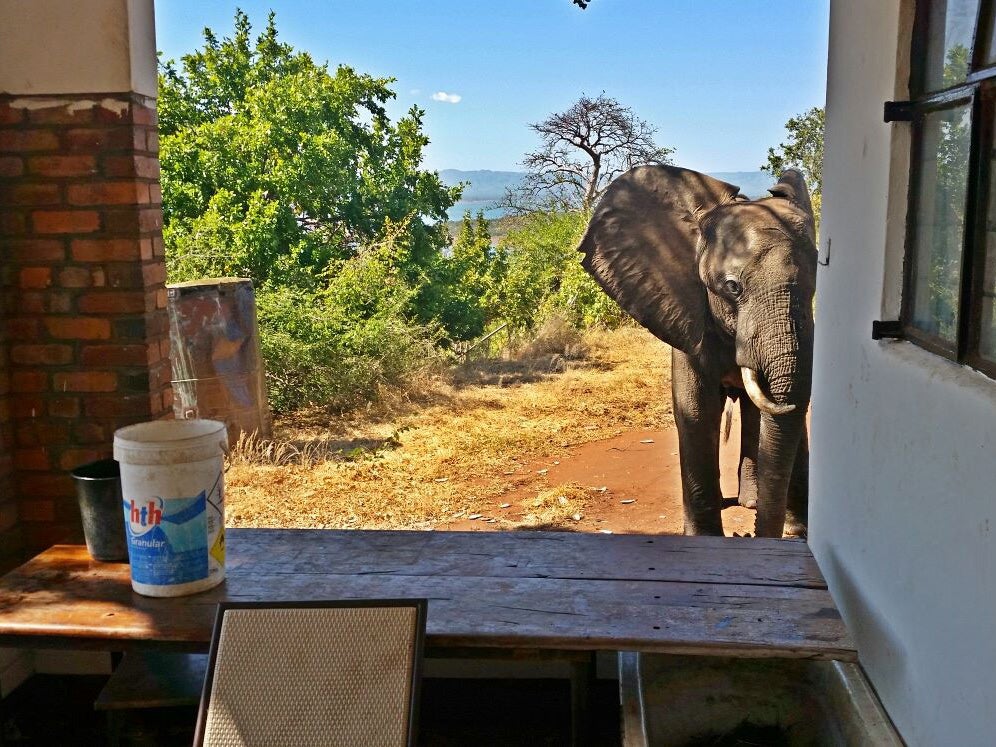
Ben the elephant arrives looking for help
Staff and guests at the Bumi Hills Foundation in Zimbabwe were surprised to see a wounded bull elephant seeming seeking help outside their window.  Bumi Hills Foundation

Labels: , , , ,

Monday, February 01, 2016

The Idling Elephant Malaise

"Modern Burmese history was built on teak, which is to say it was built on the backs of elephants. The British quickly saw teak’s potential after colonizing Burma in 1824, and realized that hitching an elephant to a two-ton log was the only way of getting timber from where it was felled to the nearest waterway, and floating it to mill and market."
"Last year, in the land that is now officially known as Myanmar, total timber exports surpassed 1.24 million cubic tons and generated more than $1 billion in revenue, of which teak alone earned $359 million. From Tuesday [March 31, 2014], however, the new quasi-democratic government is banning the export of round logs and slashing its total logging quotas. The plan is to stimulate a domestic milling and carpentry industry and protect already plundered forest, which plummeted from 58% of total land in 1990 to 47% in 2010, according to government figures."
Time Magazine
An elephant pulls a teak log
An elephant pulls a teak log in a logging camp in Pinlebu township, Sagaing, northern Burma, in this picture taken March 6, 2014  Time magazine
Beasts of burden, they are called, strong animals that were trained by men to do tasks that men could not do with the relative ease of these animals. Before the invention of the motor vehicle, horses were used for transport. I am myself old enough to remember as a child horse-drawn wagons rumbling down the street I lived on, with cold, dripping blocks of ice hawked to housewives to put in their iceboxes, before refrigerators were common household appliances.

I remember as a child the thrill of excited disbelief when we children heard that there had been a dreadful accident between a motorcar and a horse. Eventually there was no more work for horses, and they were metaphorically 'put out to pasture'. With mechanization reliance on dray animals, such as farm-working draught horses, the emergence of steam-driven tractors made the animals completely redundant. Small ponies were once used in mines to pull wagonloads of coal.

All that changed with automation and mechanization. In Myanmar, the government, taking stock of its diminishing forests due to overlogging in reflection of how important the export of exotic wood was to the country's economy, decided it had to better regulate its natural resource of wood products. And that has resulted in elephants in their thousands, no longer required to exert their enormous strength in extracting felled timber from forests.

"They become angry a lot more easily", explained U Chit Sein, the possessor of eight logging elephants. "There is no work, so they are getting fat. And all the males want to do is have sex all the time", he explained of his working elephants accustomed to hard work now no longer working more than a few days a month. Just as human beings become bored, so do animals. Just as human beings require a sense of purpose, so do animals, to give structure and meaning to their lives.

Mahouts rode their elephants back to their camp in the jungle near Wa Kalu Pu. Credit Adam Dean for The New York Times

"Unemployment is really hard to handle. There is no logging because there are no more trees", observed U Saw Tha Pyae, whose own six working elephants have been without work for two years. Daw Khyne U Mar, the country's leading elephant expert, speaks of 2,500 elephants now without work. "Most of these elephants don't know what to do. The owners have a great burden. It's expensive to keep them."

Mature elephants, weighing in the neighbourhood of 4,500 kilograms must consume 180 kg of food daily. There are options for some elephants aside from hauling logs; some are employed in circuses, but those opportunities are limited. A 2008 study concluded that Myanmar's logging elephants live much longer than elephants kept in zoos in Europe; the working elephants living approximately 42 years rather than the 19 years' longevity for their zoo counterparts.

"You see working elephants living into their 50s and 60s quite regularly. It all comes down to nutrition and proper care", advised Joshua Plotnik, a Thailand-based elephant behaviour specialist. "I don't want to anthropomorphize, but if you take away that part of their life that has entertained them or stretched them mentally and physically -- it's difficult", explained John Edward Roberts, director of elephants and conservation activities at an elephant rescue centre in Thailand, the Golden Triangle Asian Elephant Foundation.

Some Burmese elephant owners have parted with their elephants out of necessity, selling them to Thai businessmen. There they will be used in the tourism industry, in elephant shows and on jungle treks popular with tourists. This does not necessarily reflect all working elephant owners' decisions on how to solve their dilemma of no work for their elephants. "I don't know what I will do with my elephants", Saw Tha Pyae worried of the beasts he had inherited from his parents.

"But I will never sell them, never! I love them so much!"

Adam Dean for The New York Times


Labels: , ,

Tuesday, August 18, 2015

Plundered and Endangered

"I will use (Dante's) tusks to hunt the people who kill elephants to learn what roads their ivory plunder follows, which ports it leaves, what ships it travels on, what cities and countries it transits, and where it ends up."
"Will artificial tusks planted in a central African country head east or west toward a coast with reliable transportation to Asian markets? Will they go north, the most violent ivory path on the African continent? Or will they go nowhere, discovered before they're moved and turned in by an honest person'?"
Bryan Christy, National Geographic investigative reporter
A pile of 15 tonnes of ivory confiscated from smugglers and poachers is arranged before being burnt to mark World Wildlife Day at the Nairobi National Park
Each pair of tusks represents one dead elephant ... Quartz, Africa

Those are the questions that Bryan Christy, a lawyer who turned to the journalism profession, recognized recently as National Geographic's Explorer of the Year, asked himself. He ended up having a far better idea, after his journey with a pair of credibly fake elephant tusks, understanding the nexus between illegal ivory poaching, the demand from Asian sources for ivory despite elephant ivory's protected status, and one of Africa's most perniciously vicious criminal enterprises.

Bryan Christy concocted a trial, planning on planting fake elephant tusks embedded with tracking devices, to determine who might take them and where they might be taken to, to get a more complete and reliable picture of routes taken by smugglers dedicated to filling orders by clients as unscrupulous as they are, undeterred by the reality that intelligent creatures whose welfare is a concern for the international community are being slaughtered at an unsustainable rate to satisfy an illegal trade.


undefined
Mr. Christy enlisted the aid of taxidermist George Dante for the creation of fake elephant tusks which had to be sufficiently convincing to pass the scrutiny of experienced poachers. Then he turned to Quintin Kermeen, an animal tracker, to help conceal tracking devices within the fake tusks. And then, he set out with the tusks carried in a suitcase, taken with him on a trip to Dar es Salaam in Tanzania. At the airport an official thought something suspicious appeared on an X-ray machine and ordered the suitcase opened.

Producing a letter of explanation meant to certify the artificial nature of the tusks, he was met with skepticism and ended up arrested, his belongings confiscated. "I unzip my suitcase to expose two fake tusks and hand him [official in Tanzania] letters from the U.S. Fish and Wildlife Service and National Geographic certifying that they're artificial."
"A crowd gathers. Officials are pointing fingers and arguing. Those looking at the tusks think I'm an ivory trafficker. Those looking at the X-ray screen, which shows the trackers inside, think I'm smuggling a bomb. After more than an hour of animated debate, they phone the airport's wildlife expert. When he shows up, he picks up a tusk and runs his finger over the butt end. 'Schreger lines', he says. Exactly, I say, 'I had them' ..."
"He points a finger at me, and yells, 'You are a liar, b'wana!' In ten years he's never made a mistake, he says: The tusks are real. I spend a night in police custody, where I'm given a desk to sleep on. National Geographic television producer J.J. Kelley takes the floor in the waiting area. He asks for water for me and is led out of the building. When he returns hours later, he has three chicken dinners and several bottles of beer, paid for by the police chief. The three of us eat together (the police chief, a Muslim, leaves the beer to us). In the morning, after officials from Tanzania's Wildlife Division and  the U.S. Embassy arrive, I'm released."

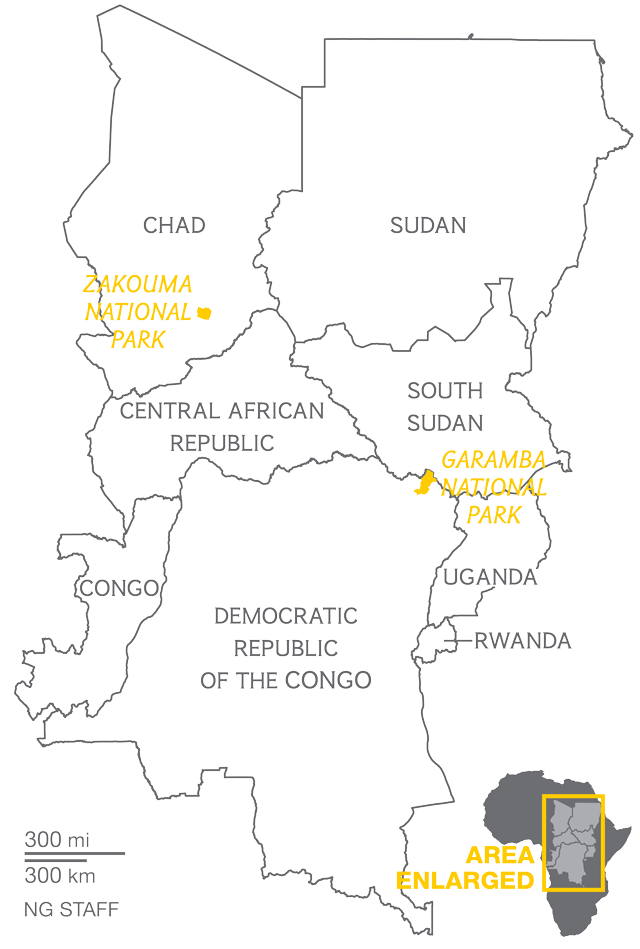
The Tanzanian officers waved him off at the airport, and he congratulated them for doing precisely what their positions as wildlife defender-conservationists mandated that they do, in holding him in suspicion  until they were certain that he was not a smuggler. Mr. Christie did manage to plant his artificial tusks on the black market in the Central African Republic at a small village along the major ivory route that smugglers are known to use, from the Garamba National Park to the Democratic Republic of Congo, to Sudan.

As he anticipated, the tusks were taken up and ferried north along the prior-identified route, from central Africa to Darfur where the civil war continues to rage. "My artificial tusks sit motionless for several weeks, a pair of tear-shaped blue dots on my computer screen, which displays a digital map of the eastern corner of Central African Republic. Then, like a bobber in a fishing hole, a nibble. They shift a few kilometres. Suddenly they move steadily north, about 15 kilometres a day along the border with South Sudan, avoiding all roads. On the 15th day after they began to move, they cross into South Sudan and from there make their way into the Kafia Kingi enclave, a disputed territory in Darfur controlled by Sudan."

Mr. Christie had heard from the grapevine, including from direct witnesses, among them Kony's Lord's Resistance Army (LRA) defectors, that terrorist chief Joseph Kony and the LRA see huge value in elephant poaching since the proceeds they realize go a long way to financing their reign of terror as they cross national borders across Africa to kill, to rape and to kidnap defenceless villagers, including among them children who are forced to join their parties, the girls as sex slaves, the boys as nascent fighters-in-training.

Kony's own hunting parties are known to have slaughtered elephants in national parks like Garamba, according to investigators that Mr. Christy interviewed. The LRA trades the ivory to the Sudanese Armed Forces and receives in exchange, weapons and ammunition. "So far, they've [his artificial tusks] travelled 965 kilometres from jungle to desert in just under two months. Their path is consistent with the route Kony's defectors tell me ivory takes on the way to the warlord's Kafia Kingi base" [in Darfur]. They're in a place 2.2 degrees Fahrenheit cooler than the ambient temperature. So perhaps they've been buried in the backyard."


Imperiled survivors: A herd migrates across Chad, once home to tens of thousands of elephants. After a surge in poaching, only about 1,000 remain. (Kate Brooks) smithsonianmag.com

"Ivory operates as a savings account for Kony" remarked Marty Regan, with the U.S. State Department's Bureau of Conflict & Stabilization Operations, in a conversation with Bryan Christy.

Labels: , , ,

Tuesday, October 07, 2014

Conserving Elephant Life

"Peter Knights heads a pressure group called Wild Aid. He has argued that only a 'demand-side' approach to elephant conservation will reduce poaching. This means working with Chinese celebrities, such as basketball star Yao Ming, to persuade China's newly empowered middle class that ivory statues made of smuggled tusks will not bring the blessings that their priests have promised them. Toward the same end, the American Buddhist Confederation has lobbied New York and other states to ban ivory sales, as Manhattan has been central to the ivory trade.
"During my 17 years in East Africa, I met many of the first Chinese entrepreneurs who had come to the continent to make their fortunes. I found them to be interested in, and open to, the world. They are also interested in wildlife and enjoy going on Safari in game parks such as the Serengeti, as much as anyone else. If a concentrated media campaign was aimed at them, utilizing Chinese media celebrities, the demand for ivory could disappear in a short period of time."
Anthropologist Geoffrey Clarfield
Elephant Herd photographed on Expedition Wild Kenya Masai Mara Tsavo Photo Safari"

Africa is in the throes of yet another continent-wide surge of elephant poaching, the illegal and brutal killing of elephants to obtain their tusks for sale to the highest bidder in a market mad for ivory. Yearly, it is estimated that roughly 25,000 of the great pachyderms are killed across Africa. In the last ten years poachers have managed to destroy 60% of Africa's elephant herds. Expert opinion has it that at the very least twenty-five elephants are killed each day.

A century earlier the elephants of the Serengeti plain were scarce in numbers. In the late 19th century they were in decline as Swahili hunters killed them in record numbers and the purpose at that time was to supply Britain and Europe with the wherewithal to produce billiard balls and piano keys. When Tanzania as Tanganyika was under the authority of Britain's East African dominion conservation and ecology were to become vital issues when the Serengeti was declared a protected area in 1940.

With the banning of big game hunting elephant herds were resuscitated. And in 1951 the Serengeti officially was declared a national park. In the early days of Tanzanian independence elephants prospered, but by the 1970s and 1980s criminal poachers were once again destroying elephant herds to sell their ivory tusks to avid buyers in the Far East where ivory sculptures were more important than living elephants.

Botswana Game Drive Digital Photo Safari

China regarded Africa as an ongoing source of raw materials, an area of prospective emigration and soon enough the Chinese were recognized as a economic and political force in sub-Saharan Africa, with over a million Chinese making their home across the continent now, and as economic prospects increase, the purchase of ivory or ivory products becomes ever more appealing. Triggering the most recent wave of elephant poaching, facilitating massive smuggling along the Indian Ocean coast.

Herds from Mali to the Red Sea suffer dreadful losses as a result of poaching. The major motivator now is the religious beliefs of the Chinese and South East Asians, including Catholic Filipinos, all of whom value smuggled ivory that become carvings of Saints and Baby Jesus in the Philippines and Islamic prayer beads in the Muslim world, Coptic Crosses in Egypt and religious sculptures in Buddhist countries. The lions share, however, goes to China.

Photo: Daniel Rosengren
© Daniel Rosengren
Daniel Rosengren

In China, 200 million Buddhists and countless millions more in Thailand and Southeast Asia, along with 75 million Catholics in the Philippines yearn for ivory in the creation of sacred statues, blessed by priests and taken to have religious power bringing good fortune. These are religious countries, and ivory is considered a sacred element. The wealth-incentive for poachers and smugglers motivates them to supply their clients with ivory from Kenya and Tanzania, located within easy access to Asian markets.

The illegal sale of two tusks of Tanzanian ivory on the black market is equivalent in value to a year's salary for people in the region. One survey from China concluded that a majority of the people polled had the idea that ivory falls out of elephants' mouths like discarded teeth, with no idea that most of the ivory they see around them transformed into talismans and statuettes and prayer beads had been smuggled into their country illegally.

Labels: , ,

 
()() Follow @rheytah Tweet