Ruminations

Blog dedicated primarily to randomly selected news items; comments reflecting personal perceptions

Sunday, October 07, 2018

Nature's Gift and Curse of Tusks to Elephants

"Tooth development has been very conserved during evolution."
"Elephants are no more different from humans than mice are, so it's quite possible that the same gene or genes are involved [in tusklessness in elephants and human toothlessness]."
Irma Thesleff, developmental biologist, University of Helsinki, Finland

"We know tusks play an important role in obtaining food, so if individuals don't have that tool, are they using the environment differently, and could those changes have consequences for other animals dependent on elephants as ecosystem engineers?"
Shane Campbell-Staton, assistant professor of ecology and evolutionary biology, University of California, Los Angeles

"They're [the tuskless elephants of Gorongosa, Mozambique] in fantastic condition, this is a very good habitat [Gorongosa national park] for them, and there's no indication they're suffering nutritionally."
Joyce Poole, scientific director, Elephant Voices research and advocacy group, Gorongosa 
Gorongosa Blog

Science has not yet unravelled the mystery of what causes tusklessness in elephants, but through slow and steady research some progress has been made deciphering the genetic program of mammalian tooth development in general, where scientists have discovered an ancient, widely-shared genetic code. Mutations linked with tooth abnormalities in mice show up as well through genetic studies of humans who have missing or malformed teeth.

Elephant tusks are overgrown upper lateral incisors -- those teeth located right beside the front teeth, before the canines. Tuskless elephants, therefore, don't have lateral incisors. Throughout Africa tuskless elephants are anomalous, found in discrete numbers. Gorongosa is an exception; there a sizeable population of tuskless elephants occur. The tusked elephants were victims of a remorseless civil war which incidentally saw elephants slaughtered for ivory. The tusklessness of those surviving elephants without ivory represented their Darwinian advantage.

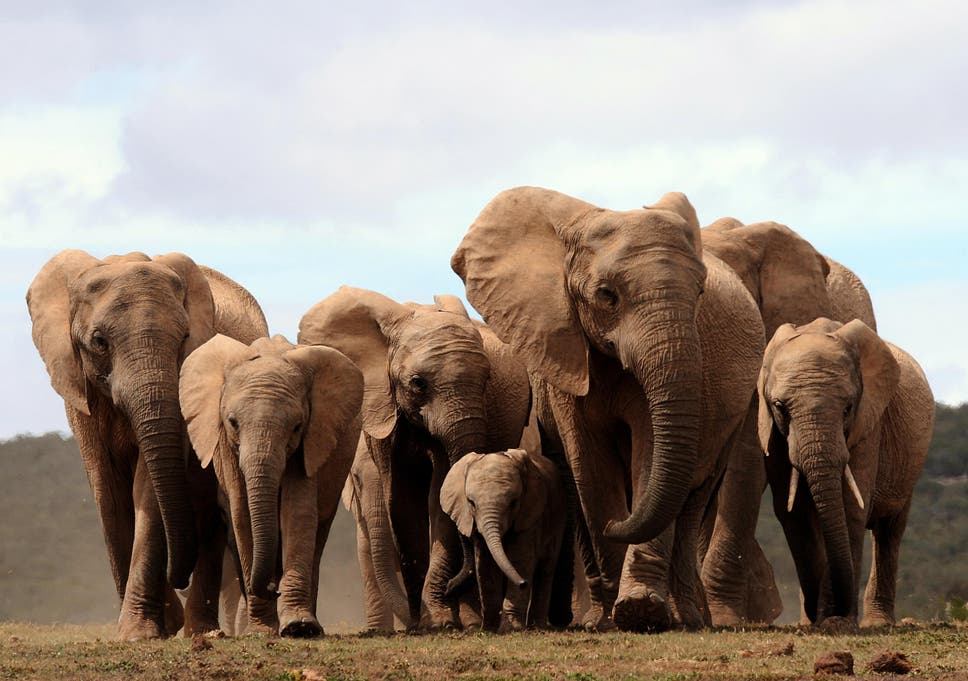
The result of that ravaging of the park's tusked elephants is that roughly a quarter of the 700 elephants living in the park are tuskless females. Among humans, missing lateral incisors represent the second most common form of tooth agenesis of which the normal rate of the condition lies between two to four percent, roughly analogous to the rate of tusklessness among African elephants.

Generally speaking, tusks are canines curving to the side and upward in wild boars and warthogs, or they droop downward in walruses, while in narwhals of the Arctic the tusk is a single overgrown canine penetrating through the left upper lip of the animal giving them their iconic 'unicorn' appearance. As multipurpose aids tusks are useful implements. Those incisors are used by elephants to dig for salts and minerals; break off branches to reach foliage; they're used to pry and peel off tree bark; to scoop a calf from a mudhole or lift a resting one to its feet.

Bull elephants contest one another by locking their tusks in combat. Those tusks can each weigh up to and over 45 kilograms, seven times the weight of an average female tusk. Those naturally-endowed implements so useful to the elephants have led to their deaths in enormous numbers by poachers setting out to harvest valuable ivory which has always been in high demand as a beautiful material used to carve detailed pieces of artful objects.

International efforts to have the trade banned have had only partial success, with the ivory so valuable that no amount of protection suffices entirely to acutely limit a billion-dollar illicit and inhumane trade. A situation that has led researchers to consider whether elephants would be better off without those mighty tusks, imagining the loss to the trade should the tuskless trait spread throughout the African population with a little bit of help from scientific human intervention.

This intriguing conundrum has the attention of Dr. Campbell-Staton and his colleagues at University of California who have been comparing tusked and tuskless elephants in Gorongosa, hoping to identify and isolate the genes involved in tusklessness, and to solve the patterns of inheritance. As for example, why it is that almost all the tuskless elephants of Africa are female.

Gorongosa Blog

Labels: , , , , ,

Tuesday, July 10, 2018

Elephant Poachers and Trunkless Cows

"Addo elephants might be the biggest success story anywhere."
"Trunklessness has helped protect them."
John Adendorff, conservation manager, Addo Elephant National Park

"Maybe tusklessness is the future."
"Our [elephant-] cows have gone a hundred years without tusks and they've done O.K."
Michael Paxton, ranger, Addo Elephant National Park, South Africa
Africa's elephant population has decreased by an estimated 110,000, down to 415,000, since 2006
Africa's elephant population has decreased by an estimated 110,000, down to 415,000, since 2006 ( Getty )

"[Tusklessness is a natural trait in elephant populations. Because poaching takes out elephants with tusks, more tuskless females survive. So a population] ends up with a higher proportion of tuskless animals who then reproduce and tend to produce tuskless offspring."
"In this day and age, with all the poaching going on, tuskless elephants are at an advantage because they are not being targeted for their tusks."
"[But, given that there is also] genetic variability with regard to tusk length and thickness, with some older males having smaller tusks, [heavy poaching of large-tusked elephants can influence the biology of future generations of elephants]. Assuming that poachers select according to tusk size, they will tend to kill older males with very large tusks, thereby taking out of the population of breeding-aged males who also happen to have very big tusks. Those males then no longer pass on their genes for large tusks."
"When these young males grow older they are killed for their tusks before they reach breeding age. In this manner, heavy poaching will select out genes for large tusks."
Joyce Poole, co-founder, non-profit Elephant Voices

As few as two percent of elephant cows in most populations of elephants in African countries, are without tusks. This places these elephants at a disadvantage in searching for food, according to some experts, since tusks are used to dig for and to manipulate vegetation for an elephant's diet. Without what can be referred to as a vital tool, tuskless elephants risk malnutrition and illness. On the other hand, they are seen as being of no value whatsoever to poachers hunting ivory for the illicit black market trade in Asia.

In the Addo Elephant National Park, the females are 90 percent to 95 percent without tusks. And when they breed, their offspring reflect similar genetic markings and are also tuskless. This is what poaching has achieved; it has stripped natural preserves of African elephants of these great majestic beasts of high intelligence of the tusked among the species, leaving behind those elephants that never grow tusks. A kind of lightning-swift-in-evolutionary-time trait that would take countless generations to achieve through natural selection.

While the prevalence of tuskless elephants is notable in Addo, the phenomenon of poaching resulting in a vastly reduced tusked population of elephants has been seen elsewhere as well in Africa. In Zambia, Tanzania, Uganda and Mozambique tuskless elephants have become the majority in some areas. In Gorongosa National Park in Mozambique the 1970s-90s civil war incited the killing of large herds of tusked elephants. Which sees as a result 53 percent of newborn females with no tusks, explains elephant biologist Joyce Poole.

Tusklessness, however, appears to be gender-linked, rarely occurring among male elephants. Almost all bull elephants have tusks in Addo; granted smaller in size than elsewhere but tusks nonetheless. On the world ivory market, a pair of tusks weighing 49 kilograms each from a 50-year-old bull can bring a profit of $100,000. The trade, not only in elephant tusks but rhinoceros horn for Eastern medicinal purposes, is viciously pernicious, killing countless animals, bringing species to the brink of endangerment of extinction.

The Addo elephant population was almost wiped out in the early 1900s, sealing the reputation of Major P.J. Pretorius as the "great white hunter" of the Eastern Cape. A mere 11 elephants were left, within the group a remaining eight cows. The present hundreds of elephants thriving in the Addo are all descendants of those eight cows, among whom four to five had been without tusks. Dr. Poole's theory has its challengers -- Anna M. Whitehouse, elephant expert among them.
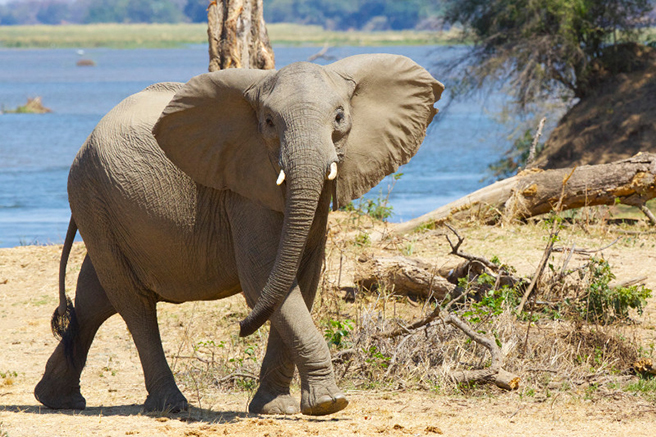
Elephant with small tusks

Decades of poaching and overhunting of large tusked elephants may be leading to generations of elephants with smaller tusks—or no tusks at all    African Wildlife Federation


Ms. Whitehouse speaks of the increase of tuskless elephants after 1931 when the park was founded, and that by the early 2000s, 98 percent represented tuskless cows descended from the original 11. The tusklessness  has resulted, according to Ms. Whitehouse. from inbreeding, known as "genetic drift". Addo park has never, as it happens, since its opening, had to cope with poaching, not one instance of poaching has been attempted. Poachers simply are disinterested in elephants lacking tusks.

Aside from which the park employs 80 rangers, armed, with military training in weaponry use, a small air wing, and high-tech infrared and motion-detecting sensors installed throughout the park. Watering holes and game trails, the likeliest place for would-be poachers to come across animals are regularly staked out by the rangers, camping in the thickets overnight to interrupt any possible incidents of poaching-in-progress should they ever occur.

Graham Kerley, from the Nelson Mandela University in South Africa and an expert on the Addo elephants, speaks of yet another factor in safeguarding the elephants at Addo. The landscape's vegetation makes ingress into the area close to impossible with the presence of impenetrable vegetation; what is known as valley thicket, spiky and thorned. The female elephants double every 13 years, standing now at over 600 individuals.
"As the greatest living targets for poachers, great tuskers are extremely rare in Africa today. Big elephants carry genes for survival and are preferred by females, living proof that they have been successful to survive so long."
"[If left alone, these big elephants, which typically bear the larger tusks, normally father the majority of calves but constant poaching and overhunting have depleted large elephants at the apex of their reproductive power, leaving an observable impact on size and weight of elephant tusks]."
"Unless the relentless pressure against bearing ivory is curbed, the African elephant may easily be reduced both in the weight of ivory and in its overall fitness to survive. There is evidence that this has happened already, with mean tusk weights lower today than in Victorian times."
Dr. Iain Douglas-Hamilton, founder and CEO, Save The Elephants
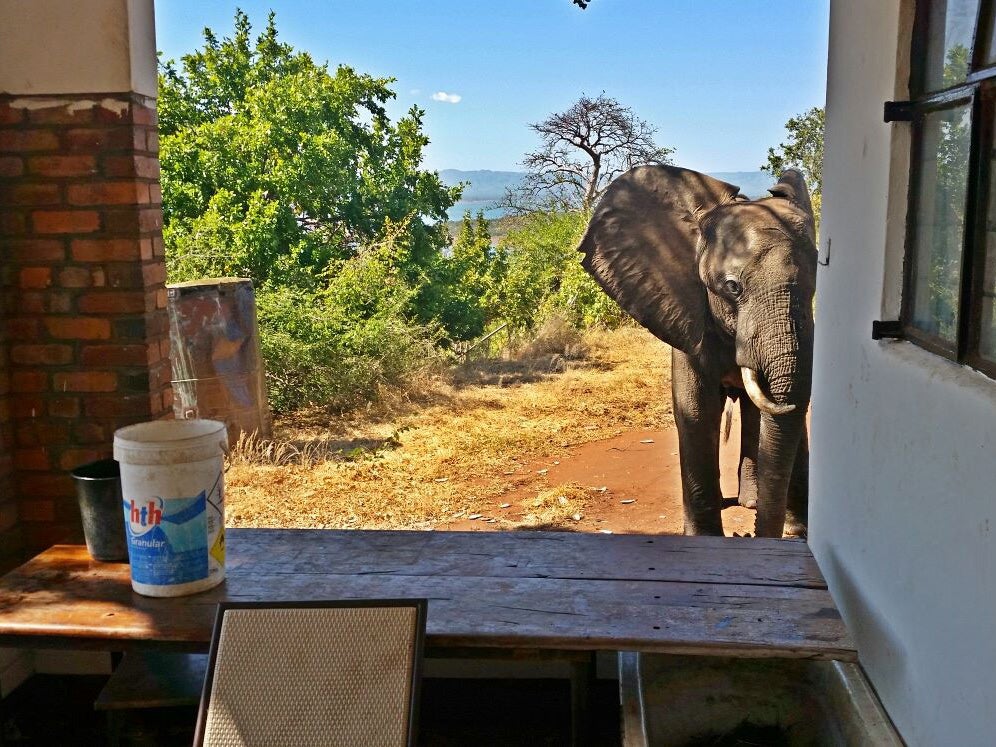
Ben the elephant arrives looking for help
Staff and guests at the Bumi Hills Foundation in Zimbabwe were surprised to see a wounded bull elephant seeming seeking help outside their window.  Bumi Hills Foundation

Labels: , , , ,

 
()() Follow @rheytah Tweet