Ruminations

Blog dedicated primarily to randomly selected news items; comments reflecting personal perceptions

Friday, June 22, 2018

Destiny's Child

"I didn't see how we were going to get out of it alive [1996 Mount Everest blizzard]. The cold was so painful, I didn't think I could endure it anymore. I just curled up in a ball and hoped death would come quickly."
"You’ve gone so far up the mountain, you’ve come so far from home, and you spent six months preparing for this goal … . There’s no way you’re going to turn around unless things are really going south."
"I thought, 'Well, old girl, it's been a good ride. No regrets'."
Charlotte Fox, American mountaineer

"Charlotte had survived so much up high."
"It was stunning and profoundly sad that she died that evening of May 24 in a household accident."
Alison Osius, Rock and Ice magazine

"Finding her body was a very shocking and difficult thing. There was something profound about [the experience of] Fox's death."
"She gave me a gift when I arrived [evening before her death]. She recently had a birthday and she told me, 'I'm happy to be 61'."
"Those words, ‘I’m happy,’ might have gone right in and out of my ears if this hadn’t happened. … To be the last person with her, with my hands on her heart, and to remember those last words she said to me, I have to look at it as a privilege rather than a horror. … I got to send her off, with love."
Kim Reynolds, friend

Charlotte Fox, a survivor of the 1996 Mount Everest expedition, died last week after an apparent fall.
Charlotte Fox, a survivor of the 1996 Mount Everest expedition, died last week after an apparent fall.  (AP)

Some people are driven to prove themselves to themselves; that they have the endurance, stamina, strength and agility let alone the determination to forge ahead where most others would hesitate and then decide that the odds were not in their favour of survival. She was one of those rare creatures who did forge on, did reach the  impossibly-heighted summits of the world's tallest, most environmentally  hostile mountain ranges. The imposing heights, the mind-boggling geological features, the constant threats posed by frighteningly inclement weather did not appear to faze her.

This women whose search for challenge and adventure seemed inexhaustible appeared not to permit age to slow her down, continuing to climb and trek two 8,000-meter mountains in the two years preceding her death. This was a woman who broke records, as the first female summitteer to climb three mountains "at altitudes of 8,000 meters or higher" following her success in summitting Mount Everest, and despite the dreadful toll that summit had taken in eight lives forfeited, while she herself endured such misery that she felt she would welcome death.

On Everest her supplemental oxygen had run out at a height where hypoxia was a constant threat, and at a time when wind, cold and snow imprisoned her in her tent post-summit, with feet frostbitten, unable to do anything to preserve body heat other than assume a fetal position alongside her climbing companions, awaiting their miserable end. Jon Krakauer's account of that dreadful night and its death toll repeated her memorable account of circumstances that had overtaken climbing groups competing for their opportunity to summit, encountering a jam at the critical Hillary Step.
In this photo taken on May 17, 2018, mountaineers make their way to the summit of  Mount Everest, as they ascend on the south face from Nepal. PHUNJO LAMA/AFP/Getty Images
Delays, confusion, crowding, all contributed to a late descent just as a dreadful howling storm descended on the mountain and visibility was eliminated as climbers and their guides found themselves in an impossible situation, anxious to find their way down to their final camp before that day's ascent to the top. "Into Thin Air" recounted a tense and desperate time of exhaustion, mental depletion, determination to survive, and heroic self-sacrifice on the part of one climber, Anatoli Boukreev, to rescue as many desperate people descending as the last of his strength could manage.

Charlotte Fox's childhood was in North Carolina; she was fascinated by high altitudes and for thirty years was a ski patroller in Colorado. She was the first American women to climb three mountains at altitudes of about 26,246 feet (8,000 meters) or higher, the first to summit Pakistan's 8,000-meter Gasherbrum II which she felt was her greatest accomplishment, and then in 1995 summitted Cho Oyu in the Himalaya. At age 59 her last climb was 7,129-meter Baruntse.

In 1993 her boyfriend died in an avalanche, and she lost her husband to a paragliding accident in 2004. She was no stranger to the tragedies that visit those rare souls who push limits that would make others blanch with horror. Death had touched her intimately when it claimed those dearest to her as they challenged nature's geological and atmospheric boundaries and their own instinct for self-preservation, failing to survive the threats their own natures demanded of them.

In the end it was a pedestrian household accident that claimed her life. A woman who had thought nothing of challenging the geological giants that nature had designed, survived each and every demanding physical effort and the impediments that chance offered to stop her from success in her bold ventures, but she was incapable in the final analysis of forestalling death that came to visit as she descended a steep wood staircase at her own home when, it would seem, she stumbled and fell at age 61.

Life 'went south' for Charlotte Fox on May 24, 2018, at her four-and-a-half-story home perched on a steep mountainside overlooking Telluride, Colorado.
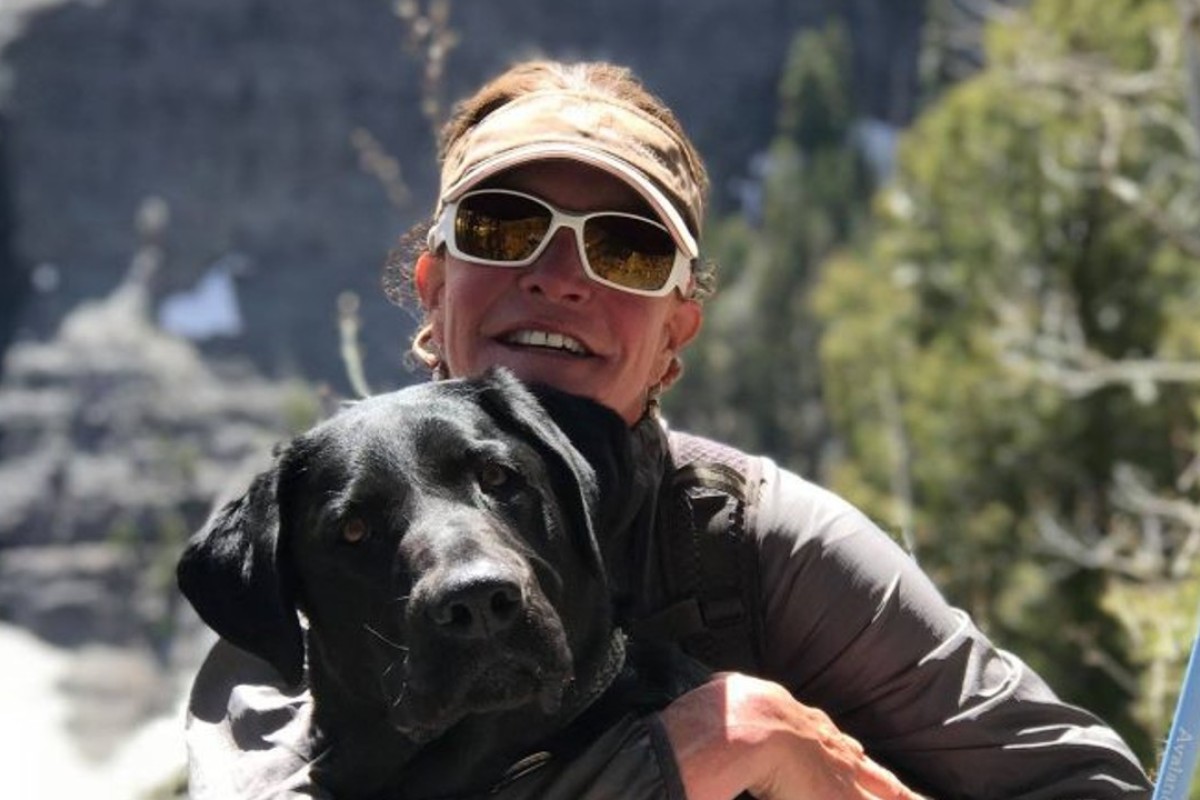
Charlotte Fox and her dog Gus. Fox has died after falling at home. Photo: Amy Denicke
Photo: Amy Denicke   Charlotte Fox and her dog Gus

Labels: , , ,

Friday, April 25, 2014

Everest avalanche: Climbers descend amid uncertainty 

BBC News online -- 25 April 2014
This April 24, 2014 photo released by Adrian Ballinger, founder and head guide of Alpenglow Expeditions, shows a meeting between Nepalese government delegation and Sherpa mountain guides near Everest base camp Sherpa mountain guides have already held some talks with the Nepalese government
About half the teams at Everest base camp are descending amid uncertainty over this year's climbing season, after 16 guides were killed in an avalanche.

A row over local guides' share of revenue from foreign climbers erupted after last week's deadly accident, prompting some to threaten a boycott.
Sherpas also want better rescue and treatment facilities for guides.

If others descend, some fear it could effectively end plans to climb the world's highest mountain this year.

Ang Tshering Sherpa, the president of the Nepal Mountaineering Association (NMA), told BBC Nepali's Surendra Phuyal that was a distinct possibility if the majority of climbers decided to abandon climbing.

But Madhusudan Burlakoti, a tourism ministry official, hoped that some teams might still climb. Sherpas have been in talks over these issues with the Nepalese government.
(FILES) In this photograph taken on May 23, 2013, unidentified mountaineers look out from the summit of Mount Everest. Everest's climbing season lasts three months every year
 
More than 300 foreigners were preparing to climb Everest this year, but the tense aftermath of the avalanche that killed 13 Sherpas and left 3 missing presumed dead dashed hopes and left many climbers disturbed and shocked, our correspondent reports.

Several expeditions appear to be cancelling their climbs. Alan Arnette, who runs a climbing blog , describes Everest as "an airport with the terminal open but the runways closed".

Monica Piris from Alpenglow Expeditions says on their website that attempting to climb Everest now would be "unwise and unsafe".

The Sherpa "need time to mourn their losses and their families want them at home", while "the ambience at base camp is becoming increasingly tense", she writes.

Saray Khumalo from the Ubuntu Everest expedition posts on their Facebook page that it was not meant to be this year, "but I have definitely enjoyed the journey till now", she says.

Meanwhile, Irish Seven Summits tweeted early on Friday: "Many groups have now left but we remain at Base Camp and are staying positive amidst the tense atmosphere....Discussions are ongoing with the expedition leader so to cover all options available to them."

About 50 expedition teams had been at the base camp, with 31 intended for Everest.
Some of the teams have chosen to go on trekking expeditions instead, while others are still waiting and watching, BBC Nepali's Navin Singh Khadka reports.

The government has assured teams that their climbing permits will remain valid for the next five years.

Last Friday's avalanche was the single deadliest accident in modern mountaineering on the world's highest peak.
It struck an area just above Everest base camp at 5,800m (19,000ft).

Sherpas can earn up to $8,000 (£4,800) in the three-month Everest climbing season - more than 10 times the average wage in Nepal, which remains one of Asia's poorest nations.

But BBC South Asia correspondent Andrew North says that does not look so good when the government is earning millions of dollars each year in fees for climbing permits. Some guiding companies charge up to $60,000 (£36,000) per person.

The guides who lost their lives had climbed up the slope early in the morning to fix ropes for climbers and prepare the route.

The avalanche struck a passage called the Khumbu Icefall, which is riddled with crevasses and ice boulders that can break free without warning.

Although relatively low on the mountain, it is one of its most dangerous points - but there are no safer paths along the famous South Col route first scaled by Sir Edmund Hillary and Tenzing Norgay in 1953.

Sherpas often make 20-25 round trips to carry kit and supplies to advanced camps, exposing themselves to greater risk.

Everest has been scaled by more than 3,000 climbers since 1953.
Map of Nepal showing Mount Everest


Labels: , ,

Friday, April 18, 2014

Everest avalanche kills at least 12 Sherpa guides

BBC News online -- 18 April 2014
Surendra Phuyal in Kathmandu says climbers gathered ahead of May's peak climbing season
At least 12 local guides have been killed after an avalanche on the slopes of Mount Everest, Nepali officials say. 

The avalanche struck around 06:45 local time (01:00 GMT) in an area known as the "popcorn field", just above Everest base camp at 5,800m (19,000ft).

A spokesman for Nepal's tourism ministry told the BBC some missing climbers had been rescued, but more are still missing.
It is thought to be the deadliest climbing tragedy on the mountain.

The Sherpa guides had climbed up the slope early in the morning to fix ropes for climbers and prepare the route for mountaineers when the avalanche hit, officials are quoted as saying by the Associated Press news agency.

In this May 19, 2009 file photograph, unidentified mountaineers walk past the Hillary Step while pushing for the summit of Mount Everest as they climb the south face from Nepal Sherpas often prepare the route for the mountaineers to follow
 
The identities of the dead and missing have not been officially disclosed, tourism ministry spokesman, Mohan Krishna Sapkota, told the BBC.

He said a search and rescue operation was now under way and that three helicopters have been sent to the area.
Several injured climbers have been brought to the base camp.

Correspondents say the accident is a reminder of the risks Sherpa guides undertake in preparing the mountain for climbers. An equal number of guides ascend the slope to help foreign mountaineers, often preparing the way by fixing ropes and setting up camp.

This accident comes during the peak climbing months of April and May as hundreds of climbers converged at base camp in the hope of scaling the summit.

In 1996 eight climbers died during a storm and the disaster eventually formed the basis of the best-selling book Into Thin Air.

More than 3,000 people have scaled Mount Everest since it was first conquered by Edmund Hillary and Tenzing Norgay in 1953, but many have died in the attempt too.

Straddling Nepal and China, the world's highest mountain has an altitude of 8,848m (29,029ft).

Labels: ,

 
()() Follow @rheytah Tweet