Ruminations

Blog dedicated primarily to randomly selected news items; comments reflecting personal perceptions

Tuesday, July 03, 2018

Cannabis: Harm Reduction and Hyperbole

"The tricky part is that part of harm reduction will continue to be that you shouldn't be using this product."
"By being more honest and open that cannabis can be used responsibly it will add credibility to the messages that say, 'but you shouldn't really use it under these settings, and one of those is if you're a young person."
"[There is evidence supporting each of the proposed health warnings by Health Canada] and none of them -- except for the warnings around pregnancy and breastfeeding -- actually say people shouldn't use cannabis. That's harm reduction."
"[Most people use pot responsibly] but there is a reasonable number who can have problems controlling their use, and signs of daily use can be an indication of that."

David Hammond, professor, school of public health, University of Waterloo, Ontario

"[People tune out sensationalist scare tactics and condescending messages; abstinence-only propaganda -- and 'Just Say No' campaigns fail to resonate with youth...]"
"If they do find themselves struggling with use, they need supports they can use rather than judgement, or, worse, criminalization."
Heather D'Alessio, spokeswoman, Canadian Students for Sensible Drug Policy
Health Canada wants all weed to be labelled with health risks. Photos via Health Canada

The group, Canadian Students for Sensible Drug Policy has undertaken an initiative of their own, to produce a "Sensible Cannabis Toolkit" information package which they have based on what they feel is realistic evidence-based information to help guide young adults in their conversations with adults when discussing the use of weed. Most pot users, they point out, do not use pot as a 'gateway' to transition to the use of harder drugs.

They also take issue with the use-associated mental health problems in the heavy use of cannabis concluding that there is an association with cognitive impairment and other mental health problems. "Any strong conclusions around causality" -- which came first? -- remain uncertain, according to their informative website.

Recently, a review of available literature associated with pot use led by researchers at the B.C. Centre on Substance Use discovered that what is believed to be a link to a lower IQ in later life among adolescent-use of high frequency, is belied by the findings of more recent studies concluding no association after controlling for social factors like background poverty and the neighbourhood that users grew up in.

Early efforts at Colorado public health after the state's 2014 legalization saw some of their informative harm-reduction efforts fall flat and face criticism by pot advocates for their condescending undertones. Leading Professor Hammond to the view that pot advertisements must reach beyond "use or not-use", to include information more specific such as that smoking adds toxicity in excess since THC levels in the pot currently in circulation are much higher than what prevailed during the Boomer era.
Who uses cannabis?

Health Canada is preparing to roll out a $5.1-million marijuana education tour to travel across the country in an effort to prepare the public before the cannabis legalization comes into effect in Canada by the target date of October 17. Plans are underway to set up exhibits at local events such as fairs, festivals and Canadian Hockey League arenas from July in the Maritimes and Northwest Territories before moving on to other provinces and territories.

Exhibits will be complete with climbing walls, interactive graffiti walls and similar such infrastructure in an effort to encourage people to to discover activities "that can give them a natural high, rather than using cannabis". "Ambassadors" will be tasked to "engage visitors in conversations about the health and safety facts on cannabis", to staff the exhibits.

A list of proposed pot packaging warning labels is being released by Health Canada. That cannabis smoking is harmful; that teens are at greater risk of harms; that people should not drive stoned; that women should not use if pregnant or breastfeeding (new links of pot exposure in the womb or through breast milk have been identified with stillbirth, preterm birth, low birth weight and poorer mental developing in children), are all driving the government's effort to ensure people are adequately informed of risks involved in indulging in cannabis.

Critics,  however, have highlighted one of the warnings for special attention; the warning that "up to one in two people who use cannabis daily will become addicted", has been seized upon as extravagantly unwarranted. Dr. Hammand and colleagues published a paper last year in the Canadian Journal of Public Health outlining their findings that a "very small proportion of Canadians report using cannabis to a degree that is problematic", with only two percent of the sample of respondents reporting the use of pot in the past three months seen to be at high risk of developing health or other problems.

Cannabis consumption through the decades

Labels: , , , , , ,

Friday, June 22, 2018

Destiny's Child

"I didn't see how we were going to get out of it alive [1996 Mount Everest blizzard]. The cold was so painful, I didn't think I could endure it anymore. I just curled up in a ball and hoped death would come quickly."
"You’ve gone so far up the mountain, you’ve come so far from home, and you spent six months preparing for this goal … . There’s no way you’re going to turn around unless things are really going south."
"I thought, 'Well, old girl, it's been a good ride. No regrets'."
Charlotte Fox, American mountaineer

"Charlotte had survived so much up high."
"It was stunning and profoundly sad that she died that evening of May 24 in a household accident."
Alison Osius, Rock and Ice magazine

"Finding her body was a very shocking and difficult thing. There was something profound about [the experience of] Fox's death."
"She gave me a gift when I arrived [evening before her death]. She recently had a birthday and she told me, 'I'm happy to be 61'."
"Those words, ‘I’m happy,’ might have gone right in and out of my ears if this hadn’t happened. … To be the last person with her, with my hands on her heart, and to remember those last words she said to me, I have to look at it as a privilege rather than a horror. … I got to send her off, with love."
Kim Reynolds, friend
Charlotte Fox, a survivor of the 1996 Mount Everest expedition, died last week after an apparent fall.
Charlotte Fox, a survivor of the 1996 Mount Everest expedition, died last week after an apparent fall.  (AP)

Some people are driven to prove themselves to themselves; that they have the endurance, stamina, strength and agility let alone the determination to forge ahead where most others would hesitate and then decide that the odds were not in their favour of survival. She was one of those rare creatures who did forge on, did reach the  impossibly-heighted summits of the world's tallest, most environmentally  hostile mountain ranges. The imposing heights, the mind-boggling geological features, the constant threats posed by frighteningly inclement weather did not appear to faze her.

This women whose search for challenge and adventure seemed inexhaustible appeared not to permit age to slow her down, continuing to climb and trek two 8,000-meter mountains in the two years preceding her death. This was a woman who broke records, as the first female summitteer to climb three mountains "at altitudes of 8,000 meters or higher" following her success in summitting Mount Everest, and despite the dreadful toll that summit had taken in eight lives forfeited, while she herself endured such misery that she felt she would welcome death.

On Everest her supplemental oxygen had run out at a height where hypoxia was a constant threat, and at a time when wind, cold and snow imprisoned her in her tent post-summit, with feet frostbitten, unable to do anything to preserve body heat other than assume a fetal position alongside her climbing companions, awaiting their miserable end. Jon Krakauer's account of that dreadful night and its death toll repeated her memorable account of circumstances that had overtaken climbing groups competing for their opportunity to summit, encountering a jam at the critical Hillary Step.
In this photo taken on May 17, 2018, mountaineers make their way to the summit of  Mount Everest, as they ascend on the south face from Nepal. PHUNJO LAMA/AFP/Getty Images
Delays, confusion, crowding, all contributed to a late descent just as a dreadful howling storm descended on the mountain and visibility was eliminated as climbers and their guides found themselves in an impossible situation, anxious to find their way down to their final camp before that day's ascent to the top. "Into Thin Air" recounted a tense and desperate time of exhaustion, mental depletion, determination to survive, and heroic self-sacrifice on the part of one climber, Anatoli Boukreev, to rescue as many desperate people descending as the last of his strength could manage.

Charlotte Fox's childhood was in North Carolina; she was fascinated by high altitudes and for thirty years was a ski patroller in Colorado. She was the first American women to climb three mountains at altitudes of about 26,246 feet (8,000 meters) or higher, the first to summit Pakistan's 8,000-meter Gasherbrum II which she felt was her greatest accomplishment, and then in 1995 summitted Cho Oyu in the Himalaya. At age 59 her last climb was 7,129-meter Baruntse.

In 1993 her boyfriend died in an avalanche, and she lost her husband to a paragliding accident in 2004. She was no stranger to the tragedies that visit those rare souls who push limits that would make others blanch with horror. Death had touched her intimately when it claimed those dearest to her as they challenged nature's geological and atmospheric boundaries and their own instinct for self-preservation, failing to survive the threats their own natures demanded of them.

In the end it was a pedestrian household accident that claimed her life. A woman who had thought nothing of challenging the geological giants that nature had designed, survived each and every demanding physical effort and the impediments that chance offered to stop her from success in her bold ventures, but she was incapable in the final analysis of forestalling death that came to visit as she descended a steep wood staircase at her own home when, it would seem, she stumbled and fell at age 61.

Life 'went south' for Charlotte Fox on May 24, 2018, at her four-and-a-half-story home perched on a steep mountainside overlooking Telluride, Colorado.

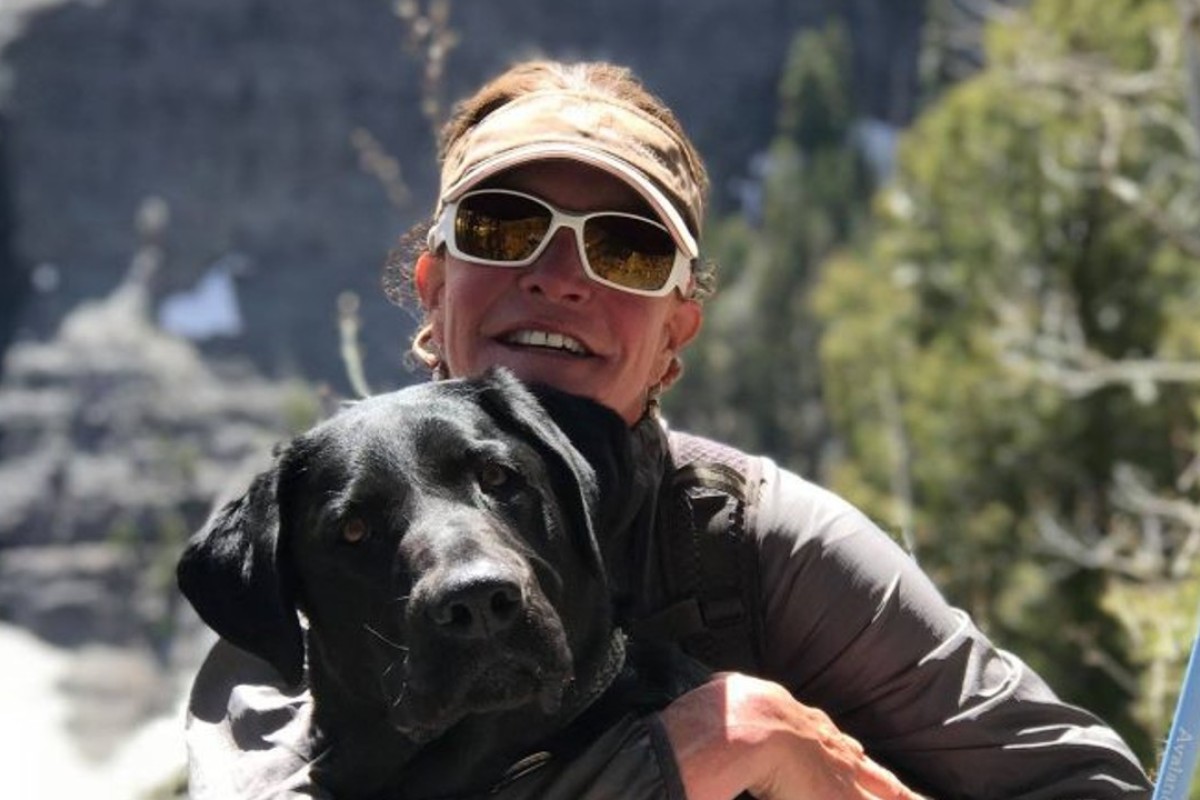
Charlotte Fox and her dog Gus. Fox has died after falling at home. Photo: Amy Denicke
Photo: Amy Denicke   Charlotte Fox and her dog Gus

Labels: , , ,

 
()() Follow @rheytah Tweet