Ruminations

Blog dedicated primarily to randomly selected news items; comments reflecting personal perceptions

Saturday, September 19, 2020

The Case for COVID Mask-Wearing

"SARS-CoV-2 has the protean ability to cause myriad clinical manifestations, ranging from a complete lack of symptoms to pneumonia, acute respiratory distress syndrome, and death. Recent virologic, epidemiologic, and ecologic data have led to the hypothesis that facial masking may also reduce the severity of disease among people who do become infected. This possibility is consistent with a long-standing theory of viral pathogenesis, which holds that the severity of disease is proportionate to the viral inoculum received. Since 1938, researchers have explored, primarily in animal models, the concept of the lethal dose of a virus — or the dose at which 50% of exposed hosts die (LD50). With viral infections in which host immune responses play a predominant role in viral pathogenesis, such as SARS-CoV-2, high doses of viral inoculum can overwhelm and dysregulate innate immune defenses, increasing the severity of disease. Indeed, down-regulating immunopathology is one mechanism by which dexamethasone improves outcomes in severe Covid-19 infection. As proof of concept of viral inocula influencing disease manifestations, higher doses of administered virus led to more severe manifestations of Covid-19 in a Syrian hamster model of SARS-CoV-2 infection."
Monica Gandhi, M.D., M.P.H., George W. Rutherford, M.D. The New England Journal of Medicine
Law enforcement trainees wearing protective face masks as they take notes while being trained on how to handle civil disputes during class at San Bernardino County Sheriff’s Frank Bland Regional Training Center in San Bernardino on Wednesday, July 29, 2020. (Photo by Watchara Phomicinda, The Press-Enterprise/SCNG)

"If facial coverings decrease the amount of virus a person is infected with, they can provide a way of tilting towards infections that result in minimal or no symptoms, yet induce some degree of immunity."
Dr. Amesh Adalja, infectious disease expert, senior scholar, Johns Hopkins Center for Health Security, Baltimore
 
"If this theory bears out, population-wide masking, with any type of mask that increases acceptability and adherence, might contribute to increasing the proportion of SARS-CoV-2 infections that are asymptomatic."
Dr. Monica Gandhi, Dr. George Rutherford, University of California, San Francisco
 
"Covering mouths and noses with filtering materials serves 2 purposes: personal protection against inhalation of harmful pathogens and particulates, and source control to prevent exposing others to infectious microbes that may be expelled during respiration. When asked to wear face coverings, many people think in terms of personal protection. But face coverings are also widely and routinely used as source control. For instance, if given the choice between having surgery performed by a team not wearing some covering over their mouths and noses vs a team that does, almost all patients would reject the former. This option seems absurd because it is known that use of face coverings under these circumstances reduces the risk of surgical site infection caused by microbes generated during the surgical team’s conversations or breathing. Face coverings do the same in blocking transmission of SARS-CoV-2."
John T.Brooks, M.D., Jay C.Butler, M.D., Robert R.Redfield, M.D. Jama 
Masks -- the public is informed by authorities urging the use of facial coverings in this time of SARS-
CoV-2 disease roiling the world order -- are essential to protect others in the event you harbour the virus and have not displayed symptoms of COVID-19. There is also, health experts inform us, a good measure of protection for the mask-wearer from contracting the virus. On the other hand, a recent paper reflecting research published in The New England Journal of Medicine posits that mask wearing may have another residual and very important outcome.

Within communities where infection is widespread and many have yet to be diagnosed while shedding infectious droplets, mask-wearing which cannot entirely prevent some degree of infection penetration, by allowing a small amount of the virus to infect in essence acts as a vaccine. Allowing one's immune system to respond to trace amounts of infection without becoming overwhelmed by a large dose of infection. This is called variolation and its effect on a broad scale is to produce a kind of community 'herd effect'.

Masks, by limiting the amount of viral particles reaching tissues of those newly infected are then serving to inoculate more than massively infecting. In virology, the authors of this new paper explain, there is a tradition called the "LD-50" of a virus; the amount of an infection scaled to body mass that will produce great harm to those exposed to a full load. Viral disease toxicity may be dependent on "dose"; the lesser the dose the lesser the damage, enhancing opportunity for the body's immune system to adapt and fight the intruder.

Verification through research and observation appears as indirect evidence that SARS-CoV-2 doses if moderated through the preventive use of masks could produce a far less harmful outcome. A Japanese-led study that found "higher doses of administered virus led to more severe manifestations of COVID-19 in a Syrian hamster model of SARS-CoV-2 infection", appears to bear out the two authors' contentions.
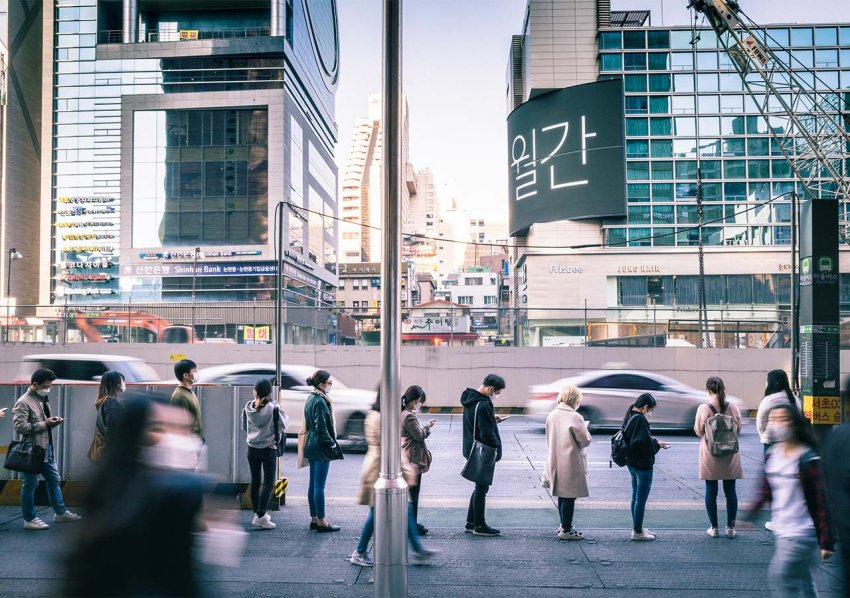
On a busy street in a city in South Korea, people stand in line, several feet apart, with masks on, going about their daily lives.
Mask-wearing is now the norm in South Korea.Photo: Wonseok Jang 

Countries practising high-masking compliance are seen to have considerably lower rates of severe COVID-19 and consequent death numbers while resulting in fewer hospital admissions. The authors suggest that since being taken up as a first line of defence, (social isolation and mask-wearing), the result has been a mass protocol of "mask variolation". The original method of vaccination where fluids from smallpox patients were collected, to expose the non-infected to harmless amounts of diseased matter to induce mild infection providing immunity; hence variolation.

Health authorities early in the first wave of COVID believed that non-symptomatic people would not significantly shed as an infection source, until experience proved otherwise and then there arose an urgency to cope with the reality that asymptomatic carriers of the virus were indeed shedding infectious particles to the same degree as those infected with the virus who exhibited a wide range of symptoms. 

The message that the latest published research is delivering is that the eventual agreement that mask-wearing represented an integral approach to prevention ended up making far more of an impression in avoidance than might have been anticipated. The wearing of masks has proven successful in shielding the wearer from heavy infection doses, while the small amount of viral infection that did penetrate the shields has proven to have far-reaching consequences in making the wider public less susceptible to serious infections requiring hospitalization, while serving to reduce the death rate.
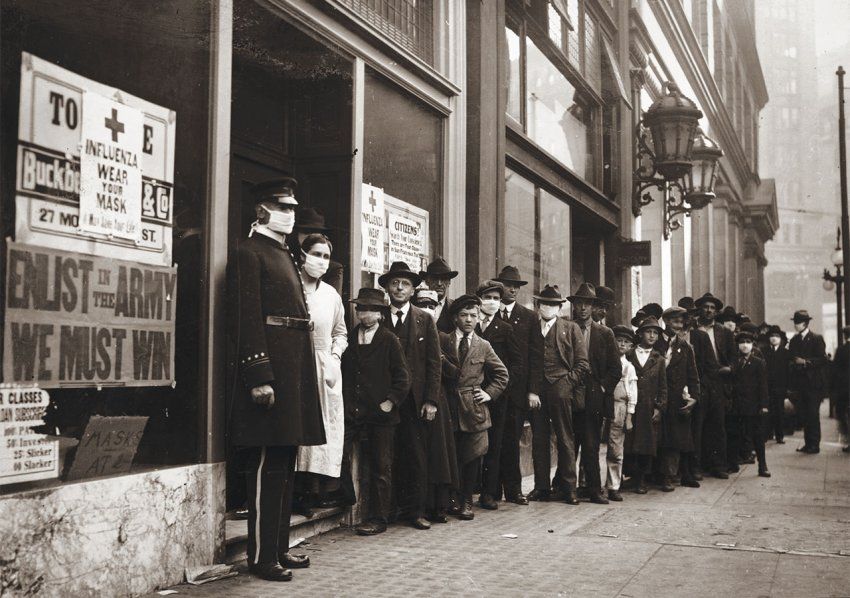
 
Line of people waiting for flu masks at 30 Montgomery Street, San Francisco, 1918. The man in uniform and the nurse in the doorway are wearing masks, as are a few of those in line. A sign on the window bearing the Red Cross logo reads: “Influenza. Wear Your Mask.” A sign underneath reads: “Enlist in the Army. We Must Win.”
A line of people on Montgomery Street in San Francisco waits to get masks during the 1918 flu pandemic. Failure to wear a mask was punishable by imprisonment or a fine. Photo courtesy of the California History Room, California State Library, Sacramento.


Labels: , , , , ,

Friday, June 12, 2020

Physical Distancing First, Face Shields Next

"We label the evidence about eye protection as low certainty, meaning any effects are suggestions."
[It's] not yet clear the relative contribution of eyes, versus nose vs. mouth."
Derek Chu, clinician scientist, McMaster University

"If you happen to encounter the respiratory droplet right next to you, and it lands in your eye, that is a potential risk."
"If we want to protect, for example, the elderly themselves then covering the eyes is an important concept."
Dr.Theresa Tam, Chief Public Health Officer, Canada

"[There's a role for face shields if masks aren't available], but that's something that needs to be discussed on where and when [shields] can be best used."
"I should remind you that masks alone will not protect you. Face shields alone will not protect you from infection."
"[All measures, including physical distancing, remain] really paramount."
Dr.Maria Van Kerkhove, head, Emerging Diseases and Zoonosis Unit, World Health Organization
Students wear face shields and gloves at the “Faik Konica” primary school in Pristina , Kosovo, on June 9, 2020. Schools in Kosovo are gradually reopening after almost three months of restrictions due to the COVID-19 pandemic. ARMEND NIMANI/AFP via Getty Images
"They're far more comfortable to wear, there's no breathing issues with them, they're not uncomfortable on hot summer days."
"They definitely cover the eyes, the nose and the mouth. You're less likely to touch your face, because you've got a shield on."
"The other beautiful aspect of them is that there are no issues with verbal and non-verbal communication. You can see people's faces right through them. The psychological and social benefits are significant."
"I'm not here to tell people what to do. I'm here to help people make informed decisions for themselves. But I think we should at least be open-minded to it."
Dr.Isaac Bogoch, Infectious Diseases specialist, University Health Network,Torontoface mask and face shield table
University of Iowa researchers produced a study, whose conclusion is that wearing face shields is superior in many ways to wearing face masks to ward off the potential of contamination by the hugely infectious novel coronavirus. Writing in JAMA, the Iowa team suggested that face shields, readily put together with materials sourced from craft and office supply shops could help contain COVID-19 infections.

While simple face masks, layered to filter out most of the tiny virus-sized particles hovering in the air when people cough, sneeze, talk or breathe, face shields, according to the Iowa researchers, may represent a superior option. Soap and water is all that is needed to cleanse shields, the shields can be "reused indefinitely". They wear comfortably, block mouths, noses and eyes from being entered by the virus and "reduce the potential for autoinoculation".

Face shields, visors or goggles may reduce to a significant degree the opportunities for viral infections or transmission, from 15 percent with no eye covering, to six percent, according to another review, published in The Lancet.  This was a review commissioned by the World Health Organization with an eye to synthesizing all available evidence on physical distancing, mask-wearing and eye protection.

Most studies were initiated to report on SARS or MERS and not SARS-CoV-2, involving for the most part, health-care settings, leaving the study authors to admit they cannot be "overly certain in the precise quantitative estimates of effects". For the general public, physical distancing of over one metre is "highly effective", face masks protect against infection and provide eye protection; "typically under-considered" they can confer added benefits, even while nothing gives complete protection.

There is evidence the virus is capable of entering the body through mucous membranes, with the inclusion of the mucous membranes on the surface of the eye and inner eye lids. Conjunctivitis (pink eye) has been reported present as a sign of COVID-19. 38 people with COVID-19 were presented in a brief report out of Hubei province in China, where "Ocular abnormalities" consistent with conjunctivitis was found in a third of the patients.

"Although there is a low prevalence of SARS-CoV-2 in tears, it is possible to transmit the virus via the eyes", the researchers wrote in JAMA Ophthalmology. No randomized trial of face shields versus cloth masks have been undertaken, but one study suggested face shields can protect people from inhaling 96 percent of droplets laden with flu following a cough, standing within 18 inches of the cougher.

At the recommended six-feet of physical distancing, the shield blocked inhaled virus by 92 percent, "similar to distancing alone and reinforces the importance of physical distancing in preventing viral respiratory infections."
Face shield medical workers
Emergency services nurses at Harborview Medical Center in Seattle demonstrate how they wear medical face shields.
Ted S. Warren/AP


Labels: , , , ,

Wednesday, May 20, 2020

The Masking Transformation

"There are really two dimensions here."
"[As economies reopen] there may be some false sense of security that because things are reopening things are getting better -- 'I don't need to wear this mask'." 
"It's kind of taboo when people are not in masks in public spaces like grocery stores [in Maine]. I don't know if it's shaming. It could just be anxiety that this person isn't wearing a mask -- 'what's that telling me about their habits and how safe they've been, and could they potentially be a carrier'?"
"We speculate that, depending on the norm, masks could signal competence -- that this person is intelligent, is following public health."
"But it could also promote more of a coldness dimension, because the mouth region gives us so much important information about emotion."
"That's not to say we shouldn't do it [wear face masks], but I wonder if there are other ways we can increase perceptions of closeness, without increasing actual risk."
Mollie Ruben, assistant professor of psychology, University of Maine

"The use of masks has perhaps been one of the most contentious aspects of the world's response to the pandemic."
"If these masks prevent even a limited amount of transmission of COVID-19, lives could be saved."
Reopening paper, Ontario Medical Association

"There  is clear survival value in noticing from a frown that someone is getting angry with us, long before they throw a spear, or dump us as lovers."
Raj Persaud, Peter Bruggen, Psychology Today paper
'The point of the mask,' says Christopher Labos, 'is to protect others from you,' especially if you are an asymptomatic carrier of the virus

When it was an issue of women in cultural, political Islam -- whom the Koran urged to modest behaviour wearing the niqab (face veil) and even more so, the complete-body-and-face-covering burqa it was perceived as dehumanizing, Western society saw it as yet another instance of a religious ideology suffocating women, removing their sovereignty as individuals due basic human rights, replacing it with a religious/cultural dictate born of misogyny, making them invisible, under the guise of 'protecting' them, burdening them with the inability to personally interact with others through a casual smile, a recognition of their humanity.

Now that so suddenly, the entire world is impacted with the need to isolate socially and wear protective face masks in the hope of distancing ourselves from the potential of contracting a potentially deadly disease, we are faced with the same dilemma. Face masks worn for health reasons, as opposed to covering the face leaving only the eyes free in the interests of ensuring that women remained 'modest' produce a like end result. Anonymity, remoteness, social coldness.

Dr.Ruben describes her mental alteration on donning a face mask: "I just shut down completely. I know I can't emit and express the cues I want to" -- of civility, friendliness, posing no threat to anyone. This locking away of our visible emotions that have served since humankind first walked the Earth, to assure and reassure those who were strangers that no harmful intentions that might impact others were being considered; of a species of animal naturally imbued with an urge to befriend strangers has come to us courtesy of a universal threat: SARS-CoV-2.

Dr.Ruben is involved in studying the field of non-verbal communications, and she has been piqued with curiosity over how much the "smoothness" [ease] of verbal communication will be affected in society taking to wearing face masks as a mode of protecting against contamination by COVID. The five public health pillars seen as necessary for a safe return to what we now yearn for as 'normalcy, include the use of face masks along with physical distancing and sound hygienic measures.

It did take awhile for Canadians to be convinced to accept those standards for everyone's protection. Particularly since Canada's chief public health officer, Dr.Theresa Tam, steadily repeated that Canadians who are asymptomatic had no need to wear masks on leaving their homes for public spaces. Then came the reversal in April with Dr.Tam stating: "[an] additional measure that you can take to protect others around you" is the wearing of face masks.

 Etsy's total sales doubled in April, due to face mask sales. (Etsy)

Americans have not taken joyfully to the wearing of such face masks. Michigan has seen armed protesters demonstrate against orders to stay at home. Asking customers entering businesses came with risks such that a Family Dollar store security guard being shot to death for cautioning a customer to wear a face mask, mandated by the state, when entering enclosed public spaces. In Oklahoma legislators were forced to reverse an emergency order for face coverings to be worn, after violence was threatened.

According to Dr.K.K. Cheng, a professor of public health at Birmingham University, mass masking could be realized as a symbol of solidarity; the people armed against a threatening virus. "Wearing masks in the community will only bring meaningful population benefits if practised by most people", wrote Dr.Cheng and colleagues, in the Lancet. Dr.Ruben is gathering selfies of people wearing and then without masks which she plans to use as a database for experiments where 'perceivers' will be asked their initial impression of the people in the photos.

Societal attitudes in North America toward wearing masks in public as protection against COVID-19 have undergone an 'unprecedented' shift in just a matter of months, one social psychologist says. (Paul Chiasson/The Canadian Press)

Labels: , , ,

 
()() Follow @rheytah Tweet