Ruminations

Blog dedicated primarily to randomly selected news items; comments reflecting personal perceptions

Monday, July 08, 2019

Criminal Harassment of a Muslim Predator

"That kind of conversation [obscene calls] happened so often I couldn’t even count. I told him, ‘You need to go to a psychiatrist'."
"I was really shocked [to be found guilty] because all the witnesses said clearly I was not the one who transmitted the material."
"I don’t really get what was defamatory [charges her predatory boss lodged against her]. It is you yourself telling people about your bad behavior [in recorded messages of his unwanted, bullying, lewd and intrusive calls to her]."
"A lot of women still feel they are under pressure from their bosses and their bosses can do whatever they want."
"For me, justice seems so far away."
Nuril Maknun, Lombok Island, Indonesia
Nuril Maknun after she received a six-month jail term for violating a controversial law against spreading indecent material, in Mataram on Lombok island on November 16, 2018. (PIKONG/AFP/Getty Images)                

"As long as the law does not change, women will forever be closed off and will never want to report it [sexual harassment]."
"Especially if you look at Nuril’s case. You are the victim, but then you are the one who is put into prison."
"If the case review does not provide justice, then she can apply for clemency to the president. Once she has applied for clemency, that’s where I come in."
Indonesian lawyer, Joko Jumadi
A panel of three judges saw fit to sentence 40-year-old, mother of three Nuril Maknun -- a bookkeeper at a school in Mataram on Lombok Island, Indonesia -- to prison in a six-month sentence. She must also pay a fine levied against her that amounts to about $35,000. Indonesian jurisprudence does not look kindly on women who soil the public character of an Indonesian man, even if that man had hounded this woman with repeated, insistent calls that she listen to his obscene talk of his sex life and agree to have a sexual dalliance with him.

Nuril Maknun did nothing to attract those calls and the lurid monologue that was unleashed on her by the man who was the principal of the Senior High School Seven where she worked as a bookkeeper. She informed her husband of the harassment that began in 2012. Eventually she took to recording those calls and had someone of her acquaintance listen to them. The obscene calls were downloaded to an electronic device. Which led the principal, whose name is simply Muslim -- quite fitting -- to declare himself to have been defamed.

The woman had shared the content of the calls from the principal in hopes of saving her own reputation from the rumours that were circulating that she was having an affair with the man she loathed. To convince her husband that the rumours were untrue, and to inform another teacher of the very same thing; she was innocent of leading the man on, had no interest in having any intimate relations with him, and wanted only to be left alone, she made the recordings.

A lawsuit ensued and an investigation and eventually a legal battle, in 2015 when Muslim, discovering the presence of the recordings reported the bookkeeper to the police claiming that his comments shared by Nuril Maknun with others without his authorization must be interpreted at defamation. That resulted in imprisonment for Nuril Maknun for a month while an investigation ensued. She was subsequently acquitted of the charge, but an appeal was filed by prosecutors.

When the panel of three judges sentenced her to six months in prison and a substantial fine, she fought for justice, evidently believing it could be achieved, and her case was brought to the Supreme Court. There, another panel of judges denied her request for a review of the verdict. She now faces the reality that should her family be unable to pay the $35,000 fine imposed upon her for defamation of Muslim's character, her prison sentence could be expanded.

"We are concerned about the impact of this decision because it opens a door for perpetrators of sexual violence to criminalize victims", stated Ade Wahyudin, head of Legal Aid Foundation in Indonesia. Bearing in mind that the superior Indonesian court handed down their ruling this week that it is she who should be punished, not her aggressor, on the basis that sharing the recordings was akin to distributing indecent material, given their content.

"If later she does not find justice ... she can request clemency to the president", declared President Joko Widodo, urging the woman to seek a judicial review. Justice in Indonesia finds women guilty of the acts of conscienceless predatory men. But as an act of public compassion, the president of the country is willing to respond positively to a request for clemency. This is the plight of women living in the world's most populous Muslim-majority country.
    CreditRichard C. Paddock/The New York Times


Labels: , , , , ,

Friday, February 09, 2018

Society's Endemic Sexist Malfunction

"Some of the deepest divisions in Canadian society on this issue of workplace sexual harassment are between men and women of the millennial generation."
"Be it male columnists decrying an apparent lack of due process when it comes to allegations of sexual harassment, or female commentators dismissing the feeble excuses of admitted abusers, the current public narrative may lead Canadians to think that gender alone is a massive, dividing driver of opinion."
"That's not necessarily the case."
Angus Reid Institute

"[The #MeToo conversation] has held up one segment of society as the blanket bogeyman in this, [specifically], baby boomer males."
"I think our [polling] data in terms of what people are thinking and what their own mindsets are does run counter to that."
"When it came to my generation, I can't say that anyone really pulled us aside in school and said, 'Actually, some men are still going to behave quite badly, so be prepared'. Instead, they told us 'You go, girl'. And so we went, empowered, but arguably not quite ready for the slap in the face [or literally, the hand on the butt] that is this persistent sexual harassment on the job."
Shachi Kurl, executive director, Angus Reid Institute

"I think the desire to be seen as strong, to be seen as a rainmaker may actually be confused with behaving in a sexually inappropriate way."
"The question for young men is, how do they prove they are a reliable team play [sic] without offending women peers, and male peers for that matter, and without violating workplace policy."
Judith Taylor, associate professor of sociology, University of Toronto
Still from video

A poll taken by the Angus Reid Institute recently surveying 2,004 Canadians appears to have elicited responses that point in the aggregate more to a generational divide in the social civil contract than one of gender alone respecting common attitudes surrounding sexual harassment in the workplace. Where older males appear to be more sensitive to acceptable behaviour permissible without offending their female co-workers than are their younger male colleagues.

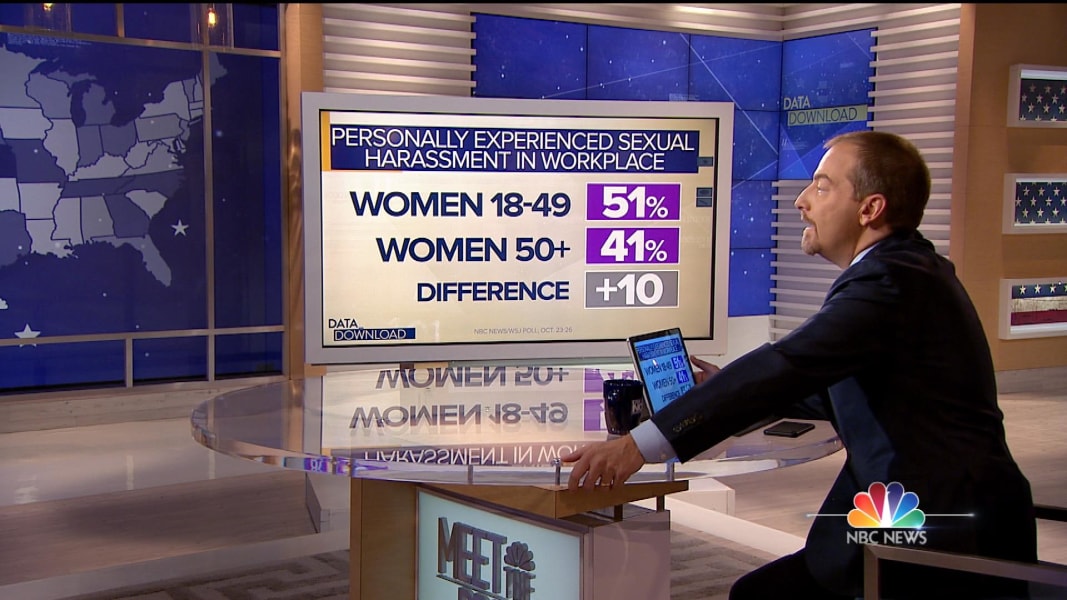
Although a staggering 89 percent of all women of all ages interviewed admitted to having been forced to develop self-protective strategies in the workplace to avoid having to experience sexual harassment of one type or another, half of all the surveyed women stated they had experience of harassing behaviour throughout their working lives. Of those women willing to respond to the question, 52 percent stated they were familiar with personal sexual harassment in their workplace.

For older women responding to the question there was less hesitation in stating they were the victims of harassment, defined as "unwelcome sexual advance, requests for sexual favours and other verbal (non-touching) conduct of a sexual nature". It is assumed that since they have been in the public sphere as a working woman for a longer period of time, they were exposed to more numerous instances of sexual harassment than younger women.

Which more or less contradicts the impression that older men were more circumspect than their younger cohorts in their relations with female co-workers. Over one in four women (28 percent) responding to questions relating to sexual harassment said they experienced non-consensual sexual touching; in other words sexual assault. One in five women between the ages of 18 to 24 reported experiencing assault, while older women were likelier to admit to having been assaulted (37 percent).


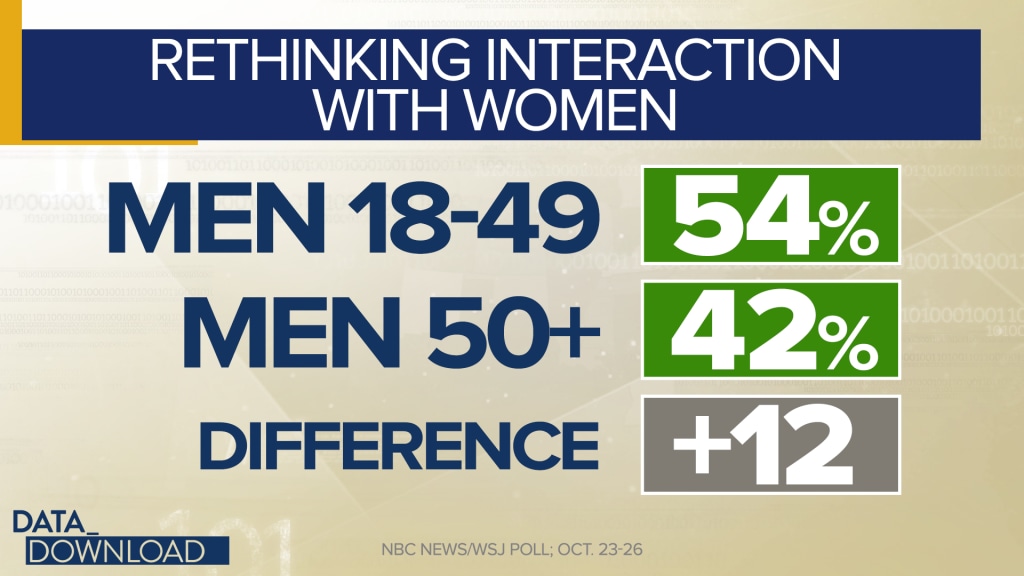
Younger men responding to the poll were likelier than their older male co-workers to see nothing particularly wrong in boorish behaviour. They were likelier to agree with the statement: "some people have definitely behaved like jerks but they shouldn't lose their jobs or reputations for it", in contrast to older men who were less likely to support that sentiment. Altogether, younger men in many instances appeared twice as likely as their older cohorts to believe it is perfectly acceptable to behave poorly toward women.

That would include giving a female workplace acquaintance a shoulder rub, completely uninvited; to make a comment relating to a woman's body, or to display, swap or openly read materials that women might view as "sexually suggestive". Among younger men, thirteen percent felt it was perfectly acceptable to read a pornographic magazine during lunch breaks taken at their desks.

Males aged 18 to 34 were close to evenly divided on the perception that "all these new rules about conduct are killing the human element at work". This point of view as justification for the behaviour they admit to, contradicts what females of their own generation believe, when close to two-thirds of women in that age group disagree with their male counterparts. And they are, after all, on the receiving end of the abuse.
Still from video

Within the oldest group of working men, age 55 and over who were surveyed, their views on the disgrace heaped on men in power who have been caught in an ongoing web of revelations of sexual harassment scandals more closely aligned with those of women with respect to the kind of behaviours acceptable in the workplace.

Twelve percent of older men stated their opinion that it was acceptable to express sexual interest in a female co-worker, in contrast to a third of millennial men's opinion on that point of view. One in four of the younger male group felt making a comment about a female colleague's physiognomy was reasonable, and one in four felt there was nothing awry in the use of "sexualized language" in conversation at work. In stark contrast, two percent of older men agreed.'

Sociologists appear to link with the prevailing culture of pornography which millennial men have grown up to consider normal, along with a desire to be viewed as "properly masculine". Whereas men of an older generation tended to audit their behaviour that second-wave feminists pointed out was offensive and demeaning to women. Those same women initiated a trend where feminists felt entitled to behave in a like manner to men and in the process became "sexually liberated".

Perhaps it was that liberation, with young women experimenting with sex, liberating themselves from the straitened morality that prevailed previously where women were meant to be modest and retiring, waiting for men to make the first move, and that encouraged women not to shy away from sexual promiscuity, and revelling in pornography geared to the enjoyment of women that prevailed in 'teaching' their young male counterparts that sex was a grab-it free-for-all.

The Insights West study used the definition of sexual harassment laid out on Canada's labour code. kieferpix / Getty Images/iStockphoto

Labels: , ,

 
()() Follow @rheytah Tweet