Ruminations

Blog dedicated primarily to randomly selected news items; comments reflecting personal perceptions

Monday, October 31, 2022

Indonesian Reticulated Constrictor Strikes

"During the search the team found a giant python, measuring seven metres in length which we suspected had preyed on the victim."
"The victim's body was not destroyed when we found her inside the snake, meaning that she had only been recently swallowed whole."
"The [search] team captured the snake."
Local police statement, Jambi province, Sumatra Island, Indonesia
 
"They are constrictors, so what they do is coil their body around you. They will give you a hug of death."
"The top and bottom jaw of a snake is connected by ligaments, it's quite flexible. They can swallow prey larger than the size of their head."
Matjam Rusli, snake conservationist, director of the Indonesia Herpetofauna Foundation
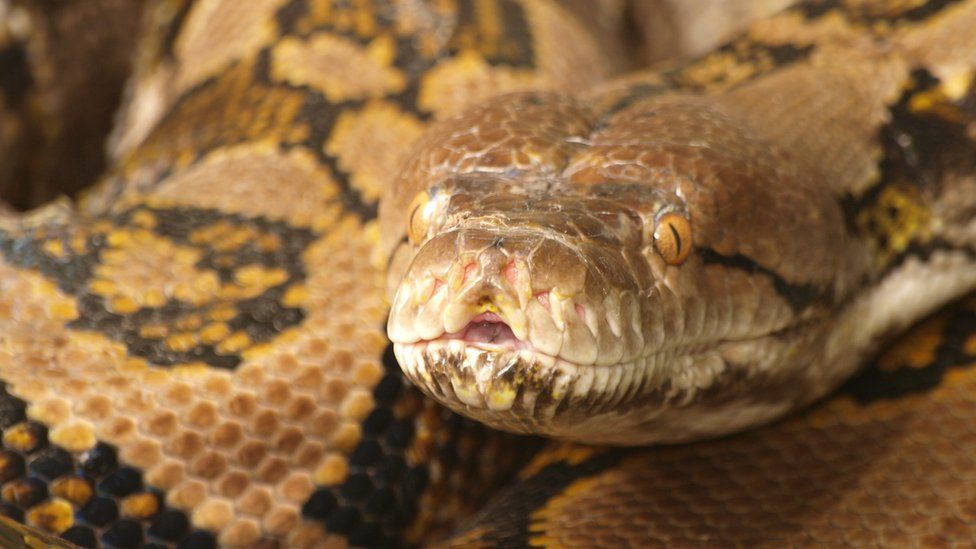
File photo - Close up of a Reticulated Python head
Reticulated pythons are believed to be able to reach over 10 metres in length  Getty Images

"Most cases are cases of farmers working in rubber and cacao plantations in Sumatra and Sulawesi, most cases occur at night", explained Indonesian snake expert Djoko Iskandar, professor at Randung Institute of Technology. Extremely long such reptiles only are capable of successfully preying on adult humans, he added. 
 
Deforestation deprives snakes of their natural habitat and sources of food; one factor cited by experts as a cause of the increasing frequency of fatal encounters between constrictors and humans. Such encounters are becoming more common in the country, given encroachment on the environment snakes depend upon.

A local women, employed as a tree tapper on an Indonesian rubber plantation, 54-year-old Jahrah, left her home Sunday morning and failed to return. When her work day was concluded and she still had not arrived back home that afternoon, her husband alerted the locals and set out to find what had happened to his wife.

He discovered his missing wife's sandals, jacket, head scarf and knife lying on the forest floor but she was nowhere about. The following morning a party searching for Jahrah (who according with Indonesian social culture is identified by only one name) encountered a heavily bloated snake, The reptile was put to death by the search team, then went on to slice open its stomach and there they discovered the unfortunate woman's remains, perfectly intact.
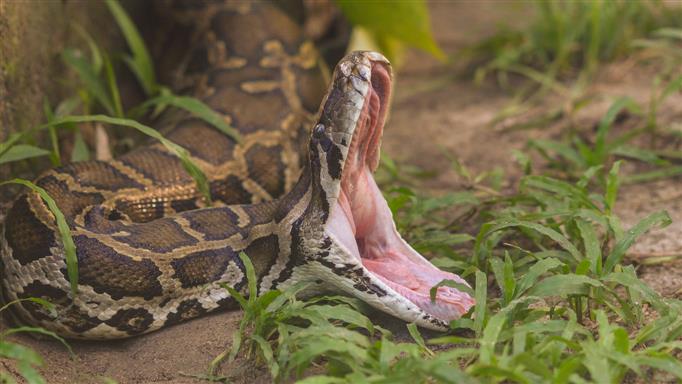
 
22-foot python entirely swallows 54-year-old woman alive in Indonesia
iStock
 
Generally, non-venomous pythons are not known to attack humans. Instead they feed on smaller animals, securing their victims with a nonvenomous bite prior to suffocating them to death through construction, before swallowing them whole. Then they rest, immobile, as digestion begins. On occasion, as with the case in this instance, they will also prey on humans.

Snake conservationist Nathan Rusli believes it was a reticulated python that was responsible, the only reptile species living in the Sumatran province of Jambi sufficiently large to consume an adult human. Incidents such as this are considered rare in their once-a-year occurrence. Understandably, for the victims and their families, once-a-year events such as this are once too often.

Reticulated pythons are the longest snakes in the world. Photo: Shutterstock

Labels: , ,

Monday, July 08, 2019

Criminal Harassment of a Muslim Predator

"That kind of conversation [obscene calls] happened so often I couldn’t even count. I told him, ‘You need to go to a psychiatrist'."
"I was really shocked [to be found guilty] because all the witnesses said clearly I was not the one who transmitted the material."
"I don’t really get what was defamatory [charges her predatory boss lodged against her]. It is you yourself telling people about your bad behavior [in recorded messages of his unwanted, bullying, lewd and intrusive calls to her]."
"A lot of women still feel they are under pressure from their bosses and their bosses can do whatever they want."
"For me, justice seems so far away."
Nuril Maknun, Lombok Island, Indonesia
Nuril Maknun after she received a six-month jail term for violating a controversial law against spreading indecent material, in Mataram on Lombok island on November 16, 2018. (PIKONG/AFP/Getty Images)                

"As long as the law does not change, women will forever be closed off and will never want to report it [sexual harassment]."
"Especially if you look at Nuril’s case. You are the victim, but then you are the one who is put into prison."
"If the case review does not provide justice, then she can apply for clemency to the president. Once she has applied for clemency, that’s where I come in."
Indonesian lawyer, Joko Jumadi
A panel of three judges saw fit to sentence 40-year-old, mother of three Nuril Maknun -- a bookkeeper at a school in Mataram on Lombok Island, Indonesia -- to prison in a six-month sentence. She must also pay a fine levied against her that amounts to about $35,000. Indonesian jurisprudence does not look kindly on women who soil the public character of an Indonesian man, even if that man had hounded this woman with repeated, insistent calls that she listen to his obscene talk of his sex life and agree to have a sexual dalliance with him.

Nuril Maknun did nothing to attract those calls and the lurid monologue that was unleashed on her by the man who was the principal of the Senior High School Seven where she worked as a bookkeeper. She informed her husband of the harassment that began in 2012. Eventually she took to recording those calls and had someone of her acquaintance listen to them. The obscene calls were downloaded to an electronic device. Which led the principal, whose name is simply Muslim -- quite fitting -- to declare himself to have been defamed.

The woman had shared the content of the calls from the principal in hopes of saving her own reputation from the rumours that were circulating that she was having an affair with the man she loathed. To convince her husband that the rumours were untrue, and to inform another teacher of the very same thing; she was innocent of leading the man on, had no interest in having any intimate relations with him, and wanted only to be left alone, she made the recordings.

A lawsuit ensued and an investigation and eventually a legal battle, in 2015 when Muslim, discovering the presence of the recordings reported the bookkeeper to the police claiming that his comments shared by Nuril Maknun with others without his authorization must be interpreted at defamation. That resulted in imprisonment for Nuril Maknun for a month while an investigation ensued. She was subsequently acquitted of the charge, but an appeal was filed by prosecutors.

When the panel of three judges sentenced her to six months in prison and a substantial fine, she fought for justice, evidently believing it could be achieved, and her case was brought to the Supreme Court. There, another panel of judges denied her request for a review of the verdict. She now faces the reality that should her family be unable to pay the $35,000 fine imposed upon her for defamation of Muslim's character, her prison sentence could be expanded.

"We are concerned about the impact of this decision because it opens a door for perpetrators of sexual violence to criminalize victims", stated Ade Wahyudin, head of Legal Aid Foundation in Indonesia. Bearing in mind that the superior Indonesian court handed down their ruling this week that it is she who should be punished, not her aggressor, on the basis that sharing the recordings was akin to distributing indecent material, given their content.

"If later she does not find justice ... she can request clemency to the president", declared President Joko Widodo, urging the woman to seek a judicial review. Justice in Indonesia finds women guilty of the acts of conscienceless predatory men. But as an act of public compassion, the president of the country is willing to respond positively to a request for clemency. This is the plight of women living in the world's most populous Muslim-majority country.
    CreditRichard C. Paddock/The New York Times


Labels: , , , , ,

Tuesday, September 25, 2018

Daily Prayers

"I was on the raft for one month and 18 days. My food ran out after the first week. I had to soak my clothes in the sea, then I squeezed and drank the water."
"I thought I will never meet my parents again, so I just prayed every day."
"It was early morning on August 31 when I saw the ship and I lighted up the lamp and shouted 'help!' using the HT [handy-talky portable radio]."
"The ship had passed about one mile but then it turned to me. Might be because I used the English word [help]. Then they talked on the HT [hand-held radio]."
Aldi Novel Adilang, 18, Jakarta, Indonesia

"Aldi said he had been scared and often cried when adrift."
"Every time he saw a large ship, he said he was hopeful, but more than ten ships passed him, and none of them stopped."
Fajar Firdaus, Indonesian diplomat, Osaka, Japan
main article image
(Indonesian Consulate General Osaka/Facebook)

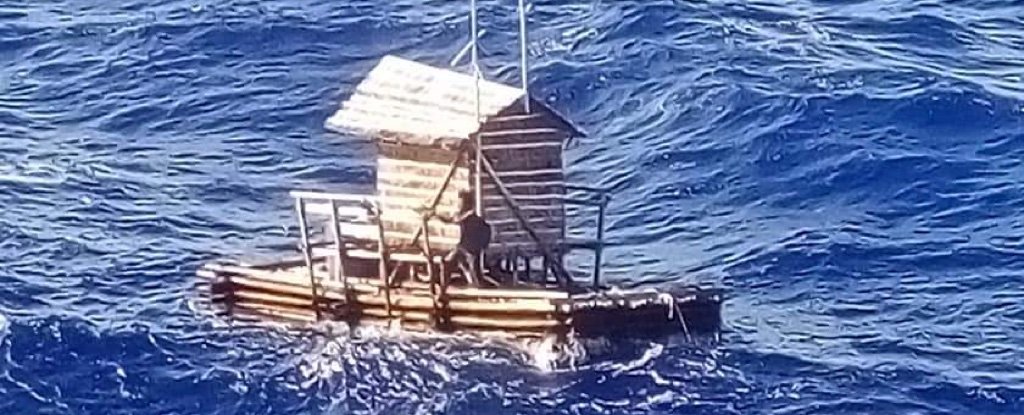
Adilang worked as a lamp lighter on a rompong since the time he was sixteen years of age. The rompong, a raft of wood topped by a hut is lit at night to attract ocean fish to the shoreline of Indonesia's coastal area of North Sulawesi, an aid to local fishermen whose living is crucial to the general diet of the population. Lamp lighters lead a solitary existence; the fishing rafts are moored at least 100 kilometres offshore, with no paddle, no engine, set dozens of kilometres apart.

The rafts are anchored with ropes but occasionally they break, from relentless friction. Once weekly supplies, fuel for a generator, food and any other necessities are dropped off for the minders who communicate with fishing boats via a hand-held radio they are supplied with. Work contracts are for six-month periods. For their efforts, the fish minders earn $130 monthly, a considerable assist to a large family whose children are expected to help support the family income.

Adilang's fish trap went adrift on the Pacific Ocean when its moorings slipped. To survive, he caught fish, cooking them by using the wooden fences along the top of the rompong to make cooking fires. Aspirants to the job must prove they are capable of fending for themselves and this young man certainly did. Ten ships passed the stranded youth and despite his efforts to bring his plight to their attention, none responded, "unaware of my ordeal", he explained. There were days with no rain, and that's when Adilang drank seawater.

After fifty days at sea the Panamanian-flagged MV Arpeggio off the island of Guam -- some 1,920 kilometre from where Adilang's wooden fish trap came loose -- stopped to rescue the boy. Although this was the third time his raft had come loose and drifted, on the other two occasions the raft had been rescued by the ship of the owner of the 50 rafts. When Adilang saw the ship passing he once again attempted to draw the attention of its crew as he had done with the previous ships that had failed to notice his efforts.
576 indonesian teenager adrift 2
(ICGO/Facebook)

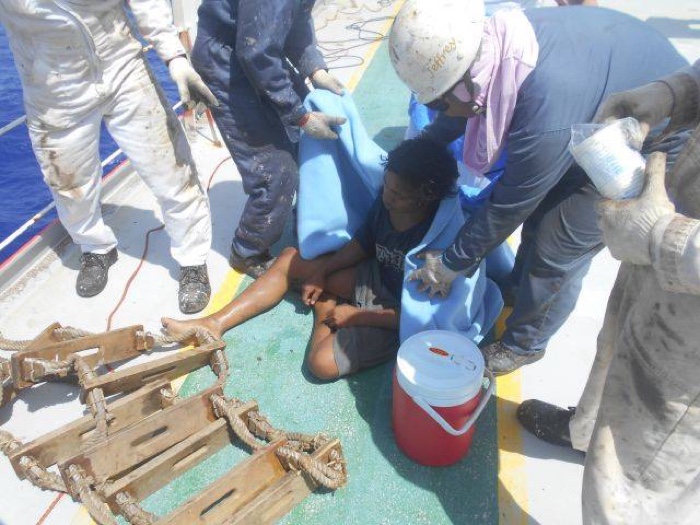
Once he had succeeded in alerting the crew of the ship to his presence, rescue was complicated by the condition of the ocean, assailed by high waves -- a completely agitated surface. The Arpeggio's crew threw a rope as the tanker circled around the raft. The rope was beyond Adilang's grasp, leading him in desperation to leap into the water. In his weakened condition he barely managed to grasp the rope. Eventually a member of the Arpeggio's crew was able to grasp his hand, pulling him to safety.

Once aboard and safe, the Arpeggio contacted the Indonesian mission in Japan when the ship docked and officials from the Osaka consulate arrived to take the boy into their custody on September 6, returning him to Indonesia two days later. The youngest son of four siblings, Adilang has decided that rompong work as a lamp lighter attracting fish is not a career he plans to carry on with. "My parents agree", he said.

576 indonesian teenager adrift 3
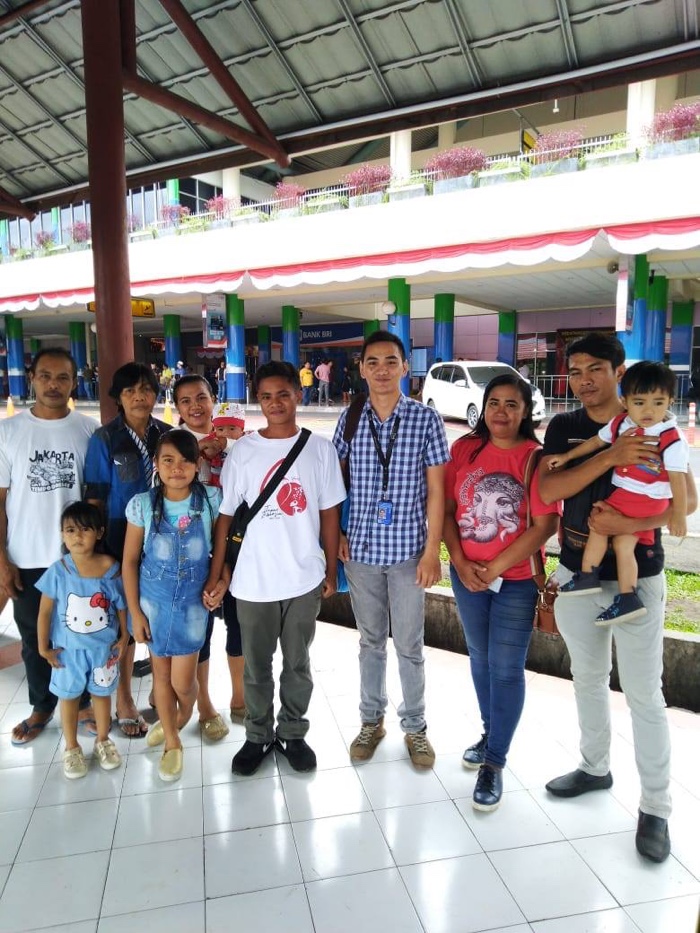
Adilang (in white T-shirt) reunited with his family (ICGO/Facebook)

Labels: , ,

Friday, May 04, 2018

Evolutionary Survival Advantages: Man as Marine Animal

"The Bajau have this subsistence that depends on marine foods, and they've been known to have this lifestyle for more than a thousand years. They're pretty incredible: They can dive for very long periods of time for more than 70 metres, with nothing but a set of rustic wooden goggles and a set of weights, nothing like the equipment we would use today."
"The Saluan diverged from them about 15,000 years ago, and they are not known to have this marine lifestyle. So the idea was to contrast these two populations with similar ancestries, but different lifestyles. We wanted to see if there was some difference in their genomes that could explain this."
"This gene existed before the Bajau, because the Saluan have it too. But once they diverged from each other, at some point in history, it became advantageous for Bajau individuals to have this after the Bajau adapted to this particular lifestyle."
"Individuals who had it tended to survive more than others, or maybe they had more children. The fact that both Bajau divers and non-divers have the large spleen points to the fact that this is something they have from birth rather than something they acquired through experience over time."
"We're [humankind] still evolving. Evolution hasn't stopped at any point in time."
Fernando Racimo, assistant professor, University of Copenhagen, Denmark
Why Bajau divers can hold their breath for minutes
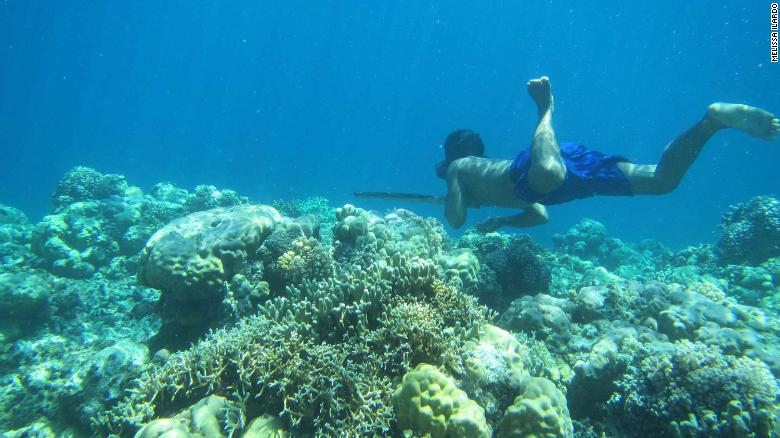
A Bajau diver uses a spear to hunt fish.  CNN
"The lung chest wall could become more compliant [the environmental adaptation displayed by the Bajau. There] could be some looseness that develops over your training [throughout a lifetime]. The diaphragm could become stretched." 
"The abs could become more compliant. We don't really know if those things occur."
"The spleen is able to contract to some extent but we don't know of any direct connection between thyroid and spleen. It may well be."
Richard Moon, Duke University School of Medicine
The seaside village of Jaya Bakti in Sulawesi, Indonesia, is inhabited largely by Bajau people.
The seaside village of Jaya Bakti in Sulawesi, Indonesia, is inhabited largely by Bajau people   CNN

One scientist's exciting finding, can be another's perceived misinterpretation of observable facts. Skepticism on the part of one researcher in response to the ebullient !Eureka! of another, is the stuff of which science and research is made; there is always that 'prove it!' element. And Dr. Racimo of the University of Copenhagan believes his hypothesis is well and truly proven by what he and his fellow researchers at University of California, Berkeley -- teamed up to study in the mystery of how it is that some humans are capable of holding their breath beyond a five-minute period -- have concluded.

The Indigenous Bajau people, resident for millennia off the coast of Southeast Asia, more commonly called Sea Nomads -- inhabiting an ancestral area close to Malaysia and the Indonesian archipelago, are capable of diving up to 70 metres undersea. They wear primitive wooden goggles, and hold a set of weights; with one deep breath they dive and the astonishing length of time they can sustain that dive, with a breath they can hold for up to five minutes sets them apart from others, quite distinctly and dramatically.

As Sea Nomads, they live in traditional houseboats and each day hours are spent hunting fish and assorted creatures of the sea. Where most fisherfolk spend their time above water casting rods or nets for fish, the Bajau people do their fishing deep under water. The amazing free diving capacity is not seen anywhere else in the world, skills they possess that have been a mystery for centuries. Which led a group of geneticists and biologists from the University of Copenhagen and University of California, Berkley to the informed belief that the answer to the mystery lies in their spleens.
Jatmin carries a freshly-speared octopus back to his boat.  Photo: James Morgan

According to conclusions published recently in the journal Cell, the Bajau people may be possessed of a genetic advantage acquired through environmental adaptation over thousands of years; when natural selection gradually gave preference to those among them capable of performing such underwater feats not given to most humans and in the process a people emerged with enlarged spleens enabling them to remain underwater for vastly prolonged periods of time on a single, expansive breath.

The spleen has a key role in the process that evolves as humans dive into water where an autonomous "diving response" ensues, as breath is held while underwater. The spleen stores red blood cells, and during the dive response it contracts, injecting oxygenated blood cells into the circulatory system, becoming the fuel partially responsible for the process that allows us to hold our breaths. The amount of time we can spend underwater is directly related to the size of the spleen, according to the researchers' hypothesis.

This neat conjecture fits very well into the fact that Sea Nomads are found to have spleens about fifty percent larger than those measured by researchers in other Indigenous people living nearby, the Saluan. Ancestrally related to the Bajau, the Saluan don't share the gift of an enlarged spleen enabling them to dive for a prolonged period as the Bajau do. Melissa Ilardo from the University of Copenhagen's Center for Geogenetics was the lead author of the paper. She had travelled to Indonesia, hauling along a portable ultrasound to measure the spleens in the two communities.
Ibu Diana Botutihe has lived her entire life at sea, visiting land only intermittently to trade fish for rice, water and other staples. Here she is pictured on her boat in Sulawesi, Indonesia.    Photo: James Morgan

The researchers discovered the Bajau also was possessed of a  higher frequency of a variant of a specific gene, called the PDE10A, once they sequenced the genomes of a few dozen Bajau and Saluan test subjects. The conclusion was drawn that increased thyroid hormone levels in the Bajau are also thought to play a significant role in the process. Their decision, however, is not necessarily shared by other scientists who believe it possible that other adaptations could be involved in the diving capability of the Bajau; further study is required for a fuller understanding of the process, they stress.

Yet the anomalous environmental process that stimulated such an evolutionary advantage for survival is seen in other study groups where genetic mutations come into play among other discreet populations living in extreme geological and atmospheric conditions globally. Studies, for example, documenting that people living in Tibet appear to have benefited through natural selection to adapt to hypoxia, an oxygen deficiency resulting from living in high altitudes that can be fatal to others, but which the Tibetans have adapted to.

The Bajau are adept free divers. Some of them spend up to five hours a day under water, searching for food and other creatures for trade.   Photo: James Morgan

Labels: , , , , ,

Wednesday, April 25, 2018

Wild-Caught or Captive-Bred Reptile Trade

"The scale is huge, much bigger than people realize"
"This trade is likely having a massive impact on ecosystems and populations of lesser-known animals."
Vincent Nijman, anthropologist, Oxford Brookes University, Britain

"These are the most blatantly questionable cases where we think something must urgently be done."
Mathias Loertscher, Convention on International Trade in Endangered Species (Cites)

"At most of these facilities, there was just no evidence of captive breeding actually happening. And at the one where breeding efforts did take place, that only applied to one to three species kept at their facility."
"If you have international demand for a species that only has a very small distribution, you have a big problem."
Mark Auliya, conservation biologist, Zoological Research Museum Alexander Koenig, Bonn, Germany

"In the Indonesian context, there's a hell of a lot of snakes and reptiles out there, and for most species the issue of laundering through breeding farms is not resulting in negative impacts on populations."
Daniel Natusch, herpetologist, University of Sydney, Australia
Illegally traded green pythons (Morelia viridis) in the black market pet trade. Photo courtesy of Jessica Lyons.

In 2016, Indonesian officials awarded a permit to PT Alam Nusantara based in Jakarta to export 45 "captive bred" echidnas. Echidnas, egg-laying mammals resembling hedgehogs, have produced a dilemma for zoos around the world attempting to breed the little creatures. They are not given to reproducing naturally in environments not their own. Over decades zoos around the world have been able to breed fewer than 50 echidnas. Something doesn't compute there.

Indonesian authorities authorized export of over four million captive-bred animals in 2016 alone. Experts know very well that it would be impossible to secure that number of animals that have been bred in captivity, not trapped in the wild, but taking animals out of their natural habitat is cheaper and far easier than committing to set up breeding operations. Tokay geckos are low-profit animals traded at high volume and as such not good candidates for breeding operations.

Caught in the wild geckos are sold for very low prices. Breeding of one million geckos, a trader would require breeding stock comprised of 140,000 females, 14,000 males along with 30,000 incubation boxes, 12,000 rearing cages and the work of hundreds of employees. Imagining a single facility geared to this kind of production, according to Dr. Nijman, would require an installation "the size of an aircraft hangar", to produce animals that sell for a few cents apiece.

It is not only Indonesia where questionable practices in the trade of animal species sold all over the world as pets occurs, but Indonesia certainly stands out as one of the major offenders in illicit trade. Indian star tortoises from Jordan, red-eyed tree frogs from Nicaragua, and savanna monitors from Ghana and Togo are also exported abroad purporting to be captive-bred, when in all likelihood, according to experts in the field, they are nothing of the sort.

Some 80 percent of 5,000 green pythons exported annually as captive-bred in Indonesia were illegally gathered in the wild, serving to deplete some island populations, cited a study published in the journal Biological Conservation. Dr. Auliya surveyed eleven registered reptile breeding facilities located in Indonesia, only to discover that merely one of them had the potential of being used for anything other than "laundering" wild animals.

Cites' investigations list five cases from Indonesia that have been examined -- the most of any country -- the result being that officials now are required to give proof that animals to be sold abroad such as Oriental rat snakes and Timor monitors have genuinely been captive-bred. Cites has the authority to bar international trade in those species.

Traders are  reliant on Indonesia's Cites authorities for responsible quotas reflecting sustainability to be set, according to Adri Tasma, owner of a reptile farm located close to Indonesia's capital, Jakarta. His installation specializes in green tree pythons. He was permitted the export of two thousand of these reptiles in 2015, but he was also authorized to trade in 45 other species, including critically endangered Sulawesi forest turtles and rare tricolour monitors.

He admitted having no idea why the government gave him permission to export these animals and went so far as to deny ever having sold them, for he had no license to breed or maintain them. The head of Indonesia's captive breeding at the Ministry of the Environment and Forestry explains that his country's quota list is regulated firmly, based on scientific data and that regional forestry officials monthly visit each farm for the purpose of counting breeding adults. The figures they acquire are then used to formalize export quotas ensuring sustainability.
Wild carpet pythons (Morelia spilota) are traded on a legal quota system, but researchers say the quota is often exceeded. Photo courtesy of Jessica Lyons.

A recent study in Conservation Biology however, suggests the number Mr. Wirasena gave of ten percent "laundering" underestimates the problem greatly. Indonesia's quotas, the authors discovered, for 99 of 129 species had been calculated based on biologically impossible parameters. "I know sometimes the traders bribe my staff", Mr. Wiranto, director general of conservation of natural resources and ecosystems said.

In the United States, bearded dragons represent the most commonly sold lizards and there they are captive-bred, all likely descendants of specimens originally smuggled out of Australia. This is seen as a positive turn since the offsprings' availability as captive-bred animals may have resulted in the prevention of animals in the wild being removed. Further, according to some in the field, the pet trade's impact on many species is in fact, negligible.

A study conducted by Daniel Natusch, a herpetologist, conducted in Indonesia, showed that even though pythons were harvested, their numbers and size remained consistent over a two-decade period of study. "We can't only point fingers at Asia and Africa", observed Sandra Alther, a founder of Pro Wildlife, a Munich-based conservation group, "if we're one of the main destinations".

Illegally traded lizards (left to right): black tree monitor (Varanus beccarii), Reisinger's tree monitor (Varanus reisingeri), emerald monitor (Varanus prasinus), and the blue-spotted tree monitor (Varanus macraei). Photo courtesy of Jessica Lyons.
Illegally traded lizards (left to right): black tree monitor (Varanus beccarii), Reisinger’s tree monitor (Varanus reisingeri), emerald monitor (Varanus prasinus), and the blue-spotted tree monitor (Varanus macraei). Photo courtesy of Jessica Lyons

Labels: , ,

Sunday, July 24, 2016

Medical Trust in Indonesia

"We are in crisis right now."
"This is a medical emergency and we have to overcome this."
Dr. Aman Bhakti Pulungan, head, Pediatrician Association, Jakarta, Indonesia

"Fake vaccines arose because there was a scarcity of vaccine a few years ago that led hospitals and clinics to look for imported vaccines."
"Also because the middle class demanded imported vaccines rather than locally made."
Jane Soepardi, director of surveillance, health quarantine and epidemiology, Indonesian Health Ministry

"I was shocked and very disappointed when the hospital management asked me, along with about 300 other parents to bring our children for revaccination, because the vaccine that is injected into our children turned out to be fake."
"How could this happen?"
"We need a medical checkup, not only an explanation. We need concrete compensation."
Danang Susilo, father of 14-month-old

"The attitude of the Indonesian people, especially the middle class, is that they look at the building and the facility and they say: 'This is the best hospital'."
"But nobody knows if it really is a good hospital or not because there is no quality control, no quality assurance done by the government."
Dr. Kartono Mohammad, (former) head, Indonesia Medical Association
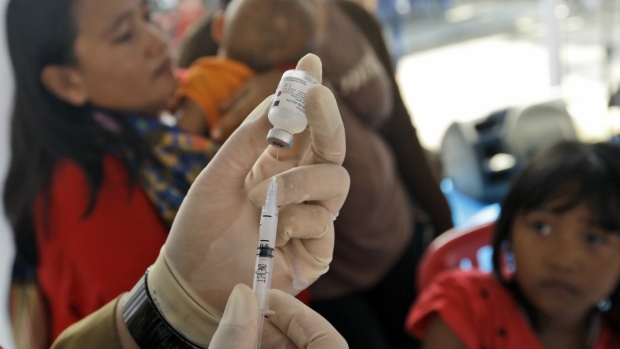
Fake vaccine scandal worries patients in Indonesia An Indonesian health official prepares a vaccine injection during a revaccination program for children who were earlier given fake vaccines, at a community health center in Jakarta, Indonesia on Monday, July 18, 2016. (AP / Achmad Ibrahim)

Dr. Mohammad points to federal regulations in place theoretically alongside the reality of lax, if not absent enforcement where the vaccine scandal, as far as he is concerned is symptomatic of more larger-reaching problems. Monitoring and enforcement of regulations to ensure the administration of safe vaccines can be assured, is simply absent. And this is the largest component of failed responsibility by the government to the safety of the country's most vulnerable, its children.

Vials identified by their labelling as vaccines have been increasingly discovered to be carrying nothing but saline solution sometimes mixed with antibiotics that have been found to be used at 37 hospitals and clinics located in nine cities throughout the country, according to revelations by Indonesia's Food and Drug Agency. Investigations have resulted in 23 people being arrested, among them three doctors.

When a nation of over 250 million people discovers that something as elemental as protecting their infants from diseases whose efficacy and reliability is generally taken for granted in a well-regulated and operated health system, has failed the test of trust, the response will be guaranteed outrage. Indonesian president Joko Widodo paid a personal visit to a clinic where several hundred children were scheduled for revaccination.

There, he appealed to parents and the public at large for patience while his government investigates further the "extraordinary crime" that has been uncovered of false vaccines, which have been a problem, as it has been revealed, as far back as 2003. Dr. Pulungan, as head of the country's pediatrician society has attested that to his knowledge no children are known to have died resulting from their unprotected status against diseases they were supposed to be vaccinated against.

Some, he agrees, may have become ill and the cause obviously not fully understood. Inoculations routinely used are those for measles, whooping cough, hepatitis and diphtheria. And their matched vaccines were labelled as imported brands. Dr. Pulungan understands that only one percent of vaccines used nationwide have been imported. A mob of raging parents appeared on television haranguing a doctor, punching and spitting on him at an eastern Jakarta hospital.

Members of Indonesian parliament have been approached by angry parents demanding action on the urgent file. The Health Ministry estimated that five thousand children from among 4.8 million who were immunized in the current year, were recipients of the fake vaccines. According to the director of surveillance with the ministry, the fake vaccines contained no harmful ingredients, though the possibility of infections resulting was possible, related to unsafe processing in their production.

The endemic corruption, overcrowding in hospitals and a severe shortage of doctors are conditions not conducive to trust by the population in the health care system. Those Indonesians who have money to spare seek treatment often in neighbouring Singapore or Malaysia. While parents are beside themselves with concern over the well-being of their children, it seems that the government had prior knowledge it failed to act upon.

Women wait for information about the alleged use of fake vaccines on their children at a hospital in East Jakarta, Indonesia   Antara Foto/Sigid Kurniawan/via Reuters

In 2013, a report from GlaxoSmithKline about counterfeit vaccines bearing their logo and guarantee was received by the Indonesian Food and Drug Agency. The person behind the scheme was apprehended and fined a grand sum total of under $100. And then in 2014 and 2015 other problems surfaced. In 2016, PT Sanofi-Aventis Indonesia, a subsidiary of the French Sanofi, informed Indonesian national police that fake vaccines were surfacing with its product labels affixed.

Hospital workers (R) collect information from parents who believe their children may have received fake vaccines at a hospital in East Jakarta, Indonesia  Antara Foto/Sigid Kurniawan/ via Reuters

Labels: , , ,

Friday, February 19, 2016

Devastating Cultural Heritage

"[The practice is] regarded as part of our culture, or a confirmation that they will be officially 'Islamized'. [The practise] in Indonesia is mostly symbolic [no cutting at all]."
Jurnalis Uddin, chairman, Center for Population and Gender Studies, Yarsi University, Jakarta

"They think it's a family or cultural tradition, and an Islamic obligation, yet they can't name any verses in the Q'uran about female circumcision."
Rena Herdiyani, government lobbyist, Kalyanamitra, NGO

"Mutilation is horrible, but it's not true that it happens here. They cannot stop us. It's our tradition."
Fitri Yanti, 30, Indonesia


The ancient ritual of female genital cutting practised throughout Africa and the Middle East is also widespread in Indonesia, which is home to 12.7% of the world's estimated 1.7-billion Muslims, qualifying it as the country with the largest Muslim population in Asia. Almost half of all women in he country appear to have undergone ritual circumcision. An adjustment was recently made by the United Nations in their global figure for women and girls who have undergone circumcision.

Where formerly that number was estimated to be $130-million women who have experienced genital cutting, that number has now risen to $200-million with the inclusion of Indonesia. Female circumcision can run the gamut from slight cuts to radical, rough surgery where the clitoris and labia are removed and the vaginal passage is sewn shut, creating all manner of dire health problems including difficulty in urinating, in menstruating and in childbirth resulting from scars tissues.

Where once, in Medieval Europe, women were often forced to wear metal girdles (chastity belts) that were locked as restraints against infidelity, either voluntary or forced, in today's world nothing like it exists except for the presence of women and girls of African, Asian or Middle Eastern heritage living in the West, where the cultural dedication to continuing the practise carries on. The number of countries across the globe where female genital cutting is a social custom, however, is 30.

"We knew the practice existed but we didn't have a sense of the scope", explained Claudia Cappa, a statistics specialist for UNICEF. With the addition of Indonesia, it is clear that genital cutting is not limited as "an African problem". Indonesian experts are quick to explain that the extremely severe disfiguring that describes female genital mutilation (Clitoridectomy or infibulation) is not normally done in that country; rather they claim, it is a mere 'scratch'.

The official Indonesian government defines female circumcision as "an act of scratching the skin that covers the front of clitoris without injuring the clitoris". The percentage of girls aged 15 to 19 who have been cut worldwide has been reduced from 51 percent in 1985 to 37 percent at the present time, in countries where the practise remains a normal part of the social-cultural contract. In Egypt 30 years ago 97 percent of 15 to 19-year-olds were circumcised; the new figure is 70%. High by any measure.

Liberia has reduced its rate of female circumcision from 72 percent to 31 percent, and Burkina Faso from 89 percent to 58 percent. Despite public pressure from outside those countries that practise circumcision, and indeed from within as well, the practise continues. "Current progress is insufficient to keep up with increasing population growth", reports UNICEF. As a result, if trends continue the number of girls and women undergoing circumcision "will rise significantly over the next 15 years".

Ten years ago in a bid to enter the modern world, the government of Indonesia attempted a ban against circumcision, but that came up against vigorous resistance from religious authorities for whom the custom is important, that girls undergo the ritual before marriage. That led the government to neutralize its position, issuing regulations that state only medical professionals should be engaged in the cutting practise.

That change has led to a bit of a dilemma. Since medical providers perform the procedure, legitimacy is conferred on the practise by default. "We are very concerned with medicalization. Medical personnel are looked up to and are seen as knowing what's good for your girl", observed Francesca Moneti, child protection specialist with UNICEF.

As for Indonesian women themselves, a survey obtained their views and they vary. While female circumcision does take place in the countryside, it is confoundingly, more prevalent among  urban, wealthier families. This is a custom that reflects a patriarchal society's concern over female sexual morals, an effort to ensure that sex is not pleasurable for women, but a painful ordeal, to restrain them from infidelity.

As in so many cultural practices introduced to demean and disempower women that become so all-prevailing, women embrace the custom because without engaging in it they become social outcasts for whom good marriages are impossible to attain to. This is so engrained in society that women become the most vocal supporters of such customs harmful to women's health,dignity and longevity.
Beliefs in female circumcision practices within society:
  • "It can ensure virginity (maintain chastity before marriage)
  • It can ensure fidelity during marriage
  • It will increase male sexual pleasure
  • It can secure or enhance fertility
  • It can secure the economic and social (i.e. marital) future of daughters
  • It will prevent the clitoris from growing long like a penis
  • Through the reduction or elimination of the female genitalia, that this will attenuate the sexual desire in the female
  • The female genitalia are considered both dirty and unsightly
  • It will keep the female clean, and more hygienic
  • It is an important ritual and part of the initiation of girls into womanhood
  • It is 'tradition' and part of one's cultural heritage
  • That it is a religious mandate -- although the practice predates both Christianity and Islam"
    • (http://www.disabilityworld.org/01-03_04/women/fgm.shtml)

Labels: , , , ,

Friday, July 03, 2015

The Slave Trade in Seafood

"You Burmese are never going home. You were sold, and no one is ever coming to rescue you."
Thai fishing boat captain

"I don’t want to speak that language anymore because I suffered so much there. I hate that language now."
"I feel like a tourist [on his return to his home in Burma]. I feel Indonesian."
"I didn’t want an Indonesian wife, I just wanted to go back home to Myanmar. I felt like I lost my young man’s life. I just thought that all of this time, I should have been in Burma having a wife and a proper family."
"My life was just so bad that it hurts me a lot to think about it. I miss my mom."
Myint Naing, 40, former fisherman slave
Myint Naing
In this May 16, 2015, photo, former slave fisherman Myint Naing, 40, center, and his sister Mawli Than, left, embrace as they are reunited after 22 years at their village in Mon State, Myanmar. He is the oldest of four boys and two girls. In 1990, his father drowned while fishing, leaving him as the man in charge at just 15.   AP Photo/Gemunu Amarasinghe

Thailand has a busy and vast seafood export industry. And it is an industry built on slavery. Where innocent Burmese anxious to find employment are assured by recruiters that in Thailand they will find full employment, earn good salaries and be able to send money back home to their impoverished families living in their Burmese villages. The reality is that they are transported to Thailand and from there handed over for payment to fish in an industry that works its slaves around the clock, sometimes giving them a pittance in recompense, sometimes nothing.

Myint Naing, at the age of 18 became one of those slaves when a broker came to southern Myanmar in 1993 promising excellent, well-paid jobs for young men willing to work. Mying's father had died three years earlier and he, as the oldest male child in the family took on the mantle head of family and wage-earner. Desperate for a living wage for the family, Myint's mother agreed he could go with the agent. He was shipped by sea to the remote Indonesian island of Tual in the midst of rich fishing grounds.

And that was when the captain of the Thai vessel informed all the young men on board that they were no longer independent, but rather that he owned them; that they had been sold to him and there was no way they could return home. The ocean became his life as he became a slave to fishing to profit the captain and the larger, wider Thai fishing enterprise in their growing export market. It is a seafood business operating on the labour of an estimated 200,000 migrant workers.
Dita Alangkara/ Associated Press
Dita Alangkara/ Associated Press   Workers in Benjina, Indonesia, load fish onto a cargo ship bound for Thailand. Seafood caught by slaves mixes in with other fish at a number of sites in Thailand, including processing plants.

Many of them are not simply 'migrant workers', but slaves who were forced onto the boats; tricked, kidnapped or sold as Myint Naing had been. Their plight similar to that of press gangs roaming the streets of 18th Century Britain for sailors when such abductions were a common occurrence. The fishing companies that make up the Thai market have a wide consumer base, from the United States to Europe and Japan. The fish these workers and slaves help catch supplies food for faroff countries unware that slave labour places fish on their dining tables or in the tins of catfood they rely upon.

The young man repeatedly begged to be allowed to return home, and for his efforts was beaten mercilessly, forced to continue working on a boat in Indonesia. Eight years after he had first been taken to the boat as a slave he begged for his freedom only to hear the captain threaten to kill him. He was chained for three days as punishment, food and water denied him. He and 800 other slaves were rescued following a yearlong Associated Press investigation into Southeast Asia's fishing industry.

AP Photo/APTN
AP Photo/APTN In this Thursday, Nov. 27, 2014 image from video, workers from Myanmar load fish onto a Thai-flagged cargo ship in Benjina, Indonesia. An intricate web of connections separates the fish we eat from the men who catch it, and obscures a brutal truth: Our seafood may come from slave workers.

With the expansion of the seafood export industry, overfishing has meant that trawlers were required to sail further and further into foreign waters for fish. The result is that the workers are virtually trapped for months, extending to years aboard their seabound prisons. There is no medical care, boiled sea water is given them, and the rescued fishermen explained that on some boats workers were killed if they slowed the frenzied pace of drawing fish from the ocean. Some, in desperation, fling themselves into the sea.

In 1996, he ran away after having been beaten yet again in response to his pleading to be released. He managed to abandon his captivity, his skull wounded from the beating. An Indonesian family sheltered him until he regained some semblance of health, offering him food and shelter in return for his work on their farm. He stayed with them for five years, yearning to return to Myanmar, and missing the friends he had made and left behind on the boat he had run away from.

Then in 2001, a captain offering to take fishermen back home if they agreed to work caught his attention. In the hope that this would solve his dilemma he returned to the sea, discovering the conditions similar to what he had fled from. The elusive payment for their labour was withheld. After another nine months the captain abandoned them, leaving them free to return to Thailand on their own. When, once again, he asked to be returned to Burma, he was chained to the boat.

He managed to pick the lock on his shackles, dove into the night-time water and swam to shore. He hid in the jungle, fearful of approaching police lest they deliver him back to the fishing captains. By 2011 his life of solitude and privation caused him to move to the island of Dobo and there he heard of a small group of former Burmese slaves, living on vegetables they raised themselves. A friend informed him eventually that the Indonesian government had begun a rescue operation, embarrassed by revelations of slavery.

Myint Naing
In this May 16, 2015 photo, former slave fisherman Myint Naing and his mother, Khin Than, cry as they are reunited after 22 years at their village in Mon State, Myanmar. Myint, 40, is among hundreds of former slave fishermen who returned to Myanmar following an Associated Press investigation into the use of forced labor in Southeast Asia’s seafood industry.  AP Photo/Gemunu Amarasinghe
 
Myint Naing's 22 years in Indonesia had come to an end. He finally received the help he had longed for to return to his small village and be reunited with his family, one of the hundreds rescued and aided to return to their families in the wake of a year-long AP expose of the labour abuses abetting Southeast Asia's seafood industry. Reports documenting the slave-caught fish shipped from Indonesia to Thailand where it was exported to the U.S. spoke volumes of the plight of these poor people.

It was revealed that the supply chains of supermarkets and distributors included Wal-Mart, Sysco and Kroger, and companies such as Fancy Feast, Meow Mix and Iams emphasize their condemnation of such labour abuse, and having had no idea that their pet food was a product of slave fishing conditions; vowing they are committed to taking steps to prevent recurrences for the future.

Labels: , , , ,

Saturday, December 27, 2014

Waiting For The "Big One"

"In some places there will be maybe 20 minutes before the wave hits."
"The gold standard is what was done in Oregon and that's what we should aim for."
"There is a very clearly defined set of tsunami problems that need to be solved."
Garry Rogers, senior research scientist, Pacific Geoscience Centre, Victoria

"There would be widespread damage, including thousands of injuries and fatalities and the destruction of hundreds of buildings."
"Overall the province [British Columbia] is still at a significant risk if a catastrophic earthquake were to occur today."
British Columbia auditor general report

The dreadful earthquake and following tsunami of horrendous proportions, took the lives of a quarter of a million people in fourteen countries on what was for those countries a truly fateful day in 2004 when Indonesia [200,000 dead, 37,000 missing], India [11,000 dead, 3,000 missing], Sri Lanka [31,000 dead, 4,000 missing] and Thailand [5,400 dead, 3,000 missing] suffered a tragedy of monumental proportions in the Indian Ocean tsunami.

A village near the coast of Sumatra lies in ruins
In the modern era, that incredible loss of life resulting from an upheaval deep within the bowels of the Earth's crust, leading to the aftermath of giant waves washing ashore, was almost matched in intensity by the 2011 earthquake that struck offshore with a 9.0-magnitude force, second to the Indian Ocean's quake that registered 9.1. Japan lies in a well-known earthquake zone; the country uses high-value technology to monitor such events, and the result was a still-considerable loss of 18,000 lives. The situation hugely compounded by a meltdown of five nuclear reactors.

This is an aerial view of damage to Sukuiso, Japan, a week after the earthquake and subsequent tsunami devastated the area in March, 2011.                                                       Credit: Dylan McCord. U.S. Navy

In the Pacific, where tectonic plates on the Cascadia subduction zone slide past one another on their 1,13-kilometre cascade, geologists say that a mega-thrust quake is inevitable. Killer quakes occur in the area every 500 years. It is now 300 years since the last one according to scientists who have found evidence of 19 giant Cascadia quakes in the past ten thousand years. Those experts now predict such a cataclysmic quake is possible in the next fifty years.

"We should be as well prepared as Japan", agrees John Clague, an expert from Simon Fraser University, in recognition of Canada's lag in mapping areas most potentially threatened by tsunamis and "seismic microzonation". Identifying pockets within cities and districts more prone to shaking, liquefaction and damage is vital to protecting the population living along the B.C. coast, particularly the vulnerable area of Vancouver Island.

TRANSITIONS - Pacific Rim National Park (British Columbia)
Pacific Rim National Park (British Columbia) (CNW Group/Transitions)

Like Japan and countries lying off the Indian Ocean, the West Coast of North America is vulnerable to earthquakes which regularly occur. No expert can predict with any reliability when the next large quake of magnitude 9 or more will occur, but they do stick with the 12 percent probability of a megathrust earthquake within the next fifty years.

When that happens, the ground will shake with an intensity sufficient to crack and collapse bridges and unreinforced buildings. Landslides will occur, cutting off roads, railways, and leaving millions of people without power, water, telephone service. A wall of water will race ashore to flood out of existence resorts, campgrounds, and any kind of human habitation, while altering shipping channels and severing major undersea cables.

And now the auditor general of British Columbia has launched a full critical review of Emergency Management BC, responsible for the response to such catastrophes, which has failed to treat the issue as a priority; devising comprehensive plans to deal with the possibility of an immense quake and the following tsunami to make certain that as many people are alerted, to head for shelter on high ground, as possible.

While North America is not likely to experience the intensity of a phenomenon leading to the horrors that resulted from the Sumatra quake, a major disaster could still develop. Emergency planners in B.C. and the U.S. consider it likely that deaths could exceed 10,000, with another 30,000 injured. Aging buildings and infrastructure in Victoria, Vancouver, Seattle and Portland are clearly at risk. Damage, should such a quake and tsunami occur, is estimated to cost Canada up to $75-billion.

A metres-height tsunami crashing ashore and racing up inlets would destroy coastal communities, fish farms, resorts and logging operations. A detailed analysis superior to anything that has as yet been undertaken is required to understand where the giant waves, capable of travelling at jet-flight speed, might break land, to result in the most damage. Inlets and channels are capable of amplifying five-metre walls of water for maximum destructive effect.

Canadian geologists point to the work by the state of Oregon in this direction, where tsunami inundation zones have been mapped out in detail to enable communities to plan evacuation routes, and identify and shape safe havens for people to flock to. And at the same time work on devising methods for the reinforcement of coastal highway bridges to withstand such a tsunami.

westcoast_quake_wordpress (1)

Five-metre waves, which are expected to result from a Cascadia tsunamis, while potentially destructive are not quite the threat seen by the size of the 40-metre monster waves the Tohoku quake off the coast of Japan presented in 2011. Canadian scientists feel it is necessary that sensors be placed on the sea floor along the Cascadian fault for finer estimates of tsunami wave heights. Japan has done just that off their coast.

"We know the on-land measurements, but we don't know what is happening under the water. That is the important part for tsunamis", according to research scientist Dr. Garry Rogers. Living in a wonderful country in a province with breathtaking and varied landscapes does have its risks as a result of natural geology for which the province is justifiably famous.

Credit John Clague


Labels: , , , , ,

Thursday, May 08, 2014

Proving Rape in Sharia Law

Fundamentalist Islam has its moral standards and they are not to be toyed with. There are stern punishments in store for those who betray the social covenant of strict separation between men and women. Women who dare flaunt those rules pit themselves against the certainty of dire punishment should they be caught out. And in Banda Aceh, Indonesia, a 25-year-old widow had been discovered in the presence of a man not of her family.

Sharia law ... A woman is caned in Aceh for selling food during Ramadan in October. A woman and a man will soon be caned publicly for adultery. Sharia law ... A woman is caned in Aceh for selling food during Ramadan in October. A woman and a man will soon be caned publicly for adultery. Photo: AFP

The unnamed woman is likely to be caned in public as punishment for violating Islamic law, according to an official. When she was found in the company of a married man in her home, the eight men who had entered her house to confront the pair beat the man, then threw sewage over the man and woman in their first humiliation, before turning them in to Islamic police in Lhokbani, in East Aceh district.

Ibrahim Latief, the head of Islamic Shariah law there, advised that his office has judged it appropriate that both the widow and the married man be caned nine times for violating religious law. And that to take place before an investigation, on the basis of the preliminary finding that the two were judged to be preparing to have sex. It was pointed out by the cleric, however, that simply by being in the same room together they had violated Shariah law.

Although the world's most populous Muslim nation of 240-million people has a secular government policy, Aceh province on the northern tip of Sumatra is permitted the implementation of a version of Sharia Islamic law. The woman in question was also gang-raped by the very men who accused her of having extra-marital sex with the man she was found with. One of the accused is a 13-year-old boy. Three of the accused have so far been arrested on charges of rape.

Prosecution will take place in a closed-door trial. The clerical authority, Ibrahim Latief, advised that the eight men could also be caned for raping the woman. "It will be too lenient if they just received the same punishment of nine strokes", he added thoughtfully in a country like Indonesia where the criminal charge of rape carries a maximum penalty of 15 years. On the other hand, a woman who is raped must 'prove' she has been raped, and Sharia courts accept as proof only the testimony of two male witnesses.

How likely is that to proceed?

Labels: , , , , ,

Monday, November 04, 2013

Indonesia volcano, Mount Sinabung, spews ash 23,000 feet high

Indonesia volcano, Mount Sinabung, spews ash 23,000 feet high

Indonesia volcano, Mount Sinabung, erupted Sunday, forcing the evacuation of nearby villages. Mount Sinabung is among more than 120 active volcanoes in Indonesia.

By Staff, Associated Press / November 4, 2013
Villagers walk on a road covered with volcanic ash from Mount Sinabung's eruption in Mardingding, North Sumatra, Indonesia, Monday, Nov. 4, 2013. The volcano erupted Sunday, unleashing volcanic ash high into the sky.   (AP Photo/Binsar Bakkara)

Medan, Indonesia
A volcano in western Indonesia erupted again Sunday, unleashing volcanic ash high into the sky and forcing the evacuation of villagers living around its slope.

Officials raised Mount Sinabung's alert status to the second-highest level after the 2,600-meter (8,530-foot) -high mountain erupted early Sunday, said National Disaster Mitigation Agency spokesman Sutopo Purwo Nugroho.

Authorities were working to evacuate residents from four North Sumatra province villages located within the mountain's three-kilometer (two-mile) danger zone, Nugroho said. About 1,300 villagers have been relocated to safer areas so far.

The Jakarta Post reported: "A thundering sound was heard for around 10 minutes on Sunday morning as volcanic ash rose to around 7,000 meters (23,000 feet) above the peak of the volcano.

As many as 1,293 residents from Mardinding and Sukameriah villages have been evacuated due to an increase in seismic activities of the volcano. The figure is likely to increase as more residents from three villages – Bekerah, Simacem and Sukameriah – are prepared to evacuate to Namanteran."

It was the volcano's second big eruption since late last month, with its Oct. 24 explosion prompting the evacuation of more than 3,300 people.

In September, more than 15,000 people were forced to flee when Mount Sinabung rumbled to life after being dormant for three years.

The volcano's previous major eruption, in August 2010, killed two people and forced 30,000 others to flee. It caught many scientists off guard because it had been quiet for four centuries.

Mount Sinabung is among more than 120 active volcanoes in Indonesia, which is prone to seismic upheaval due to its location on the Pacific "Ring of Fire," an arc of volcanoes and fault lines encircling the Pacific Basin.

Copyright 2013 The Associated Press. All rights reserved. This material may not be published, broadcast, rewritten or redistributed.

Related stories

Labels: , , ,

Sunday, December 25, 2011

Forced To Beg

In such indescribably poor countries of the world as those existing in East Asia, India and Africa many are forced to beg. There are those who know no other way of life. The few scraps of food, the tiny bits of currency they earn through the pity and charity of those among them who are more fortunate prolongs their lives, though they live in squalor and deprivation and ill health.

This is no way for any human being to live, but it is the way that countless human beings are forced to live. For the alternative is to not live. Without sustenance of even the most inadequate kind that may accrue to these beggars, the flotsam and jetsam of humanity, they would die. It is an indignity to the human spirit to be forced by circumstances one cannot control, to be a beggar.

It is an offence to nature not to make attempts - any attempts, however futile they seem - to somehow persevere, to endure the unendurable, and to eke out a life by begging, by eliciting the pity of those whose own level of poverty is slightly above their own, to share whatever they can conceivably spare. For the greatest offence is the waste of a life.

The poor, it is often said, are more generous of nature than are those who have more than they require. They are less loathe, despite their own parlous condition, to proffer some form and some level of help to others. Even the good charity of kindliness, of a warm word, a gesture, an effort at recognition of their shared humanity.

So when Mary Yuranda was swept away by the ferocious force of the tsunami that hit the Indian Ocean on Boxing Day 2004, one of 168,000 in hardest-hit Aceh alone that the tidal wave picked up and pulled into the great wide, raging seas, it was nothing less than a miracle that she survived. And that a woman, herself indigent, took in the child whom her mother was unable to save.

She has now been reunited with her family, telling them the story of her survival and adoption. She was named Wati by the woman who took her in. And with whom she lived for seven years, but never forgetting her family. Although she said she had forgotten other relatives' names, though not that of her grandfather.

Whom an acquaintance of her grandfather had brought her to, after having found her sitting, mute, in a coffee bar. She had somehow made a long journey from where she had been found, to her home. It is entirely possible that 14-year-old Mary Yuranda left her adoptive mother because she was being used as a child prostitute, not a street beggar.

Her parents, good Muslims, would far prefer she be seen as a child beggar. But they love her, and are themselves grateful to have her with them once more. The honour is theirs, in welcoming her back with love and pride at her survival.

Irrespective of what use that little girl was put to by those who saw advantage in saving her from death, she is alive, she is well, she is grateful to be reunited with her family, and they with her. What more, in the face of that indescribable natural disaster, could anyone ask for?

Labels: , , ,

 
()() Follow @rheytah Tweet