Ruminations

Blog dedicated primarily to randomly selected news items; comments reflecting personal perceptions

Friday, October 11, 2019

Humanity's Primordial Brain

"We now have great clarity that obesity is a chronic and complex, progressive, primarily genetically conferred, centred-in-the-brain, environmentally-influenced, real medical condition."
"If you take people who are the same weight and they have the same metabolic rate and  you put everyone on [a] diet, people will lose weight unequally, based on their genetics."
"[While some people gain fat from consuming excess calories], other people, their body responds by burning more, by increasing their metabolic rate and taking anything extra and putting it into muscle."
"Not only is obesity real, but treatments exist. That should be the messaging to someone with obesity."
Dr.David Macklin, medical director, high-risk pregnancy weight management program, Mount Sinai Hospital, Toronto

"In this part of the world, for most people, we don't have famine anymore, we have only a feast."
"If calories in are higher than calories out, weight will go up."
Dr.Sue Pedersen, C-ENDO Diabetes and Endocrinology Clinic, Calgary 
Humankind has evolved over millions of years to collect and store excess calories as fat to keep early humans from starving whenever food was scarce    Postmedia Network illustration

Humans have inherited many genes that evolved over timeless millions of years that instruct our brain in a feast-and-famine protocol for survival. The brain instructs and we turn our autonomic mind to collecting and storing as many calories as can be found in the form of fat from any foods available. When humans were faced with the inevitable cycles of seasonal-related food scarcity that ;ed to storing fat to avoid starvation until food could once again be accessed in plentiful amounts, the cycle of storing fat would begin anew seasonally to enable overcoming those times of food scarcity.

That very basic of all survival mechanisms, to gain weight in excess of need in preparation for an inevitable future of temporarily dim food prospects is an ancient survival inheritance that continues to inform humanity's basic survival instincts. It is a mechanism that is more robust in some people than in others, largely attributable to genetic inheritance. What was once an indispensable mechanism for survival has now become a survival liability.

For those in a population who happen to be more "genetically vulnerable" to reactively obeying the brain's instructions to eat to excess, the outcome is obesity, leading to the onset of health-destroying, longevity-shortening diseases. The brain responds to the hunger hormone ghrelin so that in those with a genetic predisposition to obesity, the intestines have a tendency to release smaller proportions of the hormones linked to satiety.

scientist looking at brain scans
MRI scans used to examine the brains of people living with obesity
Simply put, some people being less prone to burning fat, the heavier they become, the harder it is to convince the body to lose excess weight -- for nature has programmed them to hold on to that fat for leaner times ahead. Except that we no longer live in hunter-gatherer times, but in an era where food of all kinds is readily available and it would be to our advantage to relinquish the fat-storing impetus we are endowed with, to enable us to face leaner times when those leaner times will never again arrive.

That fundamental drive to consume food, known by psychologists as "wanting" is a driving force that defies our ability to control. Whether one is unable to control that fundamental urge to eat lodged deep in our psyches, or whether one can manage to control it, is heritable. Trillions of bacteria colonize our intestines following birth and evolve as we mature, reflecting what we eat and where we happen to live and what we are exposed to. The production of vitamins, our digestion and our immune system are impacted by these gut bacteria.

Evidence exists that those living with obesity have gut flora that differs from those who are not obese. It may just be that microbiota, along with our genes, reduce the expression of gut satiety hormones that 'tell' us we have consumed sufficient food and require no more; signals that people who become obese miss because of their specific microbiota as well as their genetic inheritance. Leaving scientists to continue exploring how gut bacteria interact with our brain and our intestines.

Researchers are also aware that some antidepressants and anti-psychotics of a later generation -- prescribed in great numbers in Canada -- may somehow have a hand in rapid and dramatic weight gain seen throughout North America. Montreal researchers concluded that following 24 months of treatment, mean weight of children for whom antipsychotics were prescribed for ADHD and other problems linked to behaviour, increased by 12.8 kg.

Image result for obesity, genetics

Human Obesity Linked to Genetic Variants in Receptor Coactivator


Antipsychotics are known to be able to trigger "hedonic hyperphagia"; the drugs leading to excess food intake for pleasure's sake alone, not in response to hunger pangs. People taking any of the dozen most commonly prescribed antidepressants were found to have an increased risk of weight gain that persisted for up to five years of follow-up, according to a study published in the British Medical Journal, last year. Depression itself is capable of causing weight gain; people may consume more food in an effort to improve mood.

Artificial sweeteners and other chemicals found in food may react as well with taste receptors or gut bacteria, to stimulate additional food intake, hypothesizes Dr. Pedersen. Then again, studies of recent vintage point to the theory that the sheer textural and sensory properties of ultra-processed foods entice us to eat more of them, more quickly. Which could also be attributable simply to the amount of fat, sugar and salt they contain, pleasing to our palates and triggering that ancient call to consume unreservedly.


Labels: , , , , ,

Monday, June 17, 2019

The Daily Weigh-In

"We were somewhat surprised since our instructions were to maintain weight and not lose weight."
"It is possible that [overweight and obese] adults were less aware of their actual body weights at the beginning of the study, and seeing their weight on the scale perhaps prompted them to make some healthier choices or behaviours which led to actual weight loss."
"Daily self-weighing is quick, easy, and relatively low cost."
"For example, if someone likes to exercise, they can use that and adjust exercise levels to maintain weight. For a different person who doesn't like to exercise, they can use a different strategy." 
"Maybe they exercise a little bit more the next day [after seeing a weight increase] or they watch what they're eating more carefully."
"The subjects self-select how they're going to modify their behavior, which can be effective because we know that interventions are not one-size-fits-all."
"Vacations and holidays are probably the two times of year people are most susceptible to weight gain in a very short period of time. The holidays can actually have a big impact on someone's long-term health."
Jamie Cooper, nutrition researcher, University of Georgia

"The fact that we have a US$70 billion weight-loss industry in the United States is a testament to the fact that weight loss is very hard."
"What works for one person may not work for another ... I would suggest that [daily weighing] is one more tool that can be added to the arsenal of behaviours people consider around the holidays to help prevent weight gain."
Sarah Bleich, Harvard T.H.Chan School of Public Health, Boston

"Having defined goals of metrics and feedback toward goal achievement is often motivating to those who are engaging in weight management."
Dr. Nanette Steinie, endocrinologist, nutrition expert, University of Maryland School of Medicine, Baltimore
IMAGE
Associate professor Jamie Cooper shows graduate student Liana Rodrigues how to take height and weight of a subject for clinical health measures with undergraduate Allison Jones in Cooper's clinical lab in Dawson Hall.  Photo: Andrew Davis Tucker/UGA

"People are really sensitive to discrepancies or differences between their current selves and their standard or goal."
"When they see that discrepancy, it tends to lead to behavioral change. Daily self-weighing ends up doing that for people in a really clear way."
"It works really well in the context of people's busy lives. The idea that people might already have all the resources they need is really appealing."
Michelle vanDellen, associate professor, UGA Department of Psychology
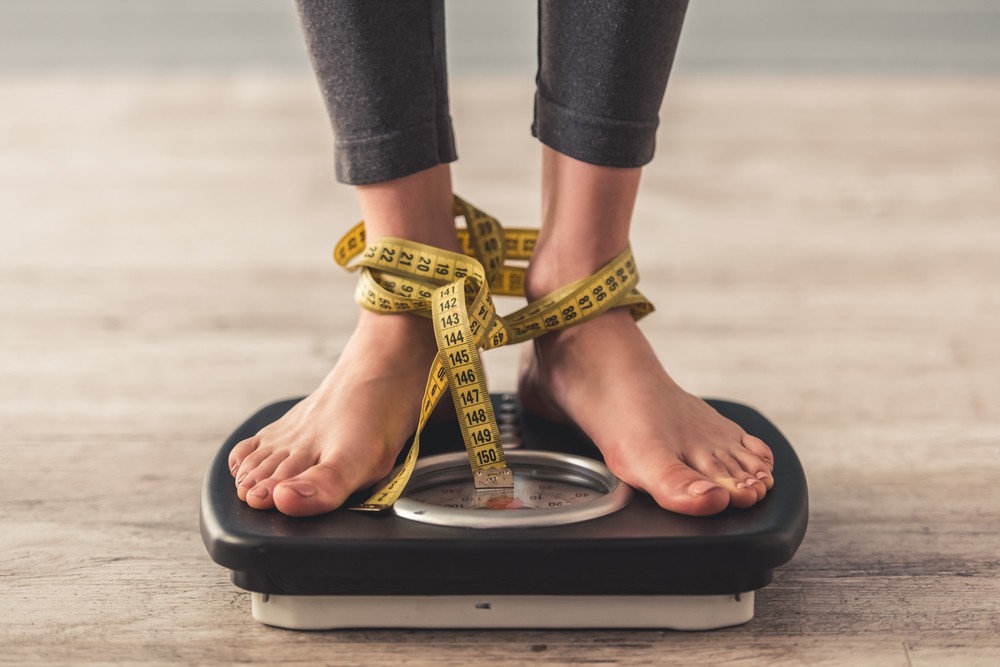
A newly-published study out of the University of Georgia has concluded that a daily weigh-in at home could prevent weight gain occurring during the winter holiday season, from mid-November to early January, coinciding needless to say with Christmas and New Year's  and just about everyone's tendency to over-indulge in holiday food of the season. What inspired nutrition researcher Jamie Cooper and her colleagues to examine the issue of seasonal weight gain was that it was known that this winter period disproportionately contributes to annual weight gain.

And even people who regularly exercise and who also indulge, are not spared. The results of their study published in the journal Obesity showed that participants who weighed themselves on a daily basis, thus receiving graphical feedback of weight changes, either managed to maintain, or even lost weight. Their study counterparts who failed to weigh themselves daily on the other hand, gained an average of around six pounds (2.7 kilograms) in that same period.

What their study emphasized was that people who began with a weight in the normal range for height remained within that range when they took the time to weigh in daily, to observe the results of their indiscreet eating during the holiday season. The study enlisted 111 adults between the ages of 18 and 65 who were instructed to maintain their weight throughout the 2017 - 2018 holiday season. Half of the study participants were randomly assigned to the weigh-in group, the other half abstained. After 14 weeks, researchers did a follow-up to determine who had succeeded.

According to Sara Bleich at Harvard, it would be difficult to ascertain whether the results owed entirely to daily self-weighing, since the instruction to maintain weight might have affected the behaviour of the participants. Though not involved in the study, she believes the data could represent a simple method whereby people could remain conscious of their weight during the holidays. And according to Dr. Steinle in Baltimore, the results suggest that using a scale daily could represent an intelligent way to boost adherence to a "healthy living" plan.

As for the study leader, Dr. Cooper feels the daily weigh-in could have popular appeal within the general public at large, since it is indeed a simple yet effective way to encourage people to remain fit during times when they are most likely to relax the standards of their normal eating patterns alongside their exercise regimen, leading them to consume more calories than they normally would at a time of seasonal lowered inhibitions. 

US researchers study self-weighing strategy to help prevent holiday weight gain
For many, the holiday season is synonymous with indulgence and overeating, which can lead to weight gain. (Shutterstock/File)

The paper, "Daily self-weighing to prevent holiday-associated weight gain in adults", can be viewed at https://onlinelibrary.wiley.com/doi/10.1002/oby.22454

Labels: , , , ,

 
()() Follow @rheytah Tweet