Ruminations

Blog dedicated primarily to randomly selected news items; comments reflecting personal perceptions

Monday, June 09, 2025

Time Spent On The Mountain -- Summiting Everest

"[There exists no evidence that xenon gas improves performance]; inappropriate use can be dangerous."
"Use without a scientific basis and with unknown health risks must be rejected." 
International Climbing and Mountaineering Federation
 
"So, what these people claim to have done is basically found a way to switch on the adaptation [of xenon gas] to low oxygen levels."
"Are we missing out on the sacrifice you sometimes have to make to get the achievement?"
Hugh Montgomery, professor of intensive care medicine, University College London 
 
"It [use of xenon gas to speed up ascents] is a provocation, especially for traditional mountaineers, who feel bad about this idea that you can climb Everest in less than a week."
"This May demonstration with four Brits, acclimatized prior to ascent] showed that it can work."
Lukas Furtenbach, expedition organizer 
https://i.cbc.ca/1.7546456.1748545621!/cpImage/httpImage/image.jpg_gen/derivatives/16x9_1180/nepal-everest-speed.jpg?im=Resize%3D780
Four British climbers pose on the summit of Mount Everest in Nepal. The mountain guide who arranged their trek said he and the team had inhaled xenon gas in Germany before embarking on the expedition where they reached the 8,848 metre peak of Everest less than five days after departing London. (Sandro Gromen/The Associated Press)
 
There are traditions born of necessity in acknowledging nature's supreme challenges and the logical physiological steps that must be undertaken in preparatory work to meet those challenges. And aspirants to ascend Mount Everest know that to achieve the summit, careful adherence to tried-and-true methods although not guaranteeing success, go a long way to improving opportunities. So to climb Mount Everest acclimatization time must be set aside to optimum success, which translates to weeks spent at base camp to allow one's body to familiarize itself with less oxygen than is normal at lower elevations.
 
From base camp, a slow progression to a number of camps, each where time is spent to enable the body to adjust to ever thinner atmospheres where oxygen is gradually diminished, until the final camp closest to the summit is reached, before the final push on to the summit. Most climbers as well make use of supplemental oxygen to enable them to fully adjust to conditions. In May of this year, an expedition of four men traveled from London to Everest, on to the summit and back in under a week. 
 
Research established that xenon gas can effectively acclimatize people to high altitudes, but on the other hand, there are some experts who feel benefits if any, are negligible, and it is as yet unknown what the use of the gas's side effects might be. According to Lukas Furtenbach, who organized the expedition, he has plans to offer two-week round-trip excursions to Mount Everest with the use of xenon gas, to cut typical time required to scale the mountain by several weeks' time.
 
https://i.cbc.ca/1.7546625.1748485121!/cpImage/httpImage/image.jpg_gen/derivatives/original_1180/nepal-crowded-everest-2019.jpg?im=Resize%3D1180
A long line of mountain climbers wait just below camp four, the final camp before the summit push on Mount Everest in Nepal on May 22, 2019. Eleven people died on Everest during that year's climbing season. (Rizza Alee/The Associated Press)
 
The need to take the time to acclimatize is to ensure the prevention of altitude sickness, whose symptoms include nausea, headaches, disrupted sleep, physical decline and the threat of potential swelling of the brain that can lead to death. The higher one climbs, the less oxygen is absorbed into the bloodstream. Which explains the common conventional use of supplemental oxygen. 
 
Some doctors have made use of the gas to 'precondition' patients to low oxygen levels prior to surgery but  because "it hasn't been as protective as one would hope", its use for that purpose has been limited, according to Professor Montgomery, at University College London, himself a mountaineer. Xenon gas is similar to the use of anesthesia; its use could lead to overdose or death according to some experts.
 
The reason for the tradition of weeks of training and acclimation on the slopes of Everest on the mountain's lower levels is an accepted practice understood to be typically required in the avoidance of unwanted complications and survival in the area above 7,925 meters on Everest, known as the 'death zone'. 
 
https://i.cbc.ca/1.7546663.1748489626!/fileImage/httpImage/image.jpg_gen/derivatives/original_1180/hypoxic-tent.jpg?im=Resize%3D1180
Akash Negi sits in a hypoxic tent set up in his New Jersey living room in April 2021. Mountaineers use the low-oxygen tents, which mimic thin air at high altitudes, to prepare themselves for the atmosphere they'll experience while climbing Mount Everest. ( Angela Weiss/AFP/Getty Images )
 
Weeks before launching themselves on the expedition the British group began sleeping in hypoxic tents to lower oxygen levels in the air to gradually acclimatize themselves to conditions on Mount Everest. Several weeks prior to the excursion they flew to Limburg, Germany where a doctor who had experimented with inhaled gases in his clinic supervised the men hooked up to ventilators while an anesthesiologist gradually introduced higher levels of xenon into their systems. 
 
Once arrived at the Everest base camp, the group ascended to the summit in less than three days. The Nepalese government's response to the group's use of gas leading to their rapid ascent was less than congratulatory.  Himal Gautam, director of Nepal's tourism department declared that using the gas was "against climbing ethics", that it would harm the tourism industry and the Sherpas who guide and assist climbers.
 
The response was that Mr. Furtenbach argued his expeditions were still making use of Sherpas, and shorter times on the mountain were safer, reducing the chance that climbers would be exposed to other health threats, including avalanches, hypothermia or falls. An argument that is questionable in its presumed merits, since accelerating the time to achieve the goal also means pushing on beyond normal endurance to meet the shorter time schedule, and as for avalanches, hypothermia or falls, they occur irrespective of time spend on the mountain.  
"[Making the mountain easier to summit, will likely attract more climbers], exacerbating the already serious overcrowding problem."
 "It just seems very, very risky at this onset, right at the beginning. It's really hard for me to think about ... using  a new type of technique. What type of safety protocol is involved with that?"
"You're not training the traditional way of being on the mountain for a month and a half, two months to acclimatize in the natural environment."
Chris Dare, Canadian Mountaineer  
https://i.cbc.ca/1.3053711.1748490634!/fileImage/httpImage/image.jpg_gen/derivatives/original_1180/rob-casserley.jpg?im=Resize%3D1180
Rob Casserley was among a team of climbers who survived avalanches on Mount Everest in 2015 that were caused by earthquakes in Nepal. He says climbers who aren't prepared for the psychological aspect of scaling the mountain could endanger themselves and others. (Rob Casserley/Facebook)
 

Labels: , , , , , , ,

Saturday, May 01, 2021

The Many Mysteries of SARS-CoV-2 Infections

"We've taken the elderly, the above-80s and, to a large extent, the above-70s, our most vulnerable patients, out of play [through inoculation]."
"But what we're left with is a group of patients who have a good chance of being saved, but the resources required to save them are sometimes astronomical."
"[Patients are remaining in intensive care longer, numbers intubated and attached to a ventilator increasing], and I think that's because we have a more salvageable population. They are appropriate to intubate, they are appropriate to care for, for a very long period of time, in the hopes that they eventually improve."
"There are some people in whom it was 100 percent predictable they were going to get bad disease because they have really bad co-morbidities [cancer, compromised immune systems]."
"But then we have a lot of people who either have no co-morbidities or just the usual things that so many people in that age group have, and why did they end up in the ICU? They were really unlucky. They got a really bad disease or their body reacted to it badly."
"You give the same virus to 20 people, one of them ends up in ICU, five of them don't have any symptoms, and they caught the same disease. It's bad luck. And nobody likes that answer."
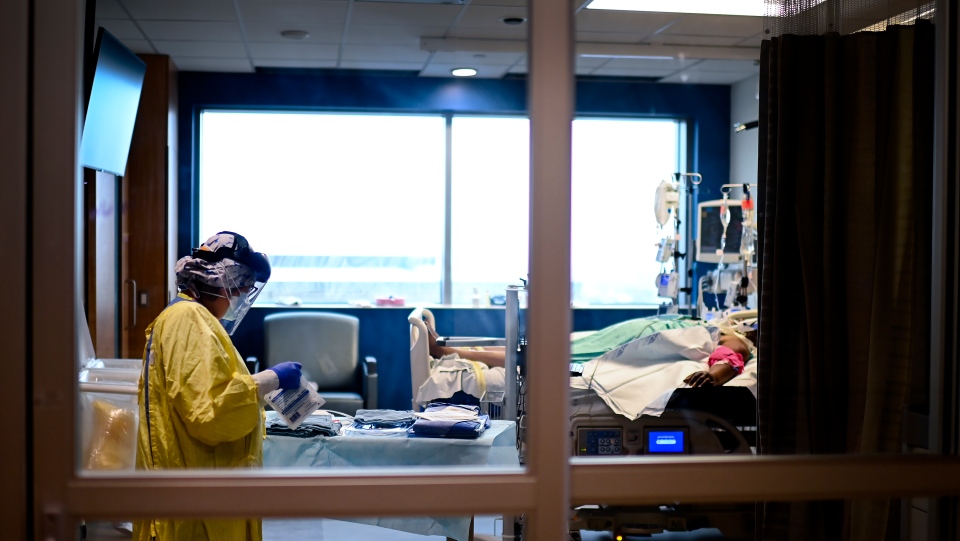
"About a third of my ICU beds are taken up with COVID patients. We're not seeing waves, we're seeing non-stop COVID for over a year. But we've been very lucky we've been able to handle it."
"[Watching what's happening in Toronto], and we're terrified. Toronto has top-level hospitals with top-level ICUs and with a good number of ICU beds per capita, and they're struggling."
Dr.Paul Warshawsky, chief, Division of Adult Critical Care Medicine, Jewish General Hospital, Montreal 
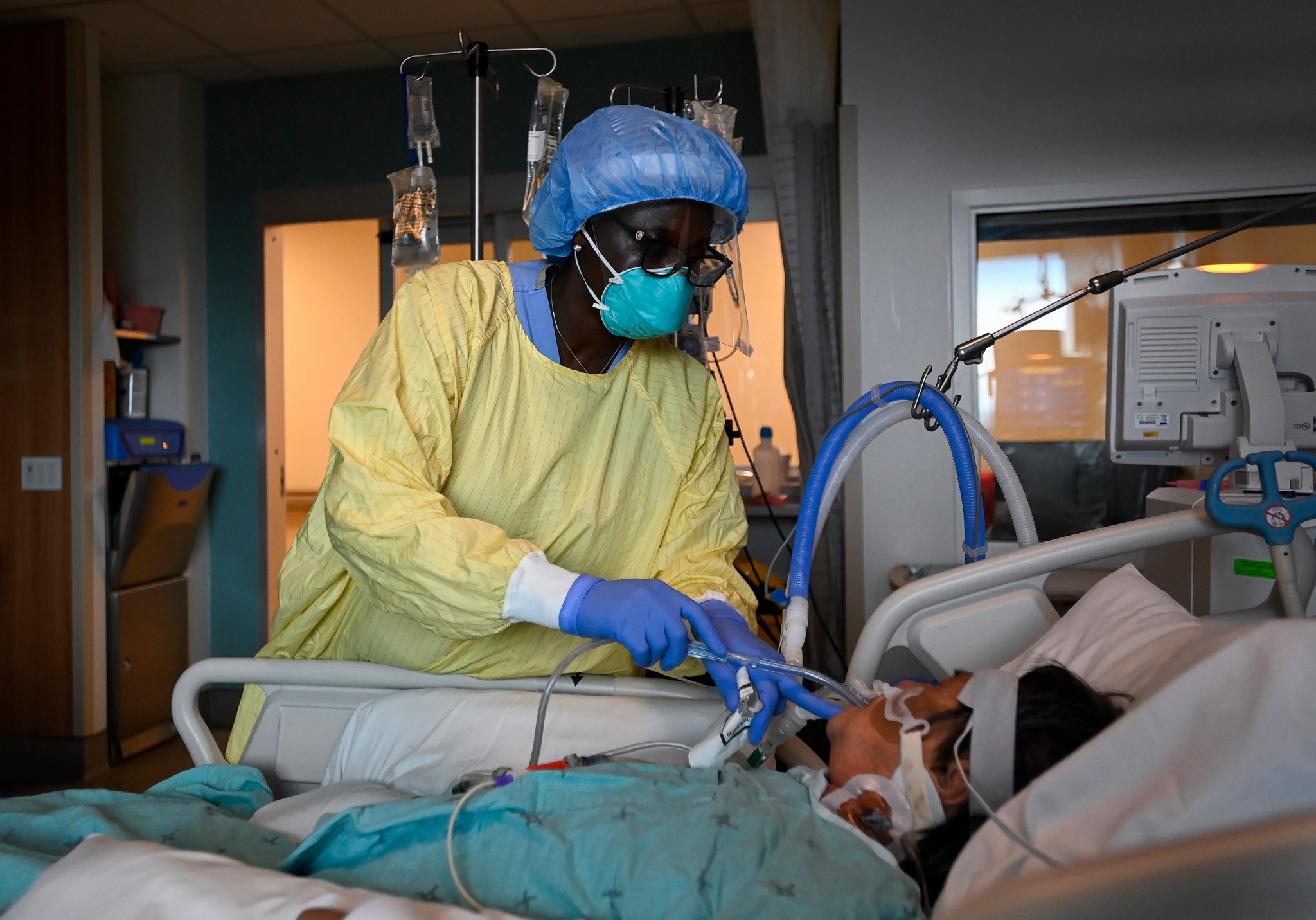
Registered nurse Jane Abas tends to a COVID-19 variant patient who is intubated and on a ventilator in the intensive care unit at the Humber River Hospital during the COVID-19 pandemic in Toronto on Tuesday, April 13, 2021.
Registered nurse Jane Abas tends to a COVID-19 variant patient who is intubated and on a ventilator in the intensive care unit at the Humber River Hospital during the COVID-19 pandemic in Toronto on Tuesday, April 13, 2021. Nathan Denette/CP
"Their hypoxemia was really out of keeping with their symptoms."
"The bulk of the ICU cases are still people in their 50s and 60s, but the ones that are standing out in everyone's attention are the ones in their 40s and into their 30s."
"There is clearly something different about this wave. It does seem like it's affecting younger people more."
"It's workplace exposure that's driving most of these infections, not children getting it at school and bringing it home to their parents."
Dr.James Downar , palliative and critical care specialist, Ottawa
 
"They're in a demographic that hasn't been vaccinated yet, and the variants are more infectious."
"We're seeing this greatly in all of the hospitals."
Dr.Anju Anand, respirologist, Toronto
 
"[While a few older teens have required ventilation}, all have been discharged in pretty good health. So kids have done well."
"I don't think we've seen more severe illness over the course of the year."
Dr.Jeremy Friedman, associate pediatrician-in-chief, Hospital for Sick Children, Toronto
ICU
 
In this, the third wave that has struck British Columbia, Alberta, Quebec and Ontario, the face of the pathogen that is COVID has changed in its targeting. In the first wave, COVID struck the health- compromised elderly in long-term care residences more than any other age group and more elderly people died than in any other age demographic. Younger people were thought to be fairly safe and children virtually immune. Now, outcomes have changed so dramatically with the SARS-CoV-2 virus infection that people are dying at home. Their symptoms advance so quickly they haven't the opportunity to go to hospital before they succumb.
 
They're being identified with hypoxia, it's what overcomes mountain summiteers when they rise too quickly in ascending toward mountain peaks where the oxygen becomes progressively diluted and it becomes difficult to breathe in enough oxygen without become acclimatized gradually at lower levels. The silent hypoxia creeping up on people so unexpectedly presents as a baffling condition of low levels of oxygen, people failing to understand how ill they are absent symptoms such as shortness of breath or gasping for air. 
 
"Younger daycare workers, ride-share drivers, factory workers ... and their families are dying", commented Dr.Michael Warner, head of critical care at Michael Garron Hospital in Toronto. In
Calgary, ICU nurses have reported entire families -- husband and wives, mothers and sons -- in critical care. Of those arriving to emergency many are essential workers or racialized populations without work-from-home options as well as those living in multi-generational homes or in cramped student housing. The more elevated community transmission is, the more opportunity of becoming infected.

Now, close to 90 percent of Canadian seniors age 80 and above have at least one dose of a COVID vaccine, leaving them with a level of protection not yet available to the younger population. And these younger people are remaining in intensive care longer with those being intubated and attached to a ventilator on the increase. It is specifically that increase of younger patients that is inexplicable. Many experts believe logically enough that variants are driving the increase leading to the "younger and sicker" phenomenon.

Close to 95,000 confirmed cases of variants of concern have been reported, the UK version accounting for fully 96 percent. Variants in Ontario are responsible for 90 percent of new infections. Mutants, according to the province's science table, carry a 63 percent higher risk of  hospitalization, a 103 percent increased risk of requiring intensive care, and a 56 percent increased risk of dying, in comparison to earlier versions of the SARS-CoV-2 virus.
 
Researchers reported in the European Journal of Epidemiology on the P.1 variant that emerged in Brazil and now spreading in Canada, linking it with a noted increase in the 20 to 59 year-olds in Amazonas requiring hospitalization and intensive ventilation care "as well as increased mortality in this age group during the second wave". Evidence has surfaced that the variants spread a higher virus dose, presumably affecting how sick someone exposed to it may become.

People sit at a restaurant patio to take advantage of sunny weather in Ottawa, March 20, 2021.
"[In the first wave it took ten to 14 days post-symptoms of] grumbling along [staying home until people got short of breath ending up in emergency or straight to the ICU]."
"[Now], it's becoming more in the neighbourhood of five to seven days. [Why?] Is it because younger people react differently to the virus, and we're only seeing  younger people now?"
"Is it because of the variants? It's still not 100 percent clear to me."
Dr.Paul Warshawsky, Jewish General Hospital, Montreal

Labels: , , , , , ,

 
()() Follow @rheytah Tweet