The power behind Olympic glory: IOC soaked in stupendous wealth, mystery and controversy

AP Photo/Lionel Bonaventure, Pool Dancers
perform during the opening ceremony of the 2014 Winter Olympics in
Sochi, Russia, Friday, Feb. 7, 2014. The show-stopping spectacles in
Sochi and Beijing distract the world from the opaque and dictatorial
political systems underpinning them, critics say.
It’s
impossible not to marvel at the spectacle and camaraderie of the
Olympics — to be awestruck by athletes who have devoted their lives with
monomaniacal intensity to perfecting a sport.
Yet behind the dramas and heartbreak that catch the world’s attention, few wonder how the games are run and funded.
That’s just the way the International Olympic Committee (IOC) likes
it. The exclusive and secretive organization is a cozy old boys’ club
(with a few women) critics compare to the Italian mafia.
Although governments contribute cash to the Olympics, the IOC is
private. It receives billions in revenue that critics say are not
subject to enough scrutiny.
“Because it’s a private organization — they are not funded by the
government or by the public — they don’t have any obligation to give
information or be transparent,” said Jean-Loup Chappelet, a professor at
the graduate school of public administration at the University of
Lausanne, Switzerland, and one of the few academics to study the IOC’s
governance.
Several members have been embroiled in match fixing or vote buying
scandals, while others have uncomfortable ties to sponsors and
broadcasters who have struck lucrative deals with the games. Some,
essentially, inherited their roles, such as Juan Antonio Samaranch Jr.,
executive committee member and son of the long-time former president.

FABRICE COFFRINI/AFP/Getty ImagesInternational Olympic Committee (IOC) executive member Juan Antonio Samaranch Jr.
The IOC has a say in every aspect of the Games. It oversees national
Olympic committees, negotiates broadcast and sponsorship rights, and
decides what sports can compete. Most crucially, it picks the sites.

FileThe
brainchild of Pierre de Coubertin, the modern Games were first held in
Athens in 1896 as an attempt to recreate the competitions of ancient
Greece.
And although IOC representatives are unpaid, their position alone
guarantees extraordinary influence. They also enjoy such perks as free
travel and event tickets.
The group’s image as a secretive coalition with a culture of
kickbacks and corruption made headlines during the Salt Lake City
scandal in 1998.
Although the IOC has attempted real reform since then, critics say it
is not as fair-minded as its Olympic ideals and far from being
democratic. Until it imposes strict term limits on members and opens its
nomination process, a secretive few will continue to control the
world’s largest celebration of sport.
The Olympics were once much more innocent. The brainchild of Pierre
de Coubertin, the modern Games were first held in Athens in 1896 as an
attempt to recreate the competitions of ancient Greece.

DAVID GOLDMAN/AFP/Getty ImagesRussian
President Vladimir Putin, centre, toasts International Olympic
Committee President Thomas Bach, left, after the opening ceremony of the
2014 Winter Olympics on Feb. 7, 2014, in Sochi.
Since then, they have evolved into a staggering and lucrative
spectacle. Under the aegis of the IOC, national bodies and international
sports federations oversee the development and qualification of
athletes. An organizing committee is struck to manage each Games.
Although the 104 members are elected, they must first pass the
scrutiny of the IOC executive. The result is a culture that is “closed
and conservative. It’s like a club,” said Prof. Chappelet.
“There’s almost no accountability or transparency. It’s a secretive
voting process. Who knows what goes on behind the scenes?” added Helen
Jefferson Lenskyj, a retired professor at the University of Toronto and
author of several books on the Olympics.
One of the most contentious issues is the IOC’s choice of
undemocratic states that have little regard for human rights, such as
China and Russia.
The IOC insists it is politically neutral, with President Thomas Bach
calling U.S. President Barack Obama’s refusal to go to Sochi an
“ostentatious gesture.”

JUNG YEON-JE/AFP/Getty ImagesInternational
Olympic Committee President Thomas Bach speaks during the Opening
Ceremony of the Sochi Winter Olympics at the Fisht Olympic Stadium on
Feb. 7, 2014 in Sochi.
“We are grateful to those who respect the fact that sport can only
contribute to the development of peace if it’s not used as a stage for
political dissent, or for trying to score points in internal or external
contexts,” Mr. Bach said.

Getty ImagesAdolf
Hitler and his staff salute the teams during the opening ceremonies of
the XI Olympic Games on Aug. 1, 1936 in Berlin, Germany.
But staging an Olympics pays big dividends for host nations. The
show-stopping spectacles in Sochi and Beijing distract the world from
the opaque and dictatorial political systems underpinning them.
The most prominent example is, of course, the 1936 Olympics in Berlin, a triumph of pre-war Nazi propaganda.
The fascist connections don’t stop there: Juan Antonio Samaranch Sr.,
IOC president for 21 years, was a sports minister under Spanish
military dictator Francisco Franco.
Andrew Jennings, a British investigative journalist who has written
several books on the IOC, has even found photographs of Mr. Samaranch
delivering “Heil Hitler” salutes.
“Nobody ever says the ‘f-word’ when writing about the Olympics,” he said.

Getty ImagesThe
Olympic torch is carried into the stadium during the opening ceremonies
of the XI Olympic Games at the Olympic Stadium in Berlin, Germany, on
Aug. 1, 1936.
“The problem with the IOC is that it’s covered by sports reporters
who are too craven and cowardly … [IOC members] are a bunch of very
dubious people seizing on ordinary people who have a passion for sport.”

PIERRE-PHILIPPE MARCOU/AFP/Getty ImagesDick Pound, a former Olympian and Canada’s only IOC member.
That passion does not seem to be abating.
Sochi’s $51-billion price tag is the most spent on any Olympics.
Prof. Chappelet said the number of cities rich enough to afford the
Games continues to shrink. A serious bid now costs $50-million to
$100-million, much of it spent on lobbying.
This gives non-democratic regimes an advantage: They can spend
enormous amounts of money without having to worry about accountability.
“It’s not politically acceptable, but it has been said that it’s
easier to organize an Olympics in non-democratic countries where people
don’t have a say,” he said.
But Dick Pound, a former Olympian and Canada’s only IOC member, says selectors shouldn’t discriminate against such states.
“The fact that the style of government is not one that mirrors Canada
doesn’t mean [such a] country is any less worthy or less able to
organize the games,” he said from Sochi.
“There’s an evolution in economics and politics … The Russia of today
is not the Soviet Union of 30 years ago. Brazil is not the country it
was 30 years ago.
“I think you have to be ready to move your event around the world,
and not try to stereotype the kinds of governments and political
organizations that are ‘worthy’ of hosting the games.”
One thing that is not in doubt is the values of the Games to the IOC.
As the increasingly wealthy Persian Gulf takes an interest in sports,
it’s not surprising princes and princesses from Saudi Arabia, the United
Arab Emirates and Qatar dominate the list of royals belonging to the
IOC. Of the 10 blue-bloods on the 108-person committee, four are from
the Middle East. Thanks to their enormous oil wealth, the Gulf states
are becoming muscular forces in the world of sport. The United Arab
Emirates, for example, has invested a small fortune to develop a Formula
One race track in a hotel just outside Abu Dhabi. Qatar is sparing no
expense to construct facilities to host the 2022 soccer World Cup. Major
sponsorship deals have recently been signed between Gulf state-owned
airlines and European soccer clubs. Several royals are also Olympic
athletes. Princess Haya Al Hussein, wife of the ruler of Dubai, competed
as an equestrienne, Prince Albert of Monaco has represented the
principality in sailing, while Princess Anne has ridden for Britain.
Sponsorships have become increasingly lucrative since the 1984 Los
Angeles Games. Those games revolutionized the revenue stream by opting
for a highly exclusive approach to corporate sponsorship — only one
sponsor was allowed in any product category. This dramatically increased
cash flow and profits. To maintain this exclusivity, Olympic organizers
go to great lengths to control what logos are broadcast. This year,
Apple logos on reporters’ laptops were taped over to preserve Samsung’s
exclusivity. Although athletes generally have to leave their individual
sponsors at home, the one exception is their equipment. That’s why
skiers, for example, quickly doff their skis for post-run interviews,
allowing them to display the logos.
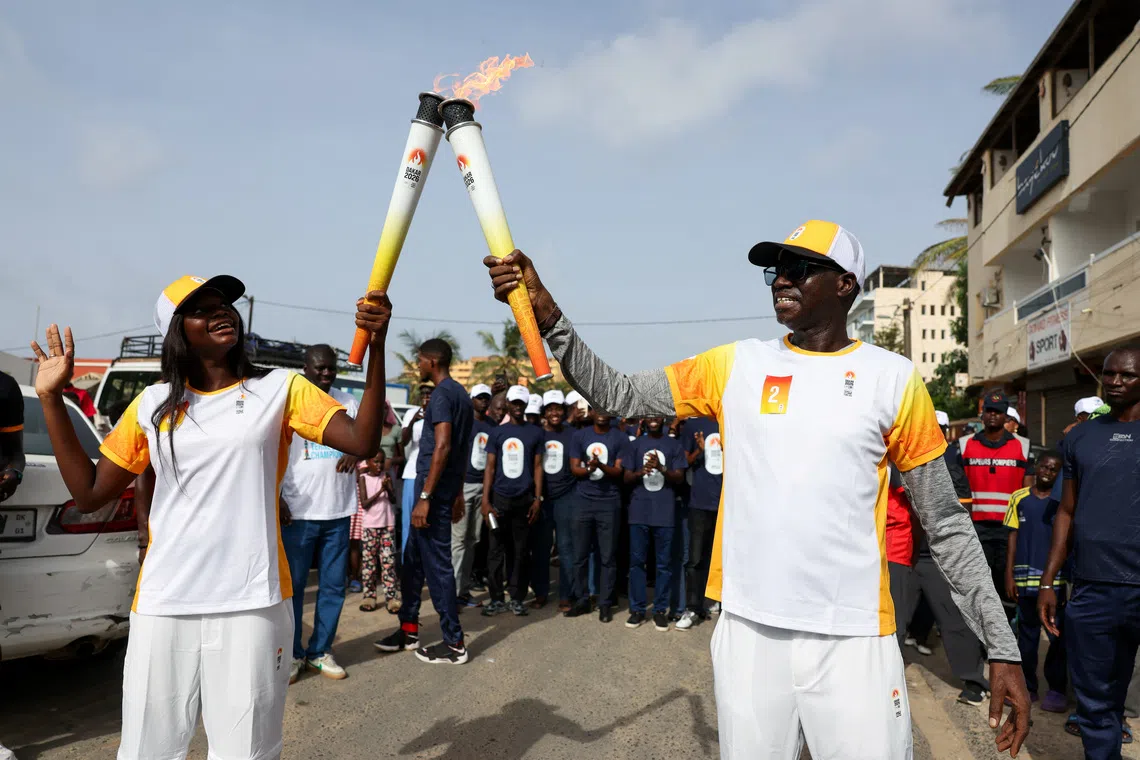
One of the most beloved traditions of the Olympics actually has its
origins in Nazi Germany. Although the Olympic torch was first lit in the
1928 Amsterdam Olympics, the cross-continent torch relay was a Nazi
innovation for the 1936 Berlin games. The Nazis’ torchbearers were the
first to carry the flame from the Olympics to the host city — it was
quite the spectacle at the time, particularly when the bearers crossed
territories that were later invaded. However, the tradition stuck and is
now regarded as a symbol of international camaraderie and cooperation.
Jen Gerson, National Post
In 2009-12, the Olympics earned more than US$8-billion, mostly from
broadcasting rights and sponsorships. Of that, 90% is distributed to
national and organizing committees.
The IOC goes to extraordinary lengths to ensure the exclusivity and
value of its corporate sponsorships. This year, for example, it ordered
the hiding of car grills and covered up the Apple logos on media laptops
with duct tape.
The competition among cities can be every bit as ruthless, as became clear during the Salt Lake City scandal.
Despite having technically superior bids, the Utah capital lost out
several times. The 1998 Winter Olympics went to Nagano, after Japanese
officials spent exorbitant sums entertaining IOC officials.
Utah officials took note. Salt Lake City’s next bid was accompanied with bribes of cash, gifts and, allegedly, prostitutes.
The IOC expelled six members. It also implemented numerous reforms,
including opening its financial statements and annual general meetings.
IOC members were also barred from visiting potential bid cities.
Mr. Pound believes these reforms had a major impact.
“[The IOC] may have been [secretive] at one point, but we’re one of
the few international organizations that opens up its meetings to the
media and publishes audited financial statements,” he said.
“In terms of governance principles that we now apply, we demonstrate best practices.”
Prof. Chappelet, on the other hand, thinks the IOC could do more to
keep up with evolving standards. While the post-Salt Lake reforms were
positive, they are now more than a decade old.
And the IOC has done little to continue improving in the meantime.
Prof. Chappelet said even FIFA, the international body that governs
soccer, has better ethics expectations than the IOC now.
“I think the public requests more now than it did in 1999 in terms of transparency,” he said. “The signposts have moved.”
Others wonder whether anything has really changed.
Ms. Lenskyj calls the post-Salt Lake improvements “superficial,”
while in 2004, a BBC probe found several well-connected people willing
to help London to secure IOC votes for the 2012 bid — for enough cash.
Several recent books include statements from IOC members boasting about
quid pro quo agreements, Ms. Lenskyj said.
As for Mr. Jennings, his response to claims of reform: “Ha.”
Labels: Finances, IOC, Olympics, Sports