Ruminations

Blog dedicated primarily to randomly selected news items; comments reflecting personal perceptions

Tuesday, May 07, 2019

Wealth In Flight

"It can be a sign of bad things to come as high-net-worth individuals are often the first people to leave -- they have the means to leave unlike middle-class citizens."
"Once the standard of living in these countries improves, we expect several wealthy people to move back [to their countries of origin]."
Andrew Amoils, head of research, New World Wealth
The Great White tax haven
Getty Images

Although according to New World Wealth even as high-net-worth people from China and India flee with their wealth to more financially stable countries to shelter their assets, the process whereby new millionaires are created continues, and as those new millionaires reach their coveted status they make up for the vacuum left by their predecessor who have flown. And whom analysts believe will return once stability and the climate for wealth to continue accumulating without undue risks returns.

In China, the state's grip on capital outflows in recent years has resulted in many of its wealthier citizens -- nervous about increased taxes -- shifting assets and people. Wealthy Asians tend to consider living in more comfortable environments where they look for greater privacy -- and where their children's education potentials can be enhanced -- when they consider where to re-locate themselves and their wealth.
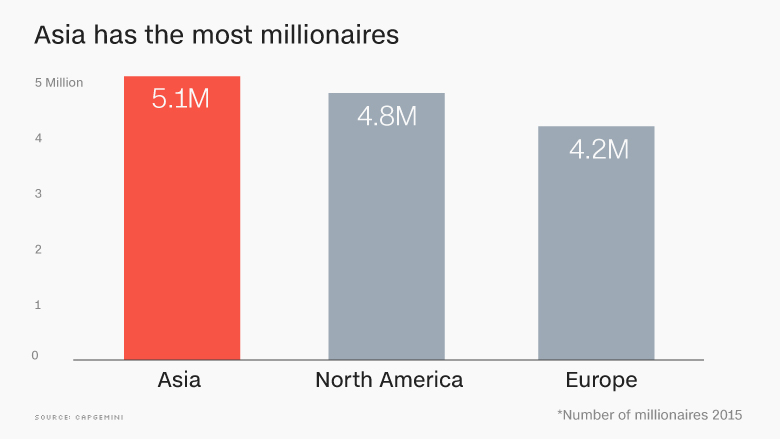
chart asia millionaires

An estimated 108,000 millionaires migrated last year, leaving their countries of origin for more promising fields abroad where concern arises over their wealth dwindling for any number of reasons related to higher taxation and growing social instability, representing an increase in such moves of 14 percent from the previous year. The numbers are over double the level in 2013, according to Johannesburg-based New World Wealth.

The top receiving destinations have been identified as Australia, Canada and the United States, cites the research firm, with China and Russia leaking their wealthy more than other countries. Even the United Kingdom saw a reduction of roughly three thousand millionaires who left for greener fields anticipating the impact that Brexit and taxation may eventually have on their wealth.
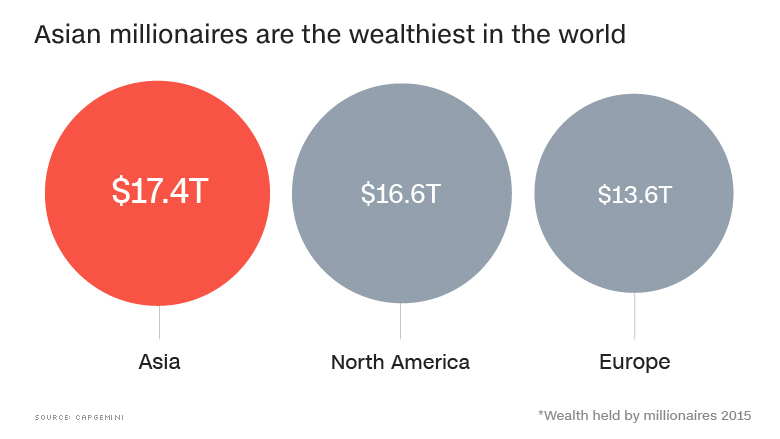
chart asian millionaires wealthiest in world

Social conditions such as crime, a paucity of business opportunities and religious tensions all have a part to play, and can be viewed as well as a future indicator, propelling the wealthy away from their current circumstances and into a more business-conducive atmosphere prevailing elsewhere. Australia appears to be top of the "wish list" for immigrants citing its safety, lack of inheritance tax and robust ties for business with China, Japan and South Korea.

Australia's sustained economic growth is yet another factor in its popular favour given that the global financial crisis left the country fairly unscathed, a country that has managed to avoid recessions in the past 27 years. The second most popular destination in 2018 was the United States. New York City, Los Angeles, Miami and the San Francisco Bay area are identified as the preferred destinations.

The volatility of emerging markets -- and downturns in others also fuels movements. Turkey lost four thousand millionaires in 2018, representing the third year in a row that many people of wealth have chosen to leave the country, while Russia last year lost about 7,000 millionaires as the nation grappled under sanctions imposed over Crimea's annexation.

wealthy hong kong
After interviewing 100 millionaires, some patterns started to emerge.
Vince Caligiuri/Getty

Labels: , ,

Wednesday, May 17, 2017

Coping With The Financial Fallout of Cancer

"It's a huge issue [loss of income and costs related to cancer care]. For middle-class Canadians and working-class Canadians a cancer diagnosis is like standing on thin ice, and you only hope you can get back to work and cover your bills before you go under."
"Those [government] benefits just expire too soon for a lot of people."
Gabriel Miller, Canadian Cancer Society

"It's something I'm not proud of [filing for personal bankruptcy], something I never thought I'd do. I've always been a proud, stand-up individual. But I had no alternative ..."
"You're not bringing in income, bills are mounting, [creditors] are not compassionate and understanding. They want their money."
Lawrence, (last name withheld),Toronto real estate agent, 56

"The thing that keeps me up at night is, if I do need a drug or some treatment of some sort, will we have the funds to cover it?"
"And if we have to sell our house, is that even a reasonable thing to do? Probably, I would just go quietly."
Deb Maskens, advanced kidney cancer patient, Guelph, Ontario

"People will deal with different stresses, they will have financial stress or problems with health."
"When you throw everything together all at once, there comes a point where you say 'I just can't do it any more'."
"You need to be able to breathe."
Monica Pope, 51, breast cancer patient
cancer cell
In Canada, a growing body of research, along with interviews with patients, point to the fact that despite universal health care coverage for everyone, a diagnosis of cancer has an enormous drag on anyone's future. Going beyond the dread diagnosis and the accompanying psychological stress and physical pain of surgery and treatment, there is the looming threat of financial insolvency caused by the inevitable prolonged income loss and costs related to cancer treatment.

Drugs required on an ongoing basis, not administered in a hospital, are paid for by the patient. If there are expenses related to travel on top of the drug costs the end result is a devastating financial burden at the very time when fear rules while the cancer is being treated and the final outcome remains unknown. An estimated one in six bankruptcies are caused by the fall-out of health problems, and many of them relate to cancer.

If there are economic options that come into play they are the draining of savings for retirement for example, the re-mortgaging of homes, and the base alternative of going on welfare. Undergoing cancer drug treatment at home, not in hospital, means it is patients who personally must pay the cost of expensive medications in some provinces. Once the fear of a dramatically shortened lifespan reflected reality, now however, patients live longer post-treatment and federal and provincial income support programs prove inadequate.

Some people have disability insurance that they rely upon to help them with their growing health-related expenses while there is a hiatus from their work, yet some insurance companies if they can prove a pre-existing condition is involved, refuse to honour the policy. Even though in Canada oncology treatment comes without a personal charge under the universal health care system, all other costs associated with treatment are at the patient's expense.

According to a 2002 survey by the Canadian Partnership Against Cancer, two of every five people diagnosed with cancer go off their work schedules for a minimum of six months while receiving treatment. The diagnosis of  cancer and its after-effects impact on caregivers, some 60 percent of whom must cut work hours or leave their employment, according to a Lung Cancer Canada Survey. Canadian patients' families experience incomes plummeting by 26 percent according to a 2010 McMaster University study.

While some employees in Canada have access to workplace disability benefits, an estimated seven million Canadians have none. Those who qualify can count on Employment Insurance kicking in, but sickness benefits last for fifteen weeks at most, providing 55% of normal salary. As for the Canada Pension Plan, cancer patients run into problems qualifying for disability benefits to people under 65 under CPP which kicks in at a rate of $1,300 monthly. And welfare provides less than that figure, as an alternative.

According to Ilene Shiller, a manager at Wellspring, a Toronto-based cancer charity, some people are so "shocked" at the prospect of their income falling so dramatically they delay treatment so they can remain at work longer. Quebec, Alberta and British Columbia pay for all cancer medications, Ontario and the Atlantic provinces provide less coverage for home medications typically costing thousands monthly. Ontario does have a catastrophic drug coverage program for patients under 65 with no workplace drug plan but patients are required to contribute four percent of their income yearly.

The nightmare for people facing a cancer diagnosis and attempting to balance all their needs as a patient with a drug protocol will continue to become an acute social problem as cancer drugs by 2020 taken at home are expected to impact 60 percent of patients. And while the Canada Health Act requires hospital-administered drugs to be covered by medicare, provinces are not expected to fund those medications self-administered in the home.

cancer bankruptcy

Labels: , , , , , ,

Saturday, May 13, 2017

The Bottom Line for Pharmaceuticals or the Top Line for Saving Lives?

"It is becoming increasingly difficult to disregard the costs of these new therapies -- side effect costs, costs to quality of life and financial costs ... especially when the benefits are very, very small."
"The vast majority ... are associated with extremely modest advances [in life-extension]."
Dr. Chris Booth, oncology professor researcher, Queen's University, Kingston, Ontario

"I just look back over the last fifteen years and [feel] we've really squandered a lot of resources pursuing meaningless targets."
Dr. Tito Fojo, oncology professor, Columbia University, New York, New York

"Lack of evidence doesn't mean there's lack of benefit, and sometimes with a patient you don't know until you've tried."
"There is nothing so powerful as seeing a patient who should be dead, who's had a complete remission."
Deb Maskens, kidney cancer patient, founder, CanCertainty, advocacy group
cancer cell
Cancer treatment has changed dramatically over the past several decades, and there have been some acclaimed success stories, with people recovering in greater numbers, and more people than ever 'beating' cancer, going on to live their lives. There is general agreement that some new cancer drugs have been transformative in the success of cancer treatment, but there is also an increasingly reluctant-to-admit but obvious failing in many others; the hype surrounding them is hopeful, but the reality belies the hype.

For all such drugs, those that have true merit and the others that promise while not delivering, the costs of their procurement and use is steep, so costly that they strain the ability of drug plans, governments, workplace insurance and patients to pay for them.Only three of 17 cancer drugs on the market since 2014 and 2015 rated well with evidence of "overall survival" with their use, after approval by Health Canada. Of four others of the 17, life was extended by 1.4 to six months. For the remainder no clear conclusion could be reached of their merit in use.

List prices for these drugs? Monthly, $4,700 to $33,000. In the early 1990s when Taxol was introduced and its effect was lauded against several types of advanced cancers, its popularity and huge cost attracted the attention of the pharmaceutical industry to the vast profits waiting to be made. Research and development to produce other successful, best-selling drugs went forward full-steam. Herceptin treatment for aggressive breast cancer; Gleevac to treat adult leukemia; BRAF-inhibitors to treat melanoma; and immunotherapy drugs with their promise in dealing with a variety of cancers, surfaced as true successes.

Dr. Maureen Trudeau, head of medical oncology at Sunnybrook Health Sciences Centre in Toronto cites Opdivo, a new treatment for melanoma, able to retain life for 30 percent more patients than had previous therapy: "It's incredible. Some of these drugs are changing lives", she notes. Those, granted, are the success stories; the list of drugs approved by Health Canada in the past two years appear to fall short of being wonder cures, despite the hype surrounding them, matching their sky-high costs.

The rising cost of cancer

The average monthly cost of newly approved cancer drugs (in 2013 U.S. $)

up to 19801981 - 19891990 - 19951996 - 20002001 - 20052006 - 20102011 - 2013$289$1,113$2,551$3,232$6,948$10,406$10,761
Source: Center for Health Policy & Outcomes, Memorial Sloan Kettering Cancer Center

Still, it is undeniable that people suffering from cancer survive longer now. The number of Canadians alive five years after their dread diagnoses has advanced to 63 percent, an increase from the 56 percent standard of the early 1990s and late 2000s. More screening, allowing cancers to be discovered at an earlier date, along with better treatments are what the Canadian Cancer Society attributes to the growing survival rates.

Preliminary results on new drug treatments are accepted as a quasi-guarantee on longer-life outcomes in recognition that actual survival improvements in short trails are difficult to measure. Health Canada, as well as U.S. and European regulars all accept this. The social pressure to permit what appear to be promising new cancer treatments to enter the market as quickly as possible without waiting to judge whether they may prolong people's lives gives priority to the former and a back seat to the latter.

From the perspective of patients, anxious to prolong their lives, improvements allowing a few months more life may permit a dying person to share their family a little longer, or even buy time during which a superior advance may be on the horizon in care and miracle drugs. Approval of new drugs is a costly affair; Opdivo, a major breakthrough for melanoma comes at a $8,200-per-month pricetag. Yet it was found to be no more effective than existing chemotherapy for lung-cancer patients, and that finding led Biristol-Myers' stock to plummet.

Novartis can produce evidence that it can cost a pharmaceutical company up to $2.6-billion to produce one single, new drug.  Blincyto, found to extend median survival for some late-stage adult leukemia patients by 3.7 months has a cost of $33,000 for 28 days' medication. Six months after its approval, an alert from Health Canada gave warning of mounting evidence it can trigger potentially fatal inflammation of the pancreas.

A high rate of death and lesser but serious side-effects in early stage patients for those using Zydelig which improved overall survival for advanced leukemia sufferers, spurred Health Canada to issue a warning. One analyst claimed the drug was "dead in the water". Its cost was relatively modest, at $4,700 a month. The simple fact is that most of the drugs have a long list of toxic side-effects attached to their use.
Steve Rudaniecki took part in a clinical trial at Hamilton’s Juravinski Cancer Centre. Almost immediately, the lumps and bumps from his chronic lymphocytic leukemia started to disappear.
Steve Rudaniecki took part in a clinical trial at Hamilton’s Juravinski Cancer Centre. Almost immediately, the lumps and bumps from his chronic lymphocytic leukemia started to disappear.  (John Rennison / The Hamilton Spectator)

Novartis charges $7,000 monthly for the drug Afinitor. And that cost is static, irrespective of whether the dose reflects the recommended 10 milligrams, or is reduced to 5 mg or even 2.5 mg. "It is reprehensible in my mind", Sunnybrook oncologist Dr. Maureen Trudeau noted. Little wonder with these sky-high prices, new cancer drugs are placing stress on public and private health plan funders. An estimated 1,800 cancer drugs are in the development stages.

And then there is the fact that a growing number of these new drugs are taken as oral pills or injectables that patients are able themselves to administer in their homes Which translates to the expectation that those people become responsible for the cost of the treatment themselves, while treatment that takes place in hospitals is covered under medicare.  In the United States, many payers remain willing to pay such exorbitant prices; a fact most encouraging to the pharmaceutical manufacturers.

cancer drug costs

Labels: , , , , ,

Sunday, September 20, 2015

The Delusion of Permanence

"We decided to move, and then we were in a position deciding whether to rent or to buy and so, Colin sold his townhouse and then we bought a house in Calgary together."
"Marriage was never part of the conversation."
"I don't feel entitled to something that I didn't earn. And it's not that I don't feel like this is half my house, it is ... When I have more solid work and as time goes by, it will end up being a more equitable purchase."
Charmaine Ferguson, Calgary

"Marriage is going to be a decision, to me, which is entirely based on your love to [sic] that person, your commitment for that person, your willingness to go forward and support that person."
"It's not in any way a financial decision for me."
Colin Andrews, Calgary
Chris Bolin for National Post
Chris Bolin for National Post   Charmaine Ferguson and Colin Anderson bought a house together, but they're not married, or even engaged
"We live in a time where people don't necessarily see marriage as necessary for making all kinds of commitments."
"I think for a lot of young couples, buying a home is an economic decision and it's a better idea than renting. I say this not as a sociologist who studied it, but also as someone who did this personally."
"For me, buying a home with someone felt like less of a commitment than getting married. It's relatively easy to sell a home if you decide you want to do that, but getting divorced is a much more complicated thing."
Eric Klinenberg, professor of sociology, New York University

"The Supreme Court of Canada case that was in the last couple of years says if you live as husband and wife, legally you should be treated the same way when it comes to property."
"However, as is their wont, they didn't give any guidelines at all."
"The longer you live together, the deeper the roots and the more you will resemble a legally married couple."
"Not to have a road map as to what you're going to do in the event of a breakdown, whether it be common law or marital, in my mind is crazy. You're really taking a big chance that you know what the odds are."
Donald S. Baker, family law specialist, Baker and Baker, Toronto
0916commonlaw

The odds are in the commitment a couple has decided to mutually invest in. Assuming that it is mutual respect and love and companionship and a wish to live together as a family that motivates them. Conventionally, it has always been marriage first, followed by the acquisition of a home in which to live and presumably, raise a family. It certainly is no casual decision for a couple to decide to couple their lives with one another.

And nor is it a casual commitment entirely to buy a home together, since that too is a hurdle to be passed; investing in their common future. Which makes it all the more puzzling that the woman, 31, gives the impression of being content with the more casual relationship rather than one that is legally and emotionally binding, with all the responsibilities to one another inherent in the marriage covenant.

All of which makes a hash of the man's statement that marriage represents a decision entirely based on love, since love is their prime motive for living together and making a home investment. The decision does speak of independence for the woman, and a more hazy commitment on the man's part. Both represent a spillover from the movement for female liberation. The alliance is a tendentiously uncertain one, not entirely beneficial to the woman.

This is a couple who met at age 28 and who have been involved in a common-law relationship for the past three years. Three years should be ample time for a man and a woman to determine whether they are suited to one another to the point where marriage seems desirable. They are among the growing trend of young Canadians preferring to live common-law, though research indicates that these relationships are more fraught than traditional marriages.

But according to Statistics Canada, the number of people who choose that route is rising, and has done almost 14% over the years 2006 to 2011, the last years for which that data is available. Of the common law couples, a study conducted in 2013 by a real estate company in the U.S. found 17 percent of such couples bought a home prior to marriage; among a younger cohort that number rose to 24 percent.

In Canada, common-law marriage does not appear in the legal code; automatic rights to property in marriage-like relationships are not assured, with provinces and government agencies having their own interpretations of how such relationships are to be parsed as far as property rights go. For those whose relationship reflects that of marriage, who buy property together, most of the same protections under the law are similar to legally married couples.

For a married couple from the day of the wedding, however, the law recognizes their legal bond as a true partnership irrespective of who pays for what, and if a breakdown of marriage occurs, everything is equally divided. For an unmarried pair this protection is afforded insofar as their relationship fits a mould: Do they use a joint bank account? How long have they been a couple?

For the couple in question, the man provided the entire down payment, while the woman contributes to the monthly mortgage and maintenance payments, proportional to her income. Were they to dissolve their relationship, the courts would be likely to hand over the house to the man, and the woman's contributions to date considered rent, without claim to the property. In marriage, this would not be the case.

This speaks to the brevity of their relationship thus far. Should it endure, the longer the couple live together the deeper the investment is assumed to be, more resembling a traditional legally married pair. No federal legislation as yet speaks to common-law couples and couples who together buy property.

The solution may be to examining the issue closely before committing to a dual purchase of anything as substantial as property, to write up a cohabitation agreement as a legal document, setting out the mutually-agreed-upon rights and responsibilities of each of the principals.

Video thumbnail for What to do if you buy a house before a ring

Labels: , , , ,

Saturday, August 01, 2015

Surgically Frugal

"All you needed to do is give the surgeons, the people on the ground, the information they needed to be helpful, and they jumped at the chance."
"Doctors would look at their bill and say 'Holy smokes, they charge $200 for that piece of foam? I don't need to use that'."
Dr. Michael Tymianski, head, Toronto University Health Network neurosurgery division

"I tend to adopt a policy ... that we use the best product that we believe works for the job and we say 'Bugger the cost'."
"There are others who are driven by cost and will say 'No, I don't care what your product is, I want to do it more cheaply."
Dr. Chris DeGara, president, Canadian Association of General Surgeons

"There are so few places in our lives where we are not aware of our costs. If you're shopping for groceries, if you're shopping for clothes, you're constantly aware of what things cost."
Dr. Leigh Sowerby, ear, nose and throat specialist, St. Joseph's Health Care, London, Ontario
J.P. Moczulski for National Post
J.P. Moczulski for National Post    Dr. Leigh Sowerby, a surgeon at St. Joseph's Hospital in London, Ont.: “There are so few places in our lives where we are not aware of our costs.”

Dr. Sowerby described a surgical instrument called a "triangle knife", which like all instruments laid out by nurses preparatory to surgery taking place in an operating room, is carefully unwrapped to ensure it is ready to be handed when and as needed by an operating-room nurse to the waiting surgeon's outstretched hand. The knife has a $110 price tag. It may or may not be used during a surgical procedure.

But it has been taken out of its sterile packing, ripped open for swift passage to a doctor who will want to use it, and is meant for use at every ENT (ear/nose/throat) operation. In the interests of prudence and cost-saving that customary unpacking of the triangle knife no longer occurs; it is left untouched but available. Since once unwrapped from its sterile packaging, if it isn't used, it is no longer sterile and must be discarded, a loss of $110 for an instrument that was not used.

J.P. Moczulski for National Post
J.P. Moczulski for National Post   Dr. Leigh Sowerby, of St. Joseph's Hospital in London, Ont., holds a disposable surgical instrument.

St. Joseph's hospital no longer indulges in that kind of waste. Once a surgeon indicates certainty that the product will be used during an operation it will be available but still kept wrapped. If it isn't in fact used, it will be returned to inventory for use during another operation. At Vancouver Coastal Health facilities an ENT surgeon replaced a tissue-sealing device that had a price tag of $375 with one that cost $35 and performed the same function.

A neurosurgeon specializing in minimally-invasive endoscopic surgery discovered a disposable scalpel used to make small incisions at the base of the brain cost $200. When he was informed how much the disposable scalpel cost he was astonished, and said: "Are you kidding? I can do that with a 65-cent scalpel blade". All examples of heightened awareness leading to operating cost-savings for hospitals.

Single use or disposable surgical supplies, including everything from sutures to scalpels and sterile draperies, total thousands per individual surgery, adding millions to hospital budget outlays. These costs are being compared to those of hospital salaries, coming in second place in a hospital's budget. Now, a new Canadian study points out that doctors in general have little knowledge of the cost of these items.

In response, many hospitals now familiarize surgeons with the sticker prices on their throwaway equipment. Moreover they've noted who among hospital surgical staff racks up high bills for disposables and take them to gentle task over it. As a result, doctors are becoming more aware, resulting in preferring products that cost less than a more costly alternative.
Varying costs, estimated by surgeons and administrators, of some of the disposable products used in surgery:
  • Bits for a microdebrider, used to break up nasal polyps: $100 to $200
  • Each staple from a surgical stapler: $100
  • Single-use stapler itself: $300
  • Triangle knife used for tight spaces: $100
  • Sutures (depending on use): 50 cents to $150
  • Implantable mesh for varying purposes: $50 to $6,000
  • Tissue-sealing device for ear, nose and throat operations: $35 to $375
  • Special scalpel used in neurosurgery: $200
  • Fibrin glue to stop internal bleeding: $360
At Toronto Western, the savings that came about through the new practices have made it possible for the neurosurgery division to bring more surgeons on staff and to substantially increase the number of operations the hospital can now offer. Best of all, the reduction of spending on single-use products has had no patient-outcome effect whatever.

Which hasn't stopped some surgeons from feeling uneasy about the situation, concerned that the move to use cheaper products during operations might place a small subset of patients at risk while achieving a negligible long-term gain. Dr. DeGara speaks of a surgical stapler that costs $300 for use in detaching an appendix, and the alternate is little loops costing $18, to be tightened around the appendix to produce a similar result.

The problem lies in the chance that the loop method might result in a one percent greater risk of complication, which would require some patients to spend longer hospital stays, thus effectively wiping out any cost savings realized.

John Lucas/Postmedia/File
John Lucas/Postmedia/File   “I tend to adopt a policy … that we use the best product that we believe works for the job and we say ‘Bugger the cost,’ ” says Dr. Chris De Gara, president of the Canadian Association of General Surgeons.

Labels: , , ,

Saturday, February 22, 2014

Sacrificing Self for God

"Archbishop Myers obviously is not paying any attention to the Pope. This is extreme, way beyond what you'd expect to happen. I can't believe the parishioners of Newark are going to allow this to happen."
Charles Zech, Villanova University business school
\"1.3
1.3 million-strong Catholic diocese pays out $500,000 for Archbishop John J. Myers of Newark's luxury retirement palace while Church cries poverty.  Photo by CNS

"Nothing short of an assault on the goodwill and trust of the people of God. The arrogance and self-importance required to undertake such a project on one's own behalf and funded, at least partially, with the proceeds from the sale of other archdiocesan-owned property is breathtaking."
National Catholic Reporter, editorial
Bishop Dennis J. SullivanBishop Dennis J. Sullivan
Bishop Dennis J. Sullivan (Photo courtesy of Diocese of Camden via camdendiocese.org)

Read More: Camden Diocese Buying New Home for Bishop | http://nj1015.com/camden-diocese-buying-new-home-for-bishop/?trackback=tsmclip

The National Catholic Reporter published the information that in the Camden, New Jersey diocese, Bishop Dennis Sullivan purchased a 7,000 square-foot mansion complete with eight bedrooms, six bathrooms, with an in0-ground pool, three fireplaces, a library and a five-car garage. In Newark, reported the paper, 28% of the population live below the poverty level.

2006 photo of Woodbury, N.J., home bought for bishop of the Diocese of Camden.(Photo: Al Schell, (Cherry Hill, N.J.) Courier-Post)

This kind of self-entitlement appears to be a specialty among some high-placed members of the Roman Catholic Church, defying and effectively denying their new Pope's message of frugality and thought for the poor of the Earth. Pope Francis has called upon members of his church to be extremely aware and sympathetic to the needs of the poor; he abjures the wretchedness of the capitalist system that results in wealth and poverty.

"Money and economic power can be a means to distance people from one another, confining them to an egocentric and egotistical plane", he wrote in a recently published preface to a book on the mission of the poor, entitled "Poor for the Poor". The message flies above the disinterested and obviously oblivious notice of some, like the New Jersey Bishop and the Newark Archbishop.

New Jersey Archbishop John Myers is being criticized for his disinterest in the plight of the poor in his diocese, and his fixation on his retirement in two years' time. In the spirit of it's never too early to plan for retirement, he is feathering an opulent nest for himself in contemplation of leisure time to enjoy it to full advantage.
He has paid out a princely $500,000 for a 4,500-square-foot, five bedroom, three bathroom, three-car-garage mansion, with a large outdoor pool. Fit for a prince of the church, without doubt. The local Star-Ledger newspaper has reported as well that the archbishop is in the full throes of having a three-storey, 3,000-square-foot addition built onto this already sumptuous home. The addition will include an indoor exercise pool, a hot tub, three fireplaces, a library and an elevator.

The house, actually, is currently used by Archbishop Myers as a weekend residence. He is preparing it for his full-time residence. His spokesperson, Jim Goodness, (how aptly named!) informed the newspaper that the addition would be paid for through selling the off of other church-owned properties. Kindly donors had also contributed to the $700,000 upgrades-cost.

Despite the advice by the good Pope, these men of the church know full well that money can help people achieve goals, and they are simply using the Church money at their command to achieve their personal goals; that it is at the expense of the community which they serve, is simply an incidental inconvenience -- not for the archbishop and the bishop involved perhaps, but the faithful who subscribe to the injunction to give and support their church.

And mostly to the disadvantage of the poor among them.

Labels: , , ,

Sunday, February 16, 2014

The power behind Olympic glory: IOC soaked in stupendous wealth, mystery and controversy

| | Last Updated: Feb 14 11:25 PM ET
National Post
Dancers perform during the opening ceremony of the 2014 Winter Olympics in Sochi, Russia, Friday, Feb. 7, 2014.  The show-stopping spectacles in Sochi and Beijing distract the world from the opaque and dictatorial political systems underpinning them, critics say.
AP Photo/Lionel Bonaventure, Pool     Dancers perform during the opening ceremony of the 2014 Winter Olympics in Sochi, Russia, Friday, Feb. 7, 2014. The show-stopping spectacles in Sochi and Beijing distract the world from the opaque and dictatorial political systems underpinning them, critics say.

It’s impossible not to marvel at the spectacle and camaraderie of the Olympics — to be awestruck by athletes who have devoted their lives with monomaniacal intensity to perfecting a sport.
NP Graphics

Yet behind the dramas and heartbreak that catch the world’s attention, few wonder how the games are run and funded.

That’s just the way the International Olympic Committee (IOC) likes it. The exclusive and secretive organization is a cozy old boys’ club (with a few women) critics compare to the Italian mafia.
Although governments contribute cash to the Olympics, the IOC is private. It receives billions in revenue that critics say are not subject to enough scrutiny.

“Because it’s a private organization — they are not funded by the government or by the public — they don’t have any obligation to give information or be transparent,” said Jean-Loup Chappelet, a professor at the graduate school of public administration at the University of Lausanne, Switzerland, and one of the few academics to study the IOC’s governance.

Several members have been embroiled in match fixing or vote buying scandals, while others have uncomfortable ties to sponsors and broadcasters who have struck lucrative deals with the games. Some, essentially, inherited their roles, such as Juan Antonio Samaranch Jr., executive committee member and son of the long-time former president.
FABRICE COFFRINI/AFP/Getty Images
FABRICE COFFRINI/AFP/Getty ImagesInternational Olympic Committee (IOC) executive member Juan Antonio Samaranch Jr.
 
The IOC has a say in every aspect of the Games. It oversees national Olympic committees, negotiates broadcast and sponsorship rights, and decides what sports can compete. Most crucially, it picks the sites.
File
FileThe brainchild of Pierre de Coubertin, the modern Games were first held in Athens in 1896 as an attempt to recreate the competitions of ancient Greece.
 
And although IOC representatives are unpaid, their position alone guarantees extraordinary influence. They also enjoy such perks as free travel and event tickets.
The group’s image as a secretive coalition with a culture of kickbacks and corruption made headlines during the Salt Lake City scandal in 1998.

Although the IOC has attempted real reform since then, critics say it is not as fair-minded as its Olympic ideals and far from being democratic. Until it imposes strict term limits on members and opens its nomination process, a secretive few will continue to control the world’s largest celebration of sport.

The Olympics were once much more innocent. The brainchild of Pierre de Coubertin, the modern Games were first held in Athens in 1896 as an attempt to recreate the competitions of ancient Greece.
DAVID GOLDMAN/AFP/Getty Images
DAVID GOLDMAN/AFP/Getty ImagesRussian President Vladimir Putin, centre, toasts International Olympic Committee President Thomas Bach, left, after the opening ceremony of the 2014 Winter Olympics on Feb. 7, 2014, in Sochi.
 
Since then, they have evolved into a staggering and lucrative spectacle. Under the aegis of the IOC, national bodies and international sports federations oversee the development and qualification of athletes. An organizing committee is struck to manage each Games.

Although the 104 members are elected, they must first pass the scrutiny of the IOC executive. The result is a culture that is “closed and conservative. It’s like a club,” said Prof. Chappelet.

“There’s almost no accountability or transparency. It’s a secretive voting process. Who knows what goes on behind the scenes?” added Helen Jefferson Lenskyj, a retired professor at the University of Toronto and author of several books on the Olympics.

One of the most contentious issues is the IOC’s choice of undemocratic states that have little regard for human rights, such as China and Russia.

The IOC insists it is politically neutral, with President Thomas Bach calling U.S. President Barack Obama’s refusal to go to Sochi an “ostentatious gesture.”
JUNG YEON-JE/AFP/Getty Images
JUNG YEON-JE/AFP/Getty ImagesInternational Olympic Committee President Thomas Bach speaks during the Opening Ceremony of the Sochi Winter Olympics at the Fisht Olympic Stadium on Feb. 7, 2014 in Sochi. 
 
“We are grateful to those who respect the fact that sport can only contribute to the development of peace if it’s not used as a stage for political dissent, or for trying to score points in internal or external contexts,” Mr. Bach said.
Getty Images
Getty ImagesAdolf Hitler and his staff salute the teams during the opening ceremonies of the XI Olympic Games on Aug. 1, 1936 in Berlin, Germany.
 
But staging an Olympics pays big dividends for host nations. The show-stopping spectacles in Sochi and Beijing distract the world from the opaque and dictatorial political systems underpinning them.
The most prominent example is, of course, the 1936 Olympics in Berlin, a triumph of pre-war Nazi propaganda.

The fascist connections don’t stop there: Juan Antonio Samaranch Sr., IOC president for 21 years, was a sports minister under Spanish military dictator Francisco Franco.

Andrew Jennings, a British investigative journalist who has written several books on the IOC, has even found photographs of Mr. Samaranch delivering “Heil Hitler” salutes.
“Nobody ever says the ‘f-word’ when writing about the Olympics,” he said.
Getty Images
Getty ImagesThe Olympic torch is carried into the stadium during the opening ceremonies of the XI Olympic Games at the Olympic Stadium in Berlin, Germany, on Aug. 1, 1936.
 
“The problem with the IOC is that it’s covered by sports reporters who are too craven and cowardly … [IOC members] are a bunch of very dubious people seizing on ordinary people who have a passion for sport.”
PIERRE-PHILIPPE MARCOU/AFP/Getty Images
PIERRE-PHILIPPE MARCOU/AFP/Getty ImagesDick Pound, a former Olympian and Canada’s only IOC member. 
 
That passion does not seem to be abating.
Sochi’s $51-billion price tag is the most spent on any Olympics. Prof. Chappelet said the number of cities rich enough to afford the Games continues to shrink. A serious bid now costs $50-million to $100-million, much of it spent on lobbying.

This gives non-democratic regimes an advantage: They can spend enormous amounts of money without having to worry about accountability.
“It’s not politically acceptable, but it has been said that it’s easier to organize an Olympics in non-democratic countries where people don’t have a say,” he said.

But Dick Pound, a former Olympian and Canada’s only IOC member, says selectors shouldn’t discriminate against such states.

“The fact that the style of government is not one that mirrors Canada doesn’t mean [such a] country is any less worthy or less able to organize the games,” he said from Sochi.
“There’s an evolution in economics and politics … The Russia of today is not the Soviet Union of 30 years ago. Brazil is not the country it was 30 years ago.

“I think you have to be ready to move your event around the world, and not try to stereotype the kinds of governments and political organizations that are ‘worthy’ of hosting the games.”
One thing that is not in doubt is the values of the Games to the IOC.

As the increasingly wealthy Persian Gulf takes an interest in sports, it’s not surprising princes and princesses from Saudi Arabia, the United Arab Emirates and Qatar dominate the list of royals belonging to the IOC. Of the 10 blue-bloods on the 108-person committee, four are from the Middle East. Thanks to their enormous oil wealth, the Gulf states are becoming muscular forces in the world of sport. The United Arab Emirates, for example, has invested a small fortune to develop a Formula One race track in a hotel just outside Abu Dhabi. Qatar is sparing no expense to construct facilities to host the 2022 soccer World Cup. Major sponsorship deals have recently been signed between Gulf state-owned airlines and European soccer clubs. Several royals are also Olympic athletes. Princess Haya Al Hussein, wife of the ruler of Dubai, competed as an equestrienne, Prince Albert of Monaco has represented the principality in sailing, while Princess Anne has ridden for Britain.

Sponsorships have become increasingly lucrative since the 1984 Los Angeles Games. Those games revolutionized the revenue stream by opting for a highly exclusive approach to corporate sponsorship — only one sponsor was allowed in any product category. This dramatically increased cash flow and profits. To maintain this exclusivity, Olympic organizers go to great lengths to control what logos are broadcast. This year, Apple logos on reporters’ laptops were taped over to preserve Samsung’s exclusivity. Although athletes generally have to leave their individual sponsors at home, the one exception is their equipment. That’s why skiers, for example, quickly doff their skis for post-run interviews, allowing them to display the logos.

One of the most beloved traditions of the Olympics actually has its origins in Nazi Germany. Although the Olympic torch was first lit in the 1928 Amsterdam Olympics, the cross-continent torch relay was a Nazi innovation for the 1936 Berlin games. The Nazis’ torchbearers were the first to carry the flame from the Olympics to the host city — it was quite the spectacle at the time, particularly when the bearers crossed territories that were later invaded. However, the tradition stuck and is now regarded as a symbol of international camaraderie and cooperation.
Jen Gerson, National Post

In 2009-12, the Olympics earned more than US$8-billion, mostly from broadcasting rights and sponsorships. Of that, 90% is distributed to national and organizing committees.

The IOC goes to extraordinary lengths to ensure the exclusivity and value of its corporate sponsorships. This year, for example, it ordered the hiding of car grills and covered up the Apple logos on media laptops with duct tape.

The competition among cities can be every bit as ruthless, as became clear during the Salt Lake City scandal.

Despite having technically superior bids, the Utah capital lost out several times. The 1998 Winter Olympics went to Nagano, after Japanese officials spent exorbitant sums entertaining IOC officials.
Utah officials took note. Salt Lake City’s next bid was accompanied with bribes of cash, gifts and, allegedly, prostitutes.

The IOC expelled six members. It also implemented numerous reforms, including opening its financial statements and annual general meetings. IOC members were also barred from visiting potential bid cities.

Mr. Pound believes these reforms had a major impact.
“[The IOC] may have been [secretive] at one point, but we’re one of the few international organizations that opens up its meetings to the media and publishes audited financial statements,” he said.

“In terms of governance principles that we now apply, we demonstrate best practices.”
Prof. Chappelet, on the other hand, thinks the IOC could do more to keep up with evolving standards. While the post-Salt Lake reforms were positive, they are now more than a decade old.

And the IOC has done little to continue improving in the meantime. Prof. Chappelet said even FIFA, the international body that governs soccer, has better ethics expectations than the IOC now.
“I think the public requests more now than it did in 1999 in terms of transparency,” he said. “The signposts have moved.”
Others wonder whether anything has really changed.

Ms. Lenskyj calls the post-Salt Lake improvements “superficial,” while in 2004, a BBC probe found several well-connected people willing to help London to secure IOC votes for the 2012 bid — for enough cash. Several recent books include statements from IOC members boasting about quid pro quo agreements, Ms. Lenskyj said.

As for Mr. Jennings, his response to claims of reform: “Ha.”

Labels: , , ,

 
()() Follow @rheytah Tweet