Ruminations

Blog dedicated primarily to randomly selected news items; comments reflecting personal perceptions

Monday, December 11, 2017

Sport Performance is Finite

"These traits [the athletic motto: 'faster, higher, stronger'] no longer increase, despite further continuous nutritional, medical and scientific progress."
"This suggests that modern societies have allowed our species to reach its limits. We are the first generation to become aware of this."
"The current declines in human capacities we can see today are a sign that environmental changes, including climate, are already contributing to the increasing constraints we now have to consider." 
"Now that we know the limits of the human species, this can act as a clear goal for nations to ensure that human capacities reach their highest possible values for most of the population. With escalating environmental constraints, this may cost increasingly more energy and investment in order to balance the rising ecosystem pressures. However, if successful, we then should observe an incremental rise in mean values of height, lifespan and most human biomarkers."
Professor Jean-Francois Toussaint, Paris Descartes University
There appears to be a plateau in the maximum biological limits for humans' height, age and physical abilities, and we seem to have reached it. Credit: © ChiccoDodiFC / Fotolia

"[The advances by superior athletes in running, swimming, jumping, cycling, weight-lifting, skiing and skating performances] considerably progressed, until the end of the 20th Century."
"[However, more recent data suggest] a trend toward a plateau during the last three decades for both sexes."
"Raising false hopes without taking into account that human beings are already extremely 'optimized' for lifespan seems inappropriate."
"The utmost challenge is now to maintain these indices at high levels."
French research team study
A study of 120 years worth of historical data suggest we've reached the biological limits of...
A study of 120 years worth of historical data suggest we've reached the biological limits of height, life expectancy and sporting performance     (Credit: vverve/Depositphotos)

Climate change, according to a recently published study, may be recognized as a factor leading to limitations of greater benefits in human health as well as in advancing athletic performances. The authors point to the fact that in some countries on the African continent there has been over the last decade a height decline in children, leaving the impression these countries have been incapable of providing sufficient nourishment to children. It would be interesting to determine whether those countries correlate with the African countries mired in endless conflict.

The 20th Century, point out the study's authors, life expectancy was seen to steadily rise by about 30 years in most high-income countries, attributable for the most part to a reduction in child mortality rates resulting from improved nutrition, hygiene, vaccination and related medical advances. However, according to the authors, improvements in medical outcomes may have reached their zenith, and they predict that additional increased expectations now have no basis in likely outcomes for the foreseeable future.

Organizers of sport events such as the Olympics might have to resort to other means to continue the impression that supreme athletes still break barriers in faster, higher, stronger -- in the creation of new record categories or the alteration of rules relating to various events. The plateau in impressive human endeavours in sport may in fact have already peaked without being realized because doping and technological improvements succeeded in leaving the impression that forward momentum was continuing, while it was really attributable to artificially advanced improvements.

As for increasing longevity, that too appears to have stalled, and has been addressed in other, earlier research results, though it remains a topic that many feel they have cause to disagree with. Yet it is a fact that the oldest person ever on record was France's Jeanne Calment who lived to 122. Since her death in 1977, no other person has lived beyond 120 years of age. The report's authors conclude that the effort to run faster and live longer may of practical necessity have to be abandoned and humankind will have to be satisfied with maintaining current levels of achievement and longevity.

There will, then, be no more events where outsized athletic performances will be enabled, to smash existing records.The study authors are firm in their conviction that their research which examined athletic performance, height and life expectancy throughout the past century (one hundred and twenty years) confirms the conclusion they reached through perusing historical records. Humans, it seems now confirmed, have reached their maximum horizon for height, age and physical capabilities.

Published in the journal Frontiers in Physiology, where the advances seen by Olympic athletes in various sports were judged against the findings that critical indices are now static, the study will no doubt dismay many who believe otherwise; no less the ambitious among high-achieving athletes hoping by their extreme prowess in athletic excellence, to lend their names to achieving astonishing new records. It is, evidently, not to be.

Only way is down: Man has reached his physical peak, says French study
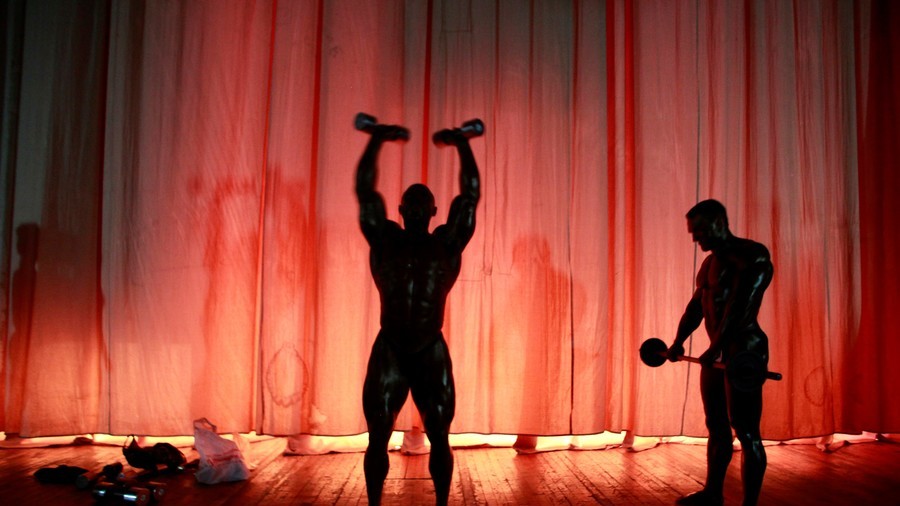
Weightlifters working out. / Reuters

Labels: , , ,

Monday, August 22, 2016

What're The Prospects of Summer Olympics Vanishing at Century's End?

After crossing the finish line in Rio's scorching heat, Alistair and Jonathan Brownlee were initially too exhausted to celebrate.
After crossing the finish line in Rio's scorching heat, Alistair and Jonathan Brownlee were initially too exhausted to celebrate.  (Gregory Bull / Associated Press)
"You could take a risk, and plan your Olympics, and maybe not get the hot days you expect, but that would be a big risk when there are many billions of dollars at stake."
"It's tricky to measure and tricky to predict, but it'll come to be understood as the best indicator of heat stress on the body [rising humidity levels]."
"At [37 C] and 100 percent humidity, you can walk slowly, outdoors, but if you try to run, you can certainly die. It's a matter of just the basic physics of it."
"I'm trying to think of ways to basically bring the future forward, to get the future in people's eyes today, and this is one."
Kirk Smith, researcher, University of California, Berkeley, School of Public Health

"Projections out to the early 22nd Century, which carry even more uncertainty, suggest the last cities in the northern hemisphere with low-risk summer conditions for the Games will be Belfast, Dublin, Edinburgh and Glasgow." 
Future Summer Games feasibility study

"A global-mean warming of roughly 7 C would create small zones where metabolic heat dissipation would for the first time become impossible, calling into question their suitability for human habitation."
2010 study excerpt, Proceedings of the National Academy of Sciences

"[Cities in the Persian Gulf region] are likely to experience temperature levels that are intolerable to humans owing to the consequences of increasing concentrations of anthropogenic greenhouses gases."
2014 paper excerpt, Nature Climate Change
"It is reasonable to think that this will only become a larger issue in the future. If we commit to such extravagant warming, the health of elite athletes running marathons will be the least of our worries [considering infinitely greater numbers of people ordinarily work outdoors in their various professions]."
Matthew Huber, Purdue University

Athletes compete in the women’s marathon at the Summer Olympics on Aug. 14. (AP Photo/Robert F. Bukaty)

The future for the Olympics may look fairly different than what pertains at the present time. Olympians representing their nations' medal aspirations were challenged in the 2016 Summer Games at Rio; concerns over the crime rate, the threat of Zika virus, and the unsanitary conditions, the pollution on beaches and the ocean where many of the summer events were taking place, all represented unusual conditions to be worked around. And perhaps none were as everpresent as the summer heat in Brazil, sapping energy from athletes requiring all their unimpaired strength and energy to succeed.

What's so different about future such events? Well, for one thing, environmental impact of Climate Change, that's what. Which makes the eventual future choice of venues problematical to say the very least. Fewer major cities, according to a new study just published in the journal the Lancet, will be capable in the future of safely providing an Olympics venue for the Summer Games. By the end of the century, this will present as a real problem.

We can shrug with the realization that very few of us will live to see the end of this century. But of course the very young and their children most certainly will, and they represent our successors. How people will fare, in adapting to changing environmental conditions which will inevitably alter the way we live and how we live will depend on acclimatization only to a degree. There is just so much the human body can tolerate; perhaps the rest will depend heavily on how through science, we will manage to continue to manipulate the environment in our favour.

The study published in the Lancet, of which Mr. Smith was the lead author, focused on the theory of "wet-bulb globe temperature" referring to how temperature, humidity, wind and heat radiation combine; a combination which at elevated levels becomes too onerous to be borne by the human body. If it's too humid, a struggle ensues as our bodies attempt to cool through evaporation through our sweat glands. And this happens at even relatively mild temperatures. High wet-bulb temperatures paired with ordinary heat become intolerable for humans.

High humidity linked with 24 C heat becomes a menacing danger zone for people engaging in heavy physical activity, whether it's work-related or leisure-time sport-related, let alone for professional-grade athletes competing at world sport venues. The study set out to calculate how frequently an unbearable wet-bulb global temperature might occur in northern hemisphere cities sufficiently large to host the Summer Olympics by the year 2085, on the assumption that global warming continues.

On the assumption that a ten percent chance of extreme conditions would prevent the Olympics from proceeding, since it would be unacceptable to spend hugely on the event, then be forced to cancel a important outdoor event due to weather, things do not look promising for the future. If it is assumed that a 26 C wet-bulb (in shade) temperature prevailed as a tolerable limit, only eight Northern Hemisphere cities outside Western Europe would represent a low risk for hosting the Games by the year 2085. Two in Canada are Calgary and Vancouver.
The coach of Poland's Olympic handball team wipes sweat from his face. (Ben Curtis/AP)

Reto Knutti, a climate researcher at ETH Zurich responsible for publishing some papers himself on the dangers of human heat stress resulting from climate change, agrees with the paper's conclusions: "I'm confident that the analysis is solid and the results make sense", he stated, adding the research did not go so far as to imply extreme warming would put an end to the Olympics, only that the Games might be channelled differently in the future.

Labels: , , ,

Thursday, July 07, 2016

Brazil's Zika Epidemic

"If she [a pregnant woman] was infected at 18 weeks, you're not going to see anything [abnormalities] at 19 weeks -- time needs to pass before things evolve."
"That's what we've been trying to say to people -- it's not about the head size. It's about brain growth."
"As a rule, children with severe brain damage have shorter lifespans. It depends on the degree of damage."
"That's essentially the conversation that one has to have. If we have absolutely no ultrasound features of concern but evidence of the woman having Zika, we have to be genuine and say, 'it's great that we don't see any abnormalities but we can't tell what future time will show."
Dr. Deborah Money, professor of obstetrics and gynaecology, exec. vice-dean, faculty of medicine, University of British Columbia
Photo: VANDERLEI ALMEIDA/AFP/Getty Images.

"It was crazy. The population of mosquitoes [in Rio de Janeiro] is huge."
"For the first time, the Olympic and Para-Olympic Games are being held in a region that is dealing with a viral epidemic. All necessary [protective] measures should be utilized."
Dr. Babak Shadgan, chair, world wrestling federation medical commission, Vancouver
Photo: VANDERLEI ALMEIDA/AFP/Getty Images.

Dr. Shadgan, in his visit to Rio, discovered that there was nowhere that the Aedes aegypti mosquitoes, carriers of the Zika virus, aren't present, indoors as well as outdoors, in overwhelming numbers. He and an American colleague wrote a position paper published in the Clinical Journal of Sports Medicine, urging all national sport teams to do as the South Koreans are preparing their athletes for, to ensure optimal safety during the games.

To design and produce sport wear with fabric impregnated with insect repellent, to consider covering arms and legs with specially designed outfits. This is the first Olympics ever where international public health experts advocated cancelling the Games because of the Zika outbreak. Their argument is that the epidemic cannot be contained; the half-million international attendees could carry the virus back with them from Rio to their homes around the world.

And the organizing committee of the Olympics has, for the first time in its history, licensed an official supplier of mosquito repellent, to be provided at no cost to all competitors. Those who might become infected may have no symptoms whatever and slough off the infection, while others have the potential to be dreadfully affected by it.

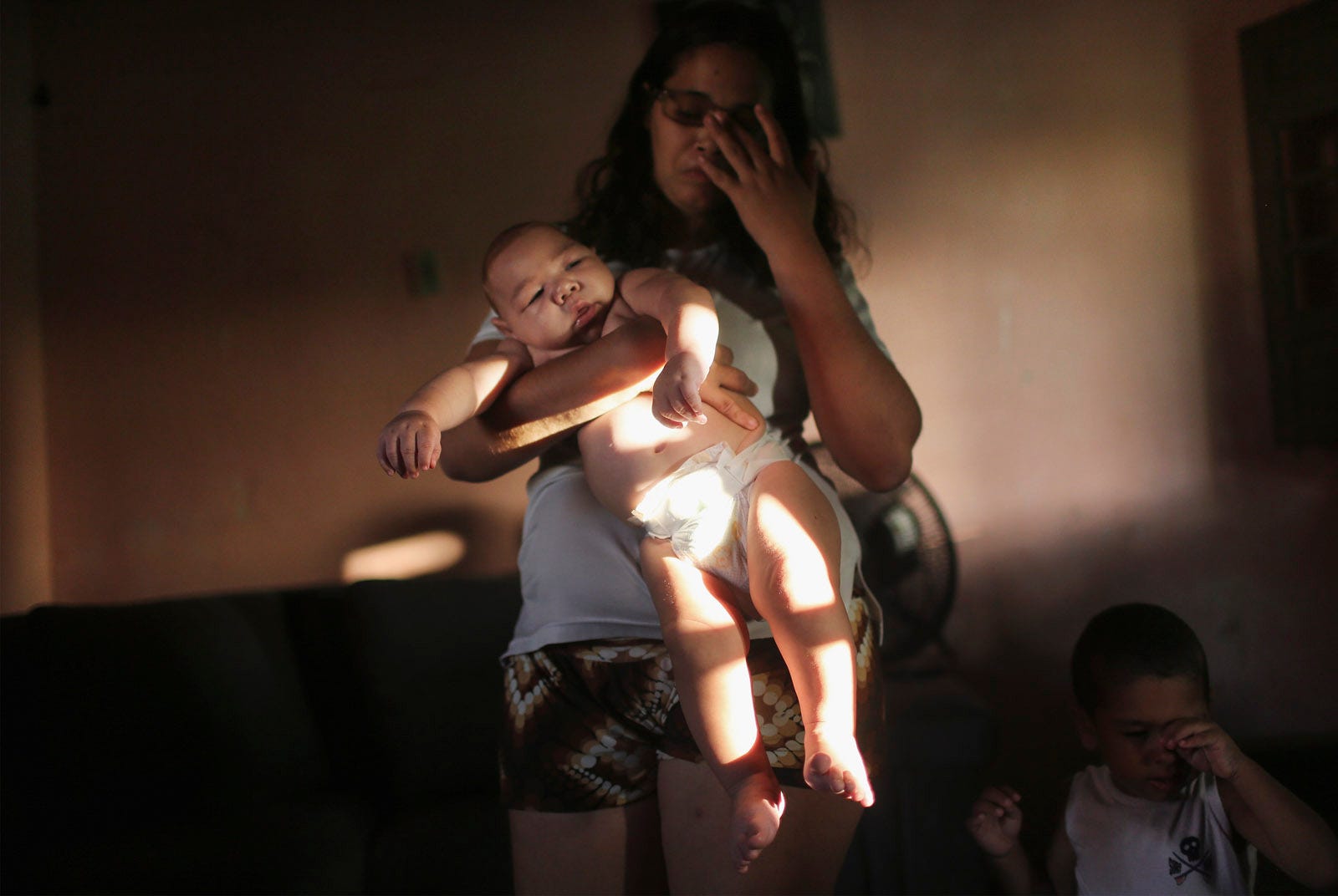
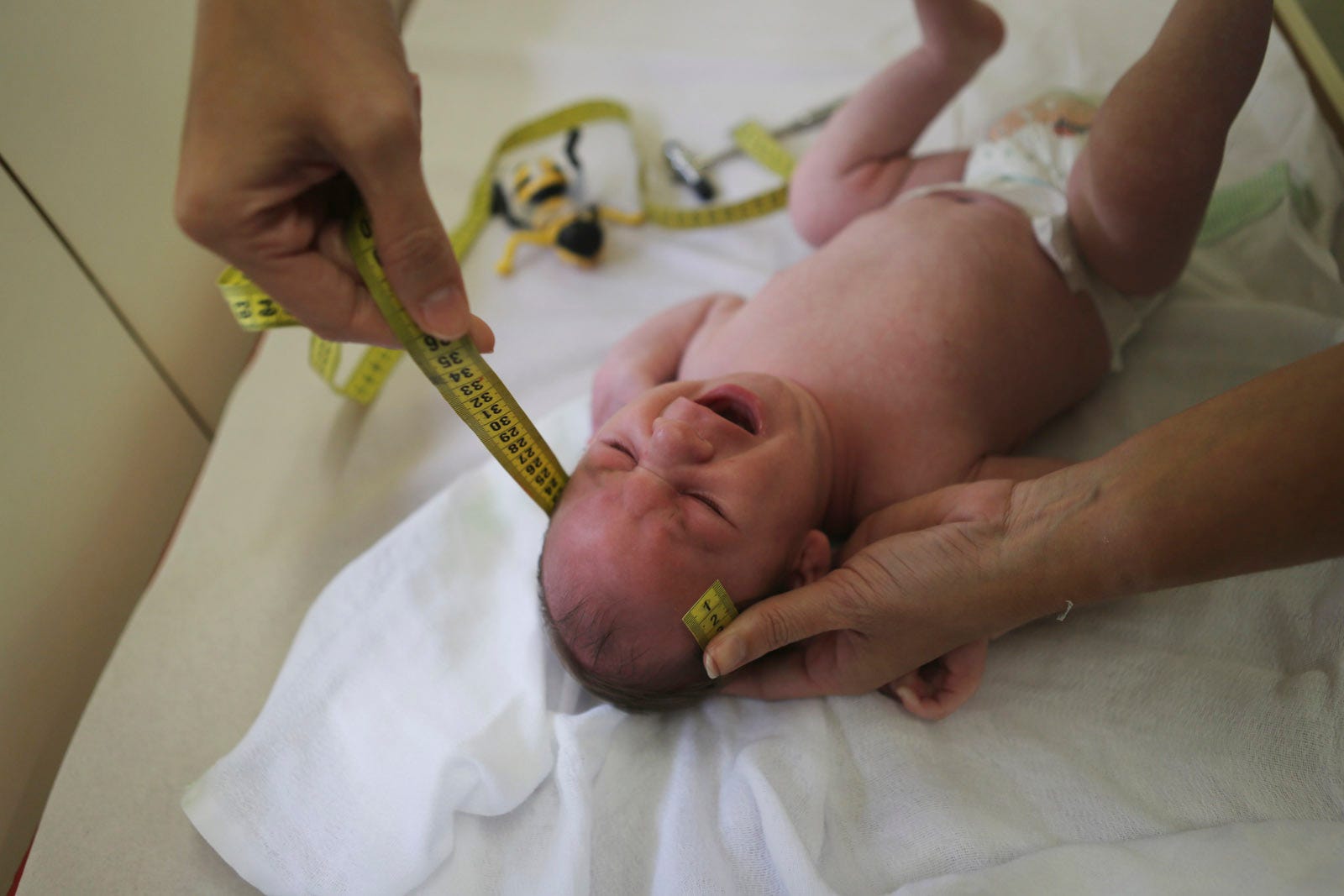
Not only does the virus cause microcephaly, the birth defect that leaves babies with abnormally small heads and developmental problems; it is also responsible for increasing the risk of Guillain-Barre syndrome, causing partial paralysis. But it is the dire effects on newborns that concern most health scientists. It is one thing to monitor women who have been exposed either during or before pregnancy, but there are complicating factors.

In Canada, there have been 137 confirmed cases of Zika, 79 of whom are female. Those who are pregnant are monitored with regular ultrasounds checking for skull abnormalities. But if a woman has been exposed well into her pregnancy that detection of something gone awry could occur when she is well advanced in her pregnancy.
Photo: VANDERLEI ALMEIDA/AFP/Getty Images.

Therein lies another dilemma, the choice of late-term abortion to allay fears of possible brain damage. And then again, even if a foetus's skull is determined to appear normal in an ultrasound, brain damage might still have occurred, so how to respond? There is, it appears, "no defined gestational age" when micocephaly can be considered to be no longer a threat, as far as the Public Health Agency of Canada's scientists can see.

Researchers studied 602 liveborn babies with definite or probable Zika in Brazil, to discover one in five had a head circumference within what is considered to be normal range. Zika brain damage can occur outside the physical reality of microcephaly. The journal The Lancet published the study confirming that Zika brain damage can occur in babies whose heads are a normal size and configuration.

If and when brain damage occurs, it ranges from visual or hearing abnormalities to "very, very severe brain growth restriction", along with conditions such as cerebral palsy, said Dr. Money. That Zika can be hidden throughout most of a pregnancy does occur, where months pass before there are any detectable symptoms of abnormal skull or brain growth, revealed by ultrasound.

And while it's all very well to avoid travelling to geographies where the mosquitoes abound and the virus has become epidemic, a growing number of cases have surfaced indicating that transmission has taken place through sexual congress.

Labels: , , , ,

Friday, March 04, 2016

High Hopes in Defiance of Low Realities

"I cannot fight for my country. I will fight for the Olympics."
"I will fight for all refugees in the world, to defend all refugees in the world."
"If my family see me on television, I can give my number, everything [renewed contact]. Because I want one day to talk even with my dad and my brothers."
"If I participated in the Olympics, I think it would change my life."
Yolande Mabika, refugee from Democratic Republic of Congo, Brazil

"I wondered sometimes how to live when so many people were dying."
"We practise judo to forget everything we saw in the war. If you think about it, you lose."
"I represent everyone. I'll get a medal for all refugees."
Congolese athlete Popole Misenga, Brazil

"The point is that they stand for these million [outstanding athletes among the millions of the world's refugees]. They are one of the very popular chances to give face to the anonymity."
Michael Schirp, deputy head media relations and public affairs, German Olympic Sports Confederation

"Many times in my head I thought it would not happen because of politics, visa problems, lack of money and I could travel to ranking events."
"I do it for my dad and my family."
Raheleh Asemani, Iranian refugee, Belgium
You’re an Olympic-caliber athlete who has fled your home country. As the 2016 Olympic Games approach, you know you could qualify, but you’re not sure what team to call your own. You’re left in limbo, but you’re not alone. Countless migrants have sought refuge from situations of political unrest within the last year, 43 of whom have been identified as Olympic hopefuls. Fortunately, the International Olympic Committee (IOC) realized this, and officially created a team of Refugee Olympic Athletes (ROA) to cater to the needs of these talented men and women 

They have much in common, these outstanding athletes, in their dedication to the competitive sport they excel at, in their wish to compete on the world stage among the most talented, and to demonstrate that despite the disadvantage of immense proportions that fate has hobbled them with, their spirit and their capacity to endure, to use their extraordinary competence to advantage despite their burden motivates them to aspire toward world championship status.

Through the auspices of the International Olympic Committee's recognized obligation to aid these national orphans of huge athletic talent to realize their dreams despite having been exiled by conflict and fear, these recognized sport figures are being given the support and opportunity to participate on a team comprised of talented athletic refugees eager to compete at the Summer Olympics in Brazil.

Among them will be a young Syrian champion swimmer who, with her sister, managed to escape death in the Mediterranean on their way to reach Greek Lesbos. The inflatable dinghy Ysra and Sarah Mardini were on with other refugees was typically overloaded by the human smugglers they had paid to convey them to Europe. Mid-trip the overloaded vessel took on water, slipping into the Mediterranean. The Mardini sisters survived because they were able to swim for three hours to reach Lesbos.

In this photo taken Monday, Nov. 9, 2015, Ysra Mardini, left, and her sister Sarah, right, from Syria pose for a photo during a training session in Berlin, Germany. Two months ago the sisters, who were once among Syria's brightest swimming stars, were swimming for their lives, after jumping off an inflatable boat that began taking on water carrying refugees to Greece. (AP Photo/Michael Sohn) Ysra Mardini, left, and her sister Sarah, right (Michael Sohn/AP)

The IOC has supported the formation of a refugee team which will represent the IOC, not their countries of origin where their lives had been blighted by violent oppression bred of tribal, sectarian and clan hatreds, leading to homelessness and often death. The sisters now live in Germany. Ysra is able to practise her swimming style at a pool that was built for the 1930 Olympics, in the hopes of competing in Brazil.

Any medals any of the 43 selected refugee athletes may win, will be presented with the Olympic flag behind them, and the Olympic anthem resounding. Yolande Mabika and Popole Misenga describe how, in their war-torn country they would be locked up when they lost a competition and be deprived of food. The violence disrupting normalcy in the DRC, and the loss of their relatives to that violence persuaded them to voluntarily seek refuge elsewhere.

The estimated twenty million refugees currently on the world stage as testament to the sad dysfunction of far too many countries will be represented by this new, state-unaffiliated group of talented refugees under the banner of Team ROA [Refugee Olympic Athletes]. Some of these young people aspiring to international athletic fame hope this may aid them in once again making contact with their families back in the countries they had come from.

William Kopati, 22, was a high-jumper and long-jumper in Bangui before he was forced to flee in late March 2013, when militants attacked the house where he was living. Since 2006, he has competed several times in the national championships for high jump, long jump and 400-meter run – winning the gold medal for high-jump in 2009. This is the second time he has fled to the DRC, having been a refugee from 2001 to 2003. His dream is to continue his career in athletics, despite the challenges.  © UNHCR / Brian Sokol

Labels: , , ,

Sunday, February 28, 2016

Achievement Exhaustion

"She's got all these degrees. She's a doctor. She's a surgeon. And she's here [Richlands, Virginia mobile trailer park]."
"I've got one year of community college. I know why I'm here. I look at her, wondering, 'Why are you not working somewhere else?'"
"I want a normal relationship."
Jamie Looney, fiance

"I don't want to be normal. Normal is not quite right. Normal is not excelling. That's why they call it normal."
"I'm very misunderstood because I look at the world differently. You can call it the Olympian mentality."
"I guess I'm somewhat under-achieving. Olympian mentality is rough because you just get frustrated with how everybody does everything. Everything needs to be done with excellence."
Debi Thomas, African-American Olympian figure skater
Former Olympian Debi Thomas is now broke and jobless. Credit: Steve Mack/FilmMagic

"She wanted and expected to be treated like a star. She would argue back. It was almost like she was contrarian, like she was trying to argue with everything I do."
Lawrence Dorr, Dorr Arthritis Institute, Los Angeles

This woman was an astonishingly capable high achiever. But then, she comes from a family for whom achievement was simply normal. In 1939 her grandfather attended Cornell University where he achieved a doctorate in veterinary medicine. Her mother was a pioneering computer engineer and her brother received a bachelor's degree in physics from University of California followed by a master's in business from Stanford University.

She was right behind them in pursuing her own professional future studying at Stanford, then on to medical school at Northwestern University to become an orthopedic surgeon and simultaneously training for the Olympics. She achieved her medical degree, she competed in the Olympics and she has medals from the World Figure Skating Championships and the Olympics. And she is now 48 years old, twice divorced, and no longer sees her son or the rest of her family.

She is, it appears, sick and tired of achieving. Why not? She has managed to achieve in her yet-young lifetime far more than most people could ever dream of. She has her demons to contend with. Her prickly personality has not endeared her to any of the people she has interacted with either in her profession of medicine or her brilliant avocation of competitive sport. "I've never lasted anywhere more than a year", she notes.
debi skating
American figure skater Debi Thomas performs her long program during the women's competition 27 February 1988 in Calgary at the Winter Olympic Games. JEROME DELAY/AFP/Getty Images

She has long since left her life of celebrity and accomplishment in both areas behind. Her medical license has expired. She has not worked in the health field or skated for quite some time. It has all been abandoned; she is a person of great talent who has alienated herself from her previous life. Her early plans to become an astronaut will never now be realized.

She is as close to penniless as it is possible to be, yet another American who has no health insurance, and who has gone through bankruptcy proceedings.

She lives now in rural Virginia, in a trailer, with a new partner, along with his two young boys. She says she enjoys her present life, without the pressure of a woman of colour having to be a role model as a spectacularly high achiever. She feels that where she lives now, the people are genuine and generous and she appreciates that. And the landscape, well, she appreciates that too: "I didn't know we even had this beauty in this country".

She is where she is because this is where she wants to be, she says. "I'm free. Don't you get it?"

Labels: , , , ,

Saturday, March 08, 2014

Comfortless Pride

"I am very much afraid that despite our call for peace during the Paralympic Games that we will see something that could not be rectified. If there is escalation, if there is more conflict, military conflict to our territory, God forbid ... we would leave at that very second."
Valeriy Suskevich, president, Ukraine Paralympic Committee
PHOTO: Hannah Peters/Getty Images
Mykailo Tkachenko of Ukraine bears the flag during the Opening Ceremony of the Sochi 2014 Paralympic Winter Games at Fisht Olympic Stadium.
"There is nothing more precious than the life of a human being and freedom. If you ask me whether we are ready to compete with the strongest desire, yes, we are here ready to compete, we're ready to fight for Ukraine."
Grygorii Vovchynskyi, 24, Ukrainian Paralympian

2014 Winter Paralympics in Sochi
Spectators of Russia and Ukraine waving flags of their countries at the Fisht Olympic stadium before the opening ceremony of the 2014 Winter Paralympics in Sochi, Russia, Friday, March 7, 2014. Photo by AP
 
When the opening ceremonies of the Sochi Paralympic Games took place on Friday, President Vladimir Putin took time away from matters of great world concern relating to the upheaval in Ukraine and Russia's military involvement in Crimea, to make his presence at Sochi, welcoming Russia's guests at the 2014 Winter Olympics. And he was enthusiastically cheered.

For Ukrainian athletes competing in the Paralympics, it has been an emotionally trying few days while they were training in Russia, while part of their country has literally been invaded by Russian troops. But they made the decision to remain where they were, dignity and love of country intact, to represent their country now under such grave duress, with pride during the nine days at Sochi.

Ukraine's Paralympic Committee president, Valeriy Suskevich delivered a fiery address on Friday, and within that address was contained the announcement that participation would take place. "Don't let us start a war during the Paralympic Games. I really hope we can keep peace. It is not politics, it is peace", he pleaded. His team, he said had no intention of mixing politics and sport, but Ukrainians "cannot remain indifferent to the situation in our country."

The Ukrainian team is comprised of 23 athletes. they protested the situation prevailing between Ukraine and Russia by having only their flag bearer, cross-country skier Mykhaylo Tkachenko, present, to take part in the parade of athletes. Mr. Tkachenko explained to the Paralympic News Service that the team's preparations had proceeded apace. While Mr. Suskevich had described the emotions and tears of Ukraine's athletes during the flag-raising ceremony at the athletes' village.

Head of the Ukraine Paralympic team Valeriy Suskevich announces that team Ukraine will participate at the Paralympic Winter Games in Sochi, Russia.
PHOTO: Leah Hennel/Calgary Herald
Head of the Ukraine Paralympic team Valeriy Suskevich announces that team Ukraine will participate at the Paralympic Winter Games in Sochi, Russia.

He had, in fact, requested a meeting with President Putin, and had spoken with him for thirty minutes the night before. A "very calm, respectful talk", when he spoke of the need for peace in Ukraine and Europe, and his hope that during the nine-day period of the Games, peace would prevail. "The athletes have the right to have the Paralympic Games under peaceful conditions", he said.

Mr. Putin, he commented, promised nothing, other than to agree he would consider Mr. Suskevich's proposals. If tensions do escalate in Ukraine over the next week, Mr. Suskevich said, he would not hesitate to pull the athletes out. The Ukrainians had received support from athletes from other countries, a significant comfort.

Labels: , , , , ,

Sunday, February 16, 2014

The power behind Olympic glory: IOC soaked in stupendous wealth, mystery and controversy

| | Last Updated: Feb 14 11:25 PM ET
National Post
Dancers perform during the opening ceremony of the 2014 Winter Olympics in Sochi, Russia, Friday, Feb. 7, 2014.  The show-stopping spectacles in Sochi and Beijing distract the world from the opaque and dictatorial political systems underpinning them, critics say.
AP Photo/Lionel Bonaventure, Pool     Dancers perform during the opening ceremony of the 2014 Winter Olympics in Sochi, Russia, Friday, Feb. 7, 2014. The show-stopping spectacles in Sochi and Beijing distract the world from the opaque and dictatorial political systems underpinning them, critics say.

It’s impossible not to marvel at the spectacle and camaraderie of the Olympics — to be awestruck by athletes who have devoted their lives with monomaniacal intensity to perfecting a sport.
NP Graphics

Yet behind the dramas and heartbreak that catch the world’s attention, few wonder how the games are run and funded.

That’s just the way the International Olympic Committee (IOC) likes it. The exclusive and secretive organization is a cozy old boys’ club (with a few women) critics compare to the Italian mafia.
Although governments contribute cash to the Olympics, the IOC is private. It receives billions in revenue that critics say are not subject to enough scrutiny.

“Because it’s a private organization — they are not funded by the government or by the public — they don’t have any obligation to give information or be transparent,” said Jean-Loup Chappelet, a professor at the graduate school of public administration at the University of Lausanne, Switzerland, and one of the few academics to study the IOC’s governance.

Several members have been embroiled in match fixing or vote buying scandals, while others have uncomfortable ties to sponsors and broadcasters who have struck lucrative deals with the games. Some, essentially, inherited their roles, such as Juan Antonio Samaranch Jr., executive committee member and son of the long-time former president.
FABRICE COFFRINI/AFP/Getty Images
FABRICE COFFRINI/AFP/Getty ImagesInternational Olympic Committee (IOC) executive member Juan Antonio Samaranch Jr.
 
The IOC has a say in every aspect of the Games. It oversees national Olympic committees, negotiates broadcast and sponsorship rights, and decides what sports can compete. Most crucially, it picks the sites.
File
FileThe brainchild of Pierre de Coubertin, the modern Games were first held in Athens in 1896 as an attempt to recreate the competitions of ancient Greece.
 
And although IOC representatives are unpaid, their position alone guarantees extraordinary influence. They also enjoy such perks as free travel and event tickets.
The group’s image as a secretive coalition with a culture of kickbacks and corruption made headlines during the Salt Lake City scandal in 1998.

Although the IOC has attempted real reform since then, critics say it is not as fair-minded as its Olympic ideals and far from being democratic. Until it imposes strict term limits on members and opens its nomination process, a secretive few will continue to control the world’s largest celebration of sport.

The Olympics were once much more innocent. The brainchild of Pierre de Coubertin, the modern Games were first held in Athens in 1896 as an attempt to recreate the competitions of ancient Greece.
DAVID GOLDMAN/AFP/Getty Images
DAVID GOLDMAN/AFP/Getty ImagesRussian President Vladimir Putin, centre, toasts International Olympic Committee President Thomas Bach, left, after the opening ceremony of the 2014 Winter Olympics on Feb. 7, 2014, in Sochi.
 
Since then, they have evolved into a staggering and lucrative spectacle. Under the aegis of the IOC, national bodies and international sports federations oversee the development and qualification of athletes. An organizing committee is struck to manage each Games.

Although the 104 members are elected, they must first pass the scrutiny of the IOC executive. The result is a culture that is “closed and conservative. It’s like a club,” said Prof. Chappelet.

“There’s almost no accountability or transparency. It’s a secretive voting process. Who knows what goes on behind the scenes?” added Helen Jefferson Lenskyj, a retired professor at the University of Toronto and author of several books on the Olympics.

One of the most contentious issues is the IOC’s choice of undemocratic states that have little regard for human rights, such as China and Russia.

The IOC insists it is politically neutral, with President Thomas Bach calling U.S. President Barack Obama’s refusal to go to Sochi an “ostentatious gesture.”
JUNG YEON-JE/AFP/Getty Images
JUNG YEON-JE/AFP/Getty ImagesInternational Olympic Committee President Thomas Bach speaks during the Opening Ceremony of the Sochi Winter Olympics at the Fisht Olympic Stadium on Feb. 7, 2014 in Sochi. 
 
“We are grateful to those who respect the fact that sport can only contribute to the development of peace if it’s not used as a stage for political dissent, or for trying to score points in internal or external contexts,” Mr. Bach said.
Getty Images
Getty ImagesAdolf Hitler and his staff salute the teams during the opening ceremonies of the XI Olympic Games on Aug. 1, 1936 in Berlin, Germany.
 
But staging an Olympics pays big dividends for host nations. The show-stopping spectacles in Sochi and Beijing distract the world from the opaque and dictatorial political systems underpinning them.
The most prominent example is, of course, the 1936 Olympics in Berlin, a triumph of pre-war Nazi propaganda.

The fascist connections don’t stop there: Juan Antonio Samaranch Sr., IOC president for 21 years, was a sports minister under Spanish military dictator Francisco Franco.

Andrew Jennings, a British investigative journalist who has written several books on the IOC, has even found photographs of Mr. Samaranch delivering “Heil Hitler” salutes.
“Nobody ever says the ‘f-word’ when writing about the Olympics,” he said.
Getty Images
Getty ImagesThe Olympic torch is carried into the stadium during the opening ceremonies of the XI Olympic Games at the Olympic Stadium in Berlin, Germany, on Aug. 1, 1936.
 
“The problem with the IOC is that it’s covered by sports reporters who are too craven and cowardly … [IOC members] are a bunch of very dubious people seizing on ordinary people who have a passion for sport.”
PIERRE-PHILIPPE MARCOU/AFP/Getty Images
PIERRE-PHILIPPE MARCOU/AFP/Getty ImagesDick Pound, a former Olympian and Canada’s only IOC member. 
 
That passion does not seem to be abating.
Sochi’s $51-billion price tag is the most spent on any Olympics. Prof. Chappelet said the number of cities rich enough to afford the Games continues to shrink. A serious bid now costs $50-million to $100-million, much of it spent on lobbying.

This gives non-democratic regimes an advantage: They can spend enormous amounts of money without having to worry about accountability.
“It’s not politically acceptable, but it has been said that it’s easier to organize an Olympics in non-democratic countries where people don’t have a say,” he said.

But Dick Pound, a former Olympian and Canada’s only IOC member, says selectors shouldn’t discriminate against such states.

“The fact that the style of government is not one that mirrors Canada doesn’t mean [such a] country is any less worthy or less able to organize the games,” he said from Sochi.
“There’s an evolution in economics and politics … The Russia of today is not the Soviet Union of 30 years ago. Brazil is not the country it was 30 years ago.

“I think you have to be ready to move your event around the world, and not try to stereotype the kinds of governments and political organizations that are ‘worthy’ of hosting the games.”
One thing that is not in doubt is the values of the Games to the IOC.

As the increasingly wealthy Persian Gulf takes an interest in sports, it’s not surprising princes and princesses from Saudi Arabia, the United Arab Emirates and Qatar dominate the list of royals belonging to the IOC. Of the 10 blue-bloods on the 108-person committee, four are from the Middle East. Thanks to their enormous oil wealth, the Gulf states are becoming muscular forces in the world of sport. The United Arab Emirates, for example, has invested a small fortune to develop a Formula One race track in a hotel just outside Abu Dhabi. Qatar is sparing no expense to construct facilities to host the 2022 soccer World Cup. Major sponsorship deals have recently been signed between Gulf state-owned airlines and European soccer clubs. Several royals are also Olympic athletes. Princess Haya Al Hussein, wife of the ruler of Dubai, competed as an equestrienne, Prince Albert of Monaco has represented the principality in sailing, while Princess Anne has ridden for Britain.

Sponsorships have become increasingly lucrative since the 1984 Los Angeles Games. Those games revolutionized the revenue stream by opting for a highly exclusive approach to corporate sponsorship — only one sponsor was allowed in any product category. This dramatically increased cash flow and profits. To maintain this exclusivity, Olympic organizers go to great lengths to control what logos are broadcast. This year, Apple logos on reporters’ laptops were taped over to preserve Samsung’s exclusivity. Although athletes generally have to leave their individual sponsors at home, the one exception is their equipment. That’s why skiers, for example, quickly doff their skis for post-run interviews, allowing them to display the logos.

One of the most beloved traditions of the Olympics actually has its origins in Nazi Germany. Although the Olympic torch was first lit in the 1928 Amsterdam Olympics, the cross-continent torch relay was a Nazi innovation for the 1936 Berlin games. The Nazis’ torchbearers were the first to carry the flame from the Olympics to the host city — it was quite the spectacle at the time, particularly when the bearers crossed territories that were later invaded. However, the tradition stuck and is now regarded as a symbol of international camaraderie and cooperation.
Jen Gerson, National Post

In 2009-12, the Olympics earned more than US$8-billion, mostly from broadcasting rights and sponsorships. Of that, 90% is distributed to national and organizing committees.

The IOC goes to extraordinary lengths to ensure the exclusivity and value of its corporate sponsorships. This year, for example, it ordered the hiding of car grills and covered up the Apple logos on media laptops with duct tape.

The competition among cities can be every bit as ruthless, as became clear during the Salt Lake City scandal.

Despite having technically superior bids, the Utah capital lost out several times. The 1998 Winter Olympics went to Nagano, after Japanese officials spent exorbitant sums entertaining IOC officials.
Utah officials took note. Salt Lake City’s next bid was accompanied with bribes of cash, gifts and, allegedly, prostitutes.

The IOC expelled six members. It also implemented numerous reforms, including opening its financial statements and annual general meetings. IOC members were also barred from visiting potential bid cities.

Mr. Pound believes these reforms had a major impact.
“[The IOC] may have been [secretive] at one point, but we’re one of the few international organizations that opens up its meetings to the media and publishes audited financial statements,” he said.

“In terms of governance principles that we now apply, we demonstrate best practices.”
Prof. Chappelet, on the other hand, thinks the IOC could do more to keep up with evolving standards. While the post-Salt Lake reforms were positive, they are now more than a decade old.

And the IOC has done little to continue improving in the meantime. Prof. Chappelet said even FIFA, the international body that governs soccer, has better ethics expectations than the IOC now.
“I think the public requests more now than it did in 1999 in terms of transparency,” he said. “The signposts have moved.”
Others wonder whether anything has really changed.

Ms. Lenskyj calls the post-Salt Lake improvements “superficial,” while in 2004, a BBC probe found several well-connected people willing to help London to secure IOC votes for the 2012 bid — for enough cash. Several recent books include statements from IOC members boasting about quid pro quo agreements, Ms. Lenskyj said.

As for Mr. Jennings, his response to claims of reform: “Ha.”

Labels: , , ,

 
()() Follow @rheytah Tweet