Ruminations

Blog dedicated primarily to randomly selected news items; comments reflecting personal perceptions

Saturday, April 16, 2022

The Ancient Past Calls Out

"You cannot see it now, but originally it was inlaid with pieces of precious marble, pieces of glass, pieces of small, finely made marble."
"It was shining and this was a really amazing artifact. It stood at the apex, at the sanctuary of the Church [of the Holy Sepulchre]."
"All the eyes of the believers, of the pilgrims [went] to this object. And right above it and around it, all the high priests, the priests and the monks of the church did all the liturgy, the main liturgy of the church, on the table, right here on the table of this altar." 
"It was forgotten in the mist of time for decades until we rediscovered it a few years ago."
Amit Re'em, Jerusalem regional archaeologist, Israel Antiquities Authority 

"Works from people of art, people of archeology, contribute to us, contribute to the belief of the church, to the conviction of the church, that this is the place ... on which Jesus Christ was crucified ... buried and from which he came to resurrection."
Archbishop Aristarchos of Constina, chief secretary, Greek Orthodox Patriarchate of Jerusalem
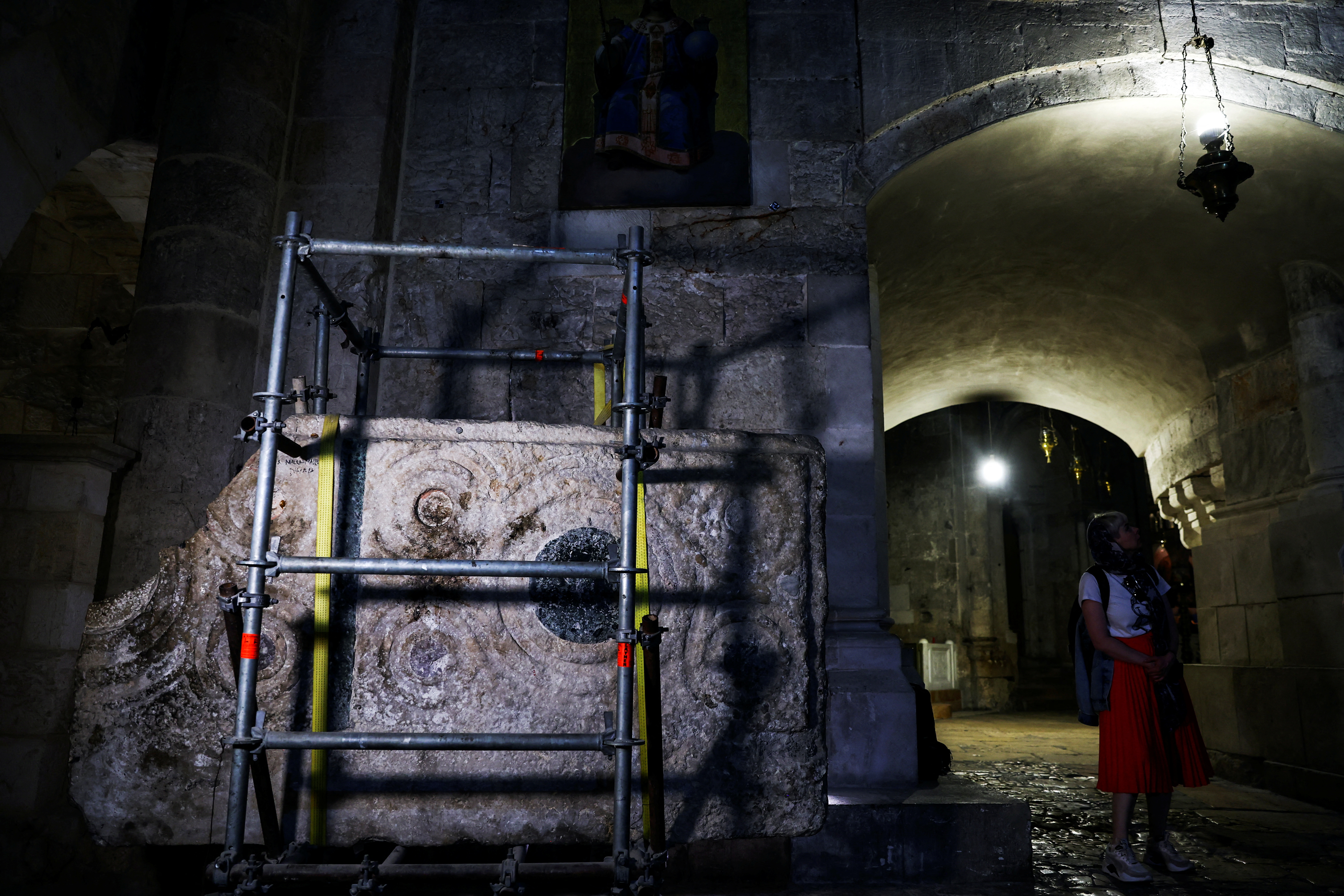
Researchers say the Church of the Holy Sepulchre centuries-old altar has been rediscovered in Jerusalem
A stone slab said to be the decorated frontal of the Crusader-era high altar of the Church of the Holy Sepulchre according to researchers at the Israel Antiquities Authority and Austrian Academy of Sciences, is seen in the Church of the Holy Sepulchre after it was recently turned over during renovations and its significance rediscovered, in Jerusalem's Old City, April 11, 2022. Picture taken April 11, 2022. REUTERS/Ronen Zvulun
 
It was just an obscure stone slab of an early period in history standing in an ancient church in one of the most historical sites of world  history. Left over the ages pressed close against a wall in a far corridor of the Church of the Holy Sepulchre in Jerusalem. On its readily visible, outward-facing side was graffiti, testament to the multitudes of pilgrims through the ages that had come to Jerusalem to pray and to revel in the church's antiquity, leaving a memento of themselves and their awe at its sacred presence, inscribed on the stone slab.

And then, because the church, celebrated as the site of Jesus's crucifixion and burial and traditionally venerated for that tradition, began undergoing renovation, and the 2.5 X 1.5-metre stone slab was moved, revealing its opposite side where elaborate looping ornaments were discovered on the long-hidden portion. Which enabled archaeologists to identify it as the decorated frontispiece of a medieval high altar in one of Christendom's holiest cities.

Research on the origins, purpose and condition of the ancient slab was carried out by two archaeologists; Amit Re'em, Jerusalem regional archaeological representative of the Israel Antiquities Authority and his colleague Ilya Berkovich of the Austrian Academy of Sciences. They were able to identify as "Cosmatesque" the unique, looping design etched deeply into the stone piece that once served as part of the church's original altar. A technique that embodied Classical Byzantine and early Islamic art where tiles of colourful marble were set into the circular engravings. 

The two researchers were familiar with the style of decoration since similar ones were found within churches in Rome that date to the 12th and 13th centuries. The Jerusalem relic corresponds with past archaeological findings, alongside accounts of pilgrims describing the consecration of the church by the Crusaders when the main altar was formed, in the year 1149.

Catholic clergy made use of the altar in celebrating mass up to the time the Crusaders left Jerusalem, after which it saw use by the Greek Orthodox church until a fire in 1808 damaged it, when it was cast aside and forgotten until recent renovations were undertaken, explained Amit Re'em. The findings of the researchers are to be published by the Exploration Society of Israel.
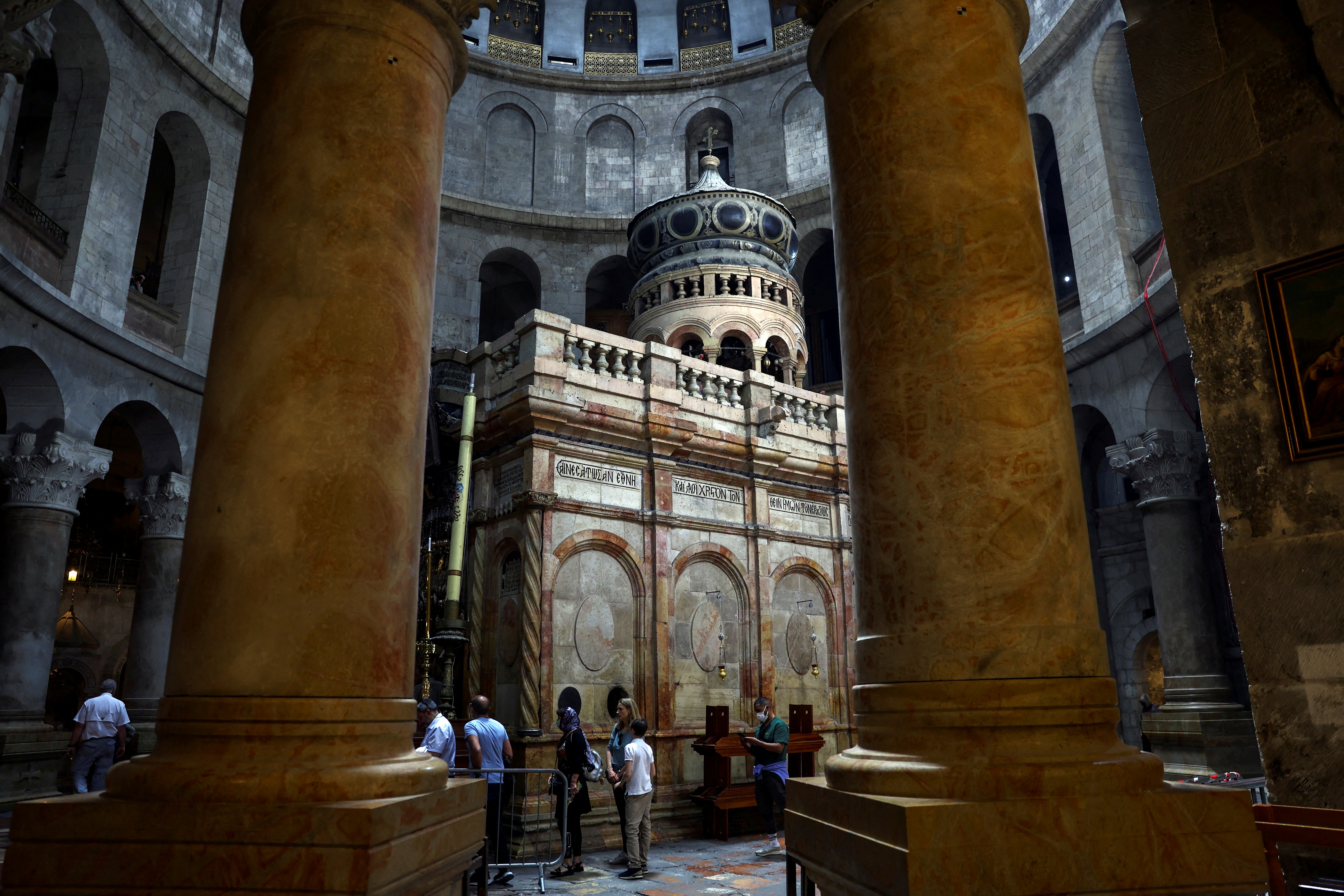
People visit the Church of the Holy Sepulchre in Jerusalem's Old City
People visit the Church of the Holy Sepulchre in Jerusalem's Old City, April 11, 2022. REUTERS/Ronen Zvulun/File Photo

Labels: , , , ,

Wednesday, May 07, 2014

The City of David

While in Tehran hard-line Iranian lawmakers interrogate the country's foreign minister about deviating from the Republic's official line on the Holocaust, referring to an interview that Mohammed Javad Zarif participated in with German media where he called the Holocaust a "horrifying tragedy" that should never re-occur though the regime denies it ever did, in Jerusalem an Israeli archaeologist claims the discovery of the legendary King David citadel dating to the capture of Jerusalem.

Validating in one instance, meticulous records maintained by the German Fascists in detailing the atrocities they visited upon European Jewry, and on the other the veracity of Biblical passages as a guide in identifying ancient ruins. Eli Shukron's claim has been criticized. As have been other announcements by Israeli archaeologists who have unearthed palaces of the biblical king, revered in Jewish tradition for establishing Jerusalem as Judaism's central holy city.

City of David
Eli Shukron, an archeologist formerly with Israel's Antiquities Authority, walks in the City of David archaeological site near Jerusalem's Old City on May 1, 2014. Photo by AP
 
The costly ($10-million, U.S.-funded) excavation took place within a currently Arab-dominated neighbourhood of East Jerusalem where such news runs counter to Palestinian demands that the Old City be recognized as the capital of a nascent Palestinian state. The archaeological dig was financed by an organization settling Jews in areas of East Jerusalem whose aim is prevention of dividing the ancient city.

"This is the citadel of King David, this is the Citadel of Zion, and this is what King David took from the Jebusites", said Mr. Shukron who worked on the excavation at the City of David site for almost two decades, believing that the evidence he uncovered had the effect of supporting his theory. "The whole site we can compare to the Bible perfectly."

The dig, initiated in 1995, uncovered a massive fortification comprised of five-tonne boulders stacked six metres wide. Shards of pottery were used to date the fortification walls as being 3,800 years in vintage. The fortifications represent the largest walls ever discovered in the region from the era of King Herod, and the presence of the Second Temple of Solomon, almost 2,100 years ago.

It had been built 800 years before King David would have wrested it from its then-Jebusite rulers. Mr. Shukron insists that  his discovery provides ample clues identifying this particular fortification as David's entry point into Jerusalem, conflating with the second Book of Samuel where David orders the walled city captured through entry at the location of a water shaft.

Fittingly enough, the excavation revealed a narrow shaft where spring water flowed into a carved pool, representing a place where people who lived at that time in history would gather to access their potable water. No other structure in the area of ancient Jerusalem appears a match to the biblical account naming it the "Citadel of David" and the "Citadel of Zion".

Claims that will be vociferously debunked by the Palestinian Authority and the greater Muslim world both of which discount entirely the presence of an ancient Jewish Temple on the Temple Mount over which Islam built their golden-domed Dome of the Rock where the Prophet Mohammed is held to have ascended to Heaven riding a white stallion. For Muslims that represents the third most holy site in Islam. The very concept of validating a Jewish prior presence is anathema to them.

Dome of the Rock, East Jerusalem
For Jews, the Temple Mount alongside of which remains the only portion of the fabled Temple of Solomon to have survived extant as the Wailing Wall, it is the first most holy site venerated in Judaism. A site forbidden for Jews to enter, to pray, to view, when it was under the control of Arabs when Jordan held the area. A site which is open to all under Israeli jurisdiction; Muslim, Christian, Jew.

And which Jews aspire to continue having access to, which would be denied them should the Palestinian Authority ever dominate it as their capital. Even under the protection of Israel, Muslim extremists in Israel riot violently when Jews ascend to the Temple Mount; Arabs refusing to allow Jews access to their most holy site. Israel remains sensitive to Muslim sensibilities; Muslims run roughshod over Jews'.

The Muslim proclivity for building mosques over the places of worship of other religions is legendary. The Islamist penchant for destroying sacred symbols of other religions represents the atrocious reality of fundamentalist intolerant rejection of equality in religious freedom.

Labels: , , , , ,

 
()() Follow @rheytah Tweet