Negotiated Settlements Set Aside by Norway, Ireland, Spain
"Today, Ireland, Norway and Spain are announcing that we recognize the state of Palestine. Each of us will now undertake whatever national steps are necessary to give effect to that decision.""There is never a wrong time to do the right thing"."It was my government’s preferred position to recognize a two-state solution as part of a peace process to bring that about, but sadly, unfortunately, such a comprehensive peace settlement now seems, in many ways, further away than it has ever been.""We believe you can’t say you’re in favor of a two-state solution and not recognize the very existence of two states."Irish Prime Minister Simon Harris
 |
Was ever a sentence uttered that should have been corrected as 'There is never a right time to do a wrong thing'? Israel, in reacting to the tripartite statement in shock and disbelief is entirely correct in chiding these three Western democracies for their gross error in judgement, deciding between them that the 'right thing' to do is to reward terrorist groups in the Middle East for their vicious penchant to declare their intention to destroy a legally and morally constituted state on its own ancestral geography that has been challenged for possession by a group of Arab (of mostly Egyptian origin) colonizers claiming it as their own. Did the three ask themselves why it was that a negotiated settlement was further away than ever?
The opportunity for a two-state 'solution' was offered through the UN's partition plan, promptly and gratefully accepted by Israel, furiously rejected by those now calling themselves 'Palestinians' who preferred to wait out the intentions of surrounding Arab/Muslim countries to march on the nascent state of Israel with a view to preventing the establishment of the Jewish state. Succeeding wars failed just as the initial one did, but the Palestinian-Arab determination to wreak havoc on Israel with the ultimate aim to destroy it and murder all its population has never faded.
The October 7 butchery that took place in southern Israel by the terrorist groups Hamas, Palestinian Islamic Jihad and the Popular Front for the Liberation of Palestine, aided and abetted by Palestinian civilians exhibiting raw savagery in the sordid, ghoulish sadistic cruelty meted out to innocent civilians has few parallels in modern history. This declaration by Palestinians both in the West Bank and the Gaza Strip who have been polled to render 85% support to Hamas terrorism and their approval of the October 7 bestiality represents the level of civilization that Spain, Norway and Ireland are prepared to recognize and legitimize with statehood.
Israel is dismayed, but perhaps not completely surprised by the three countries turning their backs on the only democracy in the Middle East, distinguished from all others because it is Jewish, its origins the very land it now sits upon, along with other areas the world prepared to honour and hand over to an Arab population that has no intention, ever, of living in peace with the original inhabitants of the land. In their preparation to recognize the State of Palestine, no effort has been made by Spain, Norway and Ireland to condemn the Palestinians for their aspirations to destroy Israel.
Nor has any overture been made to persuade the Palestinians through their leadership to turn their ambitions toward statehood infrastructure and the merits of civilized behaviour in favour of completely foregoing its lethal hostility against Israel. Needless to say, with no expectations of Palestinians curbing and abandoning their commitment to violence against Israel, the announcements of support in the form of recognition of their ambitions to form a legitimate state with no pre-conditions sits extremely well with the Palestinian leadership -- the Palestinian Authority and Gaza's Hamas rulers.
Envoys of the three countries were summoned by Israel in a diplomatic expression of profound disappointment in their judgement and decision-making. The European ambassadors to Israel, Israeli Foreign Minister Israel Katz said grimly, would be requested to witness video footage of the October 7 attack, to ensure they had intimate first-hand knowledge of what had transpired, through videos produced by the terrorists themselves as they rampaged through Israeli farming kibbutzim, raping and vandalizing, torturing children and women before murdering them.
"[A Palestinian state is] a prerequisite for achieving peace in the Middle East.""There will be no peace in the Middle East without a two-state solution.""There can be no two-state solution without a Palestinian state."Norway’s Prime Minister Jonas Gahr Støre"This recognition is not against the people of Israel and certainly not against the Jewish people.""It’s not in favor of Hamas.""It’s in favor of co-existence."Spanish Prime Minister Pedro Sánchez
"[Recognizing a Palestinian state would be a] reward for terror.""This will be a terror state, which will attempt to perpetrate the onslaught of October 7 time and again, and to that we shall not agree.""This evil must not be given a state."Israeli Prime Minister Benjamin Netanyahu
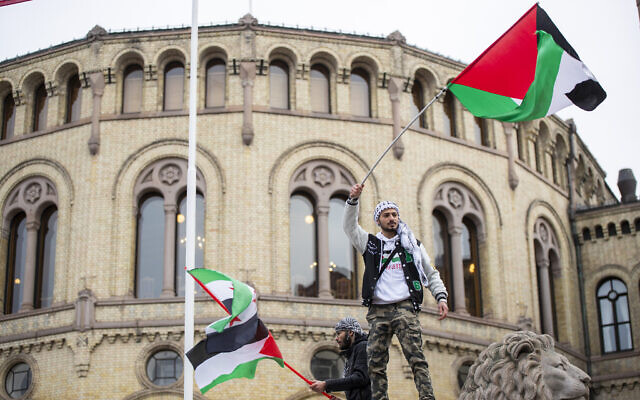 |
| A man waves the Palestinian flag in front of the Norwegian Parliament building during a demonstration in Oslo, Oct. 28, 2023. (Frederik Ringnes/NTB via AP) |
Labels: Abandoning Negotiated Settlement Agreement, Appeasement, Ireland, Israel, Norway, Palestinians, Spain, State of Palestine Recognition
posted by Pieface @ 8:16 PM
0 comments