Ruminations

Blog dedicated primarily to randomly selected news items; comments reflecting personal perceptions

Sunday, January 07, 2024

Using The Law To Sue Against Antisemitism

https://thecjn.ca/wp-content/uploads/2019/11/York-Protests.jpg
Pro-Israel and pro-Palestinian demonstrators clash in the halls of York University in Toronto on Nov. 20. (Alex Rose/The CJN)
"Behaviour that encourages hatred, violence, discrimination or interferes with the educational atmosphere, as stated in the 'Code of Students Rights and Responsibilities', reflects a breach in the University's responsibility."
"Section 319 of the Criminal Code categorizes the public incitement of hatred, the deliberate promotion of hatred, and the intentional promotion of antisemitism as criminal offences."
Sandra Zisckind, managing partner, Diamond and Diamond Lawyers
 
"Unfortunately, the hatred toward the Jewish community, which dramatically increased after October 7, continues to be prevalent on college and university campuses, including McMaster [University]."
"This lawsuit seeks to establish and enforce effective, and enduring measures to guarantee a safe, supportive and tolerant educational setting for all students, irrespective of their race, religion, or ethnicity."
Brooke Goldstein, founder, executive director, The Lawfare Project

https://smartcdn.gprod.postmedia.digital/nationalpost/wp-content/uploads/2024/01/mcmaster-Cropped-1.jpg?quality=90&strip=all&w=1128&h=846&type=webp&sig=CHKw_8WTzRHDeVlHjsufhA
On behalf of Jewish students attending McMaster University in Hamilton, Ontario, which has distinguished itself as a veritable hotbed of antisemitic action, a $77 million class-action lawsuit has been undertaken, charging the school and the McMaster Students Union, with virulent hatred and threats faced by Jewish students arising from antisemitic rhetoric that has been rife on campus since the Hamas terrorist attack in southern Israel of October 7, 2023.

Among other issues cited in the lawsuit was that of an organized vigil by Jewish student groups having been forced to move to a publicly undisclosed location in the interests of security in a climate of threat and intimidation. Also at issue, a McMaster teaching assistant who was involved in a public display of a swastika during a pro-Palestinian protest on Parliament Hill.

https://pbs.twimg.com/media/GCjFF_ZWgAA9GSp?format=jpg&name=small
The firm of Diamond and Diamond Lawyers filed the class action suit acting on behalf of plaintiffs encompassing all Jewish students enrolled at the present time at McMaster University and including Jewish students who are now graduates from the past two years. The University's Students Union, according to the lawsuit, has actively supported the Boycott, Divestment and Sanctions (BDS) movement since 2015, maintaining its support for on-campus activities of the movement.

A movement, according to a statement describing the BDS movement, by Prime Minister Justin Trudeau, as "antisemitic and contrary to Canadian values". However, on the evidence clear enough by the ruling Liberal government's lack of action in view of more recent 'pro-Palestinian' protests taking place all over Canada by organized Palestinian Student Groups not sufficiently 'contrary to Canadian values' -- even when chants of "From the river to the sea" denoting the destruction of Israel, or "gas the Jews" ring out, orchestrated along with signage reading "Free Palestine"-- for any remedial action to take place.

The Lawfare Project, an organization dedicating itself to the protection of the civil and human rights of Jewish communities through legal action, inspired the lawsuit in a partnership. This is a lawsuit that pairs with another $15 million class-action lawsuit that Diamond and Diamond previously filed last October against York University for much the same reasons. Both universities are outstanding in their support of antisemitic rhetoric in a devoted nod to the 'woke' DEI atmosphere that permeates both.

Both York University and the York Federation of Students are targeted by that lawsuit, that represents current students and recent alumni as well as school attendees from 1998 to 2021, with the claims that the plaintiffs have been threatened with physical violence, sufficiently effective to force the Jewish students to shield their Jewish identity in an effort to avoid harassment.

https://i.cbc.ca/1.6620938.1692132838!/fileImage/httpImage/image.JPG_gen/derivatives/original_1180/mcmaster-university-campus-students.JPG
McMaster University says it's committed to providing a safe and welcoming environment to all staff and students. (Michael To/CBC)

Labels: , , , , , ,

Tuesday, December 07, 2021

Inhailng a COVID-19 Vaccine

"[The original idea early in the vaccine race, was to offer it as a standalone], but as time has gone on, virtually everybody has now had the opportunity to get an mRNA vaccine."
"[The McMaster formula is administered through a jet nebulizer that generates a fine misty solution] with particles that are so tiny they're breathed right down deep into the lung."
"If you can generate that local immune response in the lung [it may prove better to boost with an inhaled vaccine]. For a number of reasons this has the promise of being a more effective way to boost [the immune system against COVID-19]."
"We seem to be doing better this time around, than we were a year ago. We've got vaccines. We've got an understanding of what the major risks are in terms of transmission. So we've made progress. How do we keep on without ever going back?"
"I think that's really what I'm looking for."
Fiona Smaill, professor of pathology and molecular medicine, McMaster University, Hamilton
Fiona Smaill and research coordinator Emilio Aguirre demonstrate the use of the nebulizer with a volunteer.
An inhaled COVID-19 vaccine in humans is to begin the testing process by Canadian scientists, with the goal of targeting both the mutating spike protein that the SARS-CoV-2 virus uses to sneak into human cells, but as well two other targets not as susceptible to mutating. This will not be a vaccine to be injected into the deltoid muscle in the upper arm, but one delivered through tiny aerosol particles to be inhaled deep into the lungs.

Part of a second generation of COVID-19 vaccines, this will be one of two Canadian-made formulae hoping to offer a more robust and more stable immune response. Results from Medicago Inc.'s Phase 3 trial of its plant-based vaccine that had involved about 24,000 people are due out shortly, as the final step of testing prior to potential approval. Trialled as a booster for people who have had two doses of an mRNA vaccine, the original focus was not as an adjunct to other vaccines.

In view of the SARS-CoV-2 virus being anticipated as a long-term threat, more booster doses are likely to result as a protection against its ongoing infectiousness and the possibility of additional mutated versions. Science recognizes the importance of testing new vaccines functioning in various ways, explained Dr.Smaill. For one thing, she points out, this mode of vaccine delivery will be welcomed by the needle-phobic, vaccine-hesitant public.

The delivery mechanism is built upon a previous twenty years of research on a tuberculosis vaccine that has been led by McMaster Professor Zhou Xing. The vaccine is designed to deliver a local "mucosal" response once inside the lungs, at the very site where the virus enters the body, with the aim of achieving a broader kind of immune response than can be seen by just injecting into the muscle of the upper arm. A more robust T cell response would be engendered; important since T cells find and destroy infected cells.

Strains of a weakened adenovirus, a family of viruses that cause the common cold, are contained in the vaccine. There are two currently being tested on 30 health volunteers; one a vaccine  using a human adenovirus, the second a chimpanzee adenovirus. The vaccine targets two cellular proteins within the virus operationally required to have it grow and spread. "Mutations would be rarely seen in those proteins", explained Dr. Smaill.

Human trials are in the initial stages; however in the meanwhile, Medicago submits data to Health Canada as part of a rolling submission to be examined piecemeal. If early anecdotal reports suggesting Omicron causes milder infections are correct "I think we're going to be OK. We're all guessing what's actually going to happen", added Dr.Smaill, and hoping for the best possible outcome.

McMaster inhaled vaccine
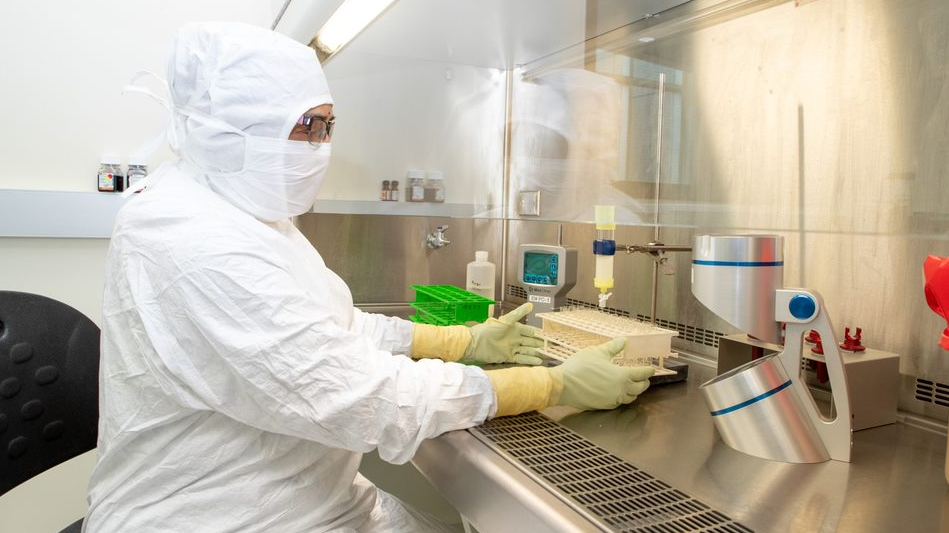
A researcher works in a McMaster lab on the inhaled aerosol COVID-19 vaccine in this undated handout photo (McMaster University/Handout)

Labels: , , , ,

Saturday, October 06, 2018

The Primal Origins of Life

"This is a very big moment. There's nothing else like this machine in the world."
"We are very interested in understanding how the first very basic cell formed on the early Earth four billion years ago."
"Nobody knows, but I think that's what we have; a very solid proposal that this is potentially the mechanism."
"The molecules started to form cell-like structures and they started to incorporate genetic material just by themselves. It's amazing."
Maikel Rheinstadter, biophysics professor, lead investigator, Origins of Life Laboratory, McMaster University, Hamilton
Professors Maikel Reinstadter, right, and Ralph Pudritz pose for a photo with the planet simulator in the origins of life lab at McMaster University in Hamilton, Ont., Wednesday, Oct. 3, 2018.
Peter Power/The Canadian Press
In 2012, Professor Rheinstadter, with Ralph Pudritz, a theoretical astrophysicist and Yingfu Li, a biochemist, made an application to the Canadian Foundation for Innovation for research funding with a proposal submitted describing their research looking for the origins of life. That proposal appeared for consideration just as NASA started revealing discovery of exoplanets where it was assumed that conditions might exist to support life, resulting in public interest surging, leading to the team's request for funding being approved. How serendipitous is that?

They then went about trying to find some company that could construct a simulator that would help to advance their work. Most companies they approached stated flat out that what they were looking for -- a planet simulator -- simply could not be built, only perhaps visualized. And then a company located in Kitchener, Ontario, decided to take on the project and the machine, after years of waiting was finally operational, allowing the researchers to mimic early Earth's 'seasons'.

They started off with a summer season within a volcanic environment, very hot during the day and cooling down at night, with occasional days of rain and periodic flooding. Within the simulator's chamber elements of the "primordial soup" were present, consistent with the chemicals and minerals that were in place during the early days of Earth's birth. That soup was comprised of inorganic salts, clays, lipid molecules and nucleotides at various concentrations.

While the lab's work is yet in its infant stages the planet simulator's results have excited great suspense. With the caveat that anything that has been done must be replicated to have any kind of scientific value. The simulator is roughly the size of a microwave, with the capacity to control temperature, humidity, pressure, atmosphere and radiation levels such as Earthly conditions at any historical point would have reflected. Moreover it has the capability of creating conditions reflective of any other planet.

Its purpose now is to test a theory suggesting life on Earth began in warm little ponds in response to meteorites splashing into them some four billion years ago. In recreating those conditions to determine whether cellular life can be created and evolve, that theory first thought by Charles Darwin, then expanded by Carl Sagan in the 1990s would have the effect of negating another theory suggesting the building blocks of life resulted through vents in the Earth's crust at the bottom of the ocean.

The researchers say their simulator has created proto-cells, not alive since the genetic material in the cells will still have to replicate itself and create proteins, but significant results withal. The lab experiments have resulted from Dr. Pudritz and graduate student Ben K.D. Pearce's calculations last year that meteorites bombarded Earth, delivering the building blocks of life which bonded to become ribonucleic acid; the basis for the genetic code.

"It's exciting times", Dr. Pudritz stated of the research the team at McMaster is currently testing. Scientists from the Max Planck Institute for Astronomy in Germany, Harvard University and the University of California, Santa Cruz are now expressing interest in joining the lab's experiments in determining the origins of life on Earth. The California professor who re-pioneered work on the warm ponds theory, David Dreamer, is impressed: "It's marvellous. They'll be able to do experiments no one else can."

Labels: , , , ,

 
()() Follow @rheytah Tweet