Ruminations

Blog dedicated primarily to randomly selected news items; comments reflecting personal perceptions

Monday, December 17, 2018

It's The Placenta!

"The missing link between complications during pregnancy and development of the fetal brain has been hiding in plain sight for a long time. It's the placenta."
"For the first time, we have found an explanation for the connection between early life complications, genetic risk, and their impact on mental illness and it all converges on the placenta." 
"We suggested that placentas of male fetuses seem to be more susceptible at a genetic level. The same story is going to be there for autism, A.D.H.D. and other developmental behavioral problems."
"The surprising results of this study make the placenta the centerpiece of a new realm of biological investigation related to how genes and the environment interact to alter the trajectory of human brain development."
Dr. Daniel R. Weinberger, director, Lieber Institute for Brain Development, Baltimore, Maryland

"Knowing that this starts early in the first trimester, could we then intervene in the first trimester -- identify early, intervene early and prevent the complication?"
Dr. Alfred Z. Abulhamad, specialist, Eastern Virginia Medical School

Autism Linked to Placenta Abnormalities
Credit: Flickr/evilpeacock
If the spiral arteries in the placenta that the developing fetus dominates in feeding itself from its mother are blocked or too narrow, sufficient oxygen may not get through to the fetus, along with enough nutrients to mature the fetus and this is where problems with the placenta appear to arise. The mother's blood pressure may rise dangerously toward pre-eclampsia and this trajectory can arise as early as the first trimester, yet there are few tools available to medical specialists at that stage to diagnose what is occurring.

Three significant studies have recently been published related to the placenta; one with a detailed analysis of all genes expressed or converted into functioning proteins in the placenta; another relates to experiments meant to silence that expression when it is the cause of problems; and the third saw researchers creating mini-placentas, three-dimensional clusters of cells to mimic the real thing in the lab which can then be useful as study models.

Several teams of researchers demonstrated new methods to enable the placenta to be studied in real time, at a recent meeting of the Human Placenta Project in Maryland. Representing work that could be of assistance to doctors diagnosing pregnancy complications, including pre-eclampsia (a type of high blood pressure) and fetal growth restrictions at an early enough date to make intervention efficiently feasible. It may also reveal why it is that boys are significantly more susceptible than are girls to disorders of brain development.

Turette's Syndrome, schizophrenia, autism and attention deficit hyperactivity disorder (A.D.H.D.) all are traced to something going seriously awry in the placenta, impacting largely on male fetuses. The placenta develops during pregnancy from a few cells into an organ that weighs roughly a half kilogram, 90 percent constructed of cells derived not from the mother but from the fetus itself.

Director of the University of Maryland's Center for Epigenetic Research in Child Health and Brain Development, Tracy Bale has discovered the placenta of a male fetus is more vulnerable to external stress than is the placenta of a female fetus, a vulnerability that may transfer to the embryo. Typically, male fetuses are larger than those of females, but higher rates of spontaneous abortions also ensue along with still-birth, premature birth and neurodevelopmental conditions.

According to an analysis found in the journal Biology of Sex Differences, during the first trimester, 58 genes are expressed differently in male fetuses than they are in female fetuses. Dr. Weinberger's team examined genes implicated in schizophrenia to discover that many of these genes are expressed in the fetal placenta, activated at even higher levels when the pregnancy is under stress where the effect becomes more dramatic in male fetuses than in females.

M.R.I., magnetic resonance imaging scans appear the first choice as the most sensitive detectors of problems as far as some scientists are concerned, useful in measuring oxygen levels in blood to catch emerging problems as early as the second trimester. Dr. Abuhamad, however, at Eastern Virginia Medical School points out that M.R.I.s typically are not used in obstetricians' offices, in comparison with the more common use of ultrasound machines.
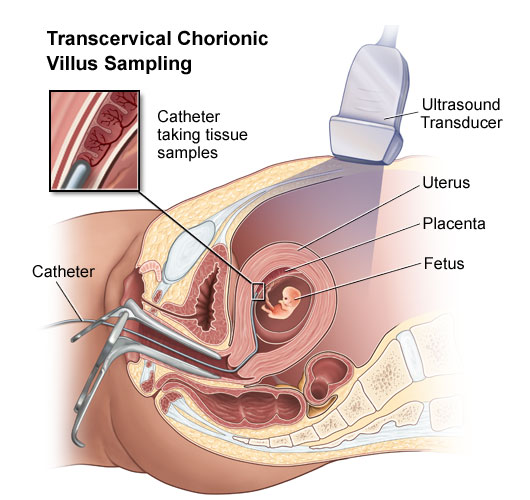
Ultrasound machines have been able to indicate structure and location of the placenta, bypassing how well the organ itself is functioning, but it is anticipated that technological advances have succeeded in sharpening the focus of the machine. It is those advances in ultrasoujnd that Dr. Abuhamad's team uses to chart placental health, collecting ultrasound and blood samples of women at eight points during pregnancy.

At the same time other research teams focus on identifying particles which the placenta may release into the bloodstream since that could lead to a simple blood test to diagnose problems. Another group of researchers is in the stages of developing a device to quantify the light reflected back through layers of fat as a measure of blood oxygen.

Looking into the future, pregnant women may be encouraged to see their doctors frequently throughout the first trimester when placental screening identifies a problem, for the obvious enough urgency of early intervention and prevention of complications.
Stanford Childeren's Hospital

Labels: ,

Sunday, March 25, 2018

 BORN Ontario: Children's Hospital of Eastern Ontario

"I think we have some of the best data in the world in Canada, particularly in Ottawa."
"This is an investment by the Ontario government in a program that has contributed to the welfare [of babies] in Ontario and, as a benefit, will be able to help countries around the world."
"We are using metabolic fingerprints -- unique patterns in specific molecules found int he blood -- to help estimate gestational age."
 Dr. Kumanan Wilson, research chair, public health innovation, Ottawa Hospital Research Unit

"One of the things that drew us to the project was the opportunity to learn how we could implement similar screening -to Ontario's] in the kinds of places the Gates Foundation was involved in, where there may also be the opportunity to help these kinds who are affected."
Dr. Pranesh Chakraborty, Newborn Screening Ontario
Ottawa Methods Centre, CHEO

The health outcomes of babies in developing countries around the world is on the cusp of being immensely improved as a result of studies and analyses of blood samples routinely taken from newborns in the province of Ontario, analyzed at the Children's Hospital of Eastern Ontario. Funded with a million-dollar grant from the Gates Foundation, a research program is set to aid in identifying the gestational age of low-resource countries newborns.

This, in turn will aid in undertaking public health measure in the prevention of pre-term births, the prevalence of which is considered an urgent international health challenge for the international community. Data gained from blood tests performed on each newborn in Ontario, stored at BORN (Better Outcomes Registry and Network) Ontario, situated at CHEO for public health innovation will now be seeing its endeavours bearing fruit abroad where it is sorely needed.

Blood routinely collected to enable screening of newborns for illnesses that can then be treated with swift intervention served its own vital interests in screening that blood derived from 140,000 newborns in the province annually. Data derived from testing the blood becomes part of the invaluable data bank. With the use of that data, Dr. Wilson, along with Dr. Steve Hawken from The Ontario Hospital and University of Ottawa succeeded in creating an algorithm to determine gerstational age of babies based on newborn blood collection data.

This vital work of developing and validating their purpose-built algorithm saw recent publication in The American Journal of Obstetrics and Gynecology, and EBioMedicine medical journals. Being tested using newborn data from Bangladesh, Zambia, China and the Philippines, the algorithim is expected to bring results enabling the medical community to reduce pre-term birth and improve newborn health outcomes.

Plans are underway to extend the testing to sub-Saharan Africa and South Asia, enabled by the new funding from the Gates Foundation. Blood taken from newborns in addition to determining gestational age, will be tested for congenital hypothyroidism and sickle0-cell disease, among other treatable diseases. Dr. Chakraborty has been brought into the project along with other researchers from Stanford University.
Knowledge of gestational age at the time of birth is important for distinguishing the preterm from the small-for-gestational age (SGA) infant, whose medical needs and expectations for achieving significant development milestones may be different. Reliable gestational age estimates are also useful for quantifying population burdens of preterm birth, which can facilitate appropriate allocation of resources to hospital centres and regions of greatest need. In many low-income and middle-income countries, maternal access to prenatal care, in particular to ultrasound dating services, is limited and imprecise measures, such as last menstrual period, fundal height, or examination of the newborn are relied on for gestational age estimation.1–3 Given that gestational dating based on knowledge of last menstrual period is frequently unreliable4–6 and postnatal physical examinations are subject to variability based on subjective scoring and poor performance in extreme preterm and SGA infants,7 8 new methods of providing gestational age estimates at the time of birth are required. This need has been recognised by organisations who have sought to improve data on preterm birth9 10 and also develop new ways to measure gestational age. 
The National Center for Biotechnology Information
Dr Kumanan Wilson, left, and Dr. Pranesh Chakraborty are part of a study to analyze data newborns' blood to better understand pre-term birth around the world. Jean Levac / Postmedia     

Labels: , , , ,

 
()() Follow @rheytah Tweet