Mumbai's Double Threat
"The Mumbai metropolitan area has 20-million people, is very vulnerable to cyclones at the best of times [not having had one ever, for all practical purposes], and is currently a hot spot of the coronavirus pandemic."
Adam Sobel, atmospheric scientist, professor, Columbia University
"Took stock of the situation in the wake of cyclone conditions in parts of India's western coast."
"Praying for everyone's well-being. I urge people to take all possible precautions and safety measures."
Indian Prime Minister Narendra Modi

"So far this is the only death [a 58-year-old man died after an electrical transformer fell on him in Raigad], reported in the state and we have begun [a] restorations operation this evening as soon as the cyclone passed.""Apart from tin roofs flying off and treefall there isn't much damage in the state and we expect to clear the roads by tomorrow.""The tail of the cyclone is currently passing over Alibag after which wind speeds will drop, once it is cleared our teams will go in to assess the extent of damage and begin restoration."Anupam Srivastava, Commandant, National Disaster Response Force, Maharashtra
Cyclone Nisarga was the second such dramatic weather event with the potential to kill people, wreck infrastructure, devastate the environment, and wreak grave financial harm to an economy already hit hard by lockdown in efforts to control the novel coronavirus that has menaced and done great harm to
Asia's third-largest economy, of which the giant metropolis happens to be the financial capital.
Asia's third-largest economy, of which the giant metropolis happens to be the financial capital.
Mumbai just incidentally became the epicentre of SARS-CoV-2 infections in India, the most populous nation on the planet, finally overtaking China for that distinction. Carrying heavy rain and wind gusts up to 120 kilometres per hour, it was expected to hit the coasts of Maharashtra and Gujarat, sufficiently intensely to cause huge damage to communication, electricity, trees and plantations, warned the India Meteorological Department.
 |
| A fisherman pulls a handcart filled with crates inland ahead of a cyclonic storm in the north western coast of Mumbai on June 2. |
The government of Prime Minister Narendra Modi had announced that it is time for India to begin lifting its lockdown and opening up the economy, after dramatic losses. Two months of lockdown when New Delhi had determined its course of action would be to shut down the nation to come to grips with the stranglehold of the novel coronavirus's threat to the huge population had come to a gradual end, only to find itself faced with yet another drawback toward achieving normalcy.
Mumbai's outbreak represented over a fifth of India's over 5,600 deaths and more than 198,000 infections. Cyclone Nisarga represented the largest such storm to make landfall in at least a decade after Phyan hit the country's western coast near Mumbai in 2009. Amphan, the worst cyclone over the Bay of Bengal in two decades, displaced millions of people, leading to the deaths of over 100 across India in May.
 |
| Rain clouds fill the sky on the Arabian Sea coast in Mumbai late Tuesday. Cyclone Nisarga was barrelling toward India's business capital, threatening to deliver high winds and flooding to an area already struggling with the nation's highest number of coronavirus infections and deaths. (Rajanish Kakade/The Associated Press) |
That India, with its huge slums and people crowded into finite spaces, with its immense workforce and temporary workers flooding its cities from India's poverty-stricken countrysides, somehow managed to control the fallout from the first wave of COVID-19 could be construed as something of a miracle. Given that a far more technologically advanced country with a more robust medical system, and less than a fourth of the population -- the wealthiest and most powerful on the planet, has suffered a death toll of over 100,000.
Extremely heavy rainfall was expected to hit the central and coastal areas of Maharashtra that includes Mumbai and Thane on Wednesday, with sea conditions such that fisherman were warned to remain on land until the following day, according to the weather office. How much more misery could be visited on one country is hard to credit, considering its epic struggle with the pandemic threat causing a massive loss of livelihood, sending millions into poverty resulting from the strict stay-at-home rules.
 |
| People gather at the site of a landslide in Udarband village, Cachar district in the Barak Valley of southern Assam state on Tuesday. At least 20 villagers, including 10 children, were killed in landslides after three days of incessant pre-monsoon rains, officials said. (AFP/Getty Images) |
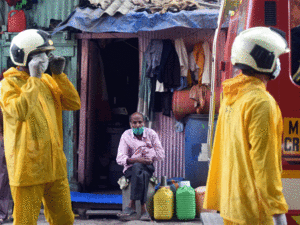
Maharashtra Chief Minister Uddhav Thackeray noted that people living in mud homes were evacuated to safer areas while the slum dwellers of Mumbai were urged to move, particularly those living in low-lying areas of a mega city prone to heavy rains and floods.

Labels: Cyclone Nisarga, India, Mumbai, Novel Coronavirus
posted by Pieface @ 7:26 PM
0 comments


![An estimated 700,000 to 1 million people are crammed in the Dharavi slum [Prashant Waydande/Reuters]](https://www.aljazeera.com/mritems/imagecache/mbdxxlarge/mritems/Images/2020/4/3/e68ececbec384214b8c379b697ebd73e_18.jpg "Concerns after Mumbai's Dharavi slum reports COVID-19 cases")