Ruminations

Blog dedicated primarily to randomly selected news items; comments reflecting personal perceptions

Thursday, October 20, 2022

As Close to Primal Human as Distant Cousins

"It makes them much more human, being able to actually show this. It brings them alive in some ways and allows me to think about them in a much more complex way."
"[These people come alive and] almost get faces, which is awesome for me [when, as a paleoanthropologist he has unearthed evidence of a small group of Neanderthals hunting ibex and bison]."
"If  you dressed up a Neanderthal in modern clothes and put him on the subway you might think he's kind of an ugly guy, but you would recognize him as just like us."
Bence Viola, paleoanthropologist, University of Toronto
A reconstruction of a Neanderthal father and his daughter is seen in this undated handout image
A reconstruction of a Neanderthal father and his daughter is seen in this undated handout photo provided by the Max Planck Institute for Evolutionary Anthropology in Leipzig, Germany. Tom Bjorklund/Max Planck Institute for Evolutionary Anthropology/Handout via REUTERS

University of Toronto paleoanthropologist Bence Viola was in distinguished company, along with his colleague Svante Paabo, winner of the 2022 Nobel Prize in Physiology or Medicine for discoveries on the genomes of extinct hominins particularly Neanderthals, and human evolution. Alongside post-doctoral researcher Laurits Skov at the Max Planck Institute for Evolutionary Anthropology in Leipzig, Germany when they joined their academic archaeological skills in the Altai Mountains of Siberia.

They discovered a 'milk tooth' of a young girl and the vertebrae and ulna of her father, in a cave . DNA linked the two, mitochondrial DNA difference indicating the likelihood they were father and daughter whose remains were over 50,000 years old. Remains from other Neanderthals of the 13 specimens the research team focused on, indicated that the males were closely genetically related, more so than the females.Two males were found to be close maternal cousins of the father, linked by a grandmother.
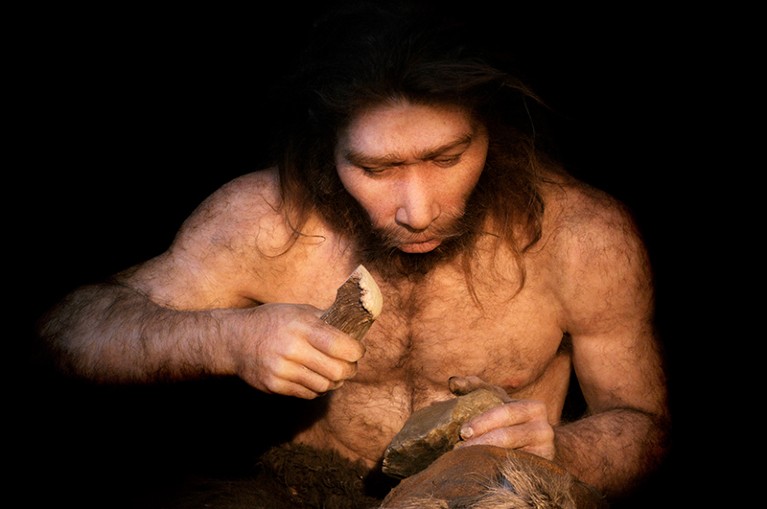
Reconstruction of a Neanderthal (Homo neanderthalensis)

Neanderthals might have lived in small groups, with females regularly arriving and leaving  .Credit: S. Plailly/E. Daynes/SPL

The research team drew the conclusion that young Neanderthal women and not young men were those who migrated between different social groups numbering, they felt, two dozen individuals. The team studied 13 individual Neanderthals making the group the largest studied ever of a Neanderthal population. It is viewed as unsurprising that people who lived together and died in close proximity would have been related.

The adolescent Neanderthal girl whose milk tooth identified her, it was surmised, accompanied her father on a hunting trip, and the cave where their remains were discovered was most likely a short-term hunting camp. The small group would have butchered their game stalked in the hills and passing by in herds through a narrow valley below.

Neanderthal remains were first discovered and identified 200 years ago. More is now known about Neanderthals, revealed over the past 20 years, due in part to Svante Paabo's genomic research. Where once people thought of Neanderthals as brutes more akin to wild animals than the animals that were humans, it is now known that they were sufficiently advanced to produce art, music and language, as well as fashioning rude tools. The patterns of their social lives appear now to be similar to that of homo sapiens.

The 13 Neanderthal remains being studied came mostly from Chagyrskaya Cave, with two from the Okladnikov Cave, both considered to have been short-term hunting camps. Located in southern Siberia's Altai Mountains, the sites are as far east as Neanderthals are known to have located themselves.  Evidence from a major Neanderthal site, the Vindija Cave in Croatia, appears to point out that Neanderthal populations in Europe may have been different.
"Our findings raise questions as to whether the characteristics of the Altai communities are related to their isolated geographical location at the easternmost extremity of the known range of Neanderthals ... or whether they are characteristic of Neanderthal communities more broadly."
Research study, published in Nature
Chagyrskaya Cave, located in the Altai Mountains of southern Siberia in Russia
Chagyrskaya Cave, located in the Altai Mountains of southern Siberia in Russia, s seen in this undated handout photo provided by the Max Planck Institute for Evolutionary Anthropology in Leipzig, Germany. Scientists have sequenced the genomes of 11 Neanderthal individuals based on remains found in the cave. Bence Viola/Handout via REUTERS

Labels: ,

Tuesday, February 22, 2022

It's The Neanderthal In You

"This major genetic risk factor for COVID-19 is so common that I started wondering whether it might actually be good for something."
"We don't know at the moment why it was likely advantageous 10,000 years ago. There are many genes involved in the immune system in this region of the genome, so there are many plausible candidate genes."
"If I were to guess, smallpox would be a good candidate. It also enters cells using chemokine receptors."
Dr.Hugo Zeberg, Max Planck Institute for Evolutionary Anthropology, Germany
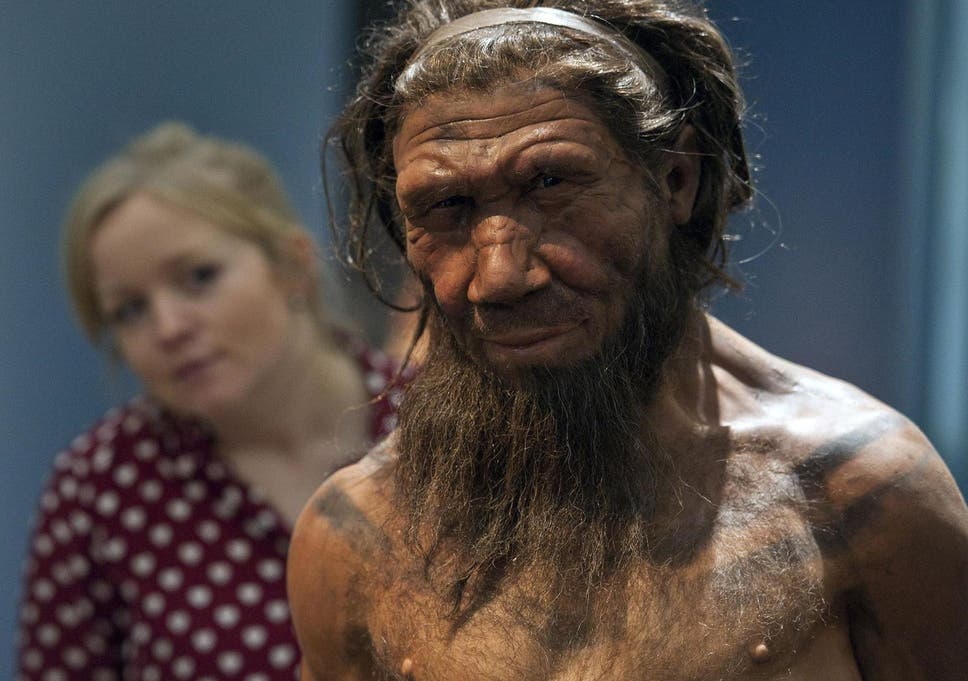
An exhibit at the Neanderthal museum in Krapina, Croatia.
An exhibit at the Neanderthal museum in Krapina, Croatia. A strand of DNA increasing the risk of developing severe Covid-19 has been inherited from the Neanderthals, scientists believe. Photograph: Nikola Solic/Reuters/Corbis

Research recently published in Proceedings of the National Academy of Sciences appears to strongly suggest that Neanderthal genes known to protect people from smallpox, could conversely explain why it is that some ethnic groups appear more at risk from contracting COVID. 
 
South Asians throughout the pandemic are seen to have been at greater risk of severe illness, for example, even accounting for factors such as deprivation, employment and living conditions. Mutated genes inherited from Neanderthals seem to have doubled the risk of contracting severe COVID.

A study conducted by Dr.Hugo Zeberg determined that roughly half of South Asians carry the mutations in comparison with a fifth of Europeans. The variants must have been beneficial at one time, reasoned Dr. Zeberg, for them to have been passed down over the ages. Research that Dr.Zeberg conducted revealed that their impact lowered the risk of HIV infection by about 27 percent.

That being the case, the researcher realized a suggestion that those same genes would in all likelihood prevent other disease from entering cells in the same manner as does smallpox. When infected with the SARS-CoV-2 virus causing COVID-19, some people become seriously ill, while others suffer mild or no symptoms.
 
Genes contribute to the chances of contracting severe infection, apart from known risk factors such as advanced age and chronic illnesses such as diabetes. Those with the Neanderthal mutation on chromosome 3 have fewer CCR5 receptors used by HIV to enter human cells, similar to the method of entry for smallpox. Leading researchers to believe that the mutation may have occurred thousands of years past, to protect against the virus, since eradicated.
 
Swedish geneticist Svante Pääbo, PhD
Swedish geneticist Svante Pääbo, PhD, Director of the Max Planck Institute for Evolutionary Anthropology in Germany, is co-author of a recent study that traced a gene cluster linked to a higher risk of severe COVID-19 to 50,000-year-old Neanderthals from Croatia   (Photo: Max Planck Institute for Evolutionary Anthropology)
 

Labels: , , , ,

Friday, November 29, 2019

Neanderthal Extinction

"Our results support the hypothesis that the disappearance of Neanderthals might have been the result of demographic factors alone, that is, the result merely of the internal dynamics that operate in small populations."
"Our results are consistent with a scenario in which a small population of Neanderthals persists for several thousands of years, and then, due to a stroke of bad luck, disappears."
"The mere fact that the Neanderthals were living in such a small population might have been enough to [make them] go extinct."
"It's not unusual they were living in small populations, either. It's known that they did."
"The arrival of [humans] would have been a contributory factor rather than the cause of the extinction."
"The species' demise might have been due merely to a stroke of bad demographic luck."
"The mere interspersal of AMH sub-populations between Neanderthal sub-populations reduced the opportunities for intrabreeding and migratory activity among the latter."
"As such, the presence of modern humans in Eurasia would have accelerated a process that, at some point, was likely to have occurred anyway."
Research study, Eindhoven University of Technology, Netherlands
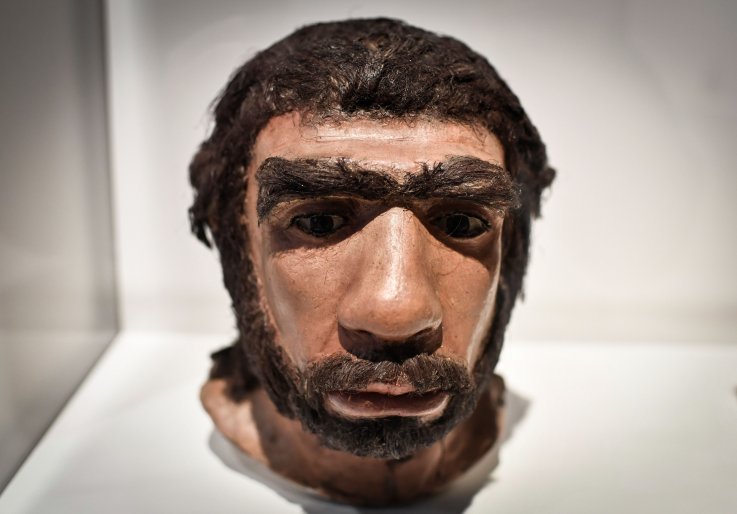
Neanderthal Man
A moulding of Neanderthal man.  Photo: Stephane D. Sakutin, AP/Getty

"We want us to play a role in their extinction, because it helps us to answer the question as to what makes us unique or human."
"So the standard story, according to which modern humans outsmarted Neanderthals, is attractive to us because it implies that our species can be distinguished from our sister species by reference to our superior intelligence."
Krist Vaesen, Associate Professor, Philosophy of Innovation, Eindhoven University of Technology 

 Published in PLOS One, new research out of the Netherlands has brought out a new theory on the possible cause of Neanderthal extinction. Possibly, the researchers posit from the results of their study, inbreeding was partially responsible. The researchers themselves were somewhat taken aback by the conclusions their research led them to. They ran simulation models that they based on existing hunter-gatherer societies with a view to discovering whether factors aside from human competition might have wiped out Neanderthals some 40,000 years ago.

Obviously, modern humans fell into the category of nature's creatures that managed to adapt and evolve as a species more successfully than did Neanderthals. Earlier research has pointed out that humans and proto-humans lived in fairly close proximity to one another, and in all probability, given that modern science has found Neanderthal DNA in a huge segment of the current population, must also have interbred. Given the larger skull dimensions of Neanderthals it has also been suggested that human females were not that likely to give birth to babies with Neanderthal characteristics; more likely that Neanderthal females more readily gave birth to babies with human features.
The new exhibition at the Canadian Museum of Nature 'deconstructs' stereotypes around Neanderthals. (Nikola Solic/Reuters)

There is agreement among Paleoanthropologists of the disappearance of Neanderthals roughly 40,000 years ago, at a time when anatomically modern humans were expanding their presence into Eurasia, steadily migrating out of Africa. Neanderthal populationss, on the other hand, arose in Eurasia. There has never been full agreement, however on whether and when and how early modern humans may have been responsible in part for the demise of Neanderthals.

The researchers simulated model groups of 50, 100, 500, 1,000 and 5,000 individual populations studying the effects within each group, of inbreeding. They included Allee effects whereby the smaller a population the lower its reproduction rate, and vice versa, along with random fluctuations of a population taking into account factors such as births, deaths and sex ratios, the aim being to determine whether factors such as these could conceivably lead to extinction over a 10,000-year period.
A picture taken on March 26, 2018 shows a thermoforming of a Flores woman displayed for the Neanderthal exhibition at the Musee de l'Homme in Paris. STEPHANE DE SAKUTIN/AFP via Getty Images
The study concluded that interbreeding, in and of itself  was not likely to  have led to extinction; the smallest studied group of 50 was found to have gone extinct in this manner, but of groups with 1,000 individuals or fewer, should only a quarter or less of females give birth in any single year, extinction could also occur. When all factors were accounted for (inbreeding Allee effects and demographic fluctuations) over the ten-thousand-year simulation period, extinction was almost certain to result for all group sizes.

The study authors suggest the presence of human ancestors might conceivably have made the presence of Neanderthals more vulnerable to the factors involved in the study, before extinction. But they are also convinced that the human presence was simply coincidental to the final extinction. Which caused the researchers themselves to entirely revise their own former belief, common among paleoanthropologists that homo sapiens contributed hugely to the obliteration of the Neanderthals.

What caused the extinction of Neanderthals after 350,000 years on the planet remains a point of debate for experts
What caused the extinction of Neanderthals after 350,000 years on the planet remains a point of debate for experts ( PA )

Neanderthals have contributed approximately 1-4% of the genomes of non-African modern humans, although a modern human who lived about 40,000 years ago has been found to have between 6-9% Neanderthal DNA (Fu et al 2015). The evidence we have of Neanderthal-modern human interbreeding sheds light on the expansion of modern humans out of Africa. These new discoveries refute many previous hypotheses in which anatomically modern humans replaced archaic hominins, like Neanderthals, without any interbreeding. However, even with some interbreeding between modern humans and now-extinct hominins, most of our genome still derives from Africa. Neanderthals could not have contributed to modern African peoples’ genomes because Neanderthals evolved and lived exclusively in Eurasia and therefore could not have bred with the humans living in Africa at that time.
Smithsonian National Museum of Natural History

Labels: , , ,

 
()() Follow @rheytah Tweet