Ruminations

Blog dedicated primarily to randomly selected news items; comments reflecting personal perceptions

Tuesday, February 22, 2022

It's The Neanderthal In You

"This major genetic risk factor for COVID-19 is so common that I started wondering whether it might actually be good for something."
"We don't know at the moment why it was likely advantageous 10,000 years ago. There are many genes involved in the immune system in this region of the genome, so there are many plausible candidate genes."
"If I were to guess, smallpox would be a good candidate. It also enters cells using chemokine receptors."
Dr.Hugo Zeberg, Max Planck Institute for Evolutionary Anthropology, Germany
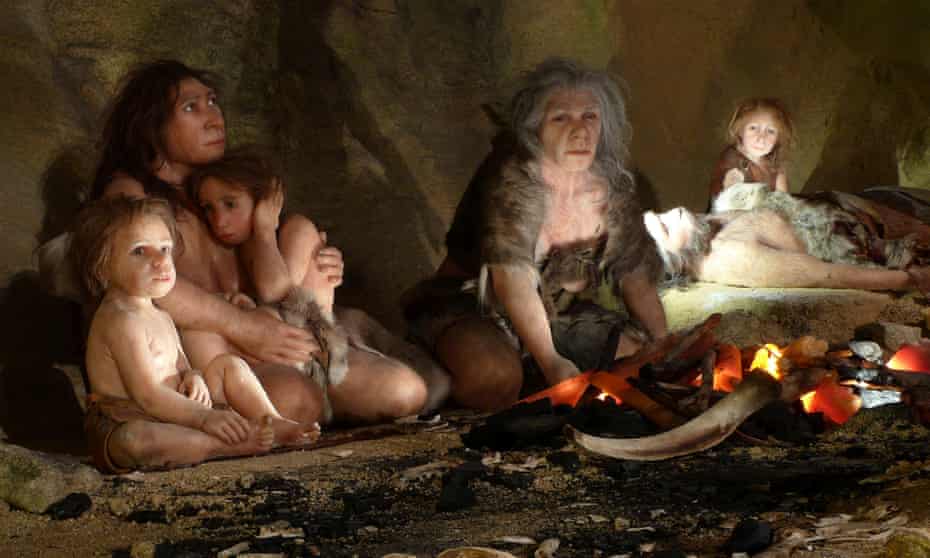
An exhibit at the Neanderthal museum in Krapina, Croatia.
An exhibit at the Neanderthal museum in Krapina, Croatia. A strand of DNA increasing the risk of developing severe Covid-19 has been inherited from the Neanderthals, scientists believe. Photograph: Nikola Solic/Reuters/Corbis

Research recently published in Proceedings of the National Academy of Sciences appears to strongly suggest that Neanderthal genes known to protect people from smallpox, could conversely explain why it is that some ethnic groups appear more at risk from contracting COVID. 
 
South Asians throughout the pandemic are seen to have been at greater risk of severe illness, for example, even accounting for factors such as deprivation, employment and living conditions. Mutated genes inherited from Neanderthals seem to have doubled the risk of contracting severe COVID.

A study conducted by Dr.Hugo Zeberg determined that roughly half of South Asians carry the mutations in comparison with a fifth of Europeans. The variants must have been beneficial at one time, reasoned Dr. Zeberg, for them to have been passed down over the ages. Research that Dr.Zeberg conducted revealed that their impact lowered the risk of HIV infection by about 27 percent.

That being the case, the researcher realized a suggestion that those same genes would in all likelihood prevent other disease from entering cells in the same manner as does smallpox. When infected with the SARS-CoV-2 virus causing COVID-19, some people become seriously ill, while others suffer mild or no symptoms.
 
Genes contribute to the chances of contracting severe infection, apart from known risk factors such as advanced age and chronic illnesses such as diabetes. Those with the Neanderthal mutation on chromosome 3 have fewer CCR5 receptors used by HIV to enter human cells, similar to the method of entry for smallpox. Leading researchers to believe that the mutation may have occurred thousands of years past, to protect against the virus, since eradicated.
 
Swedish geneticist Svante Pääbo, PhD
Swedish geneticist Svante Pääbo, PhD, Director of the Max Planck Institute for Evolutionary Anthropology in Germany, is co-author of a recent study that traced a gene cluster linked to a higher risk of severe COVID-19 to 50,000-year-old Neanderthals from Croatia   (Photo: Max Planck Institute for Evolutionary Anthropology)
 

Labels: , , , ,

Wednesday, June 30, 2021

The Neanderthal In Us

"It all started in Israel. We suggest that a local group was the source population."
"During interglacial periods, waves of humans, the Nesher Ramla people, migrated from the Middle East to Europe."
"The European Neanderthal actually began here in the Levant and migrated to Europe, while interbreeding with other groups of humans."
Dr Hila May, Tel Aviv University, Israel
 
"This is the first time we could connect the dots between different specimens found in the Levant."
"There are several human fossils from the caves of Qesem, Zuttiyeh and Tabun that date back to that time that we could not attribute to any specific known group of humans. But comparing their shapes to those of the newly uncovered specimen from Nesher Ramla justify their inclusion within the [new human] group."
Dr Rachel Sarig, Tel Aviv University  
"It was a surprise that archaic humans were using tools normally associated with Homo sapiens. This suggests that there were interactions between the two groups."   
"We think that it is only possible to learn how to make the tools through visual or oral learning. Our findings suggest that human evolution is far from simple and involved many dispersals, contacts and interactions between different species of human."
Dr Yossi Zaidner, Hebrew University of Jerusalem
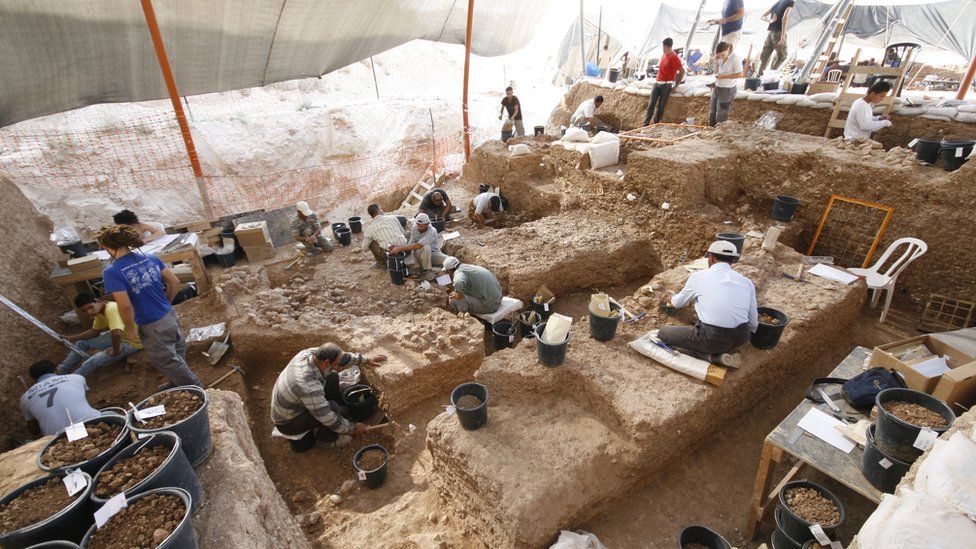
Site of Discovery
The human finds were uncovered during the excavation of a sinkhole. Thousands of stone tools and animal remains were also found  Photo: Yossi Zaidner

"The discovery of a new type of Homo is of great scientific importance."
"It enables us to make new sense of previously found human fossils, add another piece to the puzzle of human evolution, and understand the migrations of humans in the old world."
"Some fossils found in East Asia manifest Neanderthal-like features as the Nesher Ramla do."
Israel Hershkovitz, Tel Aviv University
Scientists in Israel feel they have succeeded in unearthing a discovery of a hitherto-unknown early human. Pieces of fossilized bone discovered at a site in central Israel used by a cement plant were studied carefully and led to this conclusion. Fragments were those of a skull and a lower jaw with teeth, estimated to be roughly 130,000 years old. Should their conclusions prove to be correct, the potential of reimagining parts of the human family tree is on the horizon. 

The archaeological project was a joint venture between researchers from Tel Aviv University and the Hebrew University of Jerusalem. The new proto-human was named Nesher Ramla Homo, after the area  southeast of TelAviv where the remains were discovered. The species, it is speculated, may have lived alongside our own species, Homo sapiens for over 100,000 years and it is posible that interbreeding took place, according to the team's studies.
 
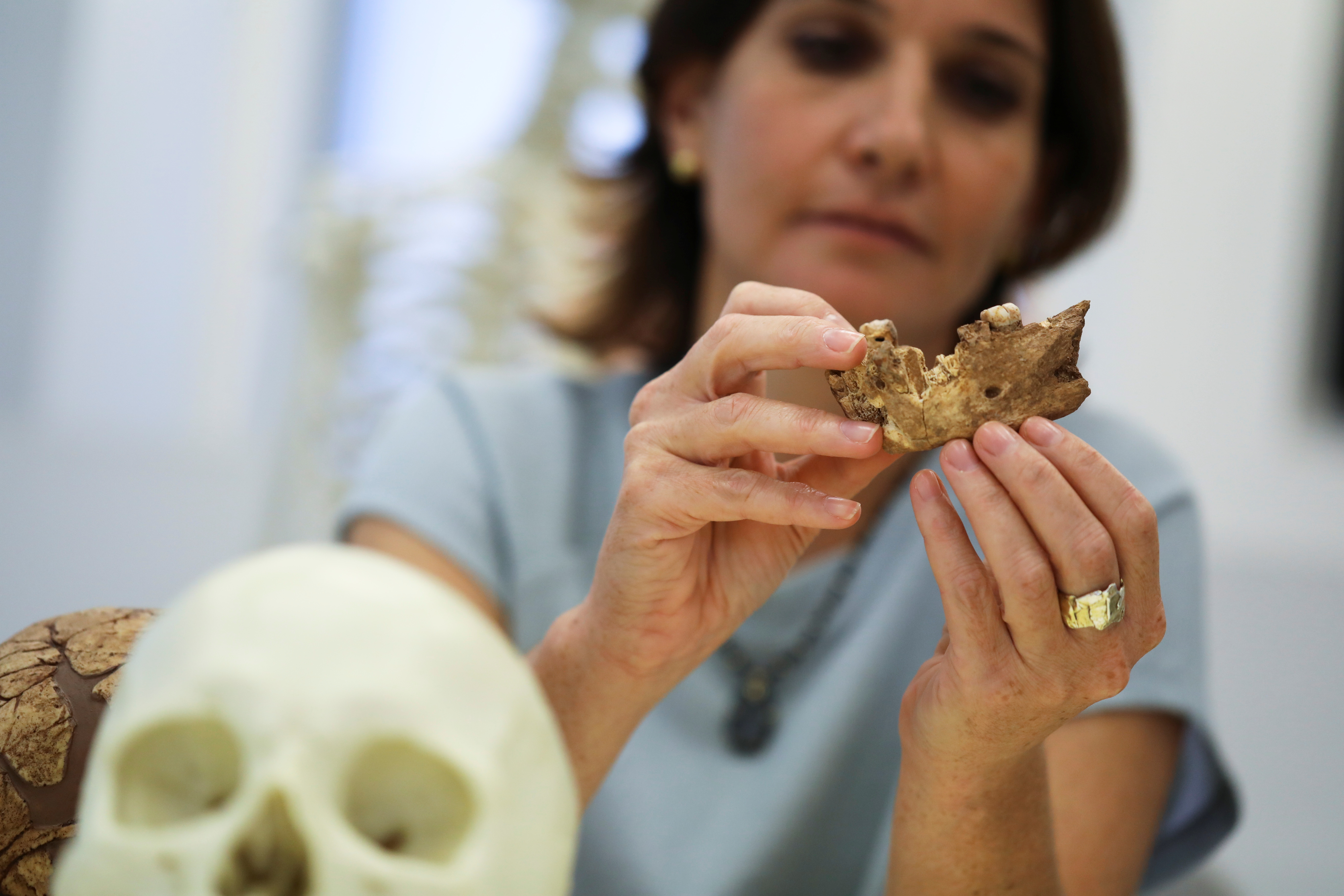
Hila May, a physical anthropologist at the Dan David Center and the Shmunis Institute of Tel Aviv University holds what scientists say is a piece of fossilised bone of a previously unknown kind of early human discovered at the Nesher Ramla site in central Israel, during an interview with Reuters at The Steinhardt Museum of Natural History in Tel Aviv, Israel June 23, 2021. Picture taken June 23, 2021. REUTERS/Ammar Awad
Hila May, a physical anthropologist at the Dan David Center and the Shmunis Institute of Tel Aviv University holds what scientists say is a piece of fossilized bone of a previously unknown kind of early human   Reuters
 
Distinguished with large teeth and chinless, these early humans may have been ancestors to Neanderthals. In making that suggestion the archaeological team is challenging the scientific given that distant evolutionary humans originated in Europe. While exploring the mining area of the Nesher cement plant not far from the city of Ramla, Dr.Yossi Zaidner of Hebrew University had discovered the fossils.

Follow-up excavation revealed the bones located roughly eight metres underground and with them were discovered stone tools, along with the skeletal remains of horses and deer. The Nesher Ramla type resembled pre-Neanderthal groups in Europe, according to the study authors whose work was published in the journal Science.

"This is what makes us suggest that this Nesher Ramla group is actually a large group that started very early in time and are the sources of the European Neanderthal", explained Hila May, physical anthropologist at the Dan David Center and the Shmunis Institute of Tel Aviv University.

Dr.May is convinced the Nesher Ramla might represent the mystery group responsible for Homo sapiens genes being present in earlier Neanderthal populations in Europe, long a puzzle to experts in the field. The skull of the species discovered is flat, the jaw bone is chinless and 3D shape analysis has ruled out any other known group related to it.

There was a match, however, with a small number of human fossils discovered elsewhere in Israel, dating back even earlier (400,000 years back in dim antiquity), and which anthropologists had been unable to place.
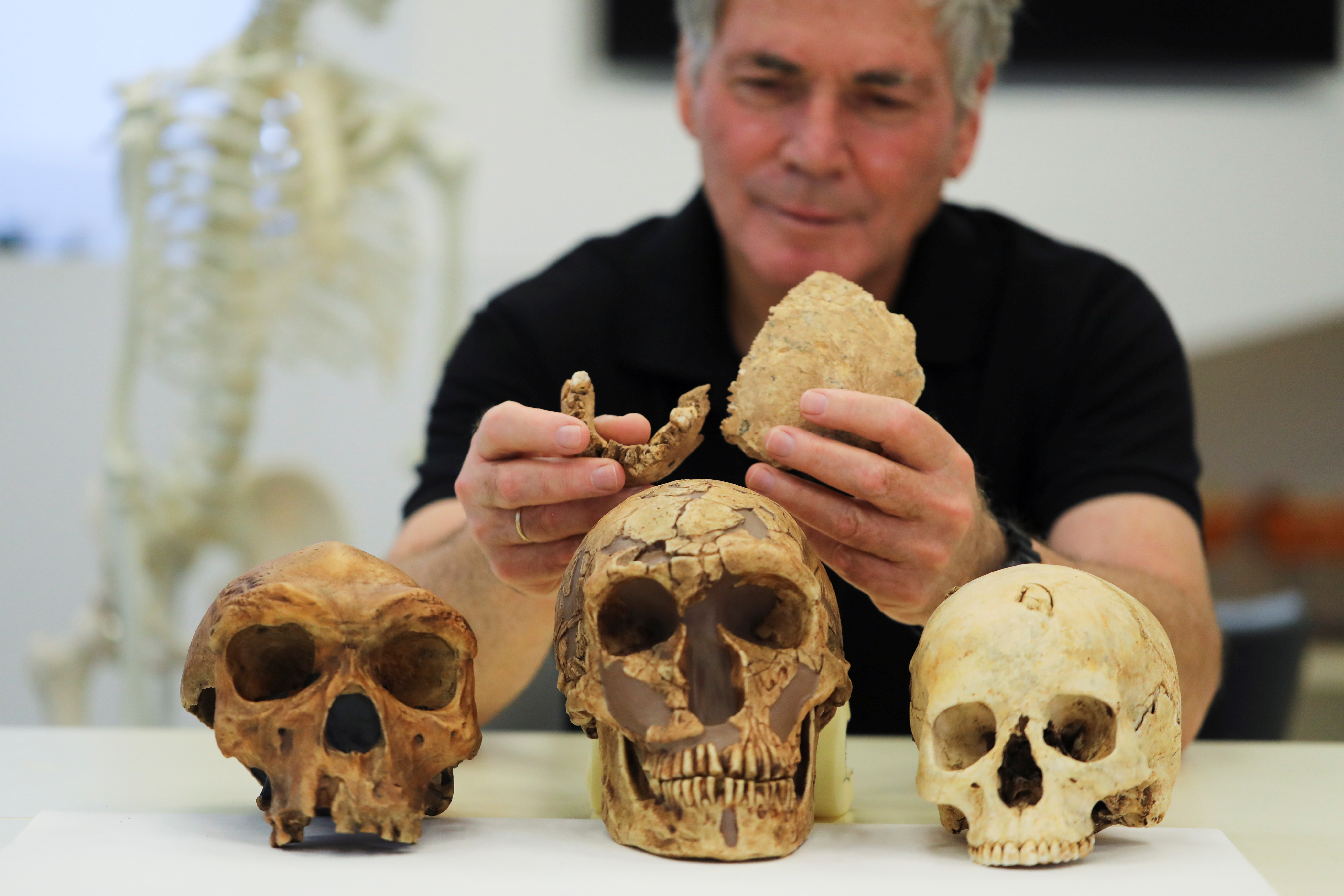
Tel Aviv University Professor Israel Hershkovitz, holds what scientists say are two pieces of fossilised bone of a previously unknown kind of early human discovered at the Nesher Ramla site in central Israel, during an interview with Reuters at The Steinhardt Museum of Natural History in Tel Aviv, Israel June 23, 2021. Picture taken June 23, 2021. REUTERS/Ammar Awad
Tel Aviv University Professor Israel Hershkovitz, holds what scientists say are two pieces of fossilised bone of a previously unknown kind of early human discovered at the Nesher Ramla site in central Israel  Reuters

Labels: , , , , , ,

Tuesday, January 22, 2019

Nature's Human Health Formula

"[There is no one 'true' diet for humans, who] can be very healthy on a wide range of diets."
"We know that because we see a wide range of diets in these very healthy [hunter-gatherer] populations."
"Our whole species has evolved from hunter-gatherer communities. We were hunting and gathering before we were us, and if you want to understand how our physiology works it is important to understand hunting and gathering and how it affects our bodies and health."
"If you go live with hunter-gatherers, the thing you’re overwhelmed by is how active they are. You are on your feet all day moving — you don’t have the luxury to be lazy, and that impressed me a lot."
Herman Pontzer, professor, Evolutionary Anthropology, Duke University, North Carolina
A Tsimane member. Image credits: jambogyuri.

"They [Indigenous Bolivian population] changed from their traditional diet to eating in town where everything is fried."
"They started eating fried chicken and rice and drinking Coca-Cola. Some of these folks can see a pretty rapid change in health."
Michael Gurven, anthropologist, University of California, Santa Barbara
"Close friendships and family bonds, low levels of social and economic inequality and lots of time spent outdoors are typical in hunter‐gatherer populations and other small‐scale societies."
"The absence of these in modern societies is associated with chronic social stress and a range of non‐communicable diseases, including metabolic disease and obesity. As we work to understand the evolutionary roots of modern disease, we should strive for a more integrative and holistic understanding of lifestyle and health among hunter‐gatherers today and in our collective past."
"Exercise may also help to regulate appetite, improving the balance between energy expenditure and intake and exercise has been shown to help maintain weight loss. The regulatory effects of exercise warrant further attention."
Study on diets of hunter-gatherer societies, published in the journal Obesity Reviews
New research into hunter-gatherers has surprising implications for diet and exercise choices
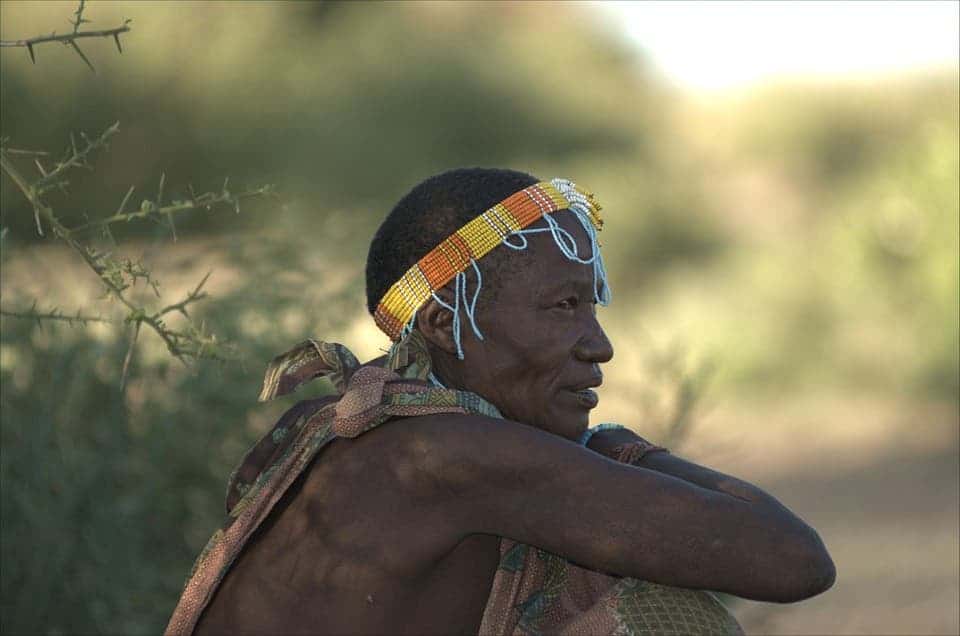
Hazda Hunters, northern Tanzania
Diets, habits and physical activity levels of modern hunter-gatherer groups with lifestyles very like those of ancient populations took the attention of a research group whose findings were recently published in the journal Obesity Reviews. The major takeaway of the research was that in reviewing these small-scale societies all appear to exhibit generally good metabolic health, although their diets varied widely. Their diets, understandably, were represented largely by what was available to them given their geographic location and their cultural habitude in hunting and gathering.

Some of these tribes obtained around 80 percent of their calories from carbohydrates while others consumed mostly meat, yet almost all eat a mix of meat, fish and plants, foods packed with vital nutrients. On the other hand, fiber is a mainstay of these diets -- derived from carbohydrates stemming from consumption of vegetables and starchy plants with a low glycemic index -- not leading to rapid blood sugar spikes. Sugar remains a part of their diets, derived from gathering honey.

One other thing distinguishes them from modern society and which they all held in common; physical action where many of these tribespeople walk up to eight to sixteen kilometers each day. Peculiarly enough, the study found no higher energy expenditure levels than those expended by the average modern-day office worker, suggesting that exercise be recommended by health authorities on the basis of improving metabolic health -- not necessarily as an antidote to obesity through calorie-burning.

Healthwise, what sets these modern hunter-gatherers apart from their modern, cosmopolitan counterparts is a relative absence of chronic conditions such as heart disease, hypertension and cancer, as well as having lower obesity rates. They exhibit quite high levels of cardiorespiratory fitness, even as they age, and Type 2 diabetes and metabolic dysfunction are conditions that are rare among these populations.

On the other hand, infant mortality rates, led by infectious diseases tends to be high and deaths occasioned by accidents, gastrointestinal illness and acute infections are commonplace, yet those who survive to adulthood reach their elder years fairly free from degenerative diseases of a type that are recognized as 'normal' in industrialized nations. In the hunter-gatherer groups, people tend to remain fit and active until death.

Studies indicate that when people of hunter-gatherer societies move to urban centres, adopting lifestyles so unlike their own, high rates of obesity and metabolic disease arise among them. Dr. Gurven from the University of California, researches the Tsimane in Bolivia -- a group with a subsistence lifestyle of hunting, gathering, fishing and farming -- studying them extensively and publishing detailed reports relating to their exceptional cardiovascular health and lack of diabetes.

However, among those he studies have been some who have left their villages to move to the town of San Burja located nearby, to take up sedentary office occupations, and in the process surrender their traditional diet. That alteration in lifestyle results in health-deleterious effects that erode their fine health condition so common in their traditional diet and lifestyle.

Dr. Pontzer and colleagues used data collected from the Hadza, a community commonly spending their time hunting and foraging in northern Tanzania, a reflection of how their ancestors lived for tens of thousands of years, consuming what is familiarly spoken of as "the oldest diet", relying on a limited number of foods whose lack of novelty and variety in such diets may explain why they tend not to overeat and become obese.

The greater the variety of food choices in modern society, the longer it appears, before people experience that 'full' feeling, a sensation understood as 'sensory specific satiety'. "It's the reason you always have room for dessert at a restaurant even when you're full", explained Dr. Pontzer. "Even though you've had a savoury meal and you can't eat one more bite of steak, you're still interested in the cheesecake because it's sweet and that button hasn't been worn out in your brain yet."
Foods rich in fibers are a staple of a healthy diet. This was one of the very few similarities across all investigated diets. Image credits: Keith Weller, USDA.


Labels: , , , , , , ,

Monday, November 27, 2017

Out of Africa

"The conventional timeline of human evolution and migration continues to crumble in the face of new research."
Gemma Tarlach, science writer, Discover Magazine

"That's just because of the way that the differences can accrue over time between the genetic lineage and the species, right? You're always going to have individuals and populations within a species that go extinct and leave no living descendants."
"So they represent basically lost lineages of people leaving Africa, and their descendants slowly expanding into parts of Europe and Asia, but then for whatever reason, those populations went extinct. And subsequently, somewhere around 40,000 to 70,000 years ago, we have groups of modern humans beginning to leave Africa again, and they're essentially the ancestors of all of us that are of non-African descent."
"The context of that find really challenged people's thinking, but now, 15 years later, it's not as challenging, because we really see this process of dispersal happening again and again for the past two million years."
"So likely Homo Florsiensis represents descendants of some of those earliest dispersals of humans out of Africa, long before even the common ancestors of humans and Neanderthals evolved and left Africa."
"[The signal of Neanderthal in modern non-African human DNA is] rather small, and there have been clear selective sweeps against Neanderthal DNA in our DNA. So what that means is essentially it wasn't really as compatible as any other two populations of modern humans breeding together." 
"The fact that [the Jebel Irhoud bones] date to that [early] time pretty much excludes them as a potential ancestor of anyone living today."
Matthew Tocheri, anthropologist, Canada Research Chair in Human Origins, Lakehead University

"The common myth that we drove them [Neanderthals] to extinction is just that, it's a myth."
"There's no evidence at all in the archaeological or fossil record of modern humans interacting with Neanderthals."
"There is no way to know from what part of that population [in Europe and Asia] the first modern humans did so [left Africa]."
David Begun, paleoanthropologist, University of Toronto
Two views of a composite reconstruction of the earliest known Homo sapiens fossils from Jebel Irhoud (Morocco) based on micro computed tomographic scans of multiple original fossils.
Philipp Gunz, MPI EVA Leipzig

At one time the scientific hypothesis called the multi-regional theory held that modern humanity resulted from an evolutionary process over the space of two million years taking place simultaneously in archaic human populations existing in Africa, Europe and Asia. That theory eventually surrendered to the more probable one that human origin could be traced to its beginnings in East Africa. More recent studies indicate that human and Neanderthal evolution diverged 500,000 years ago, scant Neanderthal DNA remaining in the human genetic code, of less than five percent.

The view that humans of today all share their origins from a small group of East African ancestors resulting in all of humanity essentially stemming from the same family tree and sharing an attractively theorized grandmother named Mitochondrial Eve, was seen as a great anthropological leveller; that we evolved as a single race. That the Caucasus did not produce Caucasians and nor did Asians originate in Asia; we all evolved from the original East African strain of humanity.

And the human record, thanks to new  strides in genetics and fossils along with biomechanics has led paleoanthropologists to believe humans as a species are older than believed to have been the case.

That the human species 'left' Africa on many occasions over the anthropological time record, evolving in different regions at variant rates, not in one fell swoop of an immense migration in a finite period of time. The Neanderthals and the littler-known Denisovans appeared, according to this new agreement between scientists, to have died out on their own, similarly to every other hominin population that once lived, with the exception of Homo sapiens.

The previously-subscribed-to timeline went back to 200,000 years earlier in East Africa when a small population of Homo sapiens, anatomically modern, having descended from an ape became behaviourally 'modern' in the last 100,000 years, colonizing the entirety of Africa, moving to the Middle East, Europe, Asia and in time, North and South America. An increasingly consistent fossil record of manufactured tools and a progression of artwork helped to tell the story of emerging conceptual thought.

The romance of the Great Rift Valley as the cradle of evolutionary humankind was the locus encouraging the shaping of the human mind and body and where the four "Fs" of evolution emerged: fighting, fleeing, feeding and mating. That is, in the popular imagination of paleontologists of the time. What has remained constant, however, while research advances a more accurate understanding of evolution is that origins in Africa remain certain, even though the scope has been recognized as somewhat more complicated.
The Moroccan hillside where anthropologists found the remains.
Shannon McPherron, MPI EVA Leipzig

In June, a discovery reported in Nature initiated a wholesale re-think when bones from a site called Jebel Irhoud in Morocco, thought to represent Neanderthals, were later identified as human when additional bones were unearthed, augmented by an improvement in scientific dating techniques of the sedimentary layer in which they were discovered, shown to be up to 350,000 years in primitive antiquity. The traditional story of evolution underwent a transformation reflecting the presence of anatomically modern Homo sapiens in Morocco dating that far back.

The lead taken from that discovery was that the emergence of humanity was not confined to a certain East African savanna, more in all likelihood the entire continent of Africa, representing a full fifth of the planet's land mass. Most of those human populations, it seems, simply failed to survive. Similar discoveries have been unearthed in Europe with genetic combinations no longer existing in modern humans, indicating a pattern of ancient humans migrating out of Africa and in so doing becoming isolated and in time, extinct, leaving behind a fossil record.

Fossils discovered in Indonesia in 2003 known as Homo Floresiensis represent one example; those discovered in Indonesia overlapping with the fossils of modern humans as little as a few thousand years ago created a conundrum for anthropologists. That they simply failed to survive as a species lends a new air of discovery relating to Neanderthals as well, dispelling the long-held theory that the superior Homo sapiens involved in conquest of a challenger for resources, exterminated Neanderthals.


This is a schematic representation of the evolutionary scenario for mitochondrial and nuclear DNA in archaic and modern humans. Neanderthal mitochondrial DNA recovered in this study suggests an intermediate migration out of Africa before 220,000 years ago.
Credit: Annette Günzel, © Max Planck Institute for the Science of Human History

Labels: , , , , ,

Friday, September 11, 2015

Homo naledi [Lesotho for 'star']

"It was soon apparent that what I thought was an individual skeleton was dozens of individuals."
"With every bone in the body represented multiple times, it is already practically the best-known fossil member of our lineage."
"It's enormously surprising to see a very primitive member of the genus [Homo], not very humanlike overall, to do something unique to humans. To see it in a small-brained hominid is completely surprising. None of us expected it."
"[H.naledi] comes near or at the root of the genus Homo] in excess of 2.5-million years ago."
Lee Berger, paleoanthropologist, University of the Witwatersrand, Johannesburg

"One of the most exciting things for us is we discovered something new in biology. We had never seen a creature like this before."
"H.naledi is unlike anything in our genus.... When you look at the anatomical elements across the body, it's an enormous assemblage of fossils. The task was to interpret these fossils and put them in the context of evolution and where they fit on the human tree."
"We have 190 teeth, and they are represented multiple times. We have more than a dozen molars, and the differences are typically less variable than in small populations of humans. Every member of every team ... agreed we were looking at the same species. The hand may be telling us a different story than the shoulder, but it would beg belief that we mixed things [belonging to different species]."
"This is an anatomical mosaic that evolutionary history gave us ... it gives us a different model for how things could fit in our own origins."
"This chamber has not given up all its secrets."
John Hawks, anthropologist, University of Wisconsin, Madison, U.S.A.
While primitive in some respects, the face, skull, and teeth show enough modern features to justify H. naledi's placement in the genus Homo. Artist Gurche spent some 700 hours reconstructing the head from bone scans, using bear fur for hair. National Geographic
The Cradle of Humankind World Heritage Site located in South Africa, given its name, is just the very place where you might expect to find ancient archaeological sites that might hold bone remnants of creatures who lived in the area in prehistoric times. It isn't called the 'cradle of humanity' for no reason. The places where primordial creatures once lived and roamed have changed as the geology undergoes variations in its original natural layout, yielding to the curious now and again proof of early hominid ancestors of modern humankind.

It takes nerve, experience and determination to enter tunnels deep in the Earth to discover caverns in the dark, close confinement of the bowels of valleys and forests that once hosted creatures long since extinct; the paleolithic record reveals to scientists answers to some mysteries the details of which can sometimes be deduced by informed research in hopes of fully understanding the long slope of evolutionary transformation from the primitive to the developed present.

It took the adventurous spirit of two amateur caver/spelunkers undeterred by smotheringly-close confines in narrow winding tunnels as dark as total absence of light can ever be, to find at last a difficult-to-reach chamber within which could be found natural artifacts proclaiming the presence, millions of years ago, of ancient creatures predating the evolution of modern man. Imagine narrow passages through which stomach-crawls are the only form of advance; stone walls, narrow ledges and a sideways-accessed descent of 122-metres.

And then the destination reached, a nine-metre-long cave of a chamber estimated to be between two million and three millions years old. And within, fossil fragments of a distant relative of the human species; a cache of bones and teeth stuck in ancient clay; some 1,500 of the objects representing the largest such fossil discovery ever discovered in Africa, the cradle of humankind. Two years of analyzing by specialized international experts followed the month-long excavation of the fossil find.

And then a joint announcement by National Geographic and the South African Department of Science and Technology/National Research Foundation and the University of the Witwatersrand, of the spectacular find in the Rising Star cave complex about 40 kilometres northwest of Johannesburg. The bone fragments have not been dated yet, but the involved scientists feel they may represent the most primitive members ever found of the genus Homo. All of the fragments of men, women, children and infants appear to have been ceremonially placed in the cave following death.

H.naledi, explain the scientists, had a brain the size of a baseball with shoulders and torso primitive in design, long, curving fingers for climbing and swinging from trees, but with wrist bones that indicate H.naledi used tools. Legs and feet almost indistinguishable from those of modern man gave it the strength and balance to walk [bipedally] upright and travel for long spaces of geography and time. It took 21 days in November of 2013 to secure the fossils by a team prepared to take part in a major excavation under physically trying and dangerous circumstances.

Six volunteers were chosen to take part in the excavation, all of them women, who had to be slender in fit into the narrow confines of the tunnels, and experienced in the technical side of the work. Two papers are set to be published about the discovery, in the open-access scientific journal eLife. The National Geographic Society features the discovery of H.naledi in next month's magazine cover. Dawn of Humanity, a special by National Geographic and Nova premieres on television on PBS, and will be available via online streaming.

The fact that the fossils weren't fused into rock which can be carbon-dated, will make it difficult to determine the age of the fossils. More research needs to be conducted to fully determine all the details involved in validation of informed hypotheses. What does appear undisputed however, is the confidence with which H.naledi is being recognized as humanity's far distant predecessor. nationalgeographic.com/2015/09/150910-human-evolution-change/

Sunlight falls through the entrance of Rising Star cave, near Johannesburg. A remote chamber has yielded hundreds of fossil bones—so far. Says anthropologist Marina Elliott, seated, “We have literally just scratched the surface.” Photo: National Geographic


Labels: , ,

 
()() Follow @rheytah Tweet