Ruminations

Blog dedicated primarily to randomly selected news items; comments reflecting personal perceptions

Thursday, April 28, 2022

Reptile Species' Endangerment of Extinction

"Reptiles represent an important and diverse branch of the tree of life and play integral roles in the eco-system where they occur."
"This global assessment is a key beginning to understanding reptile conservation needs. Now we know where the priorities are and what the threats are that we need to ameliorate."
Bruce Young, chief zoologist, senior conservation scientist, NatureServe, biodiversity science organization, Arlington, Virginia

"Global collaboration and commitment are a must if we are to prevent an extinction catastrophe."
Neil Cox, manager, Biodiversity Assessment Unit, International Union for Conservation of Nature
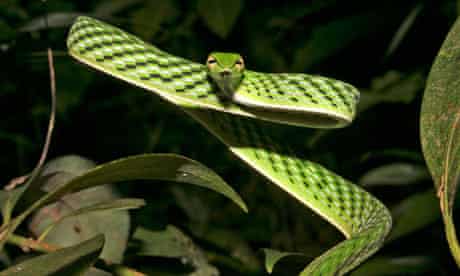
Reptiles threatened with extinction : Ahaetulla nasuta
The green vine snake (Ahaetulla nasuta ) is among the world's reptiles that face extinction. Photograph: Ruchira Somaweera/IUCN/ZSL
 
A new study on biodiversity threats focusing on the world's reptile species, published in the journal Nature, indicates that roughly one fifth of reptile species from the Galapagos tortoise to the Komodo dragon of Indonesian islands face the threat of extinction. A conclusion based on the first comprehensive global assessment of the status of reptile conservation and possible extinction.

Other species at risk studied by researchers included West Africa's rhinoceros viper and India's gharial. A total of 10,196 reptile species was included in the study from turtles, crocodilians, lizards and snakes, to the tuatara, the sole member of a lineage dating back over 200 million years still to survive. The study found that 21 percent of species classified as reptiles are in the critically endangered category; endangered or vulnerable to extinction.
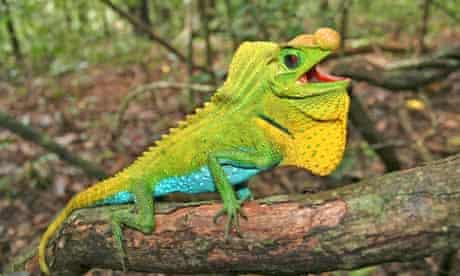
 
Reptiles threatened with extinction : Chamaeleo Lyriocephalus Scutatus
Lyriocephalus scutatus, another lizard species on threatened list. Photograph: Ruchira Somaweera/IUCN/ZSL
 
Another 31 species were identified that had already been declared extinct. The research reported that many reptiles are threatened to the brink of extinction through factors that imperil Earth's other land vertebrates, amphibians, birds and mammals. Deforestation to prepare arable lands devoted to agriculture; logging and development; urban encroachment; and hunting. Throw in climate change and invasive species competing with species indigenous to certain geographies and the threats multiply.

Status reports that preceded this one found that some 41 percent of amphibian species, 25 percent of mammal species, and 14 percent of bird species were placed on the threatened-with-extinction list.The status of species are assessed on circumstances associated with distribution, abundance, threats and population trends.

The world's longest venomous snake, the king cobra is vulnerable to extinction, as is the leatherback, the larges sea turtle. Vulnerable to extinction is the Galapagos marine iguana, and various tortoise species on Galapagos, ranging from vulnerable to extinct.
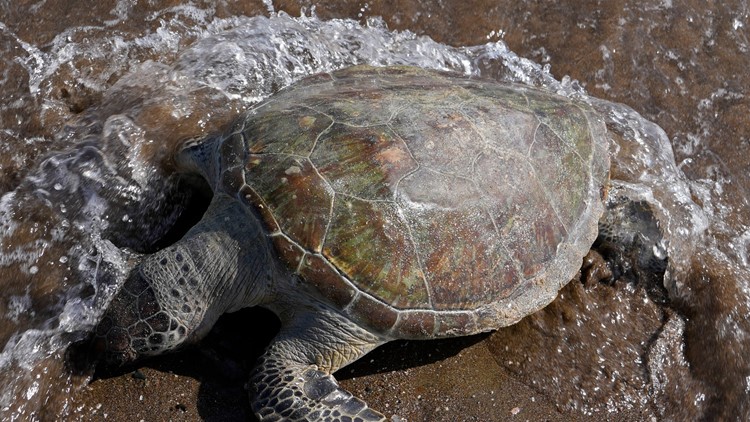
A dead green sea turtle washes up on the beach in the Khor Kalba Conservation Reserve on the east coast of the United Arab Emirates. AP Photo/Kamran Jebreili,

Labels: , , , ,

Sunday, January 12, 2020

An Insatiable Appetite = Extinction

“It is likely that the lack of reproduction was among the major causes of extinction,”
"As no individuals exist in captivity, and no living tissues are conserved for potential resurrection, the fish should be considered extinct."
Research paper, Science of the Total Environment journal

“It’s very sad. It’s a definitive loss of a very unique and extraordinary animal, with no hope of recovery."
"This is the first of these very large freshwater fish to go and many are at risk—the concern is that more will go extinct, but the hope is that we can reverse their decline before it’s too late."
Zeb Hogan, fish biologist, University of Nevada, Reno

"The extinction of the paddlefish is a huge loss and reflects the critical status of the Yangtze River ecosystem."
"The ecology of the Yangtze River is close to collapse due to human activity in past decades [overfishing, pollution and dam construction]."
Pan Wenjing, forest and oceans manager, Greenpeace East Asia
Chinese Paddlefish
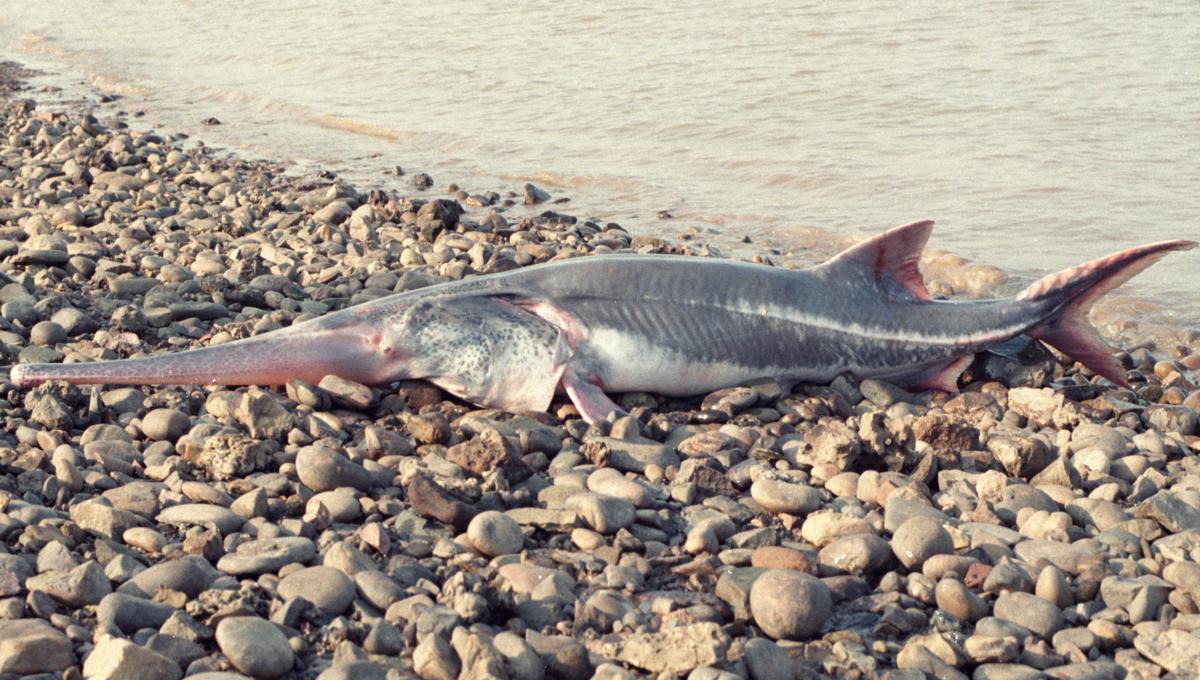
A Chinese paddlefish specimen made in 1990 is seen on display at the Museum of Hydrobiological Science of the Chinese Academy of Sciences in Wuhan, China. The Chinese paddlefish's sharp, protruding snout made it one of the largest freshwater species in the world. (Museum of Hydrobiological Science of the Chinese Academy of Sciences via AP)
"The Chinese paddlefish, Psephurus gladius, was one of only two extant members of a relict lineage that was most diverse and widespread 34–75 million years ago."
Hui Zhang, Chinese Academy of Fishery Sciences, Wuhan, China

"Of the estimated 8 million animal and plant species on Earth, about 1 million are threatened with extinction."
"The problem in China, with its rapidly developing economy and urbanizing population, has been particularly acute. Since 1970, almost half of China’s terrestrial animals have vanished."
"The Yangtze River, a key fishery and former home to the Chinese paddlefish, is so dead that President Xi Jinping has said it has reached a 'no fish' level."
"Meanwhile, consumer demand for wildlife products, like tiger-skin rugs or bear bile for medicinal use, is responsible for a boom in the trafficking of endangered species."
Adam Minter, Bloomberg Opinion
No paddlefish here.
No paddlefish here. Photographer: Goh Chai Hin/AFP/Getty Images
It was once considered one of the largest freshwater species of fish in the world. It is now considered extinct. The Chinese paddlefish was one of those strange-looking specimens of the piscine world with its overly-lengthened snout, and it was also identified as a Chinese swordfish. Its ancient lineage dated it back to at least 34 million years. A fish that could grow to aged maturity of seven metres in length. Overfishing, habitat fragmentation and loss of biodiversity in its Yangtze River home spelled its demise.

Scientists from the Chinese Academy of Fishery Sciences, the University of Kent in England, and the University of South Bohemia in the Czech Republic collaborated on the research that produced the paper pronouncing the end of the ancient fish. They found the fish's existential collapse matching all the criteria for inclusion on the International Union for Conservation of Nature's Red List (IUCN).

Since the late 1970s, populations of the Chinese paddlefish saw a dramatic decline corresponding with major dam construction on the Yangtze River, to which it was a native fish. The Gezhouba Dam, built on the main stream of the immense river, followed by the opening of the gargantuan Three Gorges Dam project in 2003, represented the very last year that anyone was able to sight a live Chinese paddlefish.

In 2017 and 2018, a survey discovered 332 species of fish in the Yantze, yet a single specimen of Chinese paddlefish eluded the researchers who estimate that the fish became extinct between 2005 and 2010. Overfishing in the most populous country of the world; pollution and dam-building reduced its numbers. Not all that long ago, in the 1970s, fishermen harvested 25 tons of Chinese paddlefish from the Yangtze River. By the 1990s, almost none remained.

A predictable outcome for a species of fish that had been on Earth longer than humanity, but whose unfortunate and tragic end resulted from the presence of humans who sought the delicate flesh of this giant fish predator for their dinner tables. A great predator of the seas, a relative of the sturgeon and American paddlefish, had suffered the fate of being victimized by a predator more populous and more dedicated to its dinner table than its own hunting habit.


 Chinese paddlefish

Labels: , , , , ,

Friday, November 29, 2019

Neanderthal Extinction

"Our results support the hypothesis that the disappearance of Neanderthals might have been the result of demographic factors alone, that is, the result merely of the internal dynamics that operate in small populations."
"Our results are consistent with a scenario in which a small population of Neanderthals persists for several thousands of years, and then, due to a stroke of bad luck, disappears."
"The mere fact that the Neanderthals were living in such a small population might have been enough to [make them] go extinct."
"It's not unusual they were living in small populations, either. It's known that they did."
"The arrival of [humans] would have been a contributory factor rather than the cause of the extinction."
"The species' demise might have been due merely to a stroke of bad demographic luck."
"The mere interspersal of AMH sub-populations between Neanderthal sub-populations reduced the opportunities for intrabreeding and migratory activity among the latter."
"As such, the presence of modern humans in Eurasia would have accelerated a process that, at some point, was likely to have occurred anyway."
Research study, Eindhoven University of Technology, Netherlands
Neanderthal Man
A moulding of Neanderthal man.  Photo: Stephane D. Sakutin, AP/Getty

"We want us to play a role in their extinction, because it helps us to answer the question as to what makes us unique or human."
"So the standard story, according to which modern humans outsmarted Neanderthals, is attractive to us because it implies that our species can be distinguished from our sister species by reference to our superior intelligence."
Krist Vaesen, Associate Professor, Philosophy of Innovation, Eindhoven University of Technology 

 Published in PLOS One, new research out of the Netherlands has brought out a new theory on the possible cause of Neanderthal extinction. Possibly, the researchers posit from the results of their study, inbreeding was partially responsible. The researchers themselves were somewhat taken aback by the conclusions their research led them to. They ran simulation models that they based on existing hunter-gatherer societies with a view to discovering whether factors aside from human competition might have wiped out Neanderthals some 40,000 years ago.

Obviously, modern humans fell into the category of nature's creatures that managed to adapt and evolve as a species more successfully than did Neanderthals. Earlier research has pointed out that humans and proto-humans lived in fairly close proximity to one another, and in all probability, given that modern science has found Neanderthal DNA in a huge segment of the current population, must also have interbred. Given the larger skull dimensions of Neanderthals it has also been suggested that human females were not that likely to give birth to babies with Neanderthal characteristics; more likely that Neanderthal females more readily gave birth to babies with human features.
The new exhibition at the Canadian Museum of Nature 'deconstructs' stereotypes around Neanderthals. (Nikola Solic/Reuters)

There is agreement among Paleoanthropologists of the disappearance of Neanderthals roughly 40,000 years ago, at a time when anatomically modern humans were expanding their presence into Eurasia, steadily migrating out of Africa. Neanderthal populationss, on the other hand, arose in Eurasia. There has never been full agreement, however on whether and when and how early modern humans may have been responsible in part for the demise of Neanderthals.

The researchers simulated model groups of 50, 100, 500, 1,000 and 5,000 individual populations studying the effects within each group, of inbreeding. They included Allee effects whereby the smaller a population the lower its reproduction rate, and vice versa, along with random fluctuations of a population taking into account factors such as births, deaths and sex ratios, the aim being to determine whether factors such as these could conceivably lead to extinction over a 10,000-year period.
A picture taken on March 26, 2018 shows a thermoforming of a Flores woman displayed for the Neanderthal exhibition at the Musee de l'Homme in Paris. STEPHANE DE SAKUTIN/AFP via Getty Images
The study concluded that interbreeding, in and of itself  was not likely to  have led to extinction; the smallest studied group of 50 was found to have gone extinct in this manner, but of groups with 1,000 individuals or fewer, should only a quarter or less of females give birth in any single year, extinction could also occur. When all factors were accounted for (inbreeding Allee effects and demographic fluctuations) over the ten-thousand-year simulation period, extinction was almost certain to result for all group sizes.

The study authors suggest the presence of human ancestors might conceivably have made the presence of Neanderthals more vulnerable to the factors involved in the study, before extinction. But they are also convinced that the human presence was simply coincidental to the final extinction. Which caused the researchers themselves to entirely revise their own former belief, common among paleoanthropologists that homo sapiens contributed hugely to the obliteration of the Neanderthals.

What caused the extinction of Neanderthals after 350,000 years on the planet remains a point of debate for experts
What caused the extinction of Neanderthals after 350,000 years on the planet remains a point of debate for experts ( PA )

Neanderthals have contributed approximately 1-4% of the genomes of non-African modern humans, although a modern human who lived about 40,000 years ago has been found to have between 6-9% Neanderthal DNA (Fu et al 2015). The evidence we have of Neanderthal-modern human interbreeding sheds light on the expansion of modern humans out of Africa. These new discoveries refute many previous hypotheses in which anatomically modern humans replaced archaic hominins, like Neanderthals, without any interbreeding. However, even with some interbreeding between modern humans and now-extinct hominins, most of our genome still derives from Africa. Neanderthals could not have contributed to modern African peoples’ genomes because Neanderthals evolved and lived exclusively in Eurasia and therefore could not have bred with the humans living in Africa at that time.
Smithsonian National Museum of Natural History

Labels: , , ,

Saturday, March 23, 2019

Dwindling Wildlife Diversity

"It was the right move [to rescue the sole remaining caribou in a now-extinct herd]. That animal was not going to survive."
"[Mountain caribou have massive hoofs] pie plate or dinner plate, that's not an exaggeration [to function like snowshoes as they traverse mountain slopes]."
"[They are elusive animals] They don't call them the grey ghost for nothing."
"I am resolute about the return of that species [Selkirk caribou to the Lower 48]. It's too easy to say, 'Well, they're not here, let's quit'. That's not the tribe's [Kalispel Washington tribe] perspective."
Ray Entz, director of wildlife and terrestrial resources, Kalispel Tribe, Washington

"[The Selkirk population had grown to almost fifty in 2009 but since then the numbers have been] going down, down. They have no future with one, two or three animals."
"The caribou are just a more vulnerable species. They don't kick hard like a moose. They're not as skittish as a deer. They never have twins."
"So with these changes [in habitat and range], they're the ones that pay the price [easy kill for predators]."
Leo DeGroot, government wildlife biologist, British Columbia
File photo of the isolated population of mountain caribou inhabiting the Selkirk Mountains of southern B.C.Handout
The decision to capture the sole remaining Selkirk caribou once it was determined that one of three remaining last year wearing radio collars had been killed by predators and no sign had been seen or heard of the other in months, led Canadian wildlife managers to move to bring in the surviving female and place her in a protective pen to enable her survival. She was caught in a net shot from a helicopter and then sedated by biologists and transported to a maternity pen near Revelstoke, British Columbia.

Used as temporary caribou obstetric wards and nurseries where wildlife managers move pregnant females to feed them until their calves are over a month old, the pens now hold the captured Selkirk caribou and three other animals; one a calf born there and brought back when its mother was killed and two others from yet another dwindling southern mountain herd. The hope is to capture a female from a herd nearby to become familiar with the other refugees so that when they are released in one fell swoop, the new female will lead them to her habitat and safety in the wild.

The Kalispel Tribe is involved in the international move to conserve the South Selkirk herd, named so in reflection of the steep mountains where they live. Traditionally, historically, the tribe had hunted the caribou. That particular herd was considered by biologists to be "functionally extirpated", one of 15 isolated subpopulations within a broader group recognized as southern mountain caribou living in various landscapes from the northern tundra herds, all of which are shrinking, reflecting human development and altered habitat.
A female mountain caribou from the beleaguered Southern Selkirks herd feeds in a wet meadow in the southern Selkirk Mountains of British Columbia, Aug. 8, 2017

At one time, northern New England and upper portions of Great Lakes states -- Minnesota for example -- were populated by caribou, but their range narrowed and contracted northward over time. Fewer than thirty animals remained by 1983, leading to the Selkirk herd joining the endangered species list. Since 2012, there has been no sightings in the United States, according to a management plan linked to a multiagency international group studying the population which lives in inland temperate rain forests.

In the winter, the mountain caribou migrate to higher elevations to search for furry arboreal lichen that hang from old-growth trees, representing their seasonal survival food; their massive hooves enabling their grip on the snowy slopes. Their forest habitat has been fragmented over generations through the intrusion of logging operations, roads, power lines and oil exploration and mining in Canada. In place of the mature trees logged out, immature vegetation grew in, opportunistically attracting moose, deer and elk.
Numbers of caribou in B.C. are in decline — with just six remaining in the two most southerly herds. (Getty Images)
Their presence in turn attracted opportunistic predators which led to wolf culls in Canada but which did little to aid the survival of the caribou, less able to defend themselves than other species. And as they fell prey to wolves and mountain lions their numbers diminished dramatically. A caribou breeding program is foreseen for the near future in Canada but prospects of captive-bred animals released before four years have passed is remote, along with the uncertainty of whether they would restore the Selkirk herd or another herd facing a precarious existence.

The Center for Biological Diversity and several allied groups announced they plan to sue the U.S. Fish and Wildlife Service for its failure in designating protected caribou habitat in northern Idaho and northeast Washington. When the agency proposed setting aside over 375,000 areas in 200, opposition from recreational snowmobilers and others resulted in the agency cutting that protected acreage down to about 30,000, and while a federal court ordered Fish and Wildlife to reconsider, no decision has been issued as yet.

https://www.ctvnews.ca/polopoly_fs/1.4163991.1541439888!/httpImage/image.jpg_gen/derivatives/landscape_620/image.jpg
A female mountain caribou from the beleaguered Southern Selkirks herd feeds in a wet meadow in the southern Selkirk Mountains of British Columbia, Aug. 8, 2017.

Labels: , , , , , ,

Tuesday, January 15, 2019

Red Wolf DNA in Wolf/Coyote Hybrids

"Overall, it's incredibly rare to rediscover animals in a region where they were thought to be extinct and it's even more exciting to show that a piece of an endangered genome has been preserved in the wild."
"I think we were all genuinely surprised that there was any indication of red wolf genes in either of these samples. We get odd samples shipped to us fairly regularly, and most of the time they turn out to be coyotes. … Initially I was extremely skeptical that the analysis would turn up anything interesting, which in the end turned out to be very humbling."
"I think of myself as an expert on these animals, but in reality most of the time I’m just looking at my computer. It’s the people on the ground, who watch these animals regularly, who have made the major discovery."
"Hybridization is relatively common in natural systems and does not always have negative consequences."
Elizabeth Heppenheimer, biologist, Princeton University

"[It's exciting to have found] this unique and fascinating medium-sized wolf. [The survival of the red wolf genes] without much help from us for the last 40 years is wonderful news."
"From a practical conservation biology standpoint, these animals have special DNA and they deserve to be protected."
Ron Sutherland, conservation scientist, Wildlands Network, North Carolina

"We can get excited, but in my mind, we really need to let science do its due diligence to determine what this animal is."
Kim Wheeler, executive director, North Carolina Red Wolf Coalition
Taya Johnston/Getty

Once common across a region extending from Texas to the south, into the Southeast and up to the Northeast, the red wolf, about 80 pounds of weight at maturity, was classified federally in the endangered category in 1967 in the United States. By 1980 the genus was declared extinct in the wild. A remnant population in Texas and Louisiana was gathered by the U.S. Fish and Wildlife Service in the 1970s which resulted in a successful captive breeding program.

In 1986 the wolves from the breeding program saw themselves integrated with an experimental wild population in North Carolina, a group that has been steadily declining since its peak at an estimated 120 to 130 wolves in 2006. According to a federal report out in April of last year, of that number only 40 remained. Representing part of captive breeding programs, an additional two hundred red wolves live in zoos and wildlife facilities.

Environmental groups argued in a lawsuit that federal authorities embarking on an effort to reduce the territory of the North Carolina wild group were in violation of law, and a federal judge in November agreed, ruling that the U.S. Fish and Wildlife also violated the Endangered Species Act, authorizing private landowners to kill the canine predators, even those who weren't a threat to humans, livestock or pets.

And now researchers have announced the presence of a pack of wild canines near the beaches of the Texas Gulf Coast, carrying a notable presence of red wolf genes, a discovery that elicited great surprise since the animal had been declared close to 40 years ago to be extinct in the wild. Wildlife biologists have been led to develop a new acknowledgement that the red wolf DNA is resilient despite decades of human hunting, loss of habitat and other factors leading them to near-decimation.

A Princeton team involved in the research on the pack discovered in Texas on Galveston Island had their study published in the scientific journal Genes. The Galveston canines' genetic analysis reveals them to be a hybrid of red wolf and coyote. Labelling the animal correctly at this point requires additional testing, pointed out biologist Dr. Heppenheimer of Princeton University, involved in the research.

Similar DNA findings in wild canines in southwestern Louisiana bolsters anticipation of conservationists concerned by the dwindling number of red wolves in North Carolina which had represented the only known pack existing in the wild. According to Dr. Sutherland, the Galveston canines' findings have succeeded in quashing a decades-old impression of red wolves being predators overwhelmed by the superiority of numbers of coyotes. The Galveston group's DNA is not found in captive populations.

To protect them, conservation easements restricting development along portions of the Gulf Coast are to be viewed as an essential first step. According to the Texas Parks and Wildlife Department, the Galveston discovery, while "interesting", will not result in any instant response as "we do not anticipate any regulatory changes or implications in Texas at this time." According to conservationists, policy-makers are required to evince a greater appreciation for hybrid animals.

ron wooten.jpg
The Galveston pack carries red wolf DNA previously thought to be lost forever (Ron Wooten)

Labels: , , , ,

Friday, July 13, 2018

The Beautiful Big Cat

"[The undertaking of breeding Iberian lynxes in captivity is costly and complex, somewhat like] having a nursery for rich kids, in which you have one teacher for each kid."
"We like to say beauty isn't everything, but it does count and -- let's be frank -- the lynx sells extremely well [as an endangered species requiring public funds toward reversing threats of extinction]."
Angelo Salso, Italian official, Brussels, manager, European Commission's Life environmental program
Iberian lynx
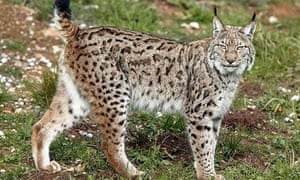
An Iberian lynx at a nature reserve in Spain. Photograph: Victor Fraile/Reuters/Corbis

"This lynx clearly evolved to be a rabbit hunter on the Iberian Peninsula -- and the price for being such a precious and specialized hunter is a higher [degree of] vulnerability."
Urs Breitennmoser, feline specialist, International Union for Conservation of Nature

"If the lynx disappears, we will of course continue to live on this planet, but I don't think with the same quality of life."
Javier Madrid, environmental official, Andalusian regional government

"We've seen the species recover, but it's still in danger. I'd love to see it, but I can't imagine a time when we won't need programs like this. We've got a lot of work ahead of us."
"We have a 70% survival rate. That's good, very good. Anything over 50% is a success."
"We get through around 600 rabbits a month." 
"We have to avoid them getting used to human presence. Also there's always a risk of people bringing some cat or dog disease in with them, that could be fatal."
"We are not just saving them, we're studying them. These are the most closely observed animals in the universe."
"It's like the Big Brother house in here [at the breeding center]. You need dedication for this work, it's not easy and it's not well-paid. It has to be a passion."
Rodrigo Serra, director, Iberian Lynx Breeding Center, Silves, Portugal 
Oryctolagus cuniculus (Linnaeus, 1758), European Rabbit
Donald Hobern (dhobern on flickr) / Licensed under Creative Commons

At the Silves breeding center space is at a premium, and workers on the breed-and-release program use a network of over 80 cameras to monitor the lynxes in their care, taking cautious measures to ensure that the 17 staff and volunteers strictly limit their physical contact with the animals, a requirement to ensure that no human-lynx patterning and dependency takes place, to keep the animals in a 'wild' condition, so that when they are eventually released they will be capable of fending for themselves as nature intended.


The existential problem that arose with these Iberian lynx is simple enough; they feed exclusively on what they prefer to hunt; diet-specific rabbits. When their food source dried up several decades ago when a catastrophic disease affecting rabbits wiped out their food source, the lynx went into starvation mode and came close to extinction. Since then, a breeding relocation program has turned the tide as Europe has succeeded in extracting the beasts from extinction -- in so doing preserving vital regional biodiversity.
Iberian Lynx mother carries cub born in the Program Ex-situ Conservation in 2005
By http://www.lynxexsitu.es [CC BY 3.0 es (http://creativecommons.org/licenses/by/3.0/es/deed.en)], via Wikimedia Commons

Veterinarians and additional staff members in four breeding centers adhere to very necessary rules to ensure young lynx are raised protected from pathogens that would affect their health, while at the same time maintaining as much of a physical distance as possible to make certain that the animals in their charge remain wary of human contact, planning ahead for their eventual release into the wild. The animals are kept from their kitten stage to their juvenile stage -- about a year in total, in captivity.

Once set free to seek out their territorial living space the rest is up to nature. The young cats are released in variant areas in hopes of avoiding inbreeding -- with each release a matter of celebration, witnessed by locals as the animal dashes out of its enclosure to vanish among the trees and bushes of its chosen area. To the present, the breeding program has come at a cost of approximately 34 million euros, some two-thirds of which is funded from the European Union.

Smaller than other lynx species in northern Europe, the Iberian lynx has similar pointed, tufted ears, large paws and glowing eyes. The rabbits are seen as expendable, readily replaced because they breed easily and frequently, while their predators are seen as valuable mainstays of the regional animal presence. Rabbits are viewed as pests; while local farmers welcome the lynx as they would not the return of brown bears and wolves, which threaten the security of livestock.
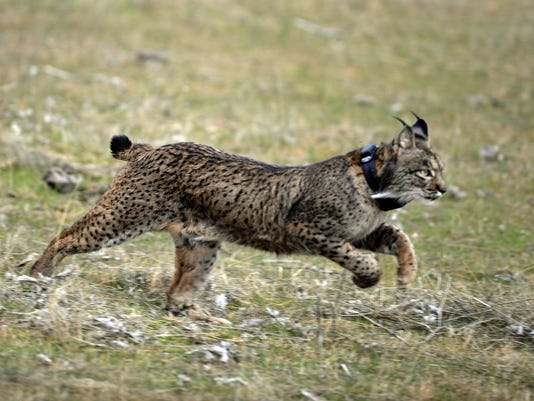
A file picture taken Dec. 14, 2009, shows a lynx being released during the first experimental reintroduction of two Iberian lynxes in Villafranca de Cordoba, southern Spain.    (Photo: Cristina Quicler, AFP/Getty Images)

Over the past five years alone 50,000 rabbits have been released into areas newly populated by lynx in the Spanish program of rehabilitation. The program is considered a resounding success; no longer is the Iberian lynx the world's most endangered feline, a huge leap in confidence and sustainability since a 2002 census indicating fewer than one hundred remained in their wilderness habitat. The lynx population has rebounded since those sober figures were released a dozen years ago, with about 550 lynx now living and prospering in nine areas of southern Spain and Portugal.

Still, there are skeptics like Urs Breitenmoser who emphasizes the difficulty of safeguarding an animal susceptible to starvation because it lacks the capacity to adjust to the disappearance of its major food source by accepting alternate food sources, should a virus once again infect the rabbits it hunts.
Iberian Lynx adult from the Program Ex-situ Conservation
By http://www.lynxexsitu.es [CC BY 3.0 es (http://creativecommons.org/licenses/by/3.0/es/deed.en)], via Wikimedia Commons

Labels: , , , , ,

 
()() Follow @rheytah Tweet