Ruminations

Blog dedicated primarily to randomly selected news items; comments reflecting personal perceptions

Sunday, July 17, 2022

Making a Statement in Extravagant Poor Taste

An aerial view of 105,000 square foot mansion dubbed "The One."
"We have a very specific client in mind. Someone who already has a $100 million yacht and has seven houses all over the world, in London and Dubai and wherever."
"[There is a library, but no books.] Nobody really reads books. So I'm just going to fill the shelves with white books, for looks."
"It is by far the most important estate project in Los Angeles over the last 25 years and will raise the bar for all other estates built in the city."
""For the $5 million houses, the buyers still needed loans. But when you moved up to $10 or $15 million, it was guys who didn't have to rely on the bank."
Nile Niami, developer of 'The One'

"What level of sanity would allow a house this big to be built, with a huge discotheque?:
"Anything over 20,000 square feet should be considered a commercial project."
Fredric Rosen,  homeowners alliance, Bel-Air, California

"It's one of the ugliest homes I've ever seen."
"Only someone with terrible taste who wants to scream to the world that they're rich [would buy it], and even then, I'm not so sure."
Real estate broker, following property tour
LA mansion developer Nile Niami purchased three ranches from Space Invaders heiress Rita Kogan in 2012 for $28 million and combined them into a single estate.
It is billed as the largest, most extravagant, most prestigious house ever built in the United States. Where else but in California? It was meant, on completion, to be a steal at half a billion dollars. A bold new vision in architecture, a sprawling residence that would offer the owners luxury, prestige, comfort, and personal access to their very own range of entertainment facilities; no need to venture outside the confines of the estate to be amused, entertained, engage in sports of any kind.

With 21 bedrooms, invite intimates to enjoy your hospitality. There are 42 full bathrooms. No one would consider buying such a residence reminiscent of an elite holiday resort, unless they're in the multi-billionaire class of the world's uber-wealthy. A platoon of personal service providers in household staff would be required just for daily maintenance, tidying up, replacing linens, cleaning the place. It comes equipped with a 4,000-square-foot guesthouse so you don't need to have your guests underfoot.
 
arely do buyers see such elaborate — and quirky — amenities, including a butterfly installation, a beauty salon, a cigar room and a 10,000-bottle wine cellar.
Rarely do buyers see such elaborate — and quirky — amenities, including a butterfly installation, a beauty salon, a cigar room and a 10,000-bottle wine cellar.
 
The infinity pool stretches 5,000 square feet. There's a sky deck with cabanas, a private theatre, a spa and beauty salon, a nightclub, a putting green, a jogging track and a moat. If there's anything missing the architect would be abashed to have it pointed out. It boggles the imagination to picture oneself living in a 100,000 square foot residence. So much so that at a price tag of $500 million, one could imagine, if they had that much at their disposal, that the residence is a veritable steal.

And is it beautifully appointed, proportionally designed and perfectly finished? How much do you like glass and steel in your architecture, as opposed to say, cut stone, brickwork, millwork, marble and glass? Fancy endless white walls? Spectacular views from the interior of a high-ceilinged expanse of rooms and hallways? It was auctioned off several days ago, and failed to realize the price assigned to it. In fact, it sold for less than the debt hanging over the property.
 
The house is surrounded by a moat on three sides and has a 400-foot-long jogging track that appears to float above Los Angeles.
 
The idea for this spectacularly located and sprawling residence dawned back in 2012 when developer Nile Niami decided he would go big, really big, and wow the moneyed world of the ultra-wealthy with the ultimate cachet of exclusivity. A large plot of land on a hill overlooking the Bel-Air country club was assigned to be the future home of this colossal mansion. Local homeowners of ordinary 10,000 sq-ft mansions failed in their bid to put a halt to the monster being built around their modest multi-million-dollar homes.

Soon rising costs of construction bloated the cost of building 'The One', necessitating the accumulation of financing debt. The property, by the time of auction, had accumulated over $191 million in debt. Building code violations were cited. Health and safety procedures had been bypassed as a result of late cost-cutting measures in the hope of restraining further escalation of building costs. "Unidentifiable bio-organic growth" mould was cited.

The property's swimming pools held intractable algae problems. The marble used in the pool interiors cracked and stained. The anticipation that Russian oligarchs would flock to challenge one another for ownership of the property was never realized once the outbreak of the Ukraine conflict marred expectations. Several  years in from its completion the expansive glass and steel architecture has taken on a dated look.

And so the property sold at auction, going for the bargain basement total of $141 million. Debt holders have no realistic expectation that they will ever recover their investment in the project; leaving the creditors somewhat crestfallen. As for the new owner reputed to be fashion mogul Richard Saghian, he can revel in his new acquisition, but not yet inhabit it. The largest, most expensive home in the U.S. lacks an occupancy permit.

"The One" is the size of a shopping mall.
The mega mansion has a 50-car garage and a 10,000-square-foot sky deck with a putting green that offers 360-degree views of the Pacific ocean, Los Angeles and the San Gabriel mountains. Photo: Douglas Friedman


Labels: , , ,

Friday, December 25, 2020

A New, Practical Pandemic Workforce Alternative

"It is tempting to believe that major cities will return to their pre-pandemic glory and that COVID-19 is nothing more than an anomaly. Cities will undoubtedly remain the economic and cultural hubs, but in the post-pandemic world, they might not regain the allure they have enjoyed in the past."
"It was not long ago that Detroit was one of the most prosperous towns in the U.S. and was known for its industriousness and innovation. Over time, Detroit and the automotive industry lost their competitive edge, and the Motor City first began losing prominence and ultimately faced bankruptcy prospects."
"The critical question is what cities can offer to attract talent, businesses and investments, if technology is making geography increasingly irrelevant."
Murtaza Haider, professor of Real Estate Management, Ryerson University, Stephen Moranis, real estate industry veteran, Financial Post 
The future of physical office spaces, and how we'll use them, hangs in the balance as we slowly march toward a post-pandemic world

Our urban landscape is changing. Once again. There was a time when prosperous middle-class people couldn't wait to leave urban centres to relocate to the suburbs where there was green spaces, larger homes and lots with gardens to raise a family, available at lesser cost than in the cities. Leaving the urban core to the lower middle class wedded to traditional city living and the larger class who remained where they were, who couldn't afford to move, mired in poverty.

And then came a reversal with the trend moving toward urban renewal and gentrification bringing a return to city living, when the poor found themselves pushed out of the downtown core unable to pay the new higher rentals, to the outskirts or to become homeless. There is nothing static about human movement geared toward benefiting those who are financially flexible enough to better their prospects by taking advantage of every new trend that appears over the horizon.

Now it appears that the global pandemic in less than a year has once again upended the social structure of urban life. Not that some corporations hadn't already decided to experiment with large parts of their workforce working remotely, reducing the need for costly real estate where workplaces could be shared among a half-dozen people who might physically appear from time to time before retreating once again to a remote workplace in their home.

The separation of work and home has dissolved, with one's home playing first fiddle to one's employment. In the process juggling responsibilities to one's private life inclusive of child care and time away from the work environment, even when it's your own home, complicating life for the employed and reducing operating costs for the employer. 

Remote working has become the norm, aside from workers in the retail industry and those working manual jobs that keep them directly in the workplace, along with factory workers struggling to observe distancing in difficult, tight physical spaces. There is increasing comfort between employers and their workforce within the tech-enabled work environment, however, where lines between home and office have been irrevocably blurred.

The test runs previously embarked upon, have been accelerated by the exigencies of exercising caution and care when at all possible during the pandemic. Company executive elite are paid to enhance the bottom line and that is done through many innovative means, and now that includes reducing real estate imprint. With the use of artificial intelligence over 4,750 earnings calls, Bloomberg LP was able to research that one in 8 corporate executives contemplate a reduction in spatial footprint.

Many are spending more time than ever inside their homes, as remote work, distance learning and social distancing shape the workweeks of many families

Plans are afoot and have advanced toward slashing office space, branch or outlet closures while taking steps to renegotiate rents  in a rental marketplace where there are now large empty gaps and building owners are anxious to make deals to retain renters in their commercial properties.  The decline in  demand for office and retail real estate has seen an opposite effect in warehousing properties, along with commercial spaces linked to retain logistics.

Online purchasing by the social distancing public consumer has boomed in lock step with a decline in in-person shopping, enhancing the need for warehouses and logistics hubs, now with more demand than in the past, leading to expanding services. Amazon Canada for example is building two new 'fulfilment' centres, in Hamilton and Ajax along with five more delivery stations throughout Ontario for a total of 16 logistic centres in Canada.

Technology adoption has been accelerated with new tech advancing in terms of months, seeing technology sales on the rise. Large technology firms are not now expanding their real estate empires. Pinterest Inc. recently paid a penalty to withdraw from its 490,000 square-foot lease in San Francisco, of $90 million to achieve its release. With Silicon Valley speedily adapting itself to remote workplaces, employers too are no longer harnessed to expensive-to-rent apartments in town.

Median rents for studio apartments in San Francisco have been reduced by 35 percent from the previous year and rental markets in cities like Boston and New York, known for their sky-high rental costs are now softening. New York and other cities now vaguely resemble ghost towns where hundreds of millions of office space rentals have been emptied of their client-base. Storefronts have been boarded up throughout the city, including parts of Manhattan.

Analysts are studying how affected the urban core of ciies have been, losing their competitive advantaqge by the growing reality of teleworking, cloud computing and video-conferencing with the long-term impact of remote working extending beyond the methods by which employees have adapted to a changed work practice where companies now can hire workers anywhere in the world with no requirement of relocating to expensive cities.

Long-term remote work has completely reshaped the 9-to-5 and blurred the lines between home and office

Labels: , , , ,

Tuesday, May 12, 2020

Escape From Fear

"For anyone looking to isolate, you can stay there minimally for a year, if not longer, without ever having to leave the island."
"The primary goal of the island was and still is to create a safe, totally self-sufficient place where the island owners live without fear of whatever ails the outside world."
"That was the initial reason why he [U.S.developer Fred Kern] built the home, post 9/11, to have that getaway. That was very important to him as the initial developer of the property. That is how it came about, to build this wonderful property as a safe haven."
"He thought maybe there was opportunity, that this time may be the time to sell it. It is quite a unique property."
Mariana Cowan, real estate broker, Nova Scotia

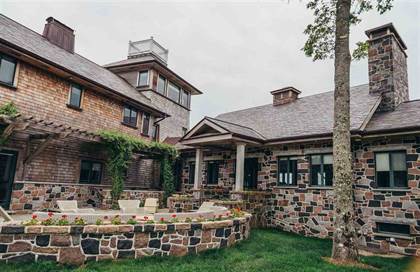
Built for "security, seclusion and self-sustainability" the private island off the coast of Nova Scotia in eastern Canada awaits a buyer. The rather palatial home located on the island is named The Lodge, located in Mahone Bay, on Strum Island. It is, in fact, the private island that is for sale, and with the island comes everything on it, natural and man-made. In the man-made category count in its private source of power, heat, light, water and food. Boats, docks, gardens, greenhouse and security. Separate out-building living quarters: "another place someone can go and quarantine" in the words of the agent.

A year ago the island and its buildings were offered as a rental property for ambitious vacationers who might not be able to quite afford the $21-million selling price, but might splurge on a special vacation offered for $9,950 for each night's accommodation for a minimum four-night stay. Near the head of Mahone Bay, not too distant from the quaintly picturesque fishing town of Lunenburg, Strum Island represents 9.88 acres of private security, a perfect getaway from, for example concerns over contracting CoV-2.


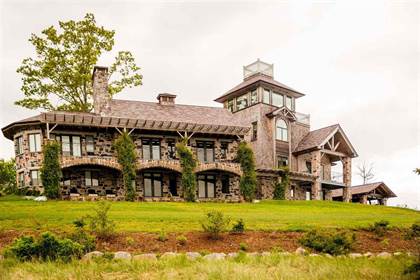
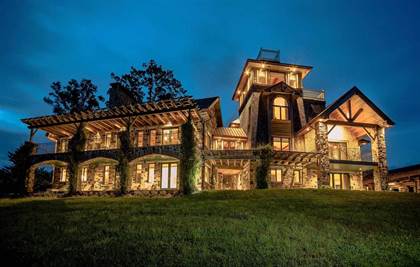
It is secluded but not entirely isolated, should the whim to leave it temporarily take hold, since a boat ride of a mere few minutes takes one to the mainland close to the town of Mahone Bay, or an hour's drive to the provincial capital city of Halifax. Alternately, a 15-minute flight from Halifax airport to the helicopter pad on the island is another choice. A granite stone exterior with slate roofing and copper gutters describes the outward appearance of the main house with its 9,500 square feet.

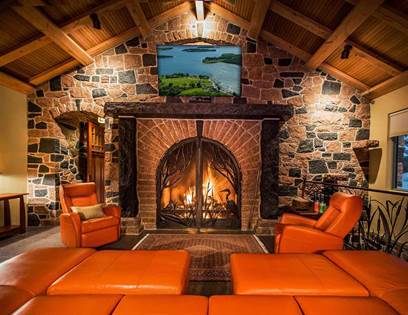
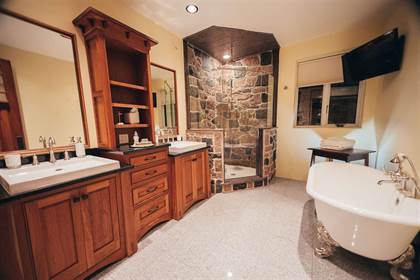
Apart from the eight bedrooms, there is a walnut hand-carved bar with hammered copper sink in the Great Room, the top storey featuring a widow's walk, in maritime tradition, accessible by a telescopic staircase, raised and lowered with the push of a button. An underground cable connects the island to the mainland electrical grid, but the property is replete with back-up generators. Boilers and wood stoves can be found throughout the buildings, including air conditioning, and two 1,000-gallon propane tanks are hidden by the pump house.


The buildings come complete with hurricane-proof windows, drilled wells provide UV filtration, and a year-round greenhouse is co-located with the main building along with vegetable gardens, apple, pear, peach and plum orchards. There are herb and berry gardens, a lobster holding-pen and an 820-square-foot building for lobster cooking and barbecuing; The Lobster Temple.

Multiple security cameras are assigned to each building, complete with security systems for each.

There is a 2,000-squarefoot boathouse with living quarters attached. There are small cottages, a pump house and a heated doghouse. It's hard, really hard, to think of any other convenience or luxury that might have been missed in planning this hideaway from life-inconvenient threats. Maintenance costs? Well, if anyone can afford the price of this kind of out-of-the-world luxury, the costs of maintenance should be of no concern whatever.


Labels: , ,

 
()() Follow @rheytah Tweet