Ruminations

Blog dedicated primarily to randomly selected news items; comments reflecting personal perceptions

Friday, April 17, 2026

Impact of Race and Cultural Assessment Justice Scams

"To be clear, the effects of anti-Black racism do not excuse Mr. Abdelgadir or lessen the seriousness of the offence. However, I am satisfied that there is some connection between Mr. Abdelgadir's life experience, anti-Black racism, and his commission of the offence such that it mitigates somewhat his degree of responsibility for the offence."
"Mr. Abdelgadir has been heavily impacted by his father's employment with the UN, multiple relocations, exposure to armed conflict, and unsafe environments. [Abdelgadir] witnessed bodies piled in the streets during the civil war in Yemen in the 1980s."
"Mr. Abdelgadir was subject to racism during his childhood in Bahrain. The IRCA [Impact of Race and Cultural Assessment] describes that he faced significant discrimination as a Black Muslim, and that his family's home was attacked." 
"As the IRCA highlights, Mr. Abdelgadir emphasizes that his stagnation was not the result of a lack of ambition or ability, but rather the consequence of systemic racism, repeated police targeting and unjust criminalization that disrupted his educational and employment trajectory."
Justice Sandra Nishikawa, Ontario Superior Court of Justice 
https://i.cbc.ca/ais/1.7489927,1742575598000/full/max/0/default.jpg?im=Crop%2Crect%3D%280%2C67%2C3606%2C2028%29%3BResize%3D860
Samir Abdelgadir, pictured here appearing in court on Zoom in a sketch artist's rendering of his hearing last year, in which he was found guilty of kidnapping, has been sentenced to serve nine-and-a-half years in prison. (Pam Davies/CBC)
 
Any neutral observer not enmeshed with Critical Race Theory, viewing IRCA documents produced by the Viola Desmond Justice Institute might feel otherwise about the 'victimhood' of the man in question, son of a diplomat who had many life advantages but turned to drugs and petty trafficking and managed to rack up a neat little background of criminal activity, crowned by helping to kidnap a child and hold the terrified 14-year-old for 36 hours as leverage against the boy's half-brother who had lifted 90 kilograms of cocaine from its criminal purveyors, his employers.  
"It is an agreed fact that the teen heard the driver tell the person in the backseat that if the teen moved, he should shoot him. I find that the teen believed that the men who kidnapped him had a firearm."
"However, based on the evidence before me, I cannot find beyond a reasonable doubt that a firearm was used."
Justice Nishikawa  
The now-45-year-old Black Muslim, born in North Sudan and estranged from his father at the age of 19 following the divorce of his parents, was not entirely bereft of family support. His father provided him with the wherewithal to buy a condominium in Mississauga, Ontario where he had moved at age 19, later transferring to Hamilton, Ontario for studies at McMaster University where he completed a Bachelor of Commerce and Economics.
 
Abdelgadir's IRCA outlined his acceptance in an MBA program at Toronto Metropolitan University, "but his involvement with the criminal justice system prevented him from pursuing further education". Evidently his efforts to find an apartment after his McMaster graduation were unsuccessful, which he attributed to 'discrimination'. This is when his father gave him a down payment on a condo in 2002, and four years afterward, his brother gave him financial support to buy a house in Hamilton.
 
His dallying with criminal elements in society appears to have led to his being shot on three occasions in May 2023, according to the IRCA. "He has lasting impairments, including difficulty walking for extended periods and chronic exhaustion when outside for more than an hour". He "uses marijuana daily to manage pain". He decided to move to 'informal economies', including sales of marijuana when he failed to find employment in Canada as a Black Muslim, he averred. Arrested age 21 for drug possession he "was taken into custody 'multiple times' for various charges" including cocaine possession.
 
CDN media
Samir Abdelgadir
He began a landscaping business, then invested in real estate, flipping houses and condominiums for profit, finally investing in two fast-food franchise location in Hamilton, his brother providing financial support for many of his business ventures. As for his interactions with police, Abdelgadir speaks of them as being 'racially motivated'. Police seized money on entering his home, intimidating him, reflecting systemic racial profiling that resulted in 4-1/2 years spent in prison on firearm charges. Abdelgadir described having been arrested some twenty times, charges ranging from substance possession to serious violent offences.
 
On the morning of March 4, 2020 "three men emerged from a Jeep, grabbed S.J." and forced the boy, on his way to school into the vehicle driven by Abdelgadir as the 14-year-old child from a deprived background screamed and struggled in resistance. "S.J. was then taken to a vacant house on Edgeforest Road in Brampton. He was bound and blindfolded." At trial, S.J.'s half-brother Olalekan Osikoya, admitted he had stolen 90 kilograms of cocaine. The boy was released 36 hours later "without proper clothing in the cold in a secluded, wooded area".
 
The boy's brother said the kidnapping had so traumatized the child he could not sleep on his own "because when he tried to sleep, he relived every detail of the abduction." Following that kidnapping, "he damned near went mute", the boy's brother said. The Crown recommended 16 years in prison, while Abdelgadir's lawyer felt five to be appropriate.
 
After crediting Abdelgadir for time spent on stringent bail conditions in pre-trial custody in harsh jail conditions, Justice Nishikawa sentenced the offender to 9.5 years in prison.
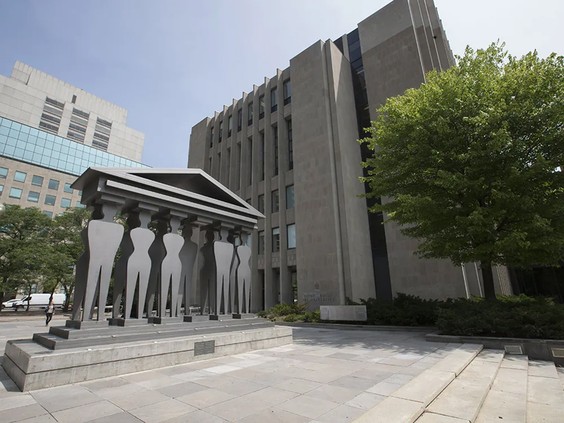
 
https://smartcdn.gprod.postmedia.digital/nationalpost/wp-content/uploads/2026/04/TO-courthouse-1.jpg?quality=90&strip=all&w=564&h=423&type=webp&sig=6wAoesFP7Q55BmorvpdMkA
An Ontario Superior Court of Justice courthouse in Toronto. Photo by Stan Behal/Postmedia


Labels: , , , , , , ,

Friday, December 25, 2020

A New, Practical Pandemic Workforce Alternative

"It is tempting to believe that major cities will return to their pre-pandemic glory and that COVID-19 is nothing more than an anomaly. Cities will undoubtedly remain the economic and cultural hubs, but in the post-pandemic world, they might not regain the allure they have enjoyed in the past."
"It was not long ago that Detroit was one of the most prosperous towns in the U.S. and was known for its industriousness and innovation. Over time, Detroit and the automotive industry lost their competitive edge, and the Motor City first began losing prominence and ultimately faced bankruptcy prospects."
"The critical question is what cities can offer to attract talent, businesses and investments, if technology is making geography increasingly irrelevant."
Murtaza Haider, professor of Real Estate Management, Ryerson University, Stephen Moranis, real estate industry veteran, Financial Post 
The future of physical office spaces, and how we'll use them, hangs in the balance as we slowly march toward a post-pandemic world

Our urban landscape is changing. Once again. There was a time when prosperous middle-class people couldn't wait to leave urban centres to relocate to the suburbs where there was green spaces, larger homes and lots with gardens to raise a family, available at lesser cost than in the cities. Leaving the urban core to the lower middle class wedded to traditional city living and the larger class who remained where they were, who couldn't afford to move, mired in poverty.

And then came a reversal with the trend moving toward urban renewal and gentrification bringing a return to city living, when the poor found themselves pushed out of the downtown core unable to pay the new higher rentals, to the outskirts or to become homeless. There is nothing static about human movement geared toward benefiting those who are financially flexible enough to better their prospects by taking advantage of every new trend that appears over the horizon.

Now it appears that the global pandemic in less than a year has once again upended the social structure of urban life. Not that some corporations hadn't already decided to experiment with large parts of their workforce working remotely, reducing the need for costly real estate where workplaces could be shared among a half-dozen people who might physically appear from time to time before retreating once again to a remote workplace in their home.

The separation of work and home has dissolved, with one's home playing first fiddle to one's employment. In the process juggling responsibilities to one's private life inclusive of child care and time away from the work environment, even when it's your own home, complicating life for the employed and reducing operating costs for the employer. 

Remote working has become the norm, aside from workers in the retail industry and those working manual jobs that keep them directly in the workplace, along with factory workers struggling to observe distancing in difficult, tight physical spaces. There is increasing comfort between employers and their workforce within the tech-enabled work environment, however, where lines between home and office have been irrevocably blurred.

The test runs previously embarked upon, have been accelerated by the exigencies of exercising caution and care when at all possible during the pandemic. Company executive elite are paid to enhance the bottom line and that is done through many innovative means, and now that includes reducing real estate imprint. With the use of artificial intelligence over 4,750 earnings calls, Bloomberg LP was able to research that one in 8 corporate executives contemplate a reduction in spatial footprint.

Many are spending more time than ever inside their homes, as remote work, distance learning and social distancing shape the workweeks of many families

Plans are afoot and have advanced toward slashing office space, branch or outlet closures while taking steps to renegotiate rents  in a rental marketplace where there are now large empty gaps and building owners are anxious to make deals to retain renters in their commercial properties.  The decline in  demand for office and retail real estate has seen an opposite effect in warehousing properties, along with commercial spaces linked to retain logistics.

Online purchasing by the social distancing public consumer has boomed in lock step with a decline in in-person shopping, enhancing the need for warehouses and logistics hubs, now with more demand than in the past, leading to expanding services. Amazon Canada for example is building two new 'fulfilment' centres, in Hamilton and Ajax along with five more delivery stations throughout Ontario for a total of 16 logistic centres in Canada.

Technology adoption has been accelerated with new tech advancing in terms of months, seeing technology sales on the rise. Large technology firms are not now expanding their real estate empires. Pinterest Inc. recently paid a penalty to withdraw from its 490,000 square-foot lease in San Francisco, of $90 million to achieve its release. With Silicon Valley speedily adapting itself to remote workplaces, employers too are no longer harnessed to expensive-to-rent apartments in town.

Median rents for studio apartments in San Francisco have been reduced by 35 percent from the previous year and rental markets in cities like Boston and New York, known for their sky-high rental costs are now softening. New York and other cities now vaguely resemble ghost towns where hundreds of millions of office space rentals have been emptied of their client-base. Storefronts have been boarded up throughout the city, including parts of Manhattan.

Analysts are studying how affected the urban core of ciies have been, losing their competitive advantaqge by the growing reality of teleworking, cloud computing and video-conferencing with the long-term impact of remote working extending beyond the methods by which employees have adapted to a changed work practice where companies now can hire workers anywhere in the world with no requirement of relocating to expensive cities.

Long-term remote work has completely reshaped the 9-to-5 and blurred the lines between home and office

Labels: , , , ,

Saturday, May 04, 2019

Caveat Emptor

"The inherent ambiguity in medical information, coupled with often-competing financial incentives, allows for high-stakes decisions to swing on very subtle bits of information."
Samuel Finlayson, lead author, new paper on AI medical diagnoses

"Researchers have demonstrated the existence of adversarial examples for essentially every type of machine-learning model ever studied and across a wide range of data types, including images, audio, text, and other inputs."
"Adversarial attacks constitute one of many possible failure modes for medical machine-learning systems, all of which represent essential considerations for the developers and users of models alike."
"From the perspective of policy, however, adversarial attacks represent an intriguing new challenge, because they afford users of an algorithm the ability to influence its behaviour in subtle, impactful, and sometimes ethically ambiguous ways."
Research paper on A.I. systems "adversarial attacks"
In medical AI as in other applications, tiny changes to input can result in massive changes to output.
my life/Getty Images

A business model of profit over ethics where behaviour may be adopted by insurers and health care agencies to profit their bottom line appears to be one potential disadvantage to the use of Artificial Intelligence in medical diagnostic devices to further the efficiency and accuracy of submitting patients to intelligent medical devices capable of discerning their health impacts. Researchers from Harvard University and the Massachusetts Institute of Technology have studied the situation and reached a conclusion that AI devices are vulnerable to manipulation.

That manipulation is meant to impact on the accuracy of the findings of the AI devices, whether analyzing a patient to determine a lesion, for example as malignant or as benign for ulterior purposes to benefit a business entity while diminishing health outcomes for an individual. Technology has proceeded at break-neck speed to develop systems capable of identifying disease symptoms expeditiously and economically, in a wide variety of images.

The medical community looks upon these systems as aids in efficiency and accuracy, relieving physicians of burdensome tasks and speeding up processes. As various forms of artificial intelligence move through the global system through computer systems in use around the world by health care professionals, the potential for interference may seem enticing to the unscrupulous. It is the unintended consequences of use of AI in medical devices that compelled this research.

A medical scanner
Some medical AIs are easily tripped up
Science Photo Library/Getty
The prospect of "adversarial attacks", defined as manipulative steps taken to alter A.I. systems through changing a few pixels on a scan for example, whereby an A.I. system could be led to 'see' an illness that does not exist, or fail to identify one that is there in reality. The caution is meant to alert developers and regulators that such potential scenarios be recognized when building and evaluating A.I. technologies.

Complex mathematical systems increasingly drive Artificial Intelligence to learn tasks on their own through analyzing vast amounts of data; "machine learning" that occurs on an enormous scale so that it can produce unexpected behaviour all its very own. Adversarial attacks could as well fool self-driving vehicles through small changes made to street signs to dupe cars into detecting a  yield sign rather than a stop sign.

A team at New York University's Tandon School of Engineering last year created virtual fingerprints that resulted in evading fingerprint readers 22 percent of the time; 22 percent of all phones and of PCs using such readers could thus potentially be unlocked.

India has implemented the world's largest fingerprint-based identity systems, to facilitate distribution of government stipends and services; a boost to the efficiency of the bureaucracy of a government responsible for an immense population. Face-recognition access to A.T.M.s similarly are being introduced by banks -- while companies are testing self-driving cars on public roads.

If regulators build A.I. systems to evaluate new technology, cautions Samuel Finlayson, device producers could conceivably alter data to foil systems into granting regulatory approval. Once deeply rooted in the North American health care systems, argue the researchers, business could adopt behaviour that nets them the most profit, in the long run; business after all, has a tendency to manoeuvre in that direction; it's called 'free enterprise'.


Robots are increasingly utilized for medical applications.
Researchers at Harvard University and the Massachusetts Institute of Technology warn new artificial intelligence technology designed to enhance healthcare is vulnerable to misuse.
Credit: Reuters

Labels: , , , ,

Sunday, October 29, 2017

Entrepreneurial Vulnerabilities

"We all know that the tech profession tears you away from family far too much."
Chris Albinson, managing director, Panorama Capital

"The majority of the time, patients with bipolar disorder will be in  he depressive phase, not the manic."
"We also look for evidence of atypical behaviour [in diagnosing the condition]."
"A true bipolar condition affects patients' ability to function well on the job."
"I would also look for changes in moods that occur in distinct phases during the year, not a day-to-day thing."
Dr. Sanjay Aro, psychiatrist, clinical leader in cognitive behavioural therapy, The Royal Ottawa
Hamster wheel
  ‘What began as a journey for work-life balance has descended into the rat race most were aiming to avoid.’ Photograph: Maximilian Weinzierl/Alamy
It's fairly well accepted that people who work in IT are very often more reclusive temperamentally, inclined to introversion as a personal characteristic, though obviously not everyone falls into that type of category, just as not everyone who becomes a leader in innovative IT technology will end up in a struggle with psychological imbalance in their lives, through an innate propensity brought closer to the surface by the very stressors that they must surmount in their efforts to succeed in a crowded field of other like entrepreneurs, all anxious to become the next big success story through the genius of their vision and accomplishments.

Sheer dogged devotion to interpreting a problem in a way others fail to recognize, and adapting one's technical abilities to introduce new concepts advancing technology to bring the world of the Internet and Artificial Intelligence to a new gradient in its steeply rising capabilities takes exhaustive effort and a firm belief in one's own capacity to visualize and develop solutions evading others. That firm belief leads to a sense of inner invincibility, a requirement for success. These are entrepreneurs whose case studies of success in their field set them apart and above their colleagues.

Perhaps it shouldn't be surprising that according to a psychiatrist working out of the University of California San Francisco School of Medicine, one in two entrepreneurs in IT reflect a lifetime of coping with at least one mental health condition. But that's not all that Dr. Michael Freeman, in his study -- Are Entrepreneurs Touched with Fire -- concludes. His survey of 242 entrepreneurs alongside 93 non-entrepreneurs of similar age revealed that 32 percent struggle with multiple mental health conditions.

Of those surveyed, 30 percent of the entrepreneurs under survey had their experiences with depression, while half that number, 15 percent of the control group, had similar experiences with depression. Moreover, 11 percent of the entrepreneurs reported bipolar disorder, while only one percent of the non-entrepreneurs allowed to having bipolar disorder. So are people who become entrepreneurs inclined through predisposition to mental disorders, or is exposure to the high-tech industry responsible for leading them toward mental illness?

One-time Intel chief executive Andy Grove touched on this issue when he wrote his opinion that in the industry of high-tech "only the paranoid survive", the rigours and expectations, disappointments and mental stresses that come with the territory. It takes a special kind of self-confidence in one's ability and foresight and capability to produce that essential break-through to ensure that a startup succeeds -- where so many fail and are soon forgotten, falling by the wayside. Alternately, struggle to exist among competitors doing the same, while a minuscule number make the grade and the big time.

The very pressures creating psychic highs and lows are dramatic and veer between being emotionally fulfilling when they succeed -- and devastating when failure occurs. When equity investment becomes a reality alongside recognition and the influx of orders, it's stimulating and supreme validation. But when deals fall through and orders begin to dry up spelling the inexorability of oblivion, the low that's felt is as mind-boggling in the wrong direction as its opposite of exaltation.

All of these signals and manifestations taking place in the human brain, an instrument of unimaginable power yet also when the wrong/right conditions are present, a delicate instrument whose equilibrium can fail catastrophically, compromise normalcy.
"Most people in startups feel they have nowhere to turn and nobody to talk to, they feel isolated. Even with all the love in the world, their close friends and family “just don’t get it” and struggle to understand their motivations. They often bottle up their mental battles and the pressure can lead to stress, anxiety and depression."
"Startups can be a lonely place, where guidance is rare. New entrepreneurs present a brave face; a reticence towards staff, investors and customers hides any mental torment and projects an air of certainty, an aura that they have it all worked out. Despite the inherent vulnerability in most young companies, it’s rare to see their true colours, we mainly see a poker face."
"Particularly in technology, the spirit of entrepreneurship is fast becoming one of toil, long hours and self-sacrifice. Angel investors, accelerators and venture capitalists (VCs) encourage startups to work harder, move faster and, in some cases, 'sleep faster'. The yardstick has seemingly become hours worked, who can leave the office the latest. What began as a journey for work-life balance has descended into the rat race most were aiming to avoid"
James Rutledge, The Guardian

Labels: , , ,

Monday, January 25, 2016

Dying To Succeed

"He was very excited. We used to tease him by addressing him as 'Doctor'. But after a few months, he began panicking. He was studying all the time, slept very little."
"Is it wrong to be ambitious? My son wanted to make the village proud by becoming a doctor."
"Every parent wants their child to become something big one day."
Mangal Singh, 52, Kolari, Rajasthan State, India

"Students are under a constant state of anxiety here. They are unable to study, concentrate, remember, sleep or eat. They complain of headaches and breathlessness. Many just weep in front of me."
"They feel guilty because their parents have spent so much money and have high expectations. Parents often impose their own unfulfilled ambitions on their children."
Madan Lal Agrawal, psychiatrist, Kota, India

"We have also told coaching schools to conduct screening tests to determine if students are really capable of scoring in Kota."
"This [sending results of bi-monthly tests to parents via text message] keeps the students on the edge all the time. The parents keep calling them to scold."
Sawai Singh Godara, Kota superintendent of police


How odd. Why would a city's police superintendent care about pupils studying in his city being under stress? Kota has a population of a million and a bit. Two decades ago the city had a small number of private math and science tutors. But in the space of that twenty years much has changed. Many private schools have opened for business in Kota, and it has become a hub for ambitious parents and their offspring to travel to in recognition that the city's business has become one of study preparations for academic opportunities and success.

Those dreaming of being admitted to India's prestige colleges make the trek to Kota. Over 160,000 students from across the country flooded into Kota's admissions schools last year. The city has attained a reputation as India's capital for test preparation. Aspirants must meet rigid requirements, however, above all determination and commitment and ability.  Proving that one has all those characteristics can be beyond gruelling for many constantly under stress to perform and devoting uninterrupted hours to study schedules.

That kind of rigour takes its toll on the vulnerable. In the past five years, more than 70 students have taken their lives in despair. Last year there were 29 students who committed suicide, unable to cope with the unending stress and disappointment. These confused and unhappy young people have hanged themselves, set themselves on fire, and taken to leaping from high-rise buildings. Mangal Singh's son, Shivdutt Singh, was one of those; he had locked himself in a dorm room after non-stop studying and hanged himself from the ceiling fan.

A dutiful son, he left behind an explanatory, apologetic note: "I am responsible for my suicide. I cannot fulfill Papa's dream." How utterly devastating, for the young man of 20 and for his expectant father now grieving the loss of his son. Both loved one another of a certainty, and each wanted the best that the future might afford for one another; the son to be able to make his father proud of him, and the father wishing to see his son fulfilled in a profession of great meaning and status.

City officials have ordered that coaching schools appoint counsellors to intervene when required in assessing the psychological stability of students; further, to commit to the organization of relief days free of study when the object in the classroom would be to have "fun". And above all, to ensure that fees are refunded to any students unable to forge their way to completing the process they had entered the coaching schools to prepare for.


The atmosphere of fierce competition for college admissions has resulted in a test prep industry in Kota, where middle-class aspirations are on the rise, and parents have ambitions for their children which may be misplaced. Young people, urged along by their families, arrive in Kota to sign up for coaching classes and to study from three months to two years. The goal is to win admission to the Indian Institutes of Technology, representing 16 public colleges.

Those colleges are recognized for their potential in realizing some fortunate students' futures, for graduates are valued by global companies offering substantive salaries. It is considered the Ivy League of Engineering education to graduate from one of the IITs; a sure-fire ticket to elevated social status and a position in a top tech company, either in India itself or California's Silicone Valley. One of IIT's most prestigious graduates is Google chief executive Sundar Pichal.

Almost one and a half million students take the entrance exam each year, with fewer than 10,000 accepted. This is where the test prep industry comes in, motivating families of modest means to aspire on behalf of their children's future prospects, to join the student body of those schools. No longer the sole preserve of the socially elite in a growing atmosphere of middle-class entitlement, offspring of modest means have made the grade, inspiring in others of their class the will to make the attempt.

Labels: , , , ,

Wednesday, October 08, 2014

The Business of the Brain

"For the first time in all of history we have identified causes of these illnesses, not just made observations of what they look, sound or feel like, but actually discovered the basic causes of mental illness -- which are these genetic discoveries."
"This is a real dramatic sea change in knowledge, and it will lead to a whole new approach to treatment. It will change the way we treat these conditions because we will now have the opportunity to treat them based on causes, not just based on appearance or symptoms."
Daniel Weinberger, director, Lieber Institute for Brain Development
bipolar depression
kimber7433 - bipolar depression

"What we have been doing isn't working, and now the question is, 'How do we fix this? What do we need for diagnostics, what do we need to do for therapeutics?' And when we actually have something to deliver then I will say we are at a turning point. But right now we are still at that point of saying, 'My goodness, we have a problem and we have to fix this."
"When you get checked out for chest pain, they do a combination of tests and put them all together in a risk calculator ... We put them together and say 'This is what you got and this is what you need.' ... We don't do that today with mental illness, and that is where we have to go."
Dr. Tom Insel, National Institute of Mental Health director

"We absolutely need the partnership with business, and I am not saying it will be nice to have; it's a need."
"What we have come to learn is that schizophrenia, bipolar, depression and the whole list of these illnesses are not some psychodynamic Freudian disorders. These are as organic as the neurologist treating the brain disorder."
"The inconvenient truth that ... treatment in 2014 ... is not more effective -- albeit safer -- than in 1955 is obviously embarrassing and not defensible."
"The heaviest hitters in the drug industry have left ... but we in academia are partly to blame because we haven't given them new targets to explore."
Roger McIntyre, psychiatry and pharmacology professor, University of Toronto

The holy grail in the medical community of neuroscientists is the discovery of a "cure" for depression and other forms of mental illness. A disease that has been gaining momentum, appearing poised to be represented as one of the most serious, largest global public health challenges. Well, of course there are other issues plaguing society and overtaking its health care systems; the growth globally of obesity with all the allied health complexes that morbid obesity causes.

But it is the festering and growing incidence of mental illness that has brought about a lightbulb-awareness-alliance between business and science that is now making waves. The current medical triad of of research, funding and regulatory models have maxed out, as science is now charting its way into knowledge of how the brain works, held in respectful anticipation as having the potential to turn psychiatry on its head.

This week has been declared Mental Illness Awareness Week, an event organized by the Canadian Alliance in Mental Illness and Mental Health.  Mental illness has come a long way in a relatively few short years, from being a secretive, hushed topic of fearful conversation, to making its debut as a fact of life for many people who are no longer willing to keep it under wraps. They need help, they want help, and they want it now. And their families, co-workers, friends and acquaintances are right behind them, encouraging and cheering them on.
Cathi Falconwing

The broad coalition of care providers and organizations embraced by the Canadian Alliance on Mental Illness and Mental Health sturdily represents the interests of people suffering with mental illnesses, and they're busy lobbying Members of Parliament to make an effort to improve access to care, services and any needed support for those living with mental illness. Mental Health International is working toward an international "business and science" partnership for the purpose of finding that elusive cure.

"We have to explicitly say we are going for the cure ... Mental health advocates have been too timid to fight for a cure for fear of creating false hopes, and what we are saying is it is time to do that. We have had enough advances to say a cure is a plausible dream", explained Mental Health International's Bill Wilkerson. The clues to causes of mental illness can be read in inherited genes now that research has identified in the human genome that specific genes represent risks for mental illness.

While not necessarily causing depression or schizophrenia, they link to a predisposition, the risk factor which when combined with environmental risks could lead to mental illness. With the dawning recognition of the plasticity of the human brain where new links and channels and skills are possible to engage other parts of the brain to perform tasks that an injured part of the brain no longer can, the potential is enormous. It is known by scientists that mental illness is initiated during childhood, before actual symptoms appear.
Tumblr Gets Deep (21 Pics) | Pleated-Jeans.com
LucyKate

No blood or saliva tests or X-rays are capable of diagnosing these biomarkers to recognize predisposition, not yet. What is happening is that neuroscientists and general practitioners are now "personalizing" treatment for those in their care suffering mental illness with the use of individual genetic data that give indication which drugs will work and which will not. Ketamine, an anesthetic, has demonstrated promise in easing depression and even suicidal thoughts, in a matter of hours, besting antidepressants taking weeks and months to work and then only for some patients.

The part that business can play is forthright and indispensable; helping to invest in research so that science can set achievable goals to turn advances into new treatments. Business, according to Dr. Weinberger, the world's leading expert on schizophrenia, brings discipline, flexibility and a "bottom line" sensibility lacking within the public sector and academia.

Pharmaceutical companies have all but abandoned mental illness, with no new drugs in the offing, and they're skittish to dedicate new costly-to-produce time, energy and profit to the search for newer, more effective formulas in the pharmacopoeia of mental illness, to hope to achieve equilibrium through chemical intervention. Dr. Anthony Phillips, chief neuroscientist at the Canadian Institutes of Health Research explains that the world's scientists are making inroads collaborating in network projects on Alzheimer's, Parkinson's disease, traumatic brain injury and other mental illnesses.

The business world's enlistment is a natural in the search for a mental health cure. After all, we are in a knowledge economy in the 21st Century where "brain capital" is key to innovation and creativity and advancement into newer levels of technological possibility and inventiveness. Discoveries take brain power, and a healthy mind is the key. Which equates to good sense in the drive toward a "business and science" alliance.

Science Can Be An Asshole

Labels: , , ,

 
()() Follow @rheytah Tweet