Wild-Caught or Captive-Bred Reptile Trade
"The scale is huge, much bigger than people realize"
"This trade is likely having a massive impact on ecosystems and populations of lesser-known animals."
Vincent Nijman, anthropologist, Oxford Brookes University, Britain
"These are the most blatantly questionable cases where we think something must urgently be done."
Mathias Loertscher, Convention on International Trade in Endangered Species (Cites)
"At most of these facilities, there was just no evidence of captive breeding actually happening. And at the one where breeding efforts did take place, that only applied to one to three species kept at their facility."
"If you have international demand for a species that only has a very small distribution, you have a big problem."
Mark Auliya, conservation biologist, Zoological Research Museum Alexander Koenig, Bonn, Germany
"In the Indonesian context, there's a hell of a lot of snakes and reptiles out there, and for most species the issue of laundering through breeding farms is not resulting in negative impacts on populations."
Daniel Natusch, herpetologist, University of Sydney, Australia
 |
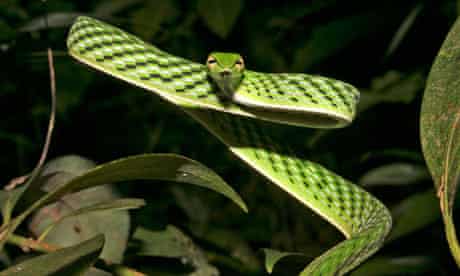
| Illegally traded green pythons (Morelia viridis) in the black market pet trade. Photo courtesy of Jessica Lyons. |
In 2016, Indonesian officials awarded a permit to PT Alam Nusantara based in Jakarta to export 45 "captive bred" echidnas. Echidnas, egg-laying mammals resembling hedgehogs, have produced a dilemma for zoos around the world attempting to breed the little creatures. They are not given to reproducing naturally in environments not their own. Over decades zoos around the world have been able to breed fewer than 50 echidnas. Something doesn't compute there.
Indonesian authorities authorized export of over four million captive-bred animals in 2016 alone. Experts know very well that it would be impossible to secure that number of animals that have been bred in captivity, not trapped in the wild, but taking animals out of their natural habitat is cheaper and far easier than committing to set up breeding operations. Tokay geckos are low-profit animals traded at high volume and as such not good candidates for breeding operations.
Caught in the wild geckos are sold for very low prices. Breeding of one million geckos, a trader would require breeding stock comprised of 140,000 females, 14,000 males along with 30,000 incubation boxes, 12,000 rearing cages and the work of hundreds of employees. Imagining a single facility geared to this kind of production, according to Dr. Nijman, would require an installation
"the size of an aircraft hangar", to produce animals that sell for a few cents apiece.
It is not only Indonesia where questionable practices in the trade of animal species sold all over the world as pets occurs, but Indonesia certainly stands out as one of the major offenders in illicit trade. Indian star tortoises from Jordan, red-eyed tree frogs from Nicaragua, and savanna monitors from Ghana and Togo are also exported abroad purporting to be captive-bred, when in all likelihood, according to experts in the field, they are nothing of the sort.
Some 80 percent of 5,000 green pythons exported annually as captive-bred in Indonesia were illegally gathered in the wild, serving to deplete some island populations, cited a study published in the journal
Biological Conservation. Dr. Auliya surveyed eleven registered reptile breeding facilities located in Indonesia, only to discover that merely one of them had the potential of being used for anything other than "laundering" wild animals.
Cites' investigations list five cases from Indonesia that have been examined -- the most of any country -- the result being that officials now are required to give proof that animals to be sold abroad such as Oriental rat snakes and Timor monitors have genuinely been captive-bred. Cites has the authority to bar international trade in those species.
Traders are reliant on Indonesia's Cites authorities for responsible quotas reflecting sustainability to be set, according to Adri Tasma, owner of a reptile farm located close to Indonesia's capital, Jakarta. His installation specializes in green tree pythons. He was permitted the export of two thousand of these reptiles in 2015, but he was also authorized to trade in 45 other species, including critically endangered Sulawesi forest turtles and rare tricolour monitors.
He admitted having no idea why the government gave him permission to export these animals and went so far as to deny ever having sold them, for he had no license to breed or maintain them. The head of Indonesia's captive breeding at the Ministry of the Environment and Forestry explains that his country's quota list is regulated firmly, based on scientific data and that regional forestry officials monthly visit each farm for the purpose of counting breeding adults. The figures they acquire are then used to formalize export quotas ensuring sustainability.
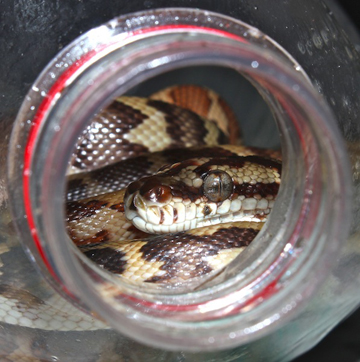 |
| Wild carpet pythons (Morelia spilota) are traded on a legal quota
system, but researchers say the quota is often exceeded. Photo courtesy
of Jessica Lyons. |
A recent study in
Conservation Biology however, suggests the number Mr. Wirasena gave of ten percent "laundering" underestimates the problem greatly. Indonesia's quotas, the authors discovered, for 99 of 129 species had been calculated based on biologically impossible parameters.
"I know sometimes the traders bribe my staff", Mr. Wiranto, director general of conservation of natural resources and ecosystems said.
In the United States, bearded dragons represent the most commonly sold lizards and there they are captive-bred, all likely descendants of specimens originally smuggled out of Australia. This is seen as a positive turn since the offsprings' availability as captive-bred animals may have resulted in the prevention of animals in the wild being removed. Further, according to some in the field, the pet trade's impact on many species is in fact, negligible.
A study conducted by Daniel Natusch, a herpetologist, conducted in Indonesia, showed that even though pythons were harvested, their numbers and size remained consistent over a two-decade period of study.
"We can't only point fingers at Asia and Africa", observed Sandra Alther, a founder of Pro Wildlife, a Munich-based conservation group,
"if we're one of the main destinations".
 |
| Illegally traded lizards (left to right): black tree monitor (Varanus
beccarii), Reisinger’s tree monitor (Varanus reisingeri), emerald
monitor (Varanus prasinus), and the blue-spotted tree monitor (Varanus
macraei). Photo courtesy of Jessica Lyons |
Labels: Indonesia, Reptiles, Trade